Today’s problem is from the 1972 book “Chess Combination as a Fine Art”, a book based on articles published in the 1950s-1960s by Kurt Richter.
Since the start of 2018, I have decided to adopt the style of only saying which side is to play: and not giving an idea if the move wins or otherwise, unless on occasion I think signposting would be helpful. Instead, the problems are posed with the instruction to decide what you would play, as in a game.
White to play: evaluate 1 Na7, as played in the game
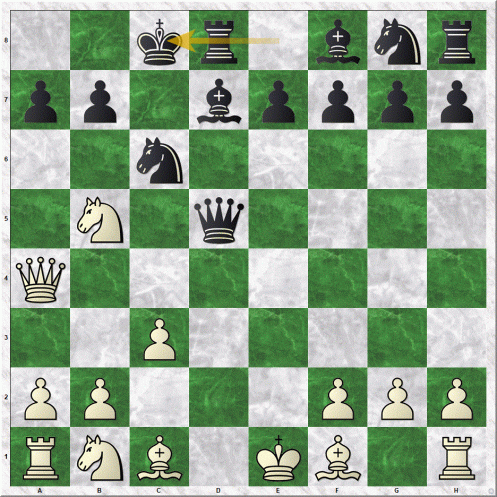
Dutch v Sugden, London 1964
Solution
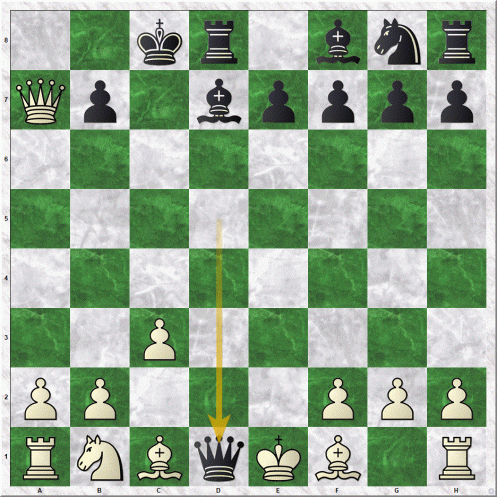
A near mirror image of Reti-Tartakower from a few days’ ago. 1 Na7+?? Na7 2 Qa7 loses to 2…Qd1+! etc.
FEN
2kr1bnr/pp1bpppp/2n5/1N1q4/Q7/2P5/PP3PPP/RNB1KB1R w KQ – 0 9
Today’s problem is from the 1972 book “Chess Combination as a Fine Art”, a book based on articles published in the 1950s-1960s by Kurt Richter.
Since the start of 2018, I have decided to adopt the style of only saying which side is to play: and not giving an idea if the move wins or otherwise, unless on occasion I think signposting would be helpful. Instead, the problems are posed with the instruction to decide what you would play, as in a game.
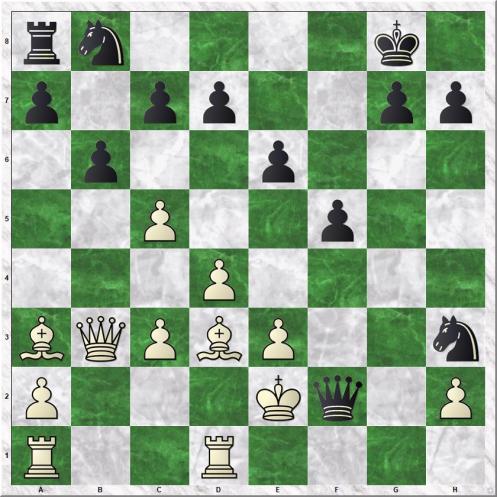
Black to play
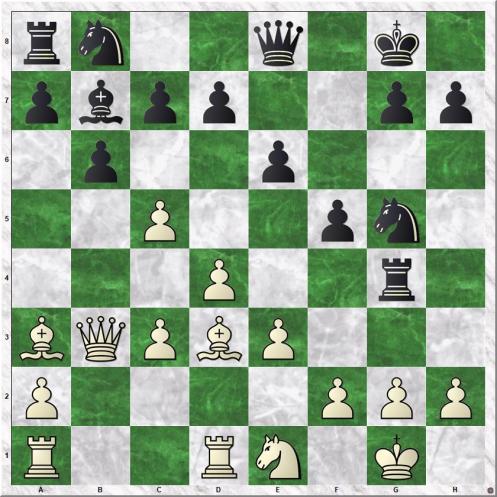
Winde v Ruotanen, corres, Finland, date not known
Solution
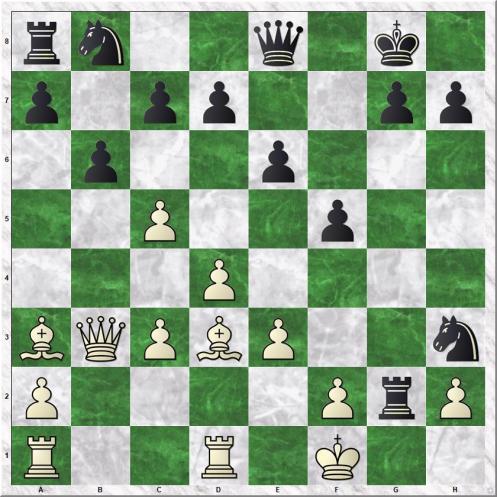
1..Bg2! us key first key, and after 2 Ng2[]. 2…Nh3+! is the main point. Then after 3 Kf1 Rg2! and 4…Qg6+ mating follows.
FEN
rn2q1k1/pbpp2pp/1p2p3/2P2pn1/3P2r1/BQPBP3/P4PPP/R2RN1K1 b – – 0 1
Today’s problem is from the 1972 book “Chess Combination as a Fine Art”, a book based on articles published in the 1950s-1960s by Kurt Richter.
Since the start of 2018, I have decided to adopt the style of only saying which side is to play: and not giving an idea if the move wins or otherwise, unless on occasion I think signposting would be helpful. Instead, the problems are posed with the instruction to decide what you would play, as in a game.
Black to play
(i) what happened in the game?
(ii) what should have happened?

von Popiel v Marco, Monte Carlo 1902
Solution
(i) Black resigned.
(ii) 1…Bg1, and it is White who should resign.

FEN
7k/1b1r2p1/p6p/1p2qN2/3bP3/3Q4/P5PP/1B1R3K b – – 0 36
Today’s problem is from the 1972 book “Chess Combination as a Fine Art”, a book based on articles published in the 1950s-1960s by Kurt Richter.
Since the start of 2018, I have decided to adopt the style of only saying which side is to play: and not giving an idea if the move wins or otherwise, unless on occasion I think signposting would be helpful. Instead, the problems are posed with the instruction to decide what you would play, as in a game.
Black to play: examine 1…Bf8 2 Re5 c5 as played in the game

Solution
3 Re6! 1-0, since 3…Ke6 is met by 4 Bh3+ skewering king and rook.

FEN
2r2b2/2p2k2/4b1pp/2R1p3/4P2P/2B1P1P1/5PB1/6K1 w – – 0 33
Today’s problem is from the 1972 book “Chess Combination as a Fine Art”, a book based on articles published in the 1950s-1960s by Kurt Richter.
Since the start of 2018, I have decided to adopt the style of only saying which side is to play: and not giving an idea if the move wins or otherwise, unless on occasion I think signposting would be helpful. Instead, the problems are posed with the instruction to decide what you would play, as in a game.
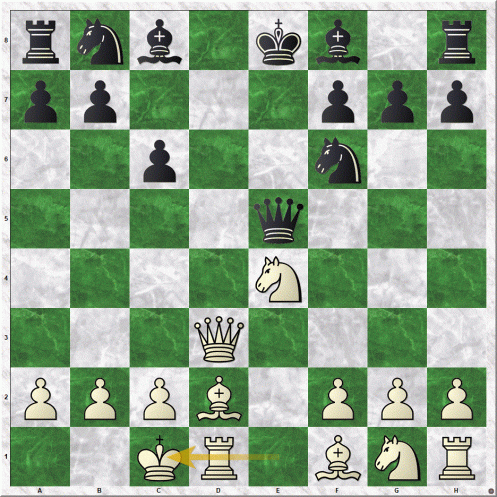
Black to play: evaluate 1…Ne4, as played in this famous game
Solution
1..Ne4? lost to the now famous 2 Qd8+! Kd8[] 3 Bg5+ Kc7 3 Bd8 mate.

1..Be7 or 1…Be6 would have left White with a good advantage, but not a winning one. I’ve just updated to Chessbase 15 and their Instant Analysis graphs are nice:

FEN
rnb1kb1r/pp3ppp/2p2n2/4q3/4N3/3Q4/PPPB1PPP/2KR1BNR b kq – 0 8
Today’s problem is from the 1972 book “Chess Combination as a Fine Art”, a book based on articles published in the 1950s-1960s by Kurt Richter.
Since the start of 2018, I have decided to adopt the style of only saying which side is to play: and not giving an idea if the move wins or otherwise, unless on occasion I think signposting would be helpful. Instead, the problems are posed with the instruction to decide what you would play, as in a game.
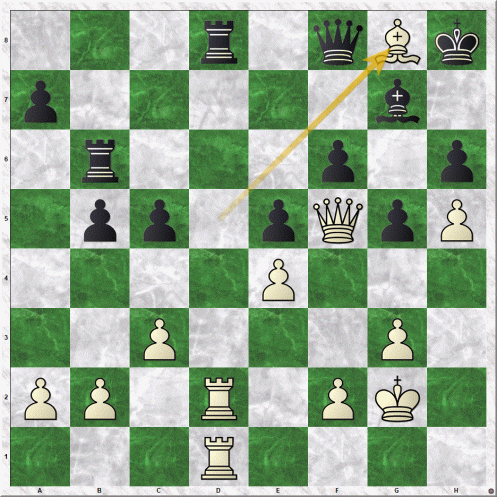
White to play; after Black played 1…Rb6 here
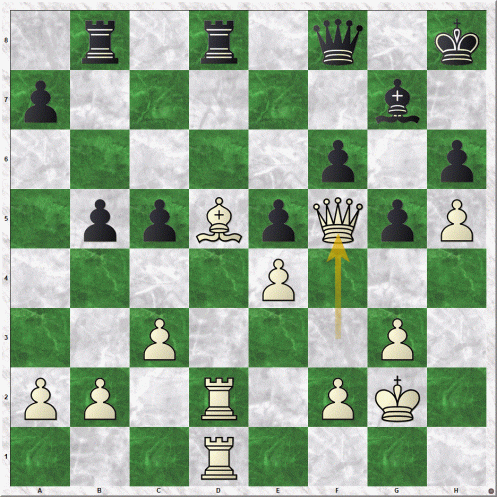
Trifunovic v Aaron, Beverwijk 1962
Solution
1…Rb6? lost to 2 Bg8! with a double attack on h7 and d8.
FEN
1r1r1q1k/p5b1/5p1p/1ppBpQpP/4P3/2P3P1/PP1R1PK1/3R4 b – – 0 30
Today’s problem is from my first ever Rook and Bishop v Rook ending, from either side. Fortunately I had the bishop, and fortunately I knew enough how to trick black, a Croatian IM, and win.
Since the start of 2018, I have decided to adopt the style of only saying which side is to play: and not giving an idea if the move wins or otherwise, unless on occasion I think signposting would be helpful. Instead, the problems are posed with the instruction to decide what you would play, as in a game.
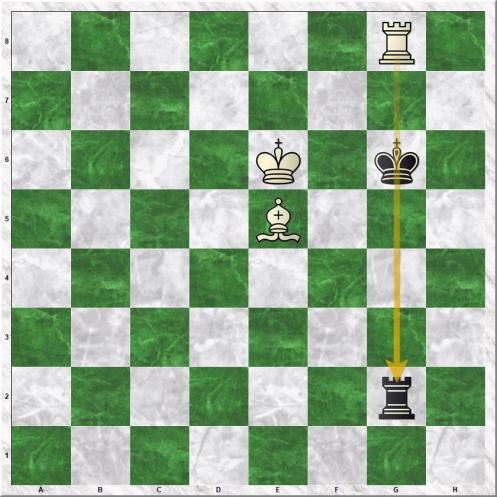
White to play, after Black’s last move, Re1-e2??

Allan Beardsworth v Milan Franic, chess.com 2/10/18
Solution
1 Ke6 is a forced mate, as I recalled from studying a series of articles by Matthew Sadler whilst on summer holiday last year.
1…Kg8 2 Rg7+! Kf8[] (otherwise the rook hangs 3 Rh7 and Black resigned.

If say 3…Rg2, then the White rook swings to the queenside, 4 Rc7 and the best that Black can do is let his Rook be skewered by the worth-being-remembered manoeuvre 4…Kg7 5 Rc8+ Kh8[] 6 Rh8+ Kg6[] 7 Rg8 mate: one of the standard motif’s Matthew’s articles point out.
Matthew Sadler’s articles are here:
https://matthewsadler.me.uk/the-endgame/rook-bishop-vs-rook-part-i/
https://matthewsadler.me.uk/the-endgame/rook-bishop-vs-rook-part-ii/
https://matthewsadler.me.uk/the-endgame/rook-bishop-vs-rook-part-iii/
The articles are well worth reading, and his blog (which seems, alas, to have now become only occasional, is always excellent and interesting.
Post script
Since drafting this note, I suspect I know why Matthew has been less active on his blog: he has been writing a new book, due out next year, on Alphazero and the development of chess/AI.
And if you haven’t seen them, see Matthew’s three wonderful videos on Games 1-8 of Carlsen- Caruana here. Three inspirational, wonderful videos, Matthew showing excellent presentation skills to go with her superb knowledge.
Prediction: it will be the ECF Book of the Year 2019.
Extra homework
In the initial diagram, it is worth:
-understanding why Black’s last move, Re1-e2, loses;
-and whether/why Re1-b1 would be a draw instead;
-and whether Re1-b1 is the only move to draw, if it does draw.
That’s homework for me, too!
FEN
5k2/2R5/3K4/4B3/8/8/8/4r3 b – – 0 3
Today’s problem is from one of my recent 3 minute online blitz games.
Since the start of 2018, I have decided to adopt the style of only saying which side is to play: and not giving an idea if the move wins or otherwise, unless on occasion I think signposting would be helpful. Instead, the problems are posed with the instruction to decide what you would play, as in a game.
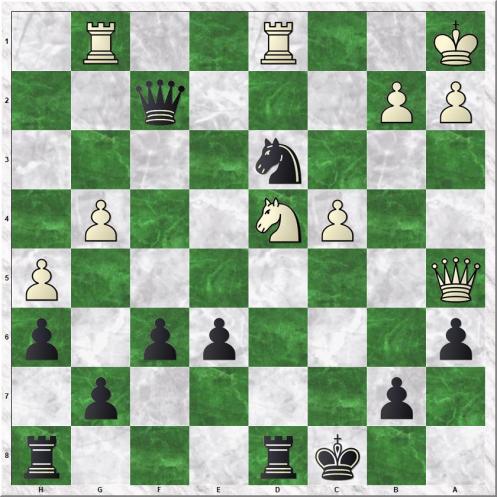
Black to play

adityass v allanbeardsworth, chess.com 3 minute blitz, 23/10/2019
Solution
1…Nd3 throws the N onto a square that is unprotected, but since the Rd1 is tied to defending the Rg1, the N can’t be captured. Qb2 mate is threatened, so that the Nd4 can be captured next move: 0-1.
FEN
2kr3r/1p4p1/p3pp1p/Q1n4P/2PN2P1/8/PP3q2/K2R2R1 b – – 0 1
Today’s problem is from a recent Sunday Times column by David Howell. I couldn’t immediately solve it on inspection, cut it out, and was pleased when the lightbulb moment occurred.
Since the start of 2018, I have decided to adopt the style of only saying which side is to play: and not giving an idea if the move wins or otherwise, unless on occasion I think signposting would be helpful. Instead, the problems are posed with the instruction to decide what you would play, as in a game.
Black to play

Mikalsen v Chatalbashev, Oslo 24/6/18
Solution
Not 1…bc(Q)+ which I kept trying to make work, but the “change the order of the moves” 1…Qg5!!
White resigned, since 2 Qg5 ba(Q); and 2 Bg5 ba(Q)+ 3 King moves Qe5
Part of the appeal of this position is that it was clearly (and TWIC confirms) from an opening line I enjoyed as a child: Austrian attack, 6 e7 7 h5, a very cave man line. My engine clearly doesn’t like the attack, giving a slight advantage to Black right away; and in the game soon growing to a decisive advantage.
FEN
rnbq2k1/pp3rbp/3pp3/4P1NQ/2B5/8/PpP3P1/R1B1K2R b KQ – 0 14
Today’s problem was one seen on Twitter. A variation in game 9 of the Carlsen-Caruana match, Tweeted by Judit Polgar as a mate in 7. I found it very satisfying to solve.
Since the start of 2018, I have decided to adopt the style of only saying which side is to play: and not giving an idea if the move wins or otherwise, unless on occasion I think signposting would be helpful. Instead, the problems are posed with the instruction to decide what you would play, as in a game.
White to play: mate in 7

variation from Carlsen v Caruana, match game 9, London 21 Nov 2018
Solution
1 Rh7+! (obvious, almost an “only move” given the problem is a mate in n) 1…Kh7 []

And now, not my first, second, third…choice, 1 Qh4+ -which I could tell loses after 1…Kg6 but kept trying to make it work, and also kept trying to find the killer (which turns to be 6 Bb7+ in the Kg7 and check-check-check hunt secondary line).
But, by not giving up, I eventually found 2 Bg8!! (again, examine all biffs) and it all immediately fell into place. It is now an easy mate in at most 6.

FEN
3rr2k/p1p4p/1b6/3Bqp2/2Q5/4P1p1/P4PK1/3R3R w – – 0 30
 allanbeardsworth