Today’s problem is from the 1972 book “Chess Combination as a Fine Art”, a book based on articles published in the 1950s-1960s by Kurt Richter.
Since the start of 2018, I have decided to adopt the style of only saying which side is to play: and not giving an idea if the move wins or otherwise, unless on occasion I think signposting would be helpful. Instead, the problems are posed with the instruction to decide what you would play, as in a game.
Black to play
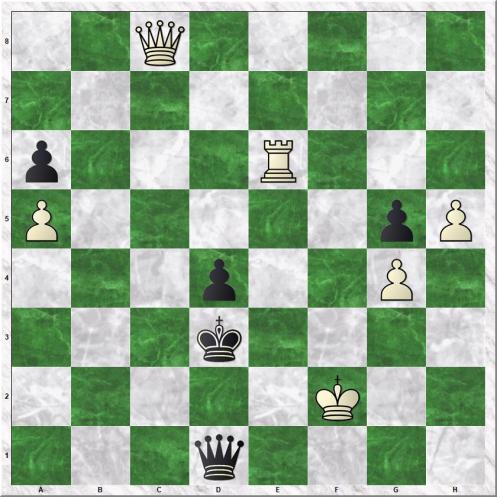
Titenko v Murey, Moscow 1963
Solution
1…Qd2+! [] 2 Kg1 (2 Kg3 Qf4+ is a trite perpetual)
2…Qc1+!! and 3 Qc1[] stalemate.

FEN
2Q5/8/p3R3/P5pP/3p2P1/3k4/5K2/3q4 b – – 0 52
Today’s problem is from the 1972 book “Chess Combination as a Fine Art”, a book based on articles published in the 1950s-1960s by Kurt Richter.
Since the start of 2018, I have decided to adopt the style of only saying which side is to play: and not giving an idea if the move wins or otherwise, unless on occasion I think signposting would be helpful. Instead, the problems are posed with the instruction to decide what you would play, as in a game.
White to play: examine 1 Ke1 as played in the game
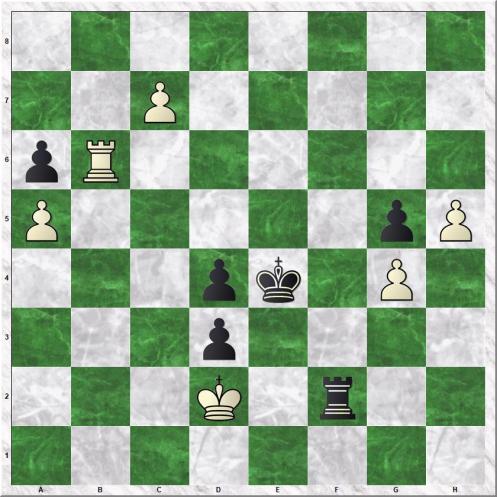
Titenko v Murey, Moscow 1963
Solution
1 Ke1 d2+! (1…Rc2 2 Re6+! and 2 Re7, followed by running the h pawn)
2 Kf2 d1(Q)
3 Re6+ Kd3!
4 c8(Q) 1/2-1/2
Why it is a draw is tomorrow’s problem.
FEN
8/2P5/pR6/P5pP/3pk1P1/3p4/3K1r2/8 w – – 0 49
Today’s problem is from the 1972 book “Chess Combination as a Fine Art”, a book based on articles published in the 1950s-1960s by Kurt Richter.
Since the start of 2018, I have decided to adopt the style of only saying which side is to play: and not giving an idea if the move wins or otherwise, unless on occasion I think signposting would be helpful. Instead, the problems are posed with the instruction to decide what you would play, as in a game.
White to play: examine 1 Bh6, as played in the game

Bannik v Ivkov, Rijeka 1963
Solution
1 Bh6? Nf4! gives Black freedom, since 2 Bf4?? allows 2…Qe1+ and a hara-kiri sac of the queen for stalemate.

Otherwise, Black gets too much play.
FEN
k7/1p2q3/pQ2n2p/P2p3P/2pP2P1/2P1B3/2P2P2/6K1 w – – 0 35
Today’s problem is from the 1972 book “Chess Combination as a Fine Art”, a book based on articles published in the 1950s-1960s by Kurt Richter.
Since the start of 2018, I have decided to adopt the style of only saying which side is to play: and not giving an idea if the move wins or otherwise, unless on occasion I think signposting would be helpful. Instead, the problems are posed with the instruction to decide what you would play, as in a game.
White to play after 1…Rc8 in the diagram position

Enigk v Effel, corres 1957
Solution
1…Rc8?? 2 Ra8! Ra8[] 3 Qa2+! and stalemate after 3..Qa2.

Black can’t escape the draw by 3..Kf8: White has a perpetual by careful checking.
FEN
5rk1/R5p1/6Pp/5p2/3p1P2/4nP1q/5Q2/6K1 b – – 0 1
Today’s problem is from the 1972 book “Chess Combination as a Fine Art”, a book based on articles published in the 1950s-1960s by Kurt Richter.
Since the start of 2018, I have decided to adopt the style of only saying which side is to play: and not giving an idea if the move wins or otherwise, unless on occasion I think signposting would be helpful. Instead, the problems are posed with the instruction to decide what you would play, as in a game.
White to play after Black played 1…Ne5

Koberl v Tipary, Budapest 1955
Solution
1 g6+!
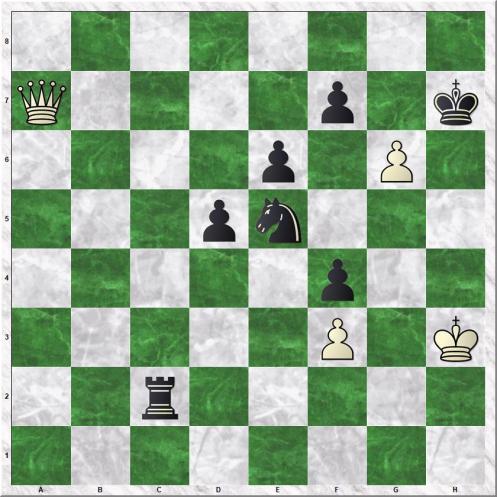
1…Kg6 (1…Ng6 2 Qf7+) 2 Qg1+ Kf6 (2…Kh7 3 Qb1 1-0) 3 Qg5+!
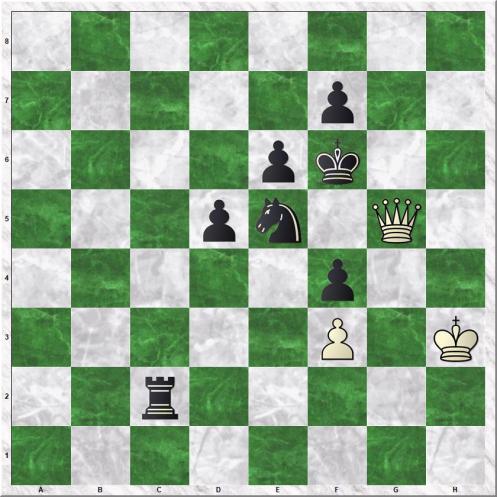
and stalemate after 3..Kg5[].
FEN
8/Q4p1k/4p1n1/3p2P1/5p2/5P1K/2r5/8 b – – 0 1
Today’s problem is from the 1972 book “Chess Combination as a Fine Art”, a book based on articles published in the 1950s-1960s by Kurt Richter.
Since the start of 2018, I have decided to adopt the style of only saying which side is to play: and not giving an idea if the move wins or otherwise, unless on occasion I think signposting would be helpful. Instead, the problems are posed with the instruction to decide what you would play, as in a game.
White to play after Black plays 1…Qc4
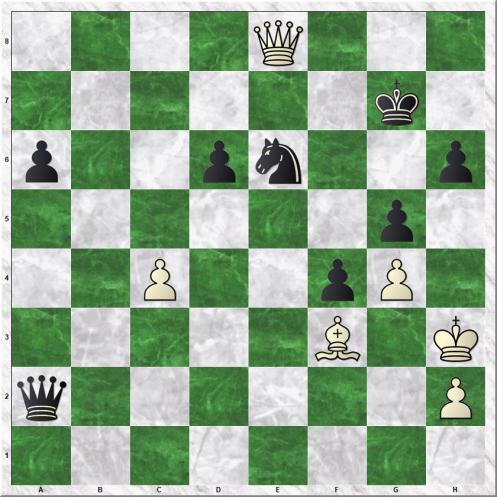
Sliwa v Doda, Lodz 1967
Solution
1…Qc4? leads to an immediate draw, though I think any other move does too: 1….Qb3 2 Qe7+ and perpetual check.
2 Qe7+ Kg6 3 Be4+! Qe4 [] 4 Qh7+ ( or g7 or f7) 4…Kh7[] stalemate.
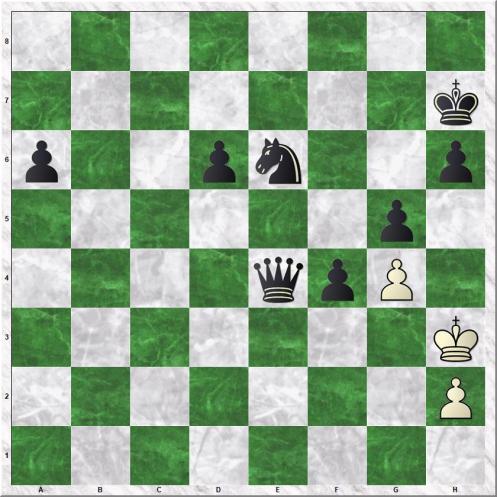
FEN
4Q3/6k1/p2pn2p/6p1/2P2pP1/5B1K/q6P/8 b – – 0 1
Today’s problem is from the 1972 book “Chess Combination as a Fine Art”, a book based on articles published in the 1950s-1960s by Kurt Richter.
Since the start of 2018, I have decided to adopt the style of only saying which side is to play: and not giving an idea if the move wins or otherwise, unless on occasion I think signposting would be helpful. Instead, the problems are posed with the instruction to decide what you would play, as in a game.
White to play
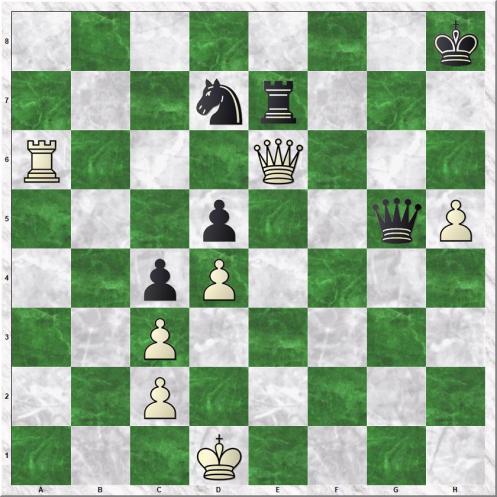
Kestler v Pesch, Traben Trarbach 1956
Solution
1 Ra8+! Kh7 2 Rh8+! Kh8[] 3 Qh6+! Qh6[] 4 Stalemate.
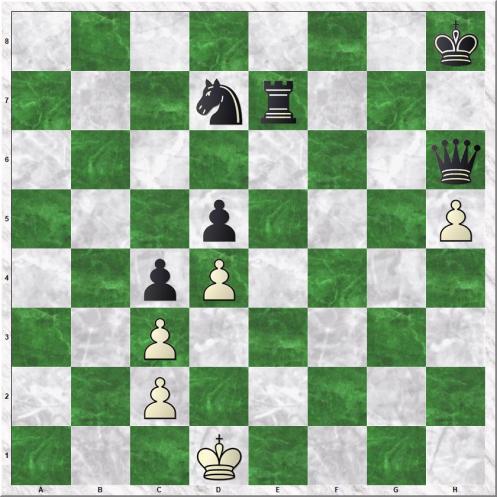
FEN
7k/3nr3/R3Q3/3p2qP/2pP4/2P5/2P5/3K4 w – – 0 13
Today’s problem is from the 1972 book “Chess Combination as a Fine Art”, a book based on articles published in the 1950s-1960s by Kurt Richter.
Since the start of 2018, I have decided to adopt the style of only saying which side is to play: and not giving an idea if the move wins or otherwise, unless on occasion I think signposting would be helpful. Instead, the problems are posed with the instruction to decide what you would play, as in a game.
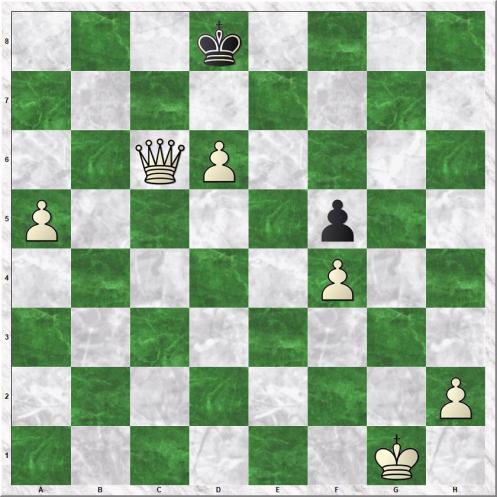
Black to play

Fichtl v Blatny, Bratislava 1956
Solution
1…Bc6+! since after the forced 2 Qc6[], 2…Rg1+! 3 Kg1[] stalemate.
FEN
3kb3/8/3P2r1/P1Q2p2/5P2/8/7P/7K b – – 0 49
Today’s problem is from another game between Darga and Spassky.
Since the start of 2018, I have decided to adopt the style of only saying which side is to play: and not giving an idea if the move wins or otherwise, unless on occasion I think signposting would be helpful. Instead, the problems are posed with the instruction to decide what you would play, as in a game.
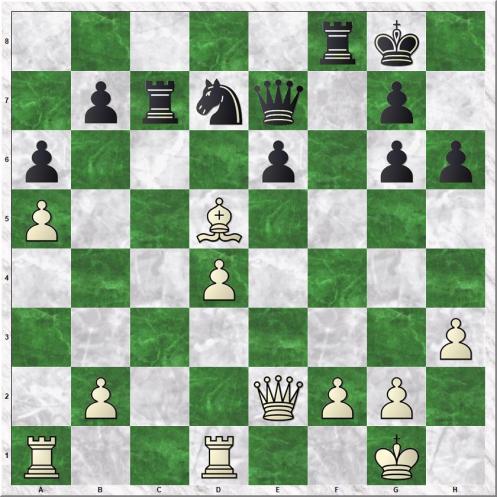
White to play

Spassky v Darga, Beverwijk, 1967
Solution
1 Ng6! fg[] 2 Bd5 and Black’s pawns are disrupted.
A nice petite combination.
The Queen is LPDO and the Pe6 pinned because of the threatened jump-biff.
FEN
5rk1/1prnqpp1/p3p2p/P2nN3/3P4/1B5P/1P2QPP1/R2R2K1 w – – 0 21
Today’s problem is another game between yesterday’s players, found when finding yesterday’s game in Megabase.
Since the start of 2018, I have decided to adopt the style of only saying which side is to play: and not giving an idea if the move wins or otherwise, unless on occasion I think signposting would be helpful. Instead, the problems are posed with the instruction to decide what you would play, as in a game.
White to play

Spassky v Darga, Varna 1962
Solution
1 Ne6! fe[] 2 Qa4+ Qb5 3 Qg4 and Black is in a losing bind.

3…Qc6 4 Qg7 Rf8 5 Rf8+ Bg8[] 6 Qh7
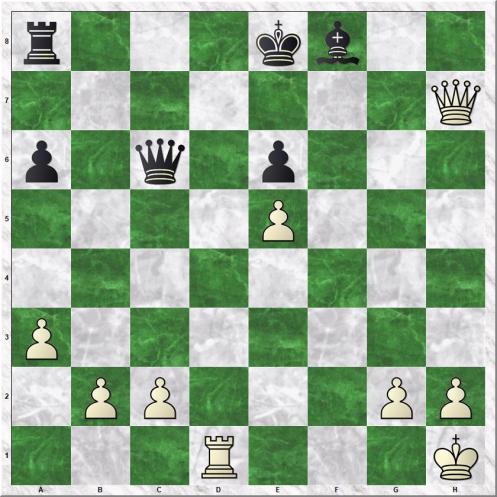
6..Rc8 7 Qg6+ Ke7[] and resigns, because 8 Rd6 wins, as does 8 Qf6+, and the computer’s preference 8 b4: the idea of b4 is that Black is in zugzwang.
FEN
r3kb1r/1q3ppp/p3p3/4P3/p2N1Q2/P7/1PP3PP/3R1R1K b kq – 0 20
 allanbeardsworth