Today’s problem is from the 1972 book “Chess Combination as a Fine Art”, a book based on articles published in the 1950s-1960s by Kurt Richter.
Since the start of 2018, I have decided to adopt the style of only saying which side is to play: and not giving an idea if the move wins or otherwise, unless on occasion I think signposting would be helpful. Instead, the problems are posed with the instruction to decide what you would play, as in a game.
White to play: examine 1 Kb7 Bd3 2 Kc8 Be2 3 Kd8
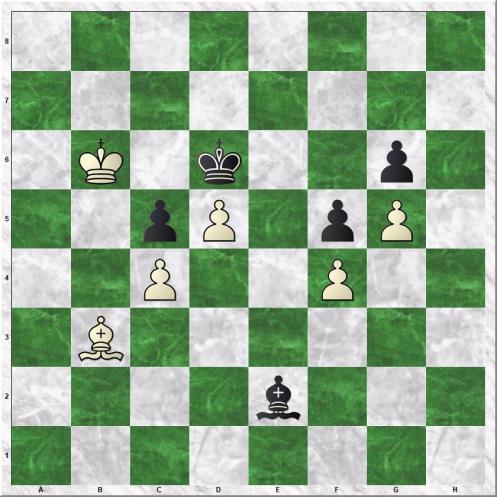
Darga v Spassky, Amsterdam 1964
Solution
3 Kd8?? would have been a blunder, and in the game White spotted why before playing it, playing 3 Kb7 and retracing his king’s steps.

3…Bc4! and if 4 Bc4, stalemate.

Darga managed to beat Spassky after another 30 moves.
FEN
8/8/1K1k2p1/2pP1pP1/2P2P2/1B6/4b3/8 w – – 0 64
Today’s problem is from the 1972 book “Chess Combination as a Fine Art”, a book based on articles published in the 1950s-1960s by Kurt Richter.
Since the start of 2018, I have decided to adopt the style of only saying which side is to play: and not giving an idea if the move wins or otherwise, unless on occasion I think signposting would be helpful. Instead, the problems are posed with the instruction to decide what you would play, as in a game.
White to play

Krahnstover v Seyferth, Bitterfeld 1957
Solution
1 Qf6! which should be drawn, after either capture on f6:
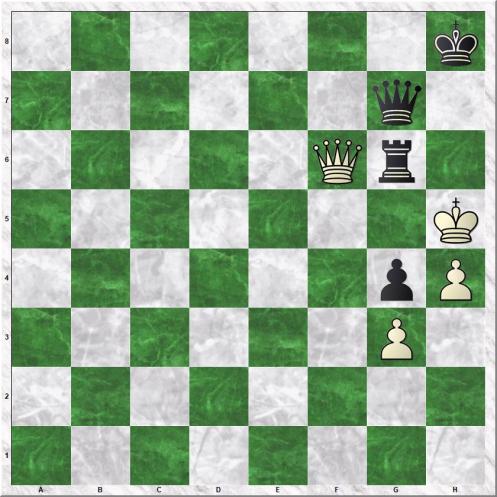
but Black played 1…Kg8?? and lost after 2 Qg6.
FEN
7k/6q1/6r1/7K/6pP/6P1/5Q2/8 w – – 0 1
Today’s problem is from the 1972 book “Chess Combination as a Fine Art”, a book based on articles published in the 1950s-1960s by Kurt Richter.
Since the start of 2018, I have decided to adopt the style of only saying which side is to play: and not giving an idea if the move wins or otherwise, unless on occasion I think signposting would be helpful. Instead, the problems are posed with the instruction to decide what you would play, as in a game.
White to play: examine 1 c4, as played in the game

Bilek v Heidenfeld, Lugano Olympiad 18/10/1958
Solution
1 c4?? Qg3+! 1/2-1/2
FEN
6q1/8/2PQ4/8/8/1KP5/8/7k w – – 0 128
Today’s problem is from the 1972 book “Chess Combination as a Fine Art”, a book based on articles published in the 1950s-1960s by Kurt Richter.
Since the start of 2018, I have decided to adopt the style of only saying which side is to play: and not giving an idea if the move wins or otherwise, unless on occasion I think signposting would be helpful. Instead, the problems are posed with the instruction to decide what you would play, as in a game.
White to play

Pilnick v Reshevsky, New York 1942
Solution
1 Qf2 1/2-1/2
An easy one today.
Surprisingly, in the book, Black’s pawns are on c4 and e4 and not on g4 and h4. Most odd. My position is from Megabase.
FEN
8/kp6/p7/P4Q2/6pp/4q3/8/7K w – – 0 93
Today’s problem is from the 1972 book “Chess Combination as a Fine Art”, a book based on articles published in the 1950s-1960s by Kurt Richter.
Since the start of 2018, I have decided to adopt the style of only saying which side is to play: and not giving an idea if the move wins or otherwise, unless on occasion I think signposting would be helpful. Instead, the problems are posed with the instruction to decide what you would play, as in a game.
Black to play, after Nd3+ Ke3[] in yesterday’s game

O’Sullivan v Walsh, Leinster 1952
Solution
1..f2 2 Nf3! []
2…Kg3
3 Nd2 Nc5
4 Ke2 Kg2

and a later Ne4 or Nb3 will prise the N away from f1.
FEN
8/8/8/8/6kN/3nKp2/8/8 b – – 0 2
Today’s problem is from the 1972 book “Chess Combination as a Fine Art”, a book based on articles published in the 1950s-1960s by Kurt Richter.
Since the start of 2018, I have decided to adopt the style of only saying which side is to play: and not giving an idea if the move wins or otherwise, unless on occasion I think signposting would be helpful. Instead, the problems are posed with the instruction to decide what you would play, as in a game.
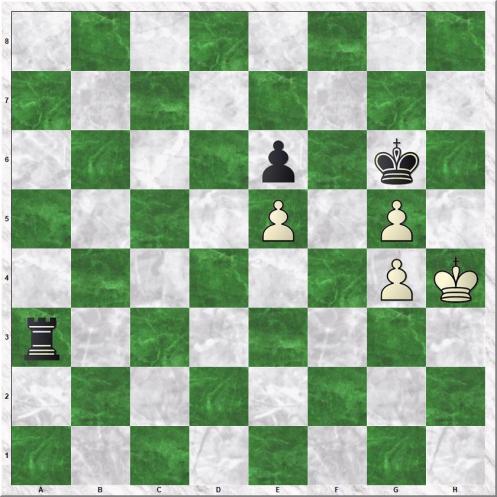
Black to play: examine 1…Ra8 2 Kh4 Kg6 as played in the game

Golz v Szabo, Dresden 1959
Solution
2..Kg6? is a blunder: 3 Ra3! and after 3…Ra3, stalemate.
FEN
8/6k1/4p3/4P1PK/r5P1/p7/R7/8 b – – 0 52
Today’s problem is from the 1972 book “Chess Combination as a Fine Art”, a book based on articles published in the 1950s-1960s by Kurt Richter.
Since the start of 2018, I have decided to adopt the style of only saying which side is to play: and not giving an idea if the move wins or otherwise, unless on occasion I think signposting would be helpful. Instead, the problems are posed with the instruction to decide what you would play, as in a game.
White to play: examine 1 Nh4 Ne4+ 2 Ke3 f2 3 Nf3 Kg3 4 Resigns, 0-1, as occurred in the game
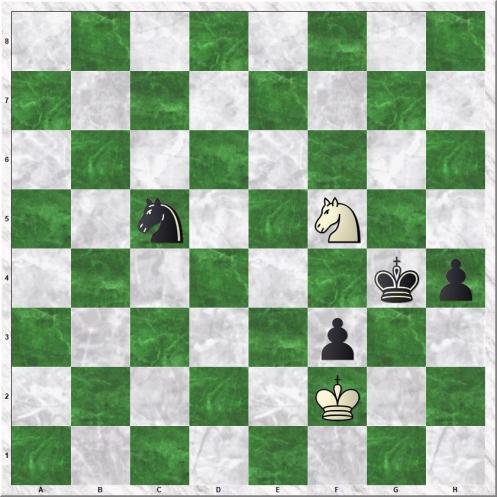
O’Sullivan v Walsh, Leinster 1952
Solution
1 Nh4?? ( 1 Ne3+)
1..Ne4+?? (1… Nd3+ -+)
2 Ke3[] f2
3 Nf3!
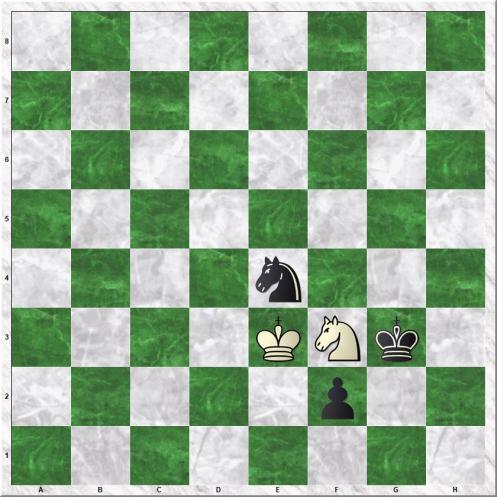
3… Kg3
4 Resigns??
White still has a draw: 4 Ke2, maybe with the idea if needed of Ne1-d3-f2; or with the idea of Kf1 Kf3 statemate.
FEN
8/8/8/2n2N2/6kp/5p2/5K2/8 w – – 0 1
Today’s problem is from the 1972 book “Chess Combination as a Fine Art”, a book based on articles published in the 1950s-1960s by Kurt Richter.
Since the start of 2018, I have decided to adopt the style of only saying which side is to play: and not giving an idea if the move wins or otherwise, unless on occasion I think signposting would be helpful. Instead, the problems are posed with the instruction to decide what you would play, as in a game.
Black to play: examine 1…Re4 2 g3 Rf4 3 Rf4 Qc5, as played in the game

Hartoch v Kramer, Wijk-aan-Zee 1969
Solution
1..Re4?? should have been met by 2 Rg3+, picking up the LPDO Re4.
FEN
8/2q2pk1/1p2r3/p6p/P1N2R2/1P3R1P/2P3PK/8 b – – 0 35
Today’s problem is from the 1972 book “Chess Combination as a Fine Art”, a book based on articles published in the 1950s-1960s by Kurt Richter.
Since the start of 2018, I have decided to adopt the style of only saying which side is to play: and not giving an idea if the move wins or otherwise, unless on occasion I think signposting would be helpful. Instead, the problems are posed with the instruction to decide what you would play, as in a game.
Black to play: examine 1…Rg8 2 1/2-1/2, as played in the game (Black was playing to the gallery)
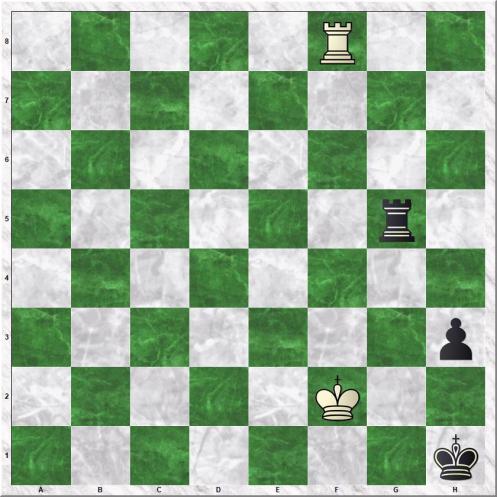
Drimer v Ciocaltea, Rumanian Championships, 1955
Solution
1…Rg8?? 2 Rg8 h2 3 Kg3! Kg1[] 4 Ra8 say and Black’s best is 4…h1(N)+

5 Kf3 Kh2 and White mates.
How? Well, that is itself a good exercise I’ll leave to my readers.
FEN
5R2/8/8/6r1/8/7p/5K2/7k b – – 0 1
Today’s problem is from the 1972 book “Chess Combination as a Fine Art”, a book based on articles published in the 1950s-1960s by Kurt Richter.
Since the start of 2018, I have decided to adopt the style of only saying which side is to play: and not giving an idea if the move wins or otherwise, unless on occasion I think signposting would be helpful. Instead, the problems are posed with the instruction to decide what you would play, as in a game.
White to play
Krahnstover v Seyferth, Bitterfeld 1957
Solution
1 Qf6!!
which should be 1/2-1/2, but Black, shocked by 1 Qf6, played 1…Kg8?? and resigned after 2 Qg6: 1-0.
FEN
7k/6q1/6r1/7K/6pP/6P1/5Q2/8 w – – 0 1
 allanbeardsworth