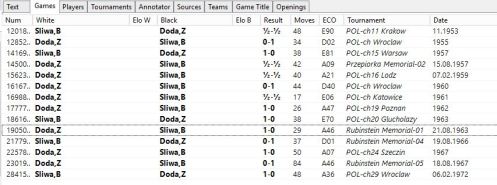
Today’s problem is from the 1972 book “Chess Combination as a Fine Art”, a book based on articles published in the 1950s-1960s by Kurt Richter. Or, actually, it isn’t from the book, but when looking in Megabase unsuccessfully for yesterday’s puzzle, I find several games between Sliwa and Doda.
Since the start of 2018, I have decided to adopt the style of only saying which side is to play: and not giving an idea if the move wins or otherwise, unless on occasion I think signposting would be helpful. Instead, the problems are posed with the instruction to decide what you would play, as in a game.
White to play
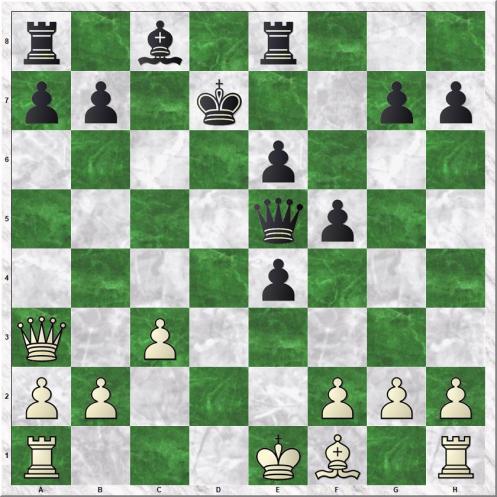
Doda v Sliwa, Polanica Zdroj 21/8/1963
Solution
1 Bb5+! is a nice move, skewering K and R, and forcing 1…Qb5. But Qb5 removes the Queen’s protection of d6, so that after 2 0-0-0+, White threatens 3 Qd6 mate, so 2…Qd5 is forced: then 3 c4 is nearly game over.

FEN
r1b1r3/pp1k2pp/4p3/4qp2/4p3/Q1P5/PP3PPP/R3KB1R w KQ – 0 19
Today’s problem is from the 1972 book “Chess Combination as a Fine Art”, a book based on articles published in the 1950s-1960s by Kurt Richter.
Since the start of 2018, I have decided to adopt the style of only saying which side is to play: and not giving an idea if the move wins or otherwise, unless on occasion I think signposting would be helpful. Instead, the problems are posed with the instruction to decide what you would play, as in a game.
Black to play: examine the game continuation, 1…g2 2 R1f2 Qa1+ 0-1
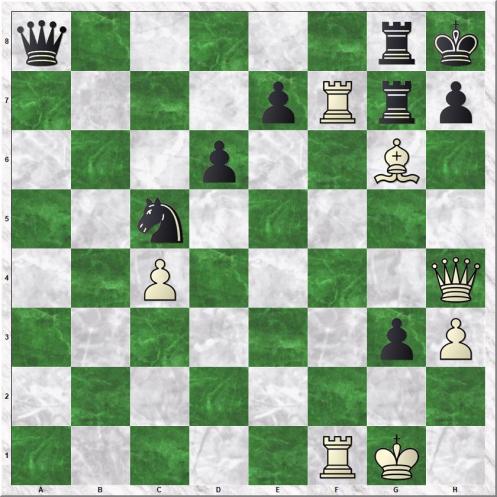
Sliwa v Doda. Lodz 1967
Solution
2 Qh7+! would have won.
So 1…g2?? and instead 1..Rf7[] 2 Rf7[] Qa1+ []
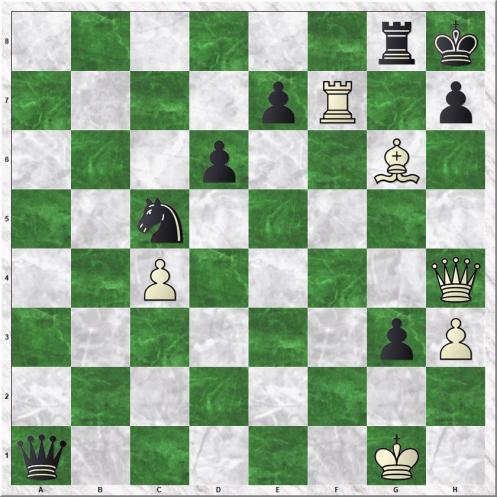
If White plats Kg2, Black checks and checks until his g pawn queens, when Rg6+ releases the pressure on h7. Or if Rf1, then Qg7 again defends h7.
FEN
q5rk/4pRrp/3p2B1/2n5/2P4Q/6pP/8/5RK1 b – – 0 1
Today’s problem is from the 1972 book “Chess Combination as a Fine Art”, a book based on articles published in the 1950s-1960s by Kurt Richter.
Since the start of 2018, I have decided to adopt the style of only saying which side is to play: and not giving an idea if the move wins or otherwise, unless on occasion I think signposting would be helpful. Instead, the problems are posed with the instruction to decide what you would play, as in a game.
Black to play
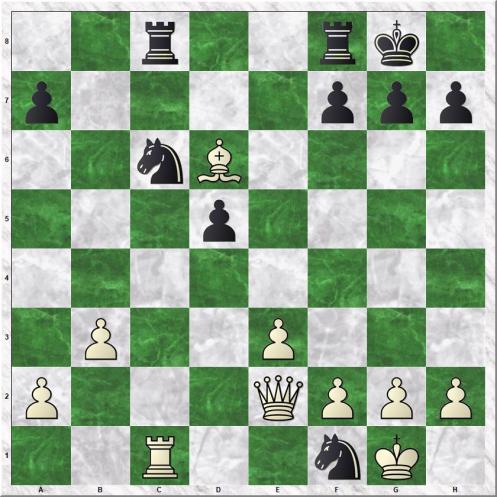
Crisovan v Naef, Lucerne 1953
Solution
1..Nd4! and if 2 Qf1 Rc1, and then 3 Qc1 Ne2+ forks the K and Q.
So, 2 ed Rc1 and if say 3 Qb2, Ng3+! prepares the same fork on e2:

(White could struggle on by 1 ed Rc1 2 Qf1 Rf1+ but it is a hopeless R v B ending).
FEN
2r2rk1/p4ppp/2nB4/3p4/8/1P2P3/P3QPPP/2R2nK1 b – – 0 1
Today’s problem is from the 1972 book “Chess Combination as a Fine Art”, a book based on articles published in the 1950s-1960s by Kurt Richter.
Since the start of 2018, I have decided to adopt the style of only saying which side is to play: and not giving an idea if the move wins or otherwise, unless on occasion I think signposting would be helpful. Instead, the problems are posed with the instruction to decide what you would play, as in a game.
White to play
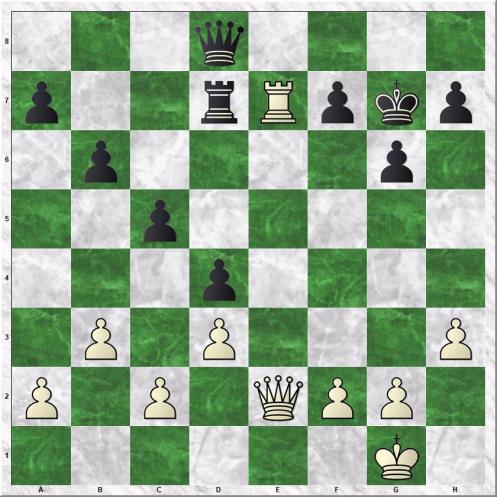
Kwilecki v Roslinsi, Poznan 1954
Solution
1 Qe5+ and now the main line is 1…Kf8, but first 1…Kh6 (1…Kg8?? 2 Re8+ is trivial, winning the Q and then the R)
2 Qf4+
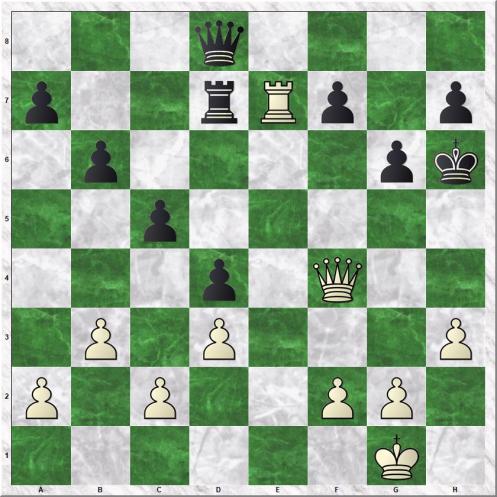
and now 2…Kh5 3 g4+ Kh4[] 4 Qh6 mate; or 2…Kg7 3 Qf7+ and mops up.
So, instead, 1…Kf8, and now the nice 2 Qf6! wins: 2…Re7 or 2…Qe7 lead to 3 Qh8 mate. I’ve had this motif in my own game; its a nice but totally well known pattern.

FEN
3q4/p2rRpkp/1p4p1/2p5/3p4/1P1P3P/P1P1QPP1/6K1 w – – 0 1
Today’s problem is an “old” chestnut, which I recently saw on Twitter, and enjoyed solving afresh.
Since the start of 2018, I have decided to adopt the style of only saying which side is to play: and not giving an idea if the move wins or otherwise, unless on occasion I think signposting would be helpful. Instead, the problems are posed with the instruction to decide what you would play, as in a game.
Black to play
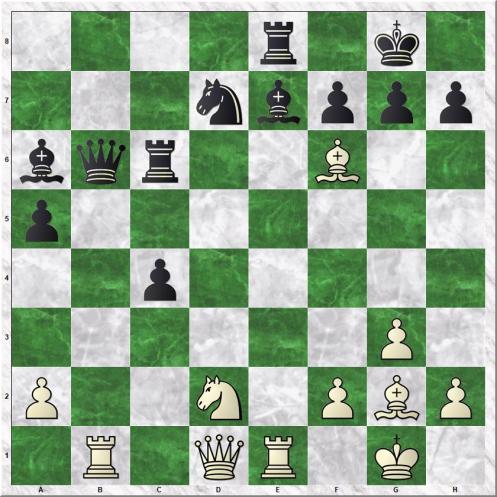
Krasenkow v Nakamura, Barcelona 19/10/2007
Solution
1…Qf2+!! is the spectacular first move. If White doesn’t take, then 2…Qf6; so 2 Kf2 Bc5+ 3 Kf3 (3 Kf1 c3+ and 4…c2) 3…Rf6+ 5 Kg4[]
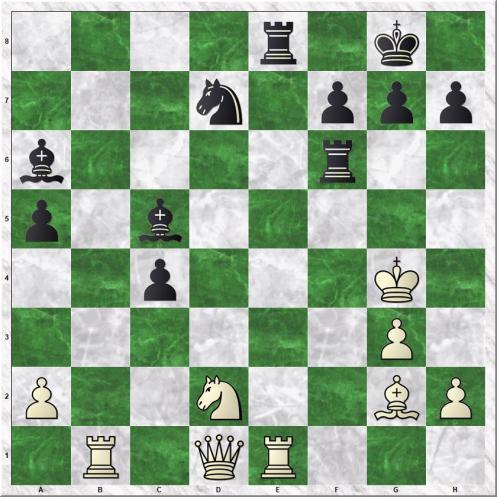
This is as far as I could see clearly: though I had the stepping stone comfort of seeing there was a draw by repetition by the Rf6, so I had nothing to lose; and felt that 5…Ne5+ might win, with the idea of gaining a tempo for Bc8+.
In fact 5…Ne5+ does win: see e.g. the analysis by Ftacnik in Megabase.
FEN
4r1k1/3nbppp/bqr2B2/p7/2p5/6P1/P2N1PBP/1R1QR1K1 b – – 0 21
Today’s problem is from the 1972 book “Chess Combination as a Fine Art”, a book based on articles published in the 1950s-1960s by Kurt Richter.
Since the start of 2018, I have decided to adopt the style of only saying which side is to play: and not giving an idea if the move wins or otherwise, unless on occasion I think signposting would be helpful. Instead, the problems are posed with the instruction to decide what you would play, as in a game.
White to play
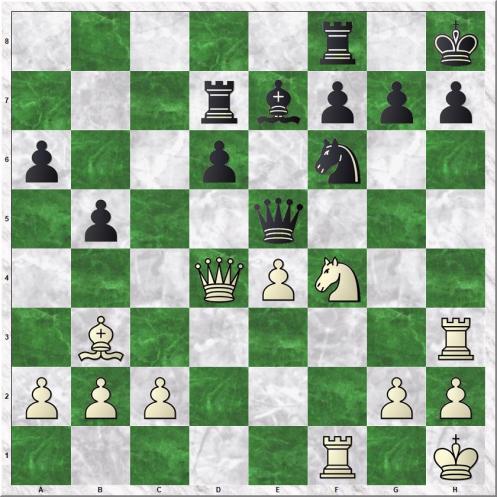
Wade v Boxall, Middleton 1953
Solution
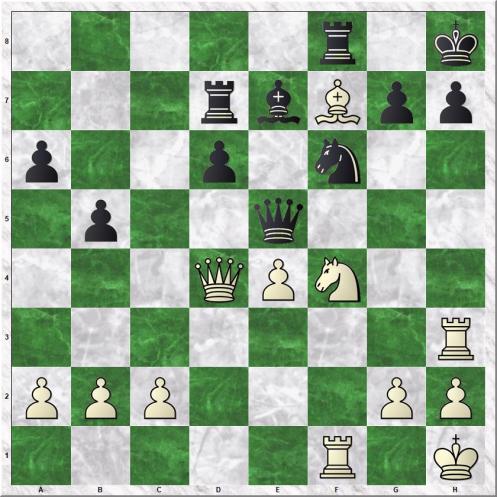
Ignore the threat, just as Purdy tells us to: 1 Bf7! and if 1…Rf7 2 Ng6 mate.
FEN
5r1k/3rbppp/p2p1n2/1p2q3/3QPN2/1B5R/PPP3PP/5R1K w – – 0 1
Today’s problem is from the 1972 book “Chess Combination as a Fine Art”, a book based on articles published in the 1950s-1960s by Kurt Richter.
Since the start of 2018, I have decided to adopt the style of only saying which side is to play: and not giving an idea if the move wins or otherwise, unless on occasion I think signposting would be helpful. Instead, the problems are posed with the instruction to decide what you would play, as in a game.
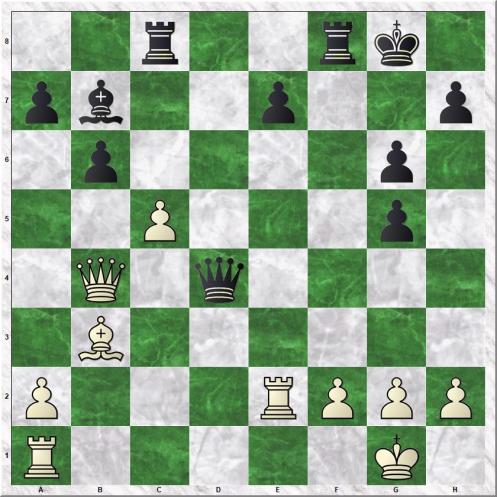
Black to play: examine 1….f6 2 Re2 fg 3 Qb4 Qd4, as played in the game
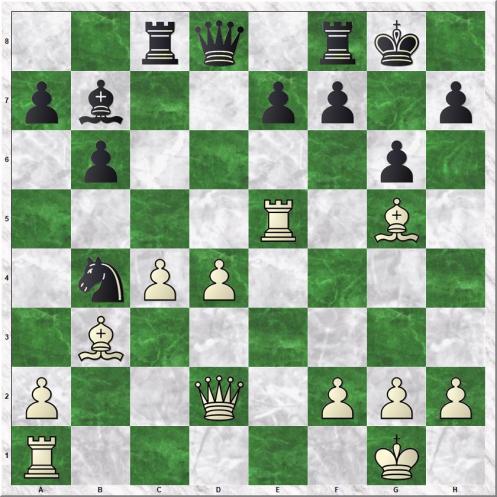
Keres v Beni, Luhcovice 1969
Solution
At the end of the sequence, 4 c5+ wins the LPDO Q.
FEN
2rq1rk1/pb2pp1p/1p4p1/4R1B1/1nPP4/1B6/P2Q1PPP/R5K1 b – – 0 18
Today’s problem is from the 1972 book “Chess Combination as a Fine Art”, a book based on articles published in the 1950s-1960s by Kurt Richter.
Since the start of 2018, I have decided to adopt the style of only saying which side is to play: and not giving an idea if the move wins or otherwise, unless on occasion I think signposting would be helpful. Instead, the problems are posed with the instruction to decide what you would play, as in a game.
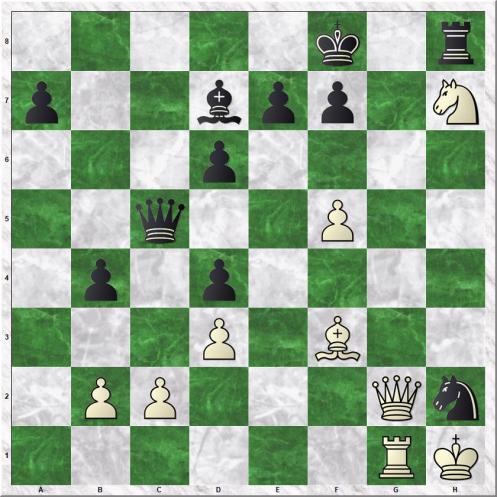
Black to play: examine 1…Ng4, as played in the game

Andersson v Doda, Lodz 1969
Solution
Ulf replied to 1…Ng4? with the fabulous 2 ef! ignoring the threat and after 2…Nh2 3 Nh7+! won the game. 2…Rh2 is similar, and 2…Bf5 is met by 3 Bg4 winning the N.
2…Nf6 would be met by 3 Ne4 with a double attack on the Q and the LPDO Rh8 (by 4Qg7+)
FEN
5k1r/p2bpp2/3p1n2/2q2pN1/1p1pP3/3P1B2/1PP3QP/6RK b – – 0 28
Today’s problem is from the 1972 book “Chess Combination as a Fine Art”, a book based on articles published in the 1950s-1960s by Kurt Richter.
Since the start of 2018, I have decided to adopt the style of only saying which side is to play: and not giving an idea if the move wins or otherwise, unless on occasion I think signposting would be helpful. Instead, the problems are posed with the instruction to decide what you would play, as in a game.
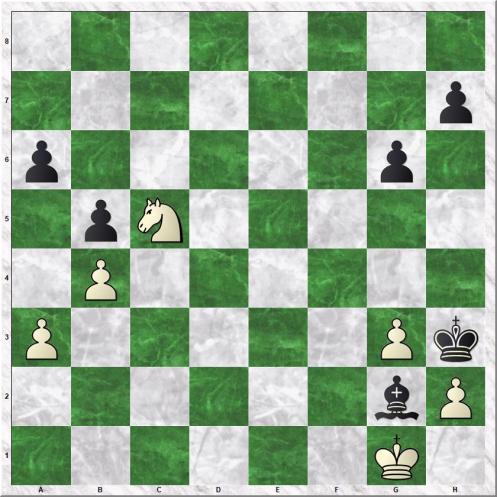
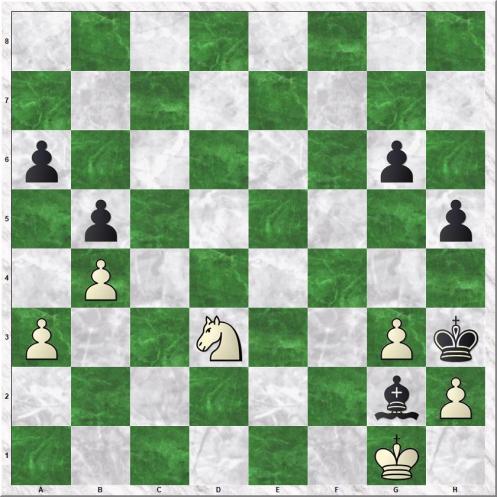
Black to play: examine 1…h5, as played in the game
Solution
1…Nd3! and the threat of 2 Nf2 mate means that Black loses his bishop: 1-0.
FEN
8/7p/p5p1/1pN5/1P6/P5Pk/6bP/6K1 b – – 0 42
Today’s problem is from the 1972 book “Chess Combination as a Fine Art”, a book based on articles published in the 1950s-1960s by Kurt Richter.
Since the start of 2018, I have decided to adopt the style of only saying which side is to play: and not giving an idea if the move wins or otherwise, unless on occasion I think signposting would be helpful. Instead, the problems are posed with the instruction to decide what you would play, as in a game.
Black to play
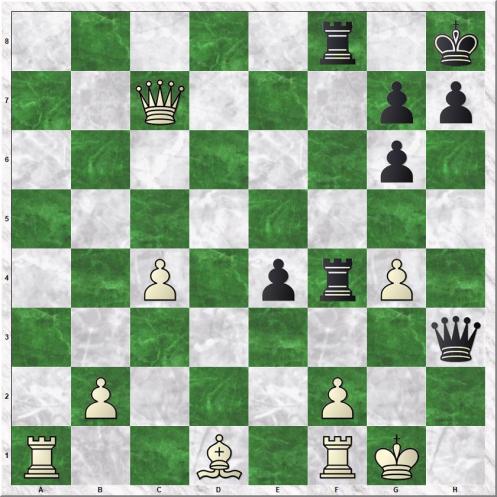
Oliff v Keogn, Dublin 1964
Solution
In the game, the players drew after 1…Qg3+ and 2…Qh3+ and perpetual check.
But 1…Qg3+ 2 Kh1 e3! breaks through.

Just as after 1..Qg3+ 2fg; if after 2..e3 White captures the Queen it is check, check and mate: Rf1+; R8f2+; Rh1 mate.
This puzzle, which I thought was nice, took me a fair while: until rather than searching for specific moves, I thought of the maxim “bringing all the pieces to the party“. Just like with Lajos’s win over Viktor yesterday, 1…e3 breaks the defences.
FEN
5r1k/2Q3pp/6p1/8/2P1prP1/7q/1P3P2/R2B1RK1 b – – 0 1
 allanbeardsworth