Today’s problem is from the 1972 book “Chess Combination as a Fine Art”, a book based on articles published in the 1950s-1960s by Kurt Richter.
Today it is the finale of yesterday’s puzzle.
Since the start of 2018, I have decided to adopt the style of only saying which side is to play: and not giving an idea if the move wins or otherwise, unless on occasion I think signposting would be helpful. Instead, the problems are posed with the instruction to decide what you would play, as in a game.
Black to play
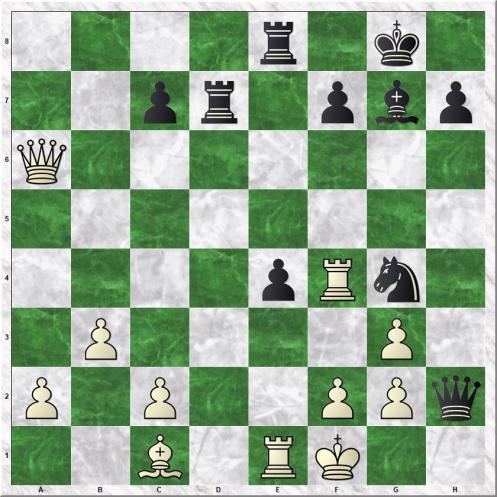
Korchnoi v Portisch, Berverwijk 1968
Solution
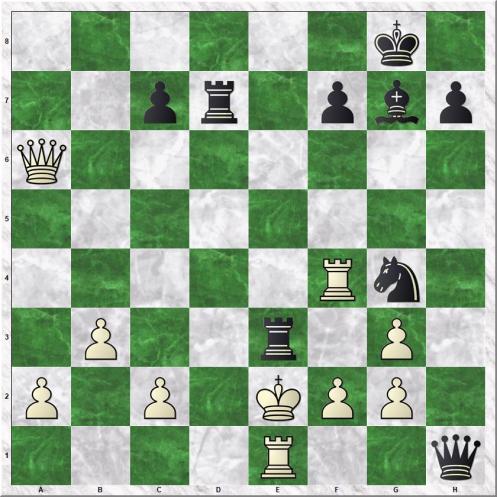
1…e3! bringing another piece to the party.
If say 2 Rg4 then 2…e2+! is a nice finish: 3 Re2[[ Qh1 mate.

In the game, Viktor played 2 Be3 and resigned after 2…Qh1+: after 3 Ke2[] Re3+! 4 fe[] Qg2 mate.
FEN
4r1k1/2pr1pbp/Q7/8/4pRn1/1P4P1/P1P2PPq/2B1RK2 b – – 0 31
Today’s problem is from the 1972 book “Chess Combination as a Fine Art”, a book based on articles published in the 1950s-1960s by Kurt Richter.
Since the start of 2018, I have decided to adopt the style of only saying which side is to play: and not giving an idea if the move wins or otherwise, unless on occasion I think signposting would be helpful. Instead, the problems are posed with the instruction to decide what you would play, as in a game.
White to play: examine 1 Nd5, as Viktor played in the game

Korchnoi v Portisch, Berverwijk 1968
Solution
1 Nd5? was a losing mistake: 1…Bd5 2 ed[] g3! is a double attack on h2 and the LPDO Nc4.

Viktor played on with only minimal compensation for about another 20 moves.
FEN
3rk1nr/1pp2pbp/p1b5/4p3/2N1P1pq/2N5/PPP2PPP/R1BQR1K1 w k – 0 13
Today’s problem is from the 1972 book “Chess Combination as a Fine Art”, a book based on articles published in the 1950s-1960s by Kurt Richter.
Since the start of 2018, I have decided to adopt the style of only saying which side is to play: and not giving an idea if the move wins or otherwise, unless on occasion I think signposting would be helpful. Instead, the problems are posed with the instruction to decide what you would play, as in a game.
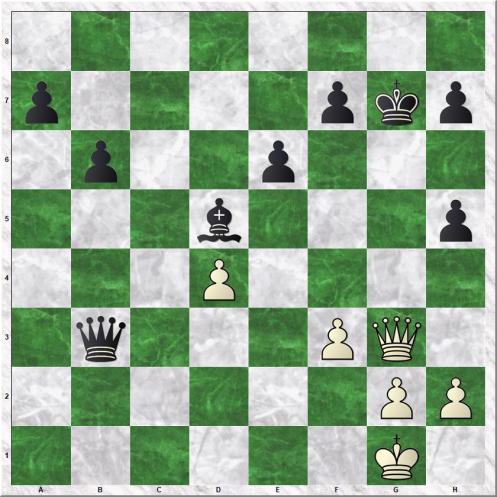
Black to play: examine 1…Qb3, as played in the game

Solution
1..Qb3? throws away the win: 2 Qb8+ Kg7[] 3 Nh5+! exposes the king too much.
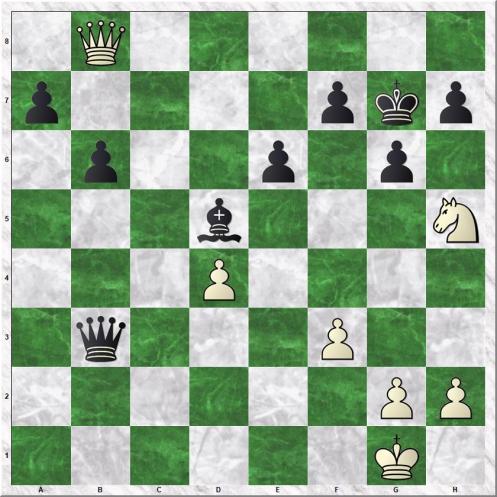
(not 2 Nh5? because 2…Qd1+, 3…Qd2+ before capturing the N).
If 3…Kh6?? White mates with 4 Qf4+; so 3…gh[] and then endless checking on the black squares.
FEN
6k1/p4p1p/1p2p1p1/1q1bQ3/3P1N2/1P3P2/6PP/6K1 b – – 0 32
Today’s problem is from the 1972 book “Chess Combination as a Fine Art”, a book based on articles published in the 1950s-1960s by Kurt Richter.
Since the start of 2018, I have decided to adopt the style of only saying which side is to play: and not giving an idea if the move wins or otherwise, unless on occasion I think signposting would be helpful. Instead, the problems are posed with the instruction to decide what you would play, as in a game.
White to play

Belov v Psachuk, RSFSR 1965
Solution
1 Qf8+! and if 1…Kf8 2 Bh6+ and 3 Re8 mate; or 1….Kg6 2 Qh6 mate.

FEN
8/1p3pkp/2rQ1p2/3b1q2/5B2/P6P/1P2R1PK/8 w – – 0 33
Today’s problem is from one of my recent 3-0 blitz games, against an IM, handle Neimar24.
Since the start of 2018, I have decided to adopt the style of only saying which side is to play: and not giving an idea if the move wins or otherwise, unless on occasion I think signposting would be helpful. Instead, the problems are posed with the instruction to decide what you would play, as in a game.
White to play
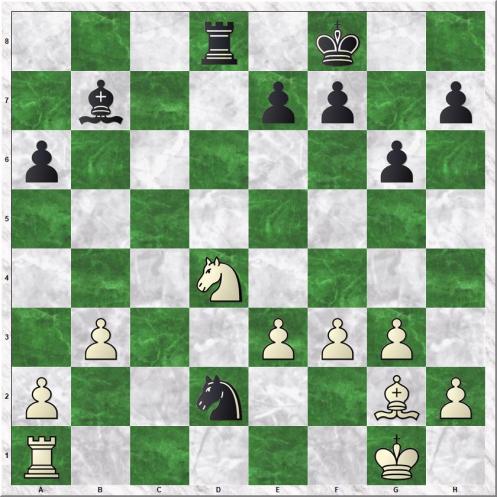
allanbeard v Neimar24, chess.com 3 minute blitz 6/9/18
Solution
The move I wanted to play was 1 Rd1, trapping the Nd2. But 1…Nf3+ 2 Bf3[] Bf3 and the N can’t take on f3 else the Rd1 is LPDO.
So 1 Rd1 doesn’t work, then?
No: it wins. 3 Ne6+! at the end wins the LPDO Rd8.

An excellent example of a mantra I have recently learned from a video by Sam Shankland. If you want to play a move, but the opponent is preventing it, look to see what happens if you play it anyway.
Great advice. I actually applied it after first rejecting 1 Rd1.
FEN
3r1k2/1b2pp1p/p5p1/8/3N4/1P2PPP1/P2n2BP/R5K1 w – – 0 1
Today’s problem is from the 1972 book “Chess Combination as a Fine Art”, a book based on articles published in the 1950s-1960s by Kurt Richter.
Since the start of 2018, I have decided to adopt the style of only saying which side is to play: and not giving an idea if the move wins or otherwise, unless on occasion I think signposting would be helpful. Instead, the problems are posed with the instruction to decide what you would play, as in a game.
White to play: played 1 Rh8 a4 2 g5: examine
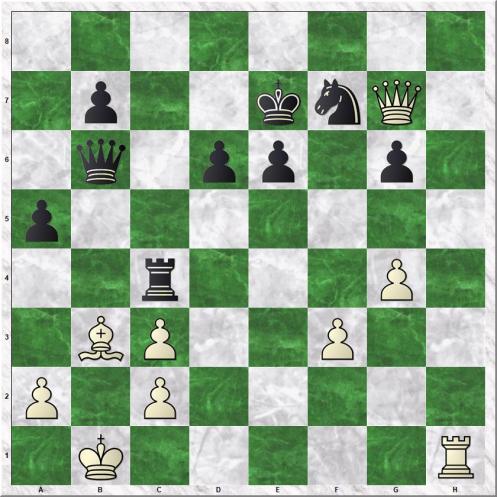
Polgar, Istvan v Bjerre Dresden 1969
Solution
Black wins by 1…Qg1+ 2 Kb2[] a3+! 0-1. After 3 Ka3[] Qc1 is mate.
FEN
8/1p2knQ1/1q1pp1p1/p7/2r3P1/1BP2P2/P1P5/1K5R w – – 0 28
Today’s problem is from the 1972 book “Chess Combination as a Fine Art”, a book based on articles published in the 1950s-1960s by Kurt Richter.
Since the start of 2018, I have decided to adopt the style of only saying which side is to play: and not giving an idea if the move wins or otherwise, unless on occasion I think signposting would be helpful. Instead, the problems are posed with the instruction to decide what you would play, as in a game.
Black to play
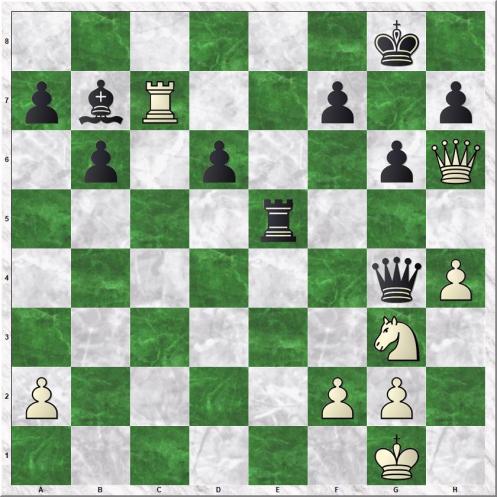
Maedler v Uhlmann, Germany 1963
Solution
1…Re1+ 2 Kh2 Rh1+!! is a “standard theme”. If 3 Kh1 Qh3+ and mates.
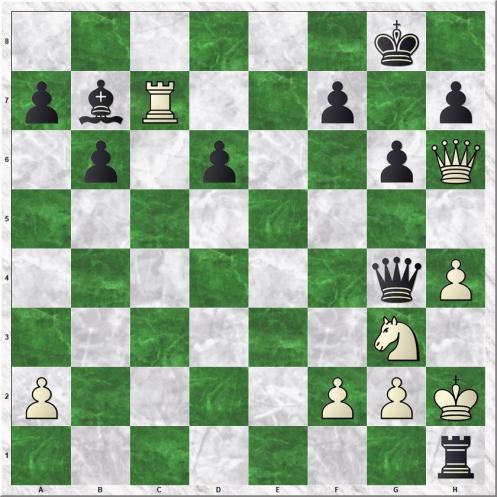
FEN
6k1/pbR2p1p/1p1p2pQ/4r3/6qP/6N1/P4PP1/6K1 b – – 0 27
Today’s problem is from the 1972 book “Chess Combination as a Fine Art”, a book based on articles published in the 1950s-1960s by Kurt Richter.
Since the start of 2018, I have decided to adopt the style of only saying which side is to play: and not giving an idea if the move wins or otherwise, unless on occasion I think signposting would be helpful. Instead, the problems are posed with the instruction to decide what you would play, as in a game.
Black to play: analyse 1…cd, as played in the game

Geir v Olafsson, Reykjavik 1953
Solution
1…cd?? loses to 2 Qf7+! and after 2…Bf7, 3 Rc8+ mates.

FEN
2r1b1kr/p3Qppp/1p6/2p1N3/3P4/P3P3/1q3PPP/R1R3K1 w – – 0 1
Today’s problem is from the 1972 book “Chess Combination as a Fine Art”, a book based on articles published in the 1950s-1960s by Kurt Richter.
Since the start of 2018, I have decided to adopt the style of only saying which side is to play: and not giving an idea if the move wins or otherwise, unless on occasion I think signposting would be helpful. Instead, the problems are posed with the instruction to decide what you would play, as in a game.
White to play: analyse 1 Kf1, as played in the game

Farbood v Panno, Varna Olympiad 19. 9. 1962
Solution
1…Qh4! 0-1. Mate follows either by 2…Qf2 if 2 Kg2 Nf4+ 3 Kg1 Qg4+ etc.

FEN
r2q3k/1p3rb1/6p1/p1Np3P/3p4/PP1P1N1n/4PP2/2RQRK2 b – – 0 27
Today’s problem is from the 1972 book “Chess Combination as a Fine Art”, a book based on articles published in the 1950s-1960s by Kurt Richter.
Since the start of 2018, I have decided to adopt the style of only saying which side is to play: and not giving an idea if the move wins or otherwise, unless on occasion I think signposting would be helpful. Instead, the problems are posed with the instruction to decide what you would play, as in a game.
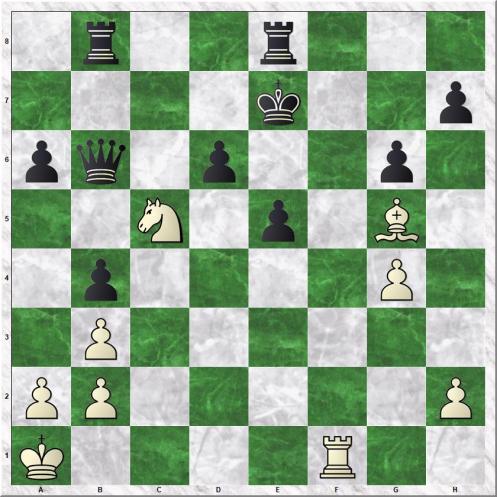
Black to play: analyse 1…Qb6, as played in the game

Platz v Lampe, Halle 1955
Solution
1…Qb6?? loses 2 Qf6+! which mates by force. 2…Kf6 3 Rf1+ and 4 Bg5 mate.
FEN
1r1qr3/5k1p/p2p1ppB/2N1p3/1p4P1/1P6/PP3Q1P/K2R4 b – – 0 1
 allanbeardsworth