Today’s problem is from the 1972 book “Chess Combination as a Fine Art”, a book based on articles published in the 1950s-1960s by Kurt Richter.
Since the start of 2018, I have decided to adopt the style of only saying which side is to play: and not giving an idea if the move wins or otherwise, unless on occasion I think signposting would be helpful. Instead, the problems are posed with the instruction to decide what you would play, as in a game.
Black to play
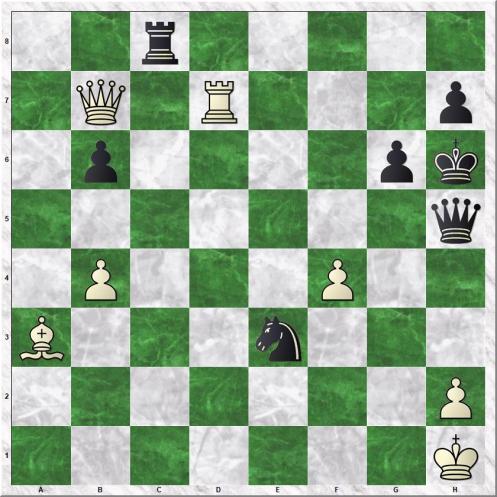
unknown players, 1944
Solution
1…Rc7!! (though my engine says 1…Rh8 is also equal).
2 b5!! =
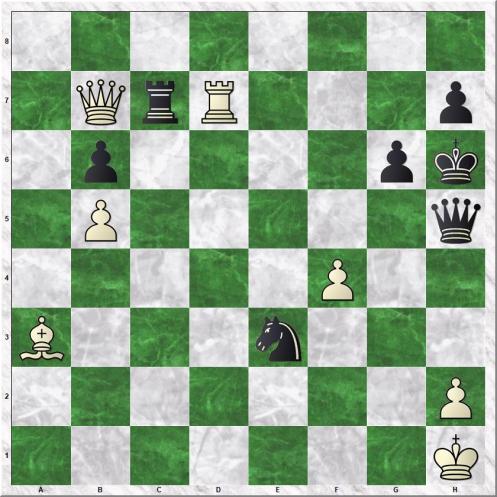
2…Qd1+! 3 Rd1[] Rb7
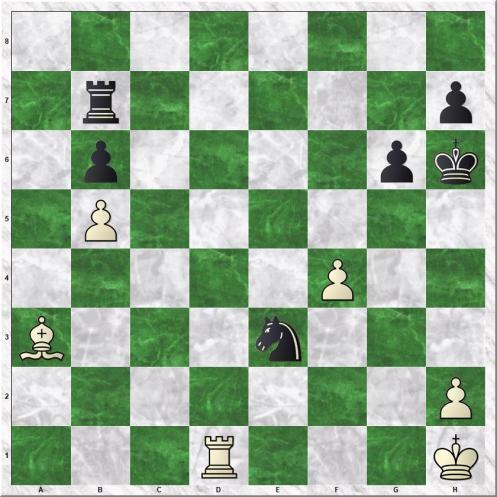
FEN
2r5/1Q1R3p/1p4pk/7q/1P3P2/B3n3/7P/7K b – – 0 1
Today’s position is a ‘classic’ which I have only recently come across.
Since the start of 2018, I have decided to adopt the style of only saying which side is to play: and not giving an idea if the move wins or otherwise, unless on occasion I think signposting would be helpful. Instead, the problems are posed with the instruction to decide what you would play, as in a game.
White to play
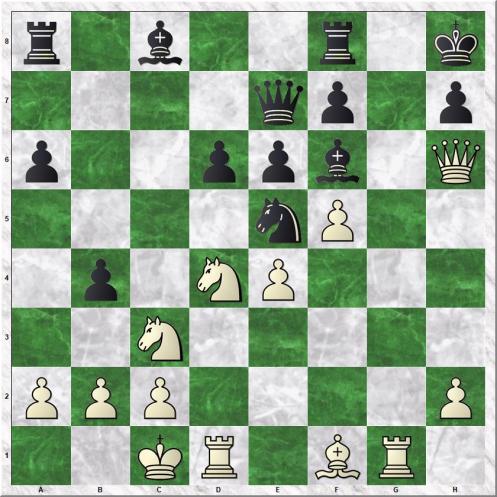
Kholmov v Bronstein, Kiev 23/1/1965
Solution
1 Nc6!!
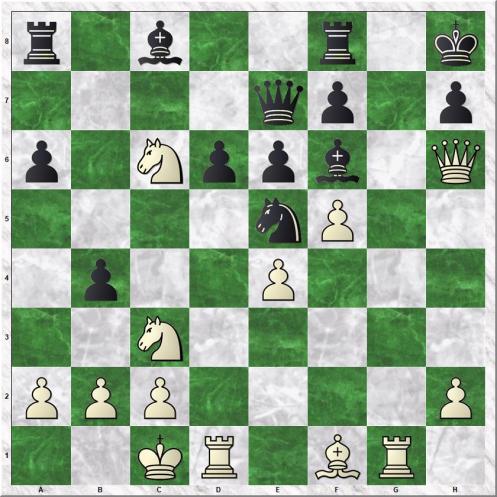
1…Nc6[] 2 e5!
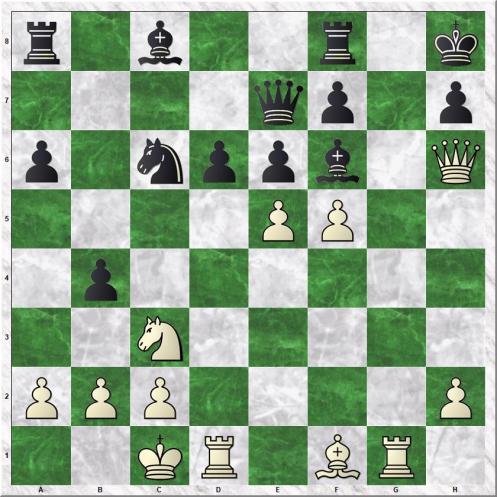
with the aim of opening up the d3-h7 diagonal. Bronstein played 2…Bg5+ (followed by 3…f6); Kholmov’s analysis suggests 2..Ne5! leads to a position in which White is only better, but better; but the sheer beauty of Nc6 and e5 are hard to beat.
Megabase 2018 has detailed analysis.
FEN
r1b2r1k/4qp1p/p2ppb1Q/4nP2/1p1NP3/2N5/PPP4P/2KR1BR1 w – – 0 18
A challenging problem which I saw in a recent edition of Chess Today. I only partially solved it, which means I didn’t solve it at all.
Since the start of 2018, I have decided to adopt the style of only saying which side is to play: and not giving an idea if the move wins or otherwise, unless on occasion I think signposting would be helpful. Instead, the problems are posed with the instruction to decide what you would play, as in a game.
Black to play

Vasquez v Van Riemsdijk, Sao Paulo 1972
Solution
1…Bd5! is the ‘obvious’ first move, though I spent time deciding between it and 1….Ba4 (which is nowhere near as good, because of 2 Be4! protecting the Rb1) 2 Rb2[] Bb2 3 Rc2

and here I missed the winning line: 3…Bc6! 4 Rc6[] Bf6! 5 Ba3[] Be7! and it is game over. Lovely.

FEN
1r4k1/4Bpbp/2B3p1/p7/8/1b2P3/1r3PPP/1RR3K1 b – – 0 25
Today’s problem is from a recent game, the position being the puzzle from Ray Keene’s column in the Times. It took me a while to solve, and made me smile when I did, so I felt it worth sharing.
Since the start of 2018, I have decided to adopt the style of only saying which side is to play: and not giving an idea if the move wins or otherwise, unless on occasion I think signposting would be helpful. Instead, the problems are posed with the instruction to decide what you would play, as in a game.
White to play
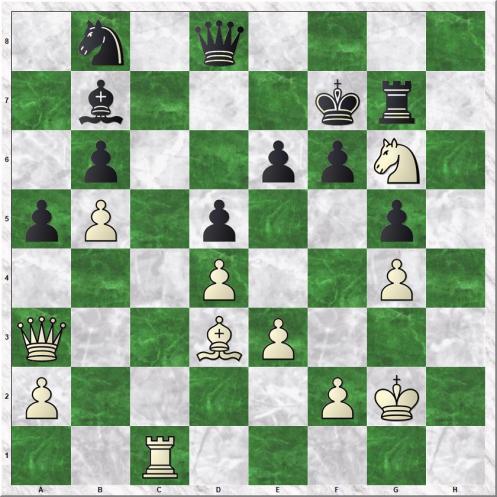
Korobov v Adly, Abu Dhabi 11/8/18
Solution
1 Rc7+! is the natural try, seeing that the Qd8 is tied to defending f8: 1…Qc7 2 Qf8 mate.
But what after 1…Kg8? This took me a while.
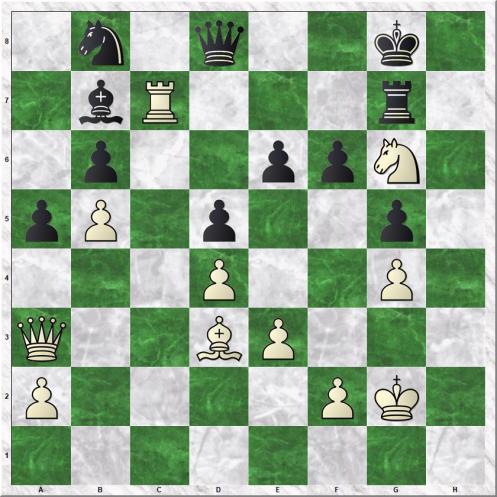
2 Ne7+! 1-0, since Black either loses the exchange, or his Bb7 is LPDO. And after 3 Rb7, it is fairly easy to see that White can untangle, after which it is a trivial win.
Nice.
FEN
1n1q4/1b3kr1/1p2ppN1/pP1p2p1/3P2P1/Q2BP3/P4PK1/2R5 w – – 0 28
Today’s problem is from the 1972 book “Chess Combination as a Fine Art”, a book based on articles published in the 1950s-1960s by Kurt Richter.
Since the start of 2018, I have decided to adopt the style of only saying which side is to play: and not giving an idea if the move wins or otherwise, unless on occasion I think signposting would be helpful. Instead, the problems are posed with the instruction to decide what you would play, as in a game.
White to play
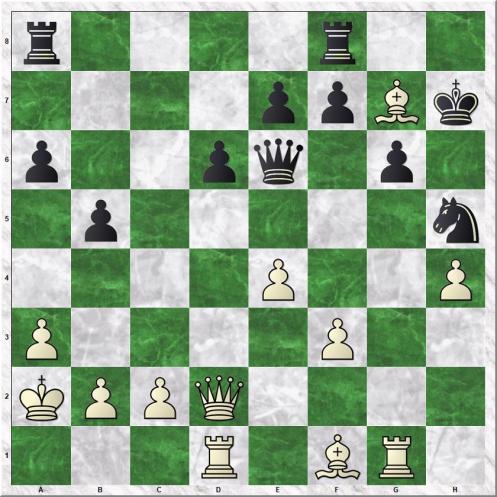
Lapiken v Reshevsky, Long Beach 11/8/1955
Solution
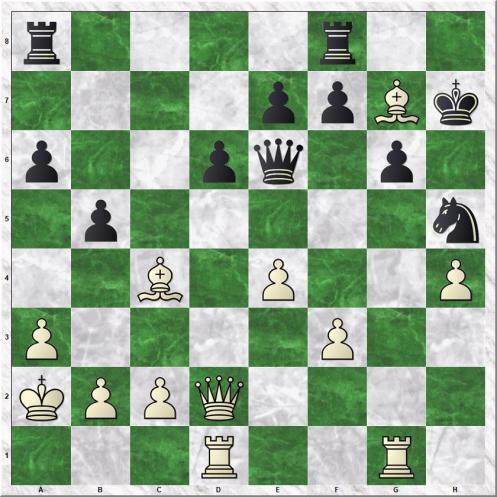
White played 1 Kb1 and the game was eventually drawn. But 1 Bc4!! wins: 1…Qc4+ 2 b3 and the double attack on the Q and the threat of Qh6+/Qh8 mate wins the game.
FEN
r4r2/4ppBk/p2pq1p1/1p5n/4P2P/P4P2/KPPQ4/3R1BR1 w – – 0 20
Footnote
The game was an exciting Sicilian Dragon; worth playing through in full. It is in Megabase.
Today’s problem is from the 1972 book “Chess Combination as a Fine Art”, a book based on articles published in the 1950s-1960s by Kurt Richter.
Since the start of 2018, I have decided to adopt the style of only saying which side is to play: and not giving an idea if the move wins or otherwise, unless on occasion I think signposting would be helpful. Instead, the problems are posed with the instruction to decide what you would play, as in a game.
White to play
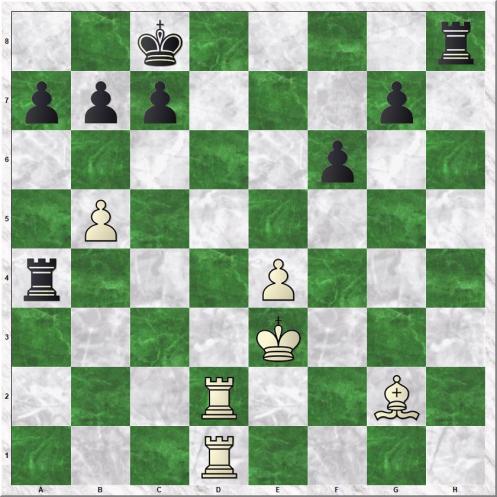
Kan v Simagin, Moscow 28/12/52
Solution
Kan played 1 Kf2? and the game was eventually drawn.
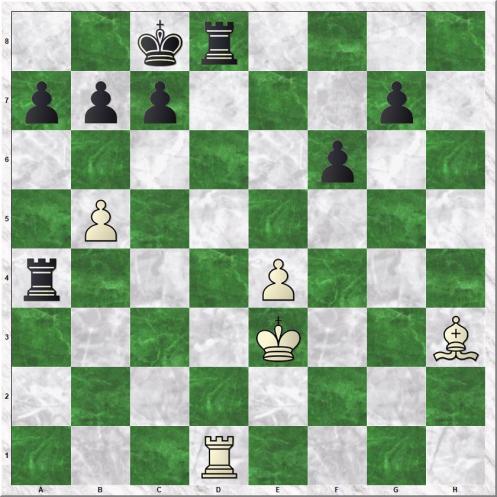
But 1 Rd8+! Rd8[] 2 Bh3+! wins: it is mate in a few moves.
FEN
2k4r/ppp3p1/5p2/1P6/r3P3/4K3/3R2B1/3R4 w – – 0 35
Daily Chess Puzzle
Today’s problem is from the 1972 book “Chess Combination as a Fine Art”, a book based on articles published in the 1950s-1960s by Kurt Richter.
Since the start of 2018, I have decided to adopt the style of only saying which side is to play: and not giving an idea if the move wins or otherwise, unless on occasion I think signposting would be helpful. Instead, the problems are posed with the instruction to decide what you would play, as in a game.
White to play evaluate 1 Rg7, as played in the game.
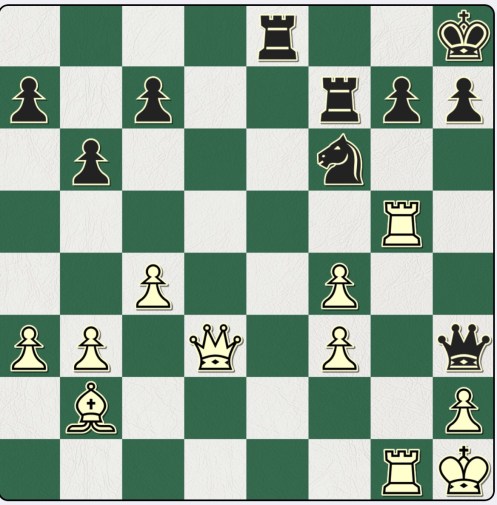
Uhlmann v Dely, Budapest 1962
Solution
Whilst 1 Be5 would have kept control and the better game, 1 Rg7?? lost to 1…Rg7 2 Bf6 Qg2+!!. Black follows up with Re1+, mating.
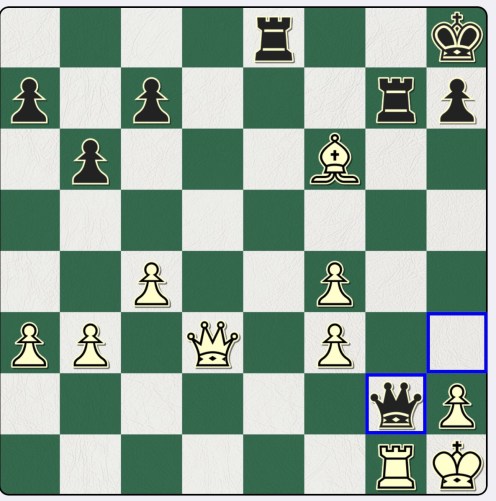
FEN
4r2k/p1p2rpp/1p3n2/6R1/2P2P2/PP1Q1P1q/1B5P/6RK w – – 0 1
Daily Chess Puzzle
Today’s problem is from the 1972 book “Chess Combination as a Fine Art”, a book based on articles published in the 1950s-1960s by Kurt Richter.
Since the start of 2018, I have decided to adopt the style of only saying which side is to play: and not giving an idea if the move wins or otherwise, unless on occasion I think signposting would be helpful. Instead, the problems are posed with the instruction to decide what you would play, as in a game.
White to play evaluate 1 Rd5, as played in the game.
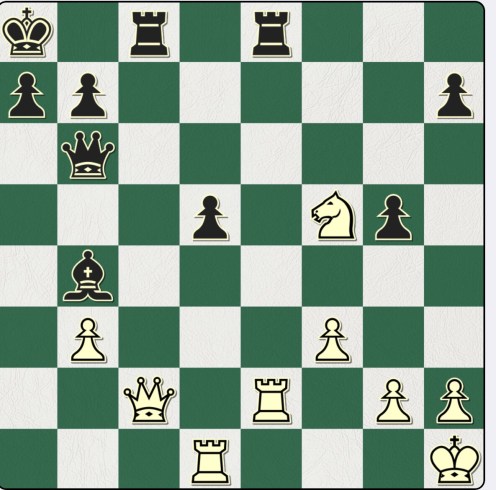
Teschner v Portisch, Monaco 1969
Solution
1 Rd5? should have lost: 1…Qf2! and Black wins material, e.g. after 2 Re8 Qc2, protecting the Rc8.

In the game, Portisch missed 1…Qf2, and the game was eventually drawn.
FEN
k1r1r3/pp5p/1q6/3p1Np1/1b6/1P3P2/2Q1R1PP/3R3K w – – 0 1
Daily Chess Puzzle
Today’s problem is from the 1972 book “Chess Combination as a Fine Art”, a book based on articles published in the 1950s-1960s by Kurt Richter.
Since the start of 2018, I have decided to adopt the style of only saying which side is to play: and not giving an idea if the move wins or otherwise, unless on occasion I think signposting would be helpful. Instead, the problems are posed with the instruction to decide what you would play, as in a game.
White to play
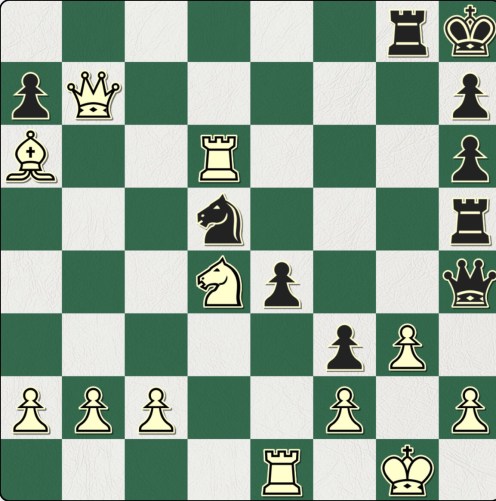
Onescius v Gama, Rumanian Championships 1955
Solution
1 Nf3!! ef[]

2 Qg7+!!
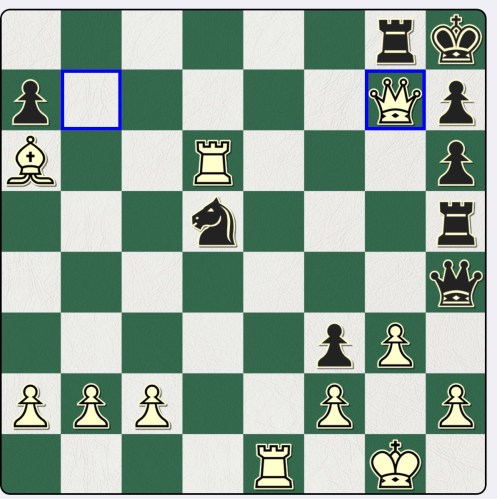
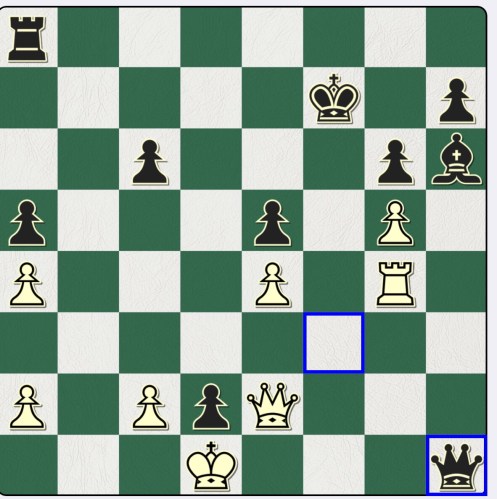
and after simplification, White is better, objectively winning. For instance in this position:
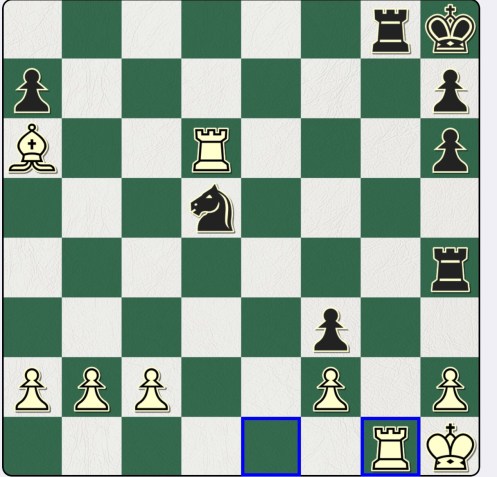
The save of the century: this problem took me a while to solve, but it was pleasing to have done so. I hope Gama was complimentary in the post mortem.
FEN
r1b5/5k1p/2p3pb/p3p1P1/P3P3/2qp1P2/P1P4Q/2K3RR b – – 0 1
Note
Puzzled by how this game ended, I checked in Megabase, to no avail; and then googled, finding this in Edward Winter’s Chess notes.

So maybe the outcome of the game will never be known, or maybe it was drawn.
Daily Chess Puzzle
Today’s problem is from the 1972 book “Chess Combination as a Fine Art”, a book based on articles published in the 1950s-1960s by Kurt Richter.
Since the start of 2018, I have decided to adopt the style of only saying which side is to play: and not giving an idea if the move wins or otherwise, unless on occasion I think signposting would be helpful. Instead, the problems are posed with the instruction to decide what you would play, as in a game.
Black to play
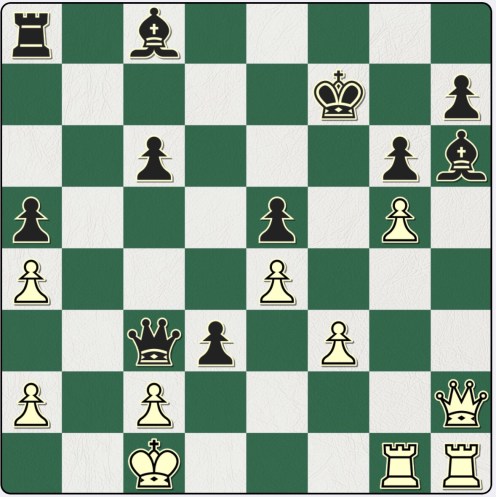
Moini v Mende, correspondence 1968
Solution
1 … Bg4! is the crushing first move.
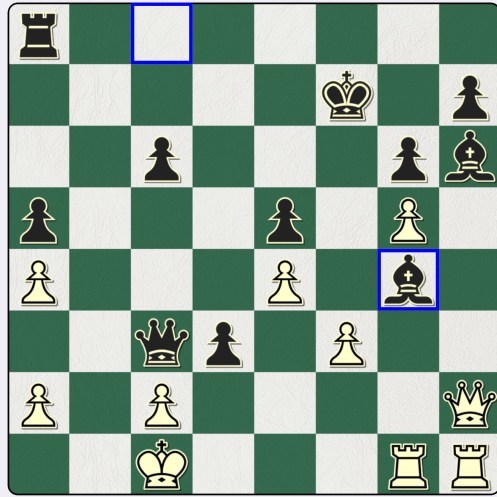
2 gh? loses simply to 2…d2+ and if 3 Kd1, then 3…Bf3+. Or 3 Qd2 Qa1 mate; 3 Kb1 Rb8 mate.
2 fg loses equally simply to 2…Bg5+ and say 3Kd1 3…Qa1 mate.
2 Qh6 is met with 2…Qc2 mate, so White’s main try is 2 Rg4. Then 2…d2+ 3 Kd1 Qf3+
If 4 Qe2 (which would have worked against the immediate 1..d2+) then 4..Qh1+, since the Rh1 is now not protected by the Rg1 and is LPDO.
FEN
r1b5/5k1p/2p3pb/p3p1P1/P3P3/2qp1P2/P1P4Q/2K3RR b – – 0 1
Engine spoiler
My engine tells me that 1…Rb8 is mate in 5, so even better than 1…Bg4. As is 1…Ba6.
 allanbeardsworth