Today’s problem is from an old edition of Chess Magazine. I don’t know which one, because, as is my habit, from time to time I photocopy a page to solve on walks or on trains etc; and my copy doesn’t show the magazine date.
As is my custom, I only say which side is to play: and not giving an idea if the move wins or otherwise, unless on occasion I think signposting would be helpful. Instead, the problems are posed with the instruction to decide what you would play, as in a game.
White to play: what happens after 1…h6?
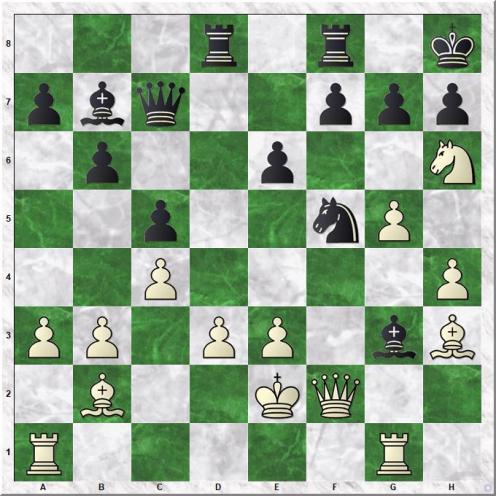
Mamedyarov v Karjakin, Saint Louis blitz 15/8/2018
Solution
1..h6 is met by 2 h6! and pins and wins.
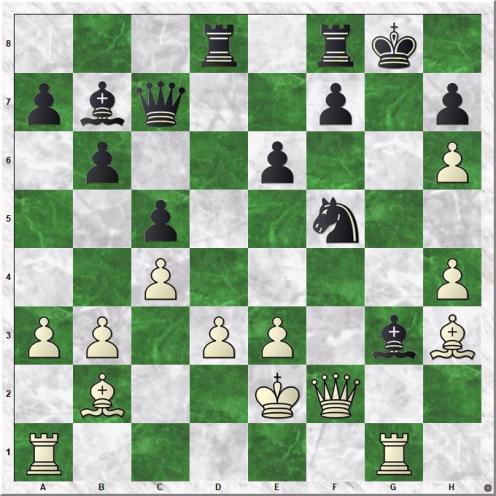
Next move, B*f5, then the Bg3 falls.
FEN
3r1rk1/pbq2ppp/1p2p2N/2p2nP1/2P4P/PP1PP1bB/1B2KQ2/R5R1 b – – 0 22
Today’s problem is from an old edition of Chess Magazine. I don’t know which one, because, as is my habit, from time to time I photocopy a page to solve on walks or on trains etc; and my copy doesn’t show the magazine date.
As is my custom, I only say which side is to play: and not giving an idea if the move wins or otherwise, unless on occasion I think signposting would be helpful. Instead, the problems are posed with the instruction to decide what you would play, as in a game.
White to play
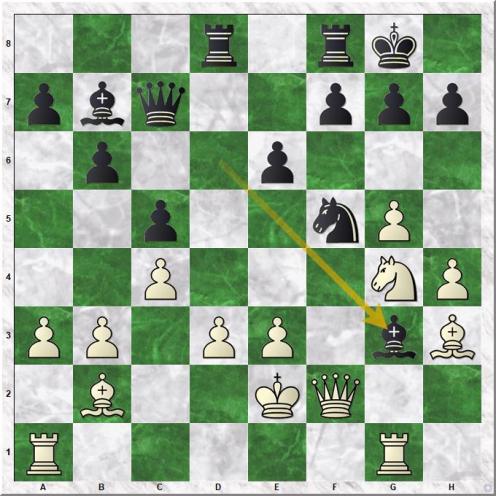
Mamedyarov v Karjakin, Saint Louis blitz 15/8/2018
Solution
1 Nh6+! has to be tried.
If 1…Kh8, then what?
Only one move wins.
Solution
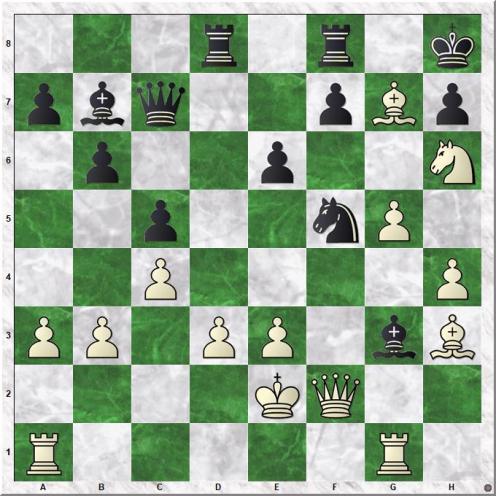
2 Bg7+! either enabling a knight fork after 2…Kg7 3 Nf5+, after which the Bg3 is captured, or if 2…Ng7, the Bg3 can again be captured.
FEN
3r1rk1/pbq2ppp/1p2p3/2p2nP1/2P3NP/PP1PP1bB/1B2KQ2/R5R1 w – – 0 22
Today’s problem is from an old edition of Chess Magazine. I don’t know which one, because, as is my habit, from time to time I photocopy a page to solve on walks or on trains etc; and my copy doesn’t show the magazine date.
As is my custom, I only say which side is to play: and not giving an idea if the move wins or otherwise, unless on occasion I think signposting would be helpful. Instead, the problems are posed with the instruction to decide what you would play, as in a game.
Black to play

Samborski v Renkowski, Pokrzywna 7/9/2018
Solution
I would play 1..Kg3 or 1..Kg2 “at random”; in fact, I would likely play 1…Kg3 just to be “nearer” to the Pf4; and not 1..Kg2, the move played in the game.
Well, 1…Kg2 is a draw, the game result; whilst 1…Kg3 wins. The difference turns out to be that after 1…Kg3, 2 Nd3 is met by 2..f3, and the b-pawn is poisoned, since 2..f2 3 Ke2 Kg2 and the f-pawn promotes.
Whereas after 1…Kg2 2 Nd3 f3 3 Nb4! is possible.
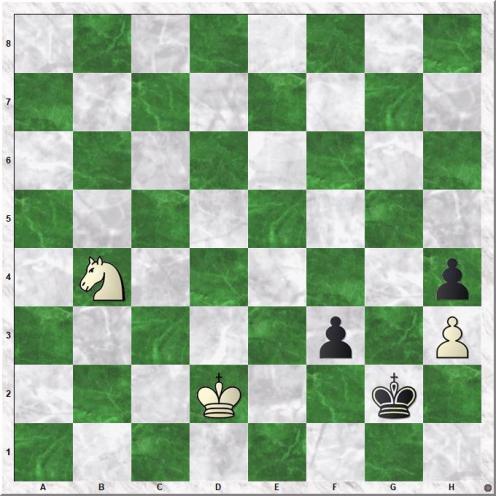
3…f2 4 Nc2! or 4 Nd5! and a Ne3+ forks if the Pawn is promoted (other than to a N).
Chess is a very deep game!
FEN
8/8/8/2N5/1p3p1p/5k1P/3K4/8 b – – 0 63
Today’s problem is from an old edition of Chess Magazine. I don’t know which one, because, as is my habit, from time to time I photocopy a page to solve on walks or on trains etc; and my copy doesn’t show the magazine date.
As is my custom, I only say which side is to play: and not giving an idea if the move wins or otherwise, unless on occasion I think signposting would be helpful. Instead, the problems are posed with the instruction to decide what you would play, as in a game.
White to play

Iturrizaga Bonelli v Warmerdam, Vlissingen, 9/8/2018
Solution
This took me a couple of sittings to solve, but, when I got the light-bulb moment, it was a moment of pleasure.
1 Nc6! disrupts Black’s counterplay sufficiently that Black is overpowered, typically by Qg5+.

FEN
2r1b1k1/1p2pp2/1q1p1b2/3P1PpR/3N2P1/1P3P2/3Q2K1/B7 b – – 0 36
Today’s problem is from an old edition of Chess Magazine. I don’t know which one, because, as is my habit, from time to time I photocopy a page to solve on walks or on trains etc; and my copy doesn’t show the magazine date.
As is my custom, I only say which side is to play: and not giving an idea if the move wins or otherwise, unless on occasion I think signposting would be helpful. Instead, the problems are posed with the instruction to decide what you would play, as in a game.
White to play
You can tell from the Chessbase evaluation that “something happened”. Aronian missed something in the position below.


Aronian v Nakamura, Saint Louis Rapid 12/8/2018
Solution
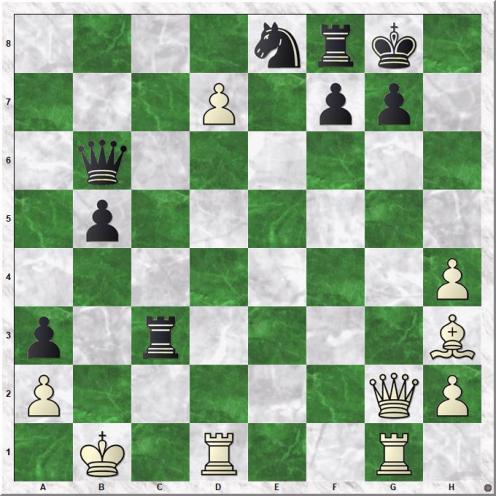
I doubt I would ever, not even in a month of Sunday’s, have played the move Levon missed: 1 c3; Komodo gives it as the only move which gives a winning advantage; all other moves, including Levon’s 1 d7, losing.
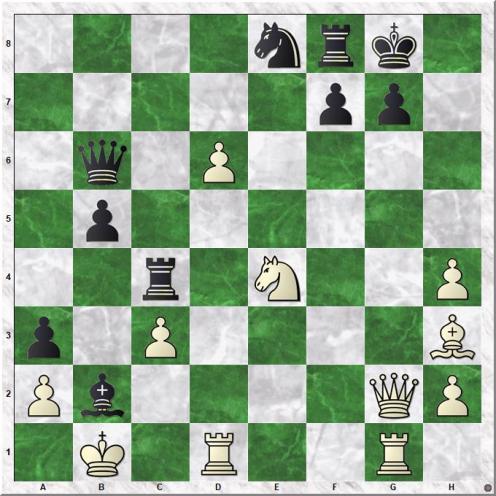
1 d7 lost to 1…Rb4; from this can be seen that 1 c3 is “simple” prophylaxis. If Black doesn’t mate White, e.g if he plays 1…Bc3 2 Nc3 Rc3, then 3 d7 and the pawn queens, since 3…Nf6 loses to 4 Qg7 mate.
FEN
4nrk1/5pp1/1q1P4/1p6/2r1N2P/p6B/PbP3QP/1K1R2R1 w – – 0 30
Today’s problem is from an old edition of Chess Magazine. I don’t know which one, because, as is my habit, from time to time I photocopy a page to solve on walks or on trains etc; and my copy doesn’t show the magazine date.
As is my custom, I only say which side is to play: and not giving an idea if the move wins or otherwise, unless on occasion I think signposting would be helpful. Instead, the problems are posed with the instruction to decide what you would play, as in a game.
Black to play and draw
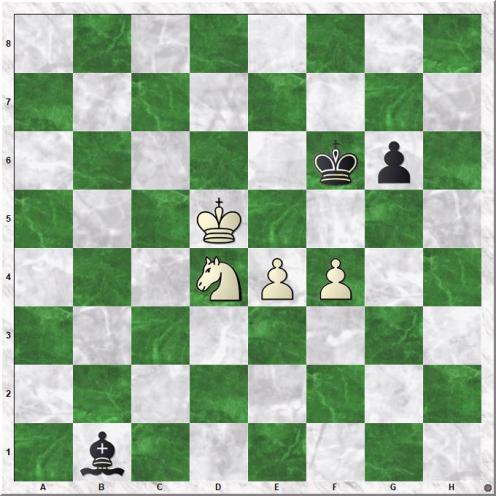
K Arkell v K Toma, Hull 30/7/2018
Solution
In the game, Black played 1…Kf7 and lost; a typical Arkell endgame grind.
I struggled (failed) this one: trying to make 1…Be4 or 1…g5 a draw, without success.
But 1…Ke7 is a draw: I don’t really know how/why, but having played around with a few lines, can just about see that it is. The engines are their unhelpful best selves, showing 0.00 as tablebase outcomes.

(Having spent a good while on this puzzle, I am not much the wiser. It seems to be just a matter of calculation; after 1…Ke7, 2 e5+ can be met by 2…Bc6+ pushing the k away; whereas if 1…Kf7 2 e5+ then 2…Ba6+ is met by 3 Kd6).
FEN
8/8/5kp1/3K4/3NPP2/8/8/1b6 b – – 0 54
Today’s problem is from an old edition of Chess Magazine. I don’t know which one, because, as is my habit, from time to time I photocopy a page to solve on walks or on trains etc; and my copy doesn’t show the magazine date.
As is my custom, I only say which side is to play: and not giving an idea if the move wins or otherwise, unless on occasion I think signposting would be helpful. Instead, the problems are posed with the instruction to decide what you would play, as in a game.
White to play
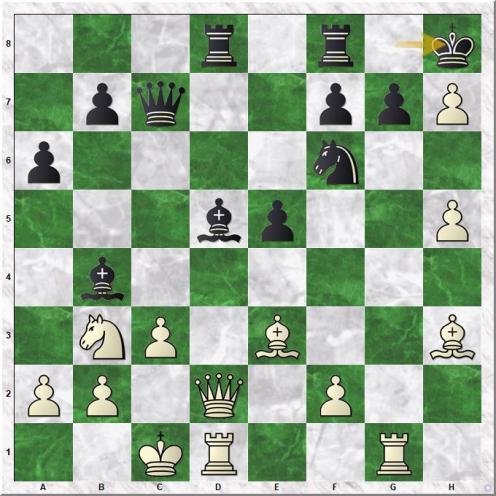
K Kulaots v Gu Xiaobing, Hastings 6/1/2013
Solution
1 Bh6! is the key, the move you more or less have to play. Black can’t capture it, so 1…Ne8 or 1…Nh5 are the only choices.
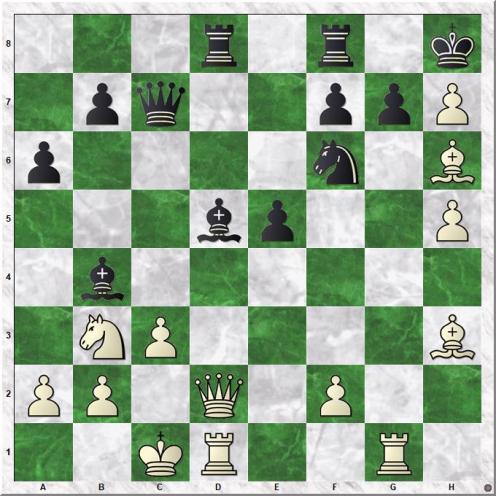
The lines are a true forest; I have spent a long while working through Black’s many defences (1…Ne8 2 Rg7! being best, but there is still a fight); one for any readers who are interested to self-study.
FEN
3r1r1k/1pq2ppP/p4n2/3bp2P/1b6/1NP1B2B/PP1Q1P2/2KR2R1 w – – 0 22
Today’s problem is from an old edition of Chess Magazine. I don’t know which one, because, as is my habit, from time to time I photocopy a page to solve on walks or on trains etc; and my copy doesn’t show the magazine date.
As is my custom, I only say which side is to play: and not giving an idea if the move wins or otherwise, unless on occasion I think signposting would be helpful. Instead, the problems are posed with the instruction to decide what you would play, as in a game.
White to play

D Yang v K Kiewra, Los Angeles 21/12/2012
Solution
Since it is a puzzle, 1 Re6! is the first move to be thought of, and, sure enough, it wins.
After 1…Re6 2 Nd5 Nc6 3 Qg4
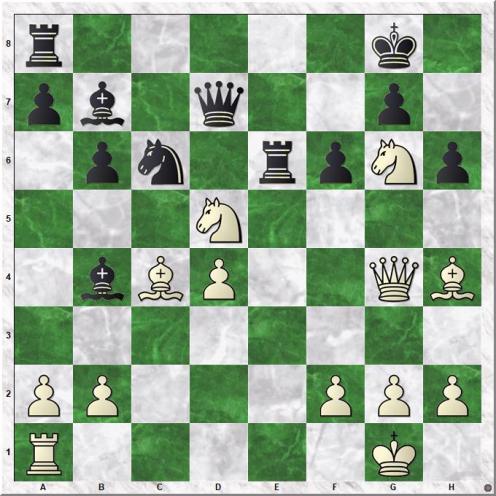
White is winning; Black has several defences, non sufficient. In some lines, the LPDO Qd7 is the end point of tactics; other times, Nf6+ is a discovered check and mate.
FEN
rn2r1k1/pb1q2p1/1p2ppNp/3n4/1bBP3B/2N2Q2/PP3PPP/R3R1K1 w – – 0 18
Today’s problem is from an old edition of Chess Magazine. I don’t know which one, because, as is my habit, from time to time I photocopy a page to solve on walks or on trains etc; and my copy doesn’t show the magazine date.
As is my custom, I only say which side is to play: and not giving an idea if the move wins or otherwise, unless on occasion I think signposting would be helpful. Instead, the problems are posed with the instruction to decide what you would play, as in a game.
White to play

S Ansell v J Rowson, London 4/12/2012
Solution
This puzzle took me several sittings; in the game, White played 1 Bf4, the obvious move, and has a slight advantage.
But eventually I found 1 Qe5! Be5 2 g4
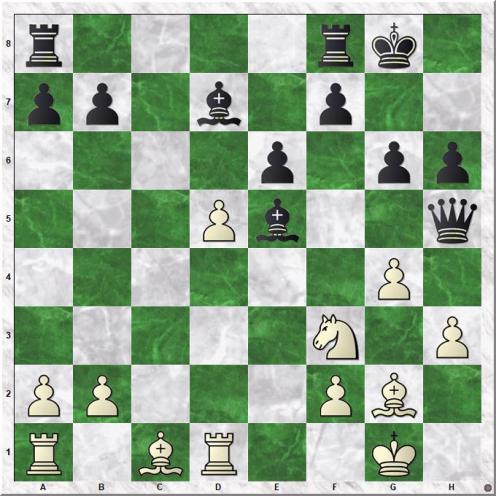
2…Bb2! 3 Bb2 Qd5[] 4 Rd5[] ed[]
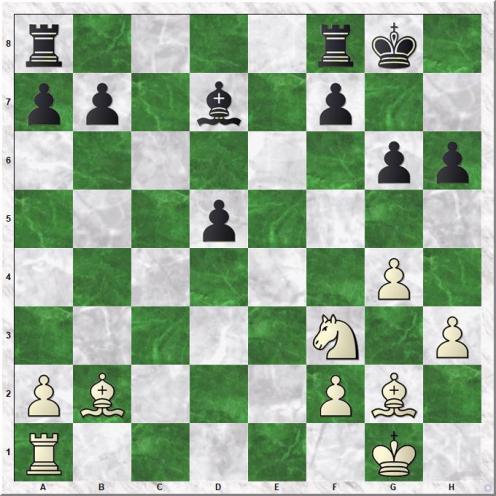
And I just about assessed this position as better for White, though to be honest, “anyone’s game” is more my judgment. Komodo thinks White is about +1
FEN
r4rk1/pp1b1pb1/4p1pp/3Pn2q/8/5NPP/PP2QPB1/R1BR2K1 w – – 0 16
Today’s problem is from an old edition of Chess Magazine. I don’t know which one, because, as is my habit, from time to time I photocopy a page to solve on walks or on trains etc; and my copy doesn’t show the magazine date.
As is my custom, I only say which side is to play: and not giving an idea if the move wins or otherwise, unless on occasion I think signposting would be helpful. Instead, the problems are posed with the instruction to decide what you would play, as in a game.
Black to play
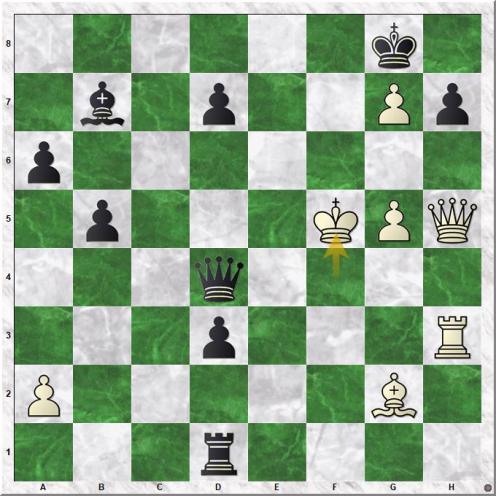
S Maze v T Gharamian, Nimes 23/8/2018
Solution
1…Rf1+! diverts the Bg2 from the long diagonal; White resigned.

If 2 Rf1, then 2…Qe4+ 3 Kf6[] Qe6 mate.
FEN
6k1/1b1p2Pp/p7/1p3KPQ/3q4/3p3R/P5B1/3r4 b – – 0 34
 allanbeardsworth