Daily Chess Puzzle
Today’s problem is from the 1972 book “Chess Combination as a Fine Art”, a book based on articles published in the 1950s-1960s by Kurt Richter.
Since the start of 2018, I have decided to adopt the style of only saying which side is to play: and not giving an idea if the move wins or otherwise, unless on occasion I think signposting would be helpful. Instead, the problems are posed with the instruction to decide what you would play, as in a game.
White to play: examine 1 Rd5, as played in the game.
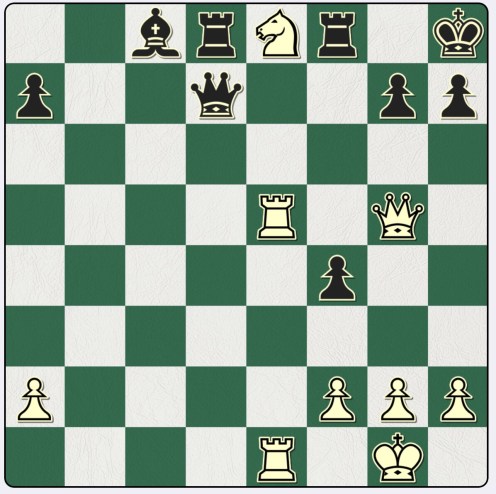
Parr v Roos, date and place unknown.
Solution
1 Rd5 loses to 1… Rde8! and the back rank mate threat decides. 2 Re8 Qe8 and it is all over.

FEN
2brNr1k/p2q2pp/8/4R1Q1/5p2/8/P4PPP/4R1K1 w – – 0 1
Daily Chess Puzzle
Today’s problem is from the 1972 book “Chess Combination as a Fine Art”, a book based on articles published in the 1950s-1960s by Kurt Richter.
Since the start of 2018, I have decided to adopt the style of only saying which side is to play: and not giving an idea if the move wins or otherwise, unless on occasion I think signposting would be helpful. Instead, the problems are posed with the instruction to decide what you would play, as in a game.
White to play: examine 1 Rf7, as played in the game.
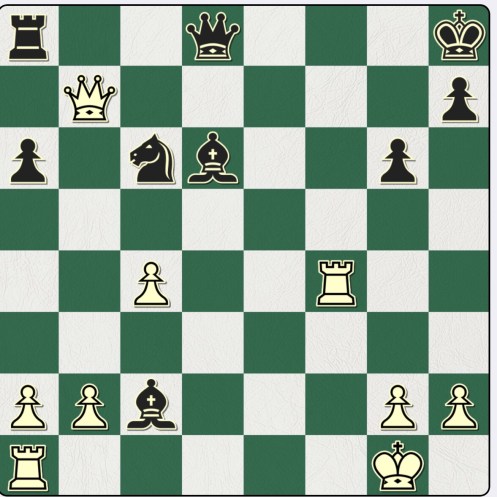
Schroeder v Golz, Aschersleben, 1963
Solution
1 Rf7 surprisingly loses to 1…Ra7, and White’s checks are fruitless.
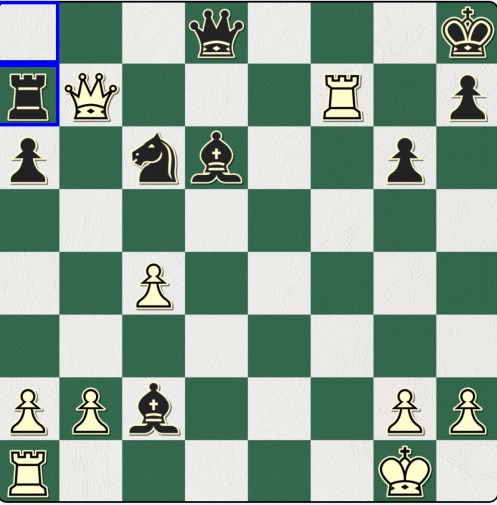
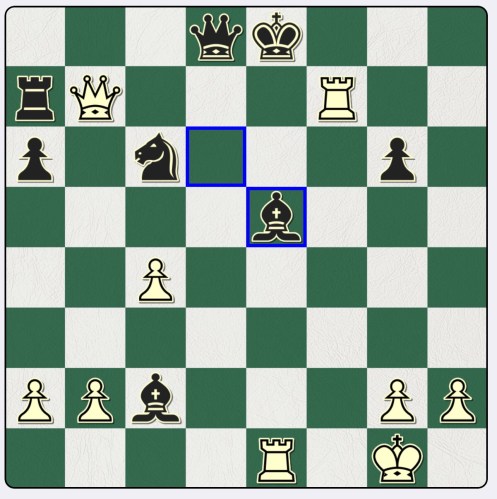
The Black king moves to e8 where it is quite safe, even after the Ra1 enters the game by Re1+. Black’s N and B provide just enough cover, after which Black wins.
FEN
r2q3k/1Q5p/p1nb2p1/8/2P2R2/8/PPb3PP/R5K1 w – – 0 1
Daily Chess Puzzle
Today’s problem is from the 1972 book “Chess Combination as a Fine Art”, a book based on articles published in the 1950s-1960s by Kurt Richter.
Since the start of 2018, I have decided to adopt the style of only saying which side is to play: and not giving an idea if the move wins or otherwise, unless on occasion I think signposting would be helpful. Instead, the problems are posed with the instruction to decide what you would play, as in a game.
White to play

Cording v Cassens, Emden 1975
Solution
1 Re7+! opens up the way after 1….Be7 for 2 Bd5+. Then if 2…Kf8 White mates by 3 Bh6+ Rh6[] 4 Qh6, so Black’s best is 2…Kg7.

Then 3 Bh6+!! all the same, since Black’s rook is tied to the eighth rank: 3…Rh6 loses to 4 Ne8+ forking Black’s king and queen.

FEN
5b1r/p1q1nk2/1r1p1Np1/1p3bBp/2pP1Q2/2P5/PP4BP/R3R1K1 w – – 0 1
Today’s problem is from the 1972 book “Chess Combination as a Fine Art”, a book based on articles published in the 1950s-1960s by Kurt Richter.
Since the start of 2018, I have decided to adopt the style of only saying which side is to play: and not giving an idea if the move wins or otherwise, unless on occasion I think signposting would be helpful. Instead, the problems are posed with the instruction to decide what you would play, as in a game.
Black to play
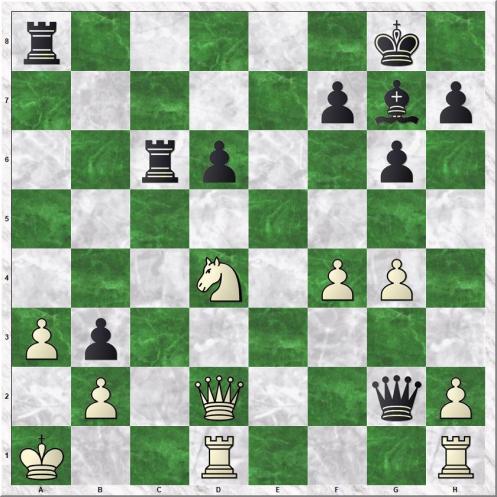
Wheeler v Hall, England 1964
Solution
A classic; which I have seen before, but for some reason isn’t in Megabase or Chessgames.com.
1..Rc1+!! ( or 1…Ra3+!) 2 Qc1 Ra3+!
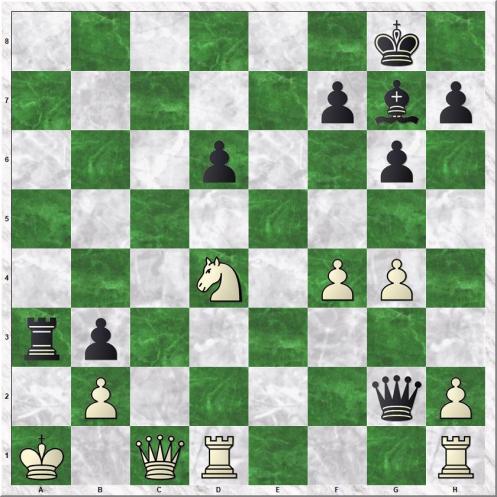
3 Kb1 Ra1+! 4 Ka1[] Qa8+
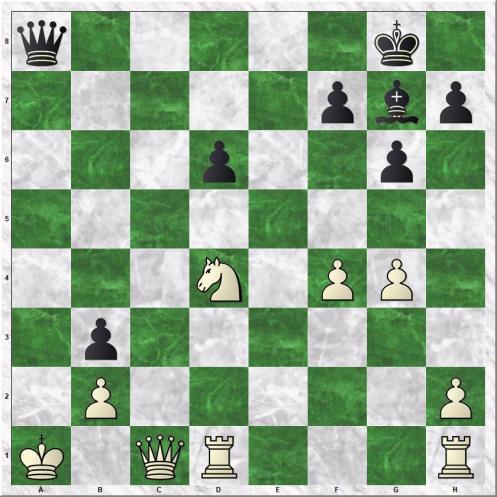
5 Kb1 Qa2 mate.
I am sure Mr Hall went home smiling that evening; and Mr Wheeler, too, probably.
FEN
r5k1/5pbp/2rp2p1/8/3N1PP1/Pp6/1P1Q2qP/K2R3R b – – 0 1
Today’s problem is from the 1972 book “Chess Combination as a Fine Art”, a book based on articles published in the 1950s-1960s by Kurt Richter.
Since the start of 2018, I have decided to adopt the style of only saying which side is to play: and not giving an idea if the move wins or otherwise, unless on occasion I think signposting would be helpful. Instead, the problems are posed with the instruction to decide what you would play, as in a game.
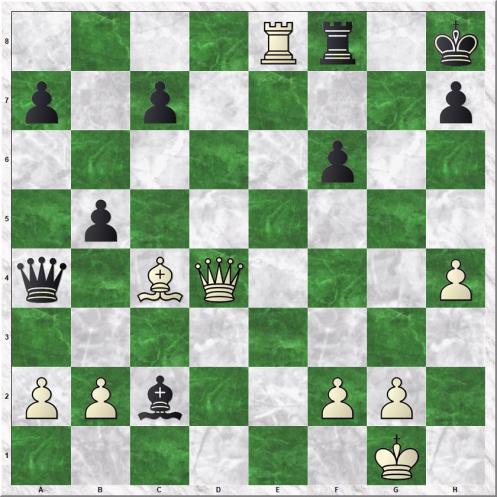
White to play: after Black plays here 1…b5

Norman Littlewood v Rolf Roth, Havana Olympiad 1966
Solution
As Purdy tells us to, ignore threats: after 1…b5, 2 Re8!! wins. Black resigned.
FEN
5r1k/ppp1R2p/5p2/8/q1BQ3P/8/PPb2PP1/6K1 b – – 0 25
Today’s problem is from the 1972 book “Chess Combination as a Fine Art”, a book based on articles published in the 1950s-1960s by Kurt Richter.
Since the start of 2018, I have decided to adopt the style of only saying which side is to play: and not giving an idea if the move wins or otherwise, unless on occasion I think signposting would be helpful. Instead, the problems are posed with the instruction to decide what you would play, as in a game.
White to play
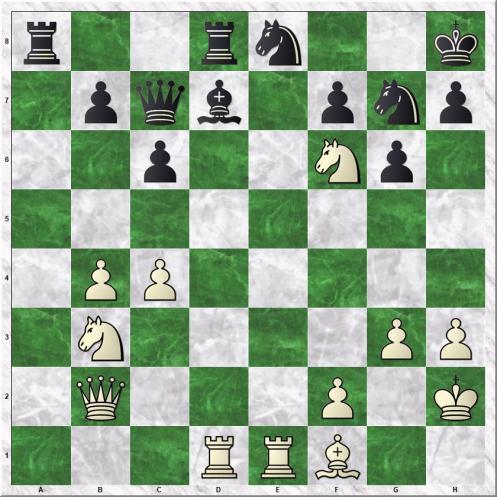
Daroczy v Dozsa, Debrecen 1956
Solution
1 Rd7! Rd7[] 2 Re8+! and wins.
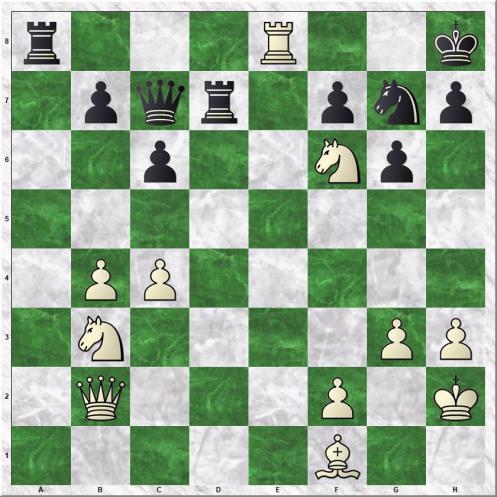
FEN
r2rn2k/1pqb1pnp/2p2Np1/8/1PP5/1N4PP/1Q3P1K/3RRB2 w – – 0 28
Today’s puzzle is from the current Sinquefield Cup in St Louis. I watched the latter half of this game live, from our holiday villa, unable to sleep. Watching without an engine on, I felt the R+P ending was probably winning for Mamedyarov, but wasn’t sure [one analysis I have subsequently seen suggests So might at one stage have been able to hold].
Near the end, I felt it was going to be a win, but still wasn’t sure.
White to play

Mamedyarov v So, Sinquefield Cup, August 2018
Solution
1 Kg3 (or 1Kf3 or 1 Kh3) wins, as one might expect. But how?
1…b4 2 Kg4 b3 3 h7+! (the key move) Kh8[] 4 Kg5 Rb5+ 5 Kh6 (the point) and White mates.

Early hours of the morning, when So resigned after 1 Kg3, the resignation at first felt premature. I initially tried to stop the b pawn with the Rook, until I saw 3 h7+! which enables the King to ‘hide’ on h6.
FEN
1r4k1/R7/6PP/1p6/8/8/6K1/8 w – – 0 1
Daily Chess Puzzle
Today’s problem is from the 1972 book “Chess Combination as a Fine Art”, a book based on articles published in the 1950s-1960s by Kurt Richter.
Since the start of 2018, I have decided to adopt the style of only saying which side is to play: and not giving an idea if the move wins or otherwise, unless on occasion I think signposting would be helpful. Instead, the problems are posed with the instruction to decide what you would play, as in a game.
Black to play: examine 1 …Qb3, as played in the game.

Damjanovic v Lehmann, Beverwijk 1966
Solution
1…Qb3 loses:

Black’s weakness is clearly the risk of bank rank mate (in CJS Purdy terms, his king is in a net). So 2 Bg5!

If 2…Bg5, 3 Nb3 since the N is no longer pinned by the bishop on e7.
Or if 2…Qa3, 3 Be7 wins a piece. Black must make luft for his king, after which 4ba
FEN
r3b1k1/4b1pp/1q6/2NpP3/p1pP4/Q3B2P/1P3RPK/8 b – – 0 1
Daily Chess Puzzle
Today’s problem is from the 1972 book “Chess Combination as a Fine Art”, a book based on articles published in the 1950s-1960s by Kurt Richter.
Since the start of 2018, I have decided to adopt the style of only saying which side is to play: and not giving an idea if the move wins or otherwise, unless on occasion I think signposting would be helpful. Instead, the problems are posed with the instruction to decide what you would play, as in a game.
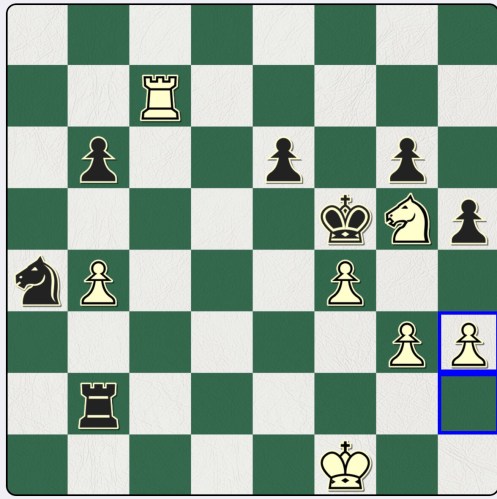
White to play: examine 1 Ng5+ Kf6, as played in the game.

Smyslov v Benko, Monaco 1969
Solution
After 1 Ng5+ Kf6, Smyslov played 2 Kf1! after which Benko gave up the rook by 2…Rf2+.

Instead, 2… Rb2 (say) is met by 3 f4, and Black’s king is caught in a net.
He can’t escape: 3…Kf5 4h3 and mate follows.
FEN
8/2R2Nk1/1p2p1p1/7p/nP6/6P1/4rPKP/8 w – – 0 1
Daily Chess Puzzle
Today’s problem is from the 1972 book “Chess Combination as a Fine Art”, a book based on articles published in the 1950s-1960s by Kurt Richter.
Since the start of 2018, I have decided to adopt the style of only saying which side is to play: and not giving an idea if the move wins or otherwise, unless on occasion I think signposting would be helpful. Instead, the problems are posed with the instruction to decide what you would play, as in a game.
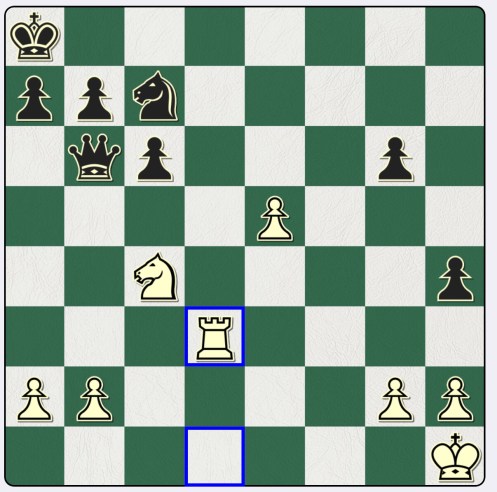
White to play

Horne v Mardle, Hastings, 1953
Solution
1 Nc4! and after 1…Rd3, 2 Rd3! and White ends up the exchange up, with a winning position.
FEN
k2r4/ppn5/1qpN2p1/4P3/7p/3Q4/PP4PP/3R3K w – – 0 1
 allanbeardsworth