Daily Chess Puzzle
Today’s problem is from the 1972 book “Chess Combination as a Fine Art”, a book based on articles published in the 1950s-1960s by Kurt Richter.
Since the start of 2018, I have decided to adopt the style of only saying which side is to play: and not giving an idea if the move wins or otherwise, unless on occasion I think signposting would be helpful. Instead, the problems are posed with the instruction to decide what you would play, as in a game.
White to play
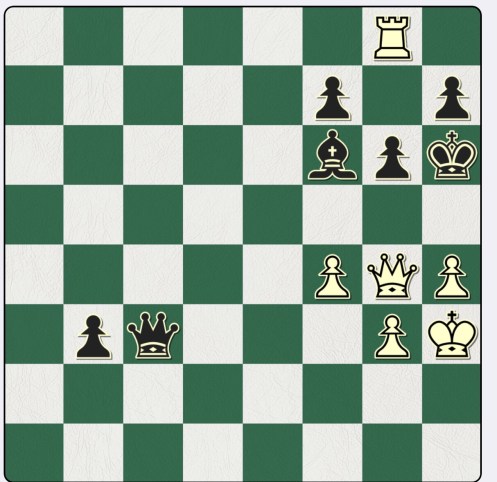
Unknown players, England, 1962
Solution
1 Qg5+ is a move that has to be tried, and does indeed win. 1…Bf6[] 2 hg+ Kh5[]

3 Rh8![] (when solving this puzzle, I got it wrong, playing 3 Rg7 with the same idea, but 3…Qc8+ refutes it).
It is mate either by 4 g4 or 4 Rh7, unless Black desperadoes his Queen.
FEN
6R1/5p1p/5bpk/8/5PQP/1pq3PK/8/8 w – – 0 1
Daily Chess Puzzle
Today’s problem is from the 1972 book “Chess Combination as a Fine Art”, a book based on articles published in the 1950s-1960s by Kurt Richter.
Since the start of 2018, I have decided to adopt the style of only saying which side is to play: and not giving an idea if the move wins or otherwise, unless on occasion I think signposting would be helpful. Instead, the problems are posed with the instruction to decide what you would play, as in a game.
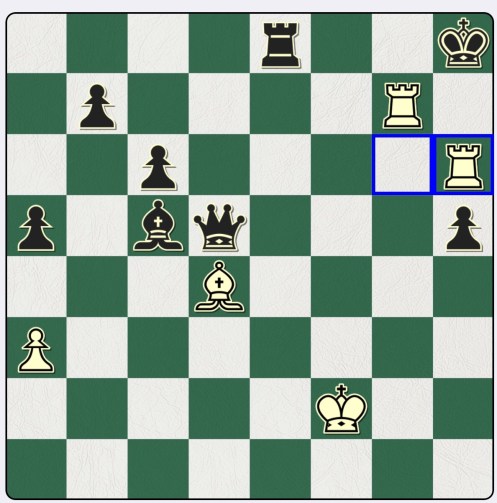
Black to play: analyse 1..Bc5, as played in the game.

Miszto v Kloza, USSR v Poland 1955
Solution
1…Bc5?? loses, but only to a beautiful move. My engine tells me that 1…Re5 was equal, and that does indeed look likely after the fairly forced 2 Be5 Qe5 3 Rg7 Rg7- or zwischenschach 3…Qf6+, to prevent 4 Qd8+, not that it needs to be prevented).
2 Qh7+!! is a lovely finale.

2…Kh7[] 3 Rg7+ Kh8 (3…Kh6? 4 R1g6 mate)

And then check, check, check…mate.
FEN
4rb1k/1p4r1/2p5/p2q3p/3B4/P2Q2R1/5K2/6R1 b – – 0 1
Daily Chess Puzzle
Today’s problem is from the 1972 book “Chess Combination as a Fine Art”, a book based on articles published in the 1950s-1960s by Kurt Richter.
Since the start of 2018, I have decided to adopt the style of only saying which side is to play: and not giving an idea if the move wins or otherwise, unless on occasion I think signposting would be helpful. Instead, the problems are posed with the instruction to decide what you would play, as in a game.
Black to play: analyse 1..Qf6, as played in the game.

Taimanov v Milic, USSR v Yugoslavia 1966
Solution
Black is lost anyway after e.g. 1 … Ng3+, but 1… Qf6 loses to an under promotion. 2 e7! and after 2..Qd6, 3 e8[N)+ forks king and queen.

FEN
8/5pk1/3QP1pp/p1p4n/8/2q4P/3NK1P1/8 b – – 0 1
Daily Chess Puzzle
Today’s problem is from the 1972 book “Chess Combination as a Fine Art”, a book based on articles published in the 1950s-1960s by Kurt Richter.
Since the start of 2018, I have decided to adopt the style of only saying which side is to play: and not giving an idea if the move wins or otherwise, unless on occasion I think signposting would be helpful. Instead, the problems are posed with the instruction to decide what you would play, as in a game.
Black to play: analyse 1…Rg5+
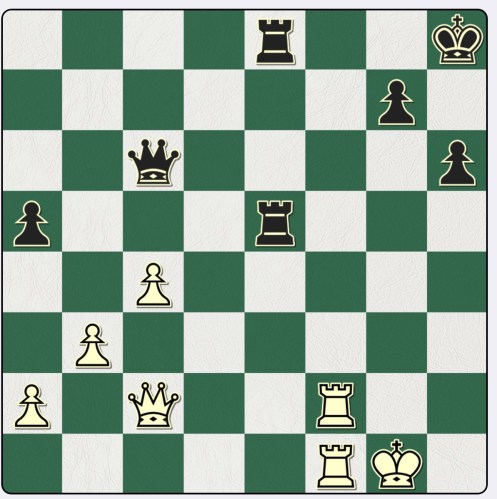
Bannik v Cherepov, USSR 1961
Solution
1…Rg5+ 2 Rg2 Qc5+ 3 Qf2 is the ‘main line’

Then 3…Ree2! Is the very pretty key.
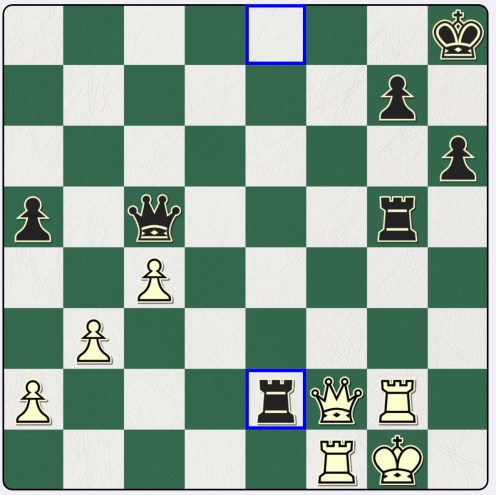
After 4 Qc5 Rgg2+ it is smothered mate in 2.
White has plenty of other defences, and I spent a happy while finding the precise move orders to defeat them. My readers might enjoy the same exercise; White does need a modicum of care to ensure neither a back rank mate or a simplification.
FEN
4r2k/6p1/2q4p/p3r3/2P5/1P6/P1Q2R2/5RK1 b – – 0 1
Daily Chess Puzzle
Today’s problem is from the 1972 book “Chess Combination as a Fine Art”, a book based on articles published in the 1950s-1960s by Kurt Richter.
Since the start of 2018, I have decided to adopt the style of only saying which side is to play: and not giving an idea if the move wins or otherwise, unless on occasion I think signposting would be helpful. Instead, the problems are posed with the instruction to decide what you would play, as in a game.
Black to play

Volvo v Sherwin, USA 1964
Solution
Not a great puzzle today, since 1…a5 2 Qc5 Rd2 is winning, but ‘clearly’ the book included the game because of 1…Qh4! which is very ‘spectacular’. After White’s best 1 Qa3 (White played weaker in the game) Black plays 1…Rf2 and is much better, winning, but not immediately.
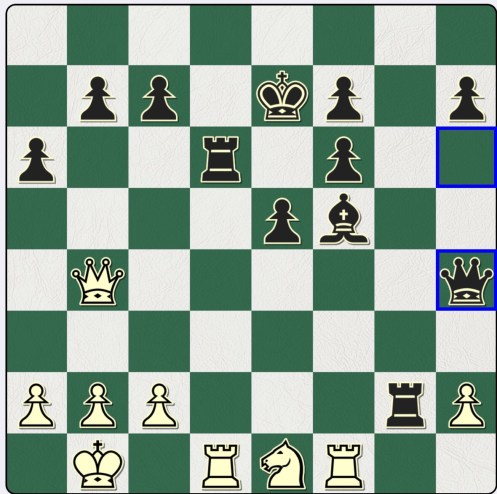
White is tied down and Black’s passed pawns roll.

FEN
8/1pp1kp1p/p2r1p1q/4pb2/1Q6/8/PPP3rP/1K1RNR2 b – – 0 1
Daily Chess Puzzle
Today’s problem is from the 1972 book “Chess Combination as a Fine Art”, a book based on articles published in the 1950s-1960s by Kurt Richter.
Since the start of 2018, I have decided to adopt the style of only saying which side is to play: and not giving an idea if the move wins or otherwise, unless on occasion I think signposting would be helpful. Instead, the problems are posed with the instruction to decide what you would play, as in a game.
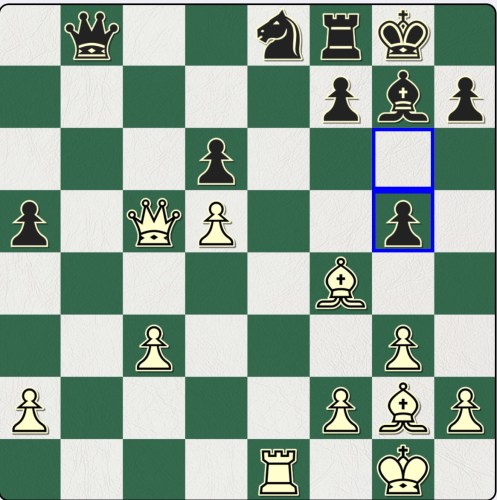
White to play, played 1 Qc5; examine

Castagna v Marcus, Berne 1965
Solution
1Qc5? is a mistake since 1…g5! diverts the Bishop, breaking its pin of the d6 pawn. In the game White played 2 Re8 met with 2…Qb1+ after which White resigned.
FEN
1q2nrk1/5pbp/3p2p1/p1pP4/2Q2B2/2P3P1/P4PBP/4R1K1 w – – 0 1
Daily Chess Puzzle
Today’s problem is from the 1972 book “Chess Combination as a Fine Art”, a book based on articles published in the 1950s-1960s by Kurt Richter.
Since the start of 2018, I have decided to adopt the style of only saying which side is to play: and not giving an idea if the move wins or otherwise, unless on occasion I think signposting would be helpful. Instead, the problems are posed with the instruction to decide what you would play, as in a game.
Black to play: played 1…Re8. Analyse
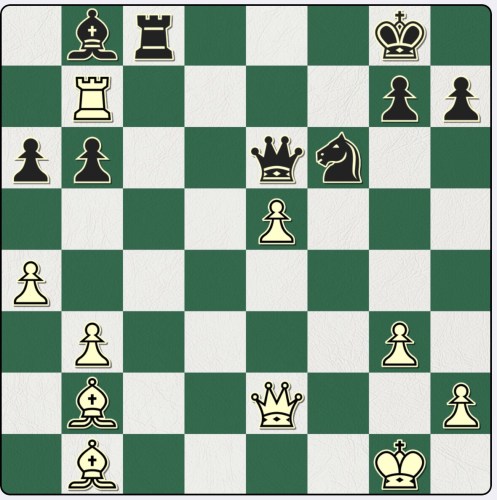
Böök v Koponen Helsinki 1961
Solution
Black’s position is lost anyway, but 1…Re8 is met by 2 ef! and after 2…Qe2 3 f7+ Kf8 4 Bg7+! wraps the game up.
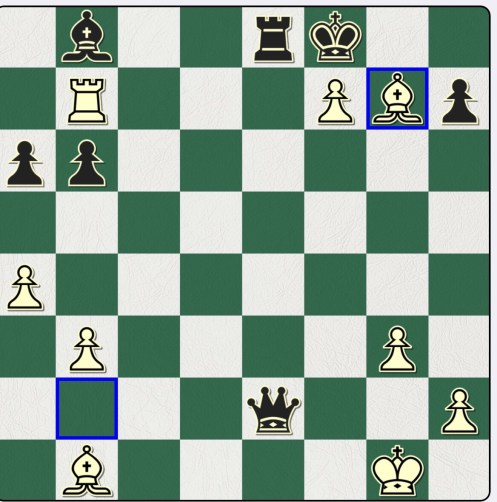
FEN
1br3k1/1R4pp/pp2qn2/4P3/P7/1P4P1/1B2Q2P/1B4K1 b – – 0 1
Daily Chess Puzzle
Today’s problem is from the 1972 book “Chess Combination as a Fine Art”, a book based on articles published in the 1950s-1960s by Kurt Richter.
Since the start of 2018, I have decided to adopt the style of only saying which side is to play: and not giving an idea if the move wins or otherwise, unless on occasion I think signposting would be helpful. Instead, the problems are posed with the instruction to decide what you would play, as in a game.
Black to play

Kleist v Wilke Saarbrücken 1958
Solution
1…Qf4! and after say 2 gf, 2…Bg8 traps White’s Queen, and Black emerges material up.

For instance, the final position after exchanges could well be as below, when Black mops up, for instance by …d4.

FEN
r3rk2/p4bbQ/6Bp/3pq3/2p2R2/4PPP1/Pp3P2/1K5R b – – 0 1
Today’s problem is from the 1972 book “Chess Combination as a Fine Art”, a book based on articles published in the 1950s-1960s by Kurt Richter.
Since the start of 2018, I have decided to adopt the style of only saying which side is to play: and not giving an idea if the move wins or otherwise, unless on occasion I think signposting would be helpful. Instead, the problems are posed with the instruction to decide what you would play, as in a game.
Black to play: evaluate 1…Bd4+ 2 Be3 Qg5, as played in the game

Solution
Trivial, today. 1…Bd4+ 2 Be3 Qg5?? is met with by 3 Qd4 and the pin is broken: 1-0.
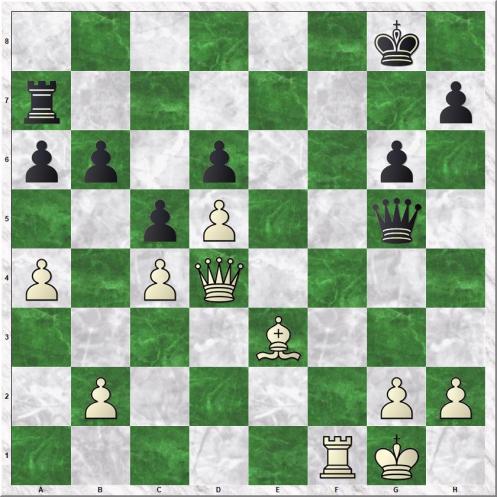
FEN
6k1/r5bp/pp1p2p1/2pP1qB1/P1P5/8/1P1Q2PP/5RK1 b – – 0 23
Today’s problem is from the 1972 book “Chess Combination as a Fine Art”, a book based on articles published in the 1950s-1960s by Kurt Richter.
Since the start of 2018, I have decided to adopt the style of only saying which side is to play: and not giving an idea if the move wins or otherwise, unless on occasion I think signposting would be helpful. Instead, the problems are posed with the instruction to decide what you would play, as in a game.
White to play

Barczay v Sebestyen, Gyor 1954
Solution
1 Rc4?? Rb3+ and the Rc4 falls; but 1 Nd4+! is a nice zwischenzug so that after 1…ed, 2 Rc4 Rb3+ can now be met with by 3 Kd4
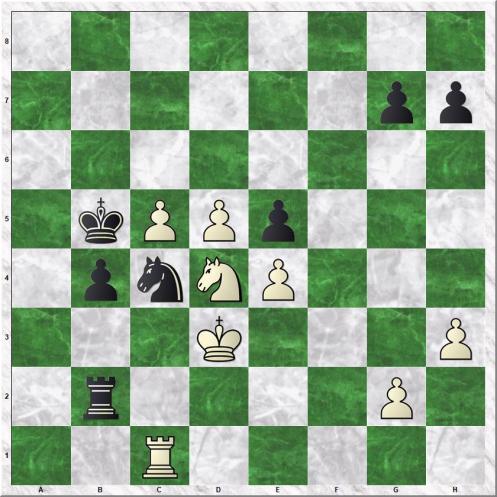
FEN
8/6pp/8/1kPPp3/1pn1P3/1N1K3P/1r4P1/2R5 w – – 0 1
 allanbeardsworth