Today’s problem is from the 1972 book “Chess Combination as a Fine Art”, a book based on articles published in the 1950s-1960s by Kurt Richter.
Since the start of 2018, I have decided to adopt the style of only saying which side is to play: and not giving an idea if the move wins or otherwise, unless on occasion I think signposting would be helpful. Instead, the problems are posed with the instruction to decide what you would play, as in a game.
Black to play
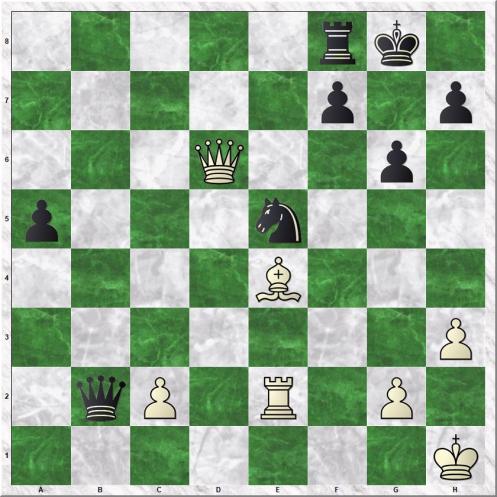
Carro v Rossolimo, 1951
Solution
1…Qc1+ 2 Kh2[] Qf4+ is the natural try, setting up a jump-biff on the b8-h2 diagonal, with the Qd6 being LPDO.

3 g3? and 3 Kg1? lose the queen to 3…Nf3+; so 3 Kh1: but then 3…Qf1+ and 4…Qe2, picking up the LPDO Re2.

FEN
5rk1/5p1p/3Q2p1/p3n3/4B3/7P/1qP1R1P1/7K b – – 0 1
Today’s problem is something I saw on Twitter: I can’t remember who posted it, but I do know the puzzle had an unknown author.
White to play: mate in 3

Solution
1 Rd7! is the lovely key.

1..Nd7 2 Nc6! and 3 Nf6 mate follows.
FEN
1n2k1K1/7R/8/4N3/6N1/8/8/8 w – – 0 1
Today’s problem is from the 1972 book “Chess Combination as a Fine Art”, a book based on articles published in the 1950s-1960s by Kurt Richter.
Since the start of 2018, I have decided to adopt the style of only saying which side is to play: and not giving an idea if the move wins or otherwise, unless on occasion I think signposting would be helpful. Instead, the problems are posed with the instruction to decide what you would play, as in a game.
White to play
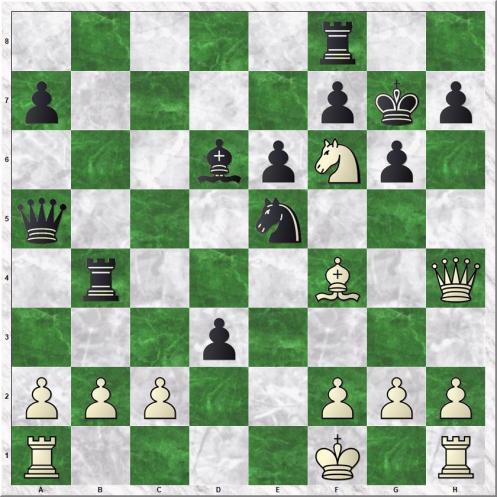
Kubanek v Kopriva, Prague 1952
Solution
An unusual and pretty solution.
1 Bh6+ and 1 Qh7+ don’t work- the latter because capturing the h7 pawn gives Black’s king luft: but 1 Qh6+! Kf6 2 Qh4+! does. A very unusal clearance.
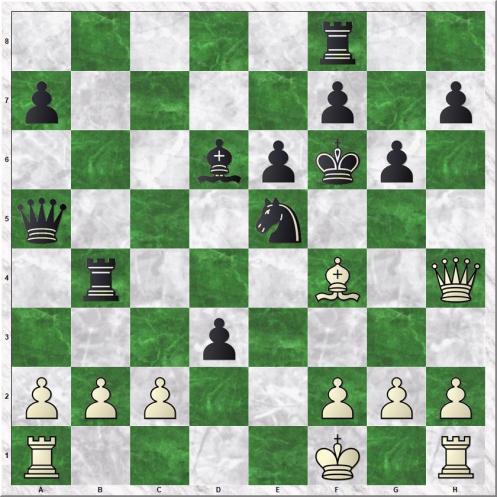
2..Kg7 repeats the position, but with the Nf6 off the board, so that 3 Bh6+ Kg8 4 Qf6 is now possible, mating:
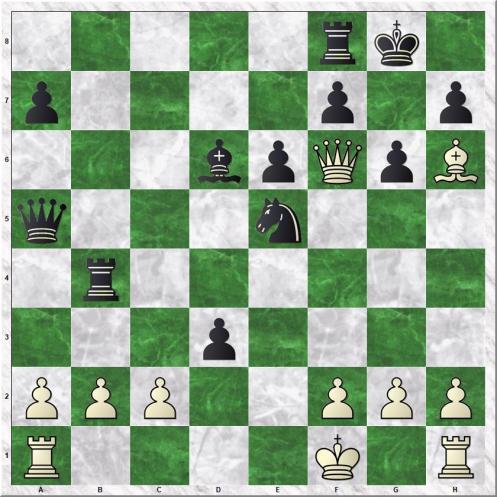
Very elegant.
Harder, and more prosaic, is 2…Kf5 3 Qg5+ Ke4[]
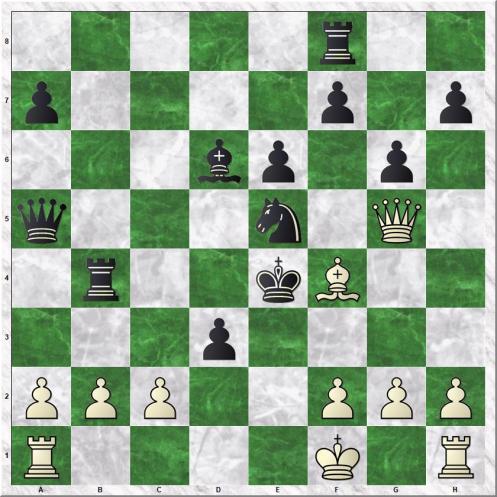
4 Re1+
(a) 4…Kd5 5 Re5+! Be5[] 6 Qe5+ Kc6 7 Qa5
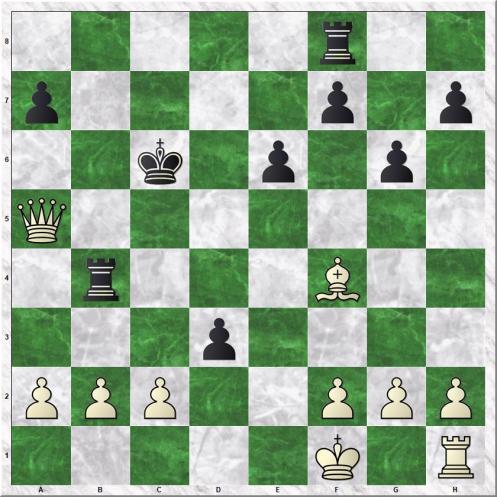
and the pawn can be prevented from promoting, so it is 1-0.
(b) 4…Kd4 5 Be5+ and if 5…Be5 6 c3+ wins; and 5…Qe5 6 Re5 wins.
FEN
5r2/p4pkp/3bpNp1/q3n3/1r3B1Q/3p4/PPP2PPP/R4K1R w – – 0 1
Today’s problem is from the 1972 book “Chess Combination as a Fine Art”, a book based on articles published in the 1950s-1960s by Kurt Richter.
Since the start of 2018, I have decided to adopt the style of only saying which side is to play: and not giving an idea if the move wins or otherwise, unless on occasion I think signposting would be helpful. Instead, the problems are posed with the instruction to decide what you would play, as in a game.
Black to play
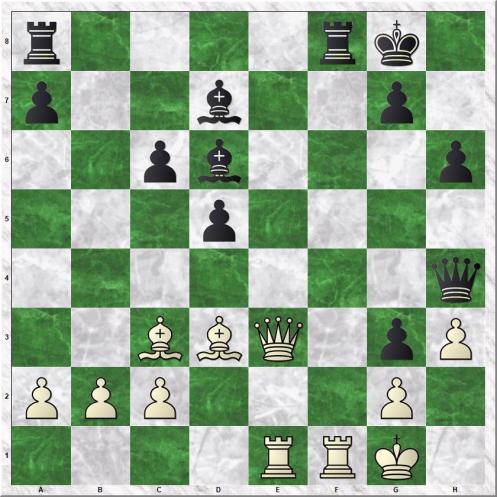
Jezek v Vanka, Prague 1958
Solution
1..Bh3! is the obvious first move; but the problem is 2 gh Qh3 3 Qe6+, exchanging the queens.
But the zwischenzug 2…Bc5! distracts the White Queen so that Qh3 can follow without the risk of an exchange of queens: 0-1.

FEN
r4rk1/p2b2p1/2pb3p/3p4/7q/2BBQ1pP/PPP3P1/4RRK1 b – – 0 1
Today’s problem is from the 1972 book “Chess Combination as a Fine Art”, a book based on articles published in the 1950s-1960s by Kurt Richter.
Since the start of 2018, I have decided to adopt the style of only saying which side is to play: and not giving an idea if the move wins or otherwise, unless on occasion I think signposting would be helpful. Instead, the problems are posed with the instruction to decide what you would play, as in a game.
White to play: examine 1 Qb5, as played
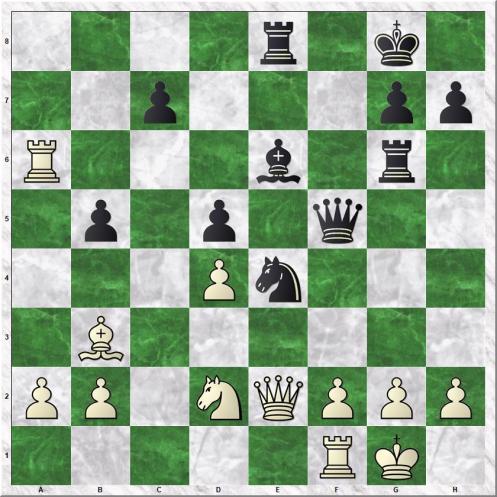
Urbanec v Engel, 7th world correspondence chess final, year unknown
Solution
1…c6! overloads White: 2 Qc6 keeping an attack on the LPDO Re8 is met by 2…Bf7!, the key move, and White’s position collapses: either the Ra6 or Nd2 fall.
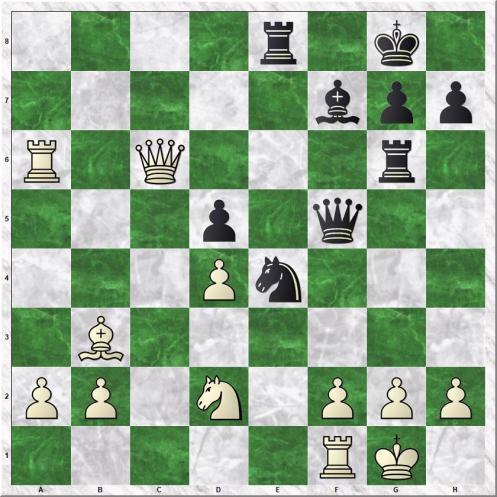
FEN
4r1k1/2p3pp/R3b1r1/1p1p1q2/3Pn3/1B6/PP1NQPPP/5RK1 w – – 0 1
Today’s problem is from the 1972 book “Chess Combination as a Fine Art”, a book based on articles published in the 1950s-1960s by Kurt Richter.
Since the start of 2018, I have decided to adopt the style of only saying which side is to play: and not giving an idea if the move wins or otherwise, unless on occasion I think signposting would be helpful. Instead, the problems are posed with the instruction to decide what you would play, as in a game.
White to play

Briones v Garcia, Cadiz, 1956
Solution
1 Rc5!! is the obvious first move, but the tactics are deep.

1…cd is easy: 2 Bd5+ Ke7 (or Ke8) 3 Qe4+! and 4 Ba8 wins.
1..Ng3+ is harder:
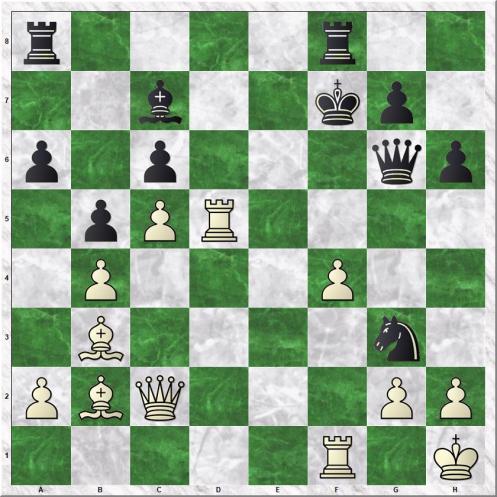
2 hg Qc2 3 Rf5+!- the key move:

3…Kg6 4 Bc2 Rf5 and now the winning move, exploiting the pin: 5 g4

FEN
r4r2/2b2kp1/p1p3qp/1pPp1n2/1P3P2/1B6/PBQ3PP/3R1R1K w – – 0 1
Today’s problem is what I think is the prettiest combination I’ve played in 2018, to mark the birthday of a close friend.
Since the start of 2018, I have decided to adopt the style of only saying which side is to play: and not giving an idea if the move wins or otherwise, unless on occasion I think signposting would be helpful. Instead, the problems are posed with the instruction to decide what you would play, as in a game.
White to play
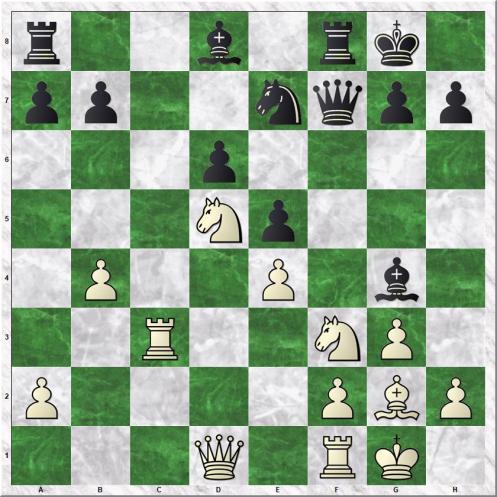
Allan Beardsworth v Alan Walton, Rapidplay, 21/6/18
Solution
With some hesitation, I played 1 Ne5!, thinking that at least I wasn’t worse after it. The game was a 30 minute per player Rapidplay, and I spent a lot of time on 1…Qf2+!!; but my opponent didn’t play it, immediately replying 1..Bd1.
There are numerous possibilities, too many for me to calculate, but with the LPDO Bg4 I felt the tactics wouldn’t work against me; besides, 1 Ne5 unpins, and otherwise I could have been in difficulties.
In the game, after 2 Nf7 Nd5 3 ed Be2 4 Re1 Rf7 5 Re2 White emerged with a pleasant plus.

I thought with R+B vs R+ opposite bishop I would have a big advantage, and indeed in the game I converted it; see my previous posting for the finale. But the engine tells me White is only somewhat better. It is the sort of position where practice against the engine is educational, to see Black’s resources. The FEN file is: r2b2k1/pp3rpp/3p4/3P4/1P6/2R3P1/P3RPBP/6K1 b – – 0 23 for anyone interested.
Black could have played for strongly with 1…Qf2+! which as I suspected is equal after an engine line. White can even be worse if not careful, given Black has the two bishops and White’s pawns are fairly broken. 2 Rf2[] Bd1 3 Ne7+ Be7 4 Nd3 Rf2 5 Kf2 Bg4 6 Rc7 Bd8 7 Rb7 Bb6+ 8 Ke1 Kf8 9 e5! Rd8 10 Nf2 Bc8 11 Rb8= is my engine’s line.

FEN
r2b1rk1/pp2nqpp/3p4/3Np3/1P2P1b1/2R2NP1/P4PBP/3Q1RK1 w – – 0 19
Today’s problem is from the 1972 book “Chess Combination as a Fine Art”, a book based on articles published in the 1950s-1960s by Kurt Richter.
Since the start of 2018, I have decided to adopt the style of only saying which side is to play: and not giving an idea if the move wins or otherwise, unless on occasion I think signposting would be helpful. Instead, the problems are posed with the instruction to decide what you would play, as in a game.
White to play: evaluate 1 Ng6, as played in the game

van Wijngaarden v Karaklajic, 13/1/1967

Solution
1 Ng6?? is a blunder: 1….Rd1! and if 2 Nd1 Bb4; or if 2 Rd1 Kg6 wind.
FEN
3r3r/1bp1bpk1/p6p/1p2N1p1/8/1PN3P1/PP3PP1/3RR1K1 w – – 0 19
Today’s problem is from the 1972 book “Chess Combination as a Fine Art”, a book based on articles published in the 1950s-1960s by Kurt Richter.
Since the start of 2018, I have decided to adopt the style of only saying which side is to play: and not giving an idea if the move wins or otherwise, unless on occasion I think signposting would be helpful. Instead, the problems are posed with the instruction to decide what you would play, as in a game.
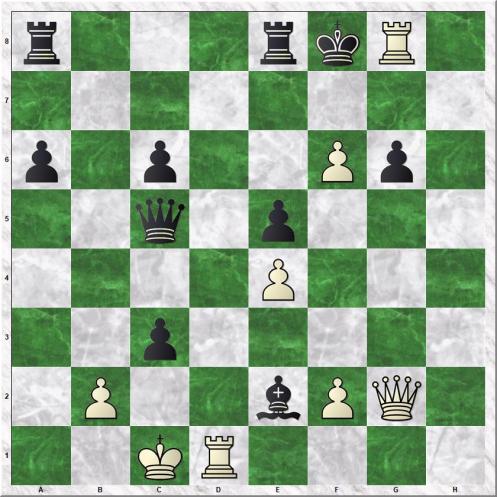
White to play
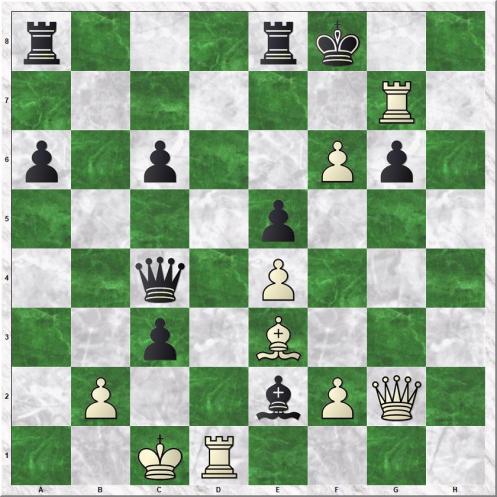
Rico Gonzalez v Ballbe Anglada, Gijon 8/8/1995
Solution
1 Bc5+!! deflects the Queen;

after 1…Qc5 (1…Re7 2 Be7+ and 3 Qg6 mate) 2 Rg8+! and mates.
FEN
r3rk2/6R1/p1p2Pp1/4p3/2q1P3/2p1B3/1P2bPQ1/2KR4 w – – 0 26
Today’s problem is from the 1972 book “Chess Combination as a Fine Art”, a book based on articles published in the 1950s-1960s by Kurt Richter.
Since the start of 2018, I have decided to adopt the style of only saying which side is to play: and not giving an idea if the move wins or otherwise, unless on occasion I think signposting would be helpful. Instead, the problems are posed with the instruction to decide what you would play, as in a game.
White to play: evaluate 1 Red5, as played in the game.
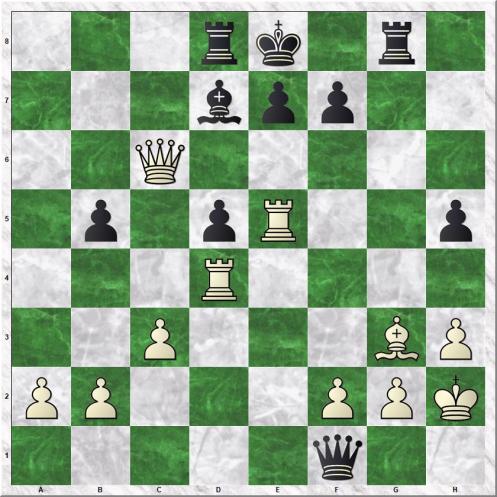
Olsen v Jacobsen, Aarhus, 1953
Solution
Easy today: 1 Red5 is a mistake, sicne 1….Qg2+! and after 2 Kg2[] Bc6 pins the rook.

FEN
3rk1r1/3bpp2/2Q5/1p1pR2p/3R4/2P3BP/PP3PPK/5q2 b – – 0 1
 allanbeardsworth