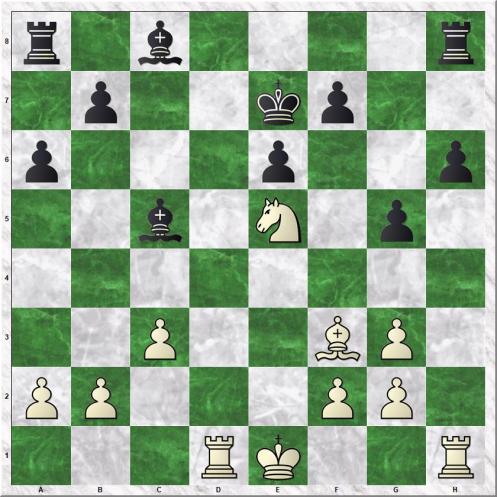
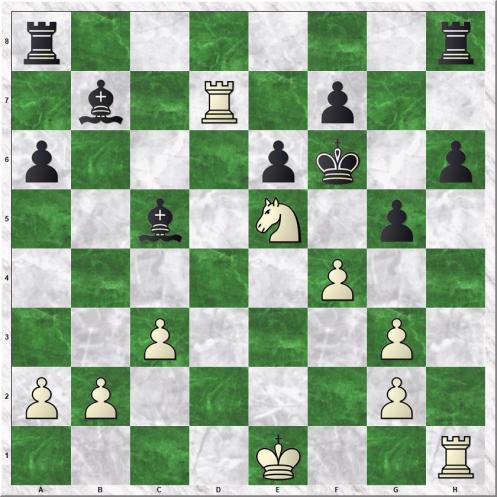
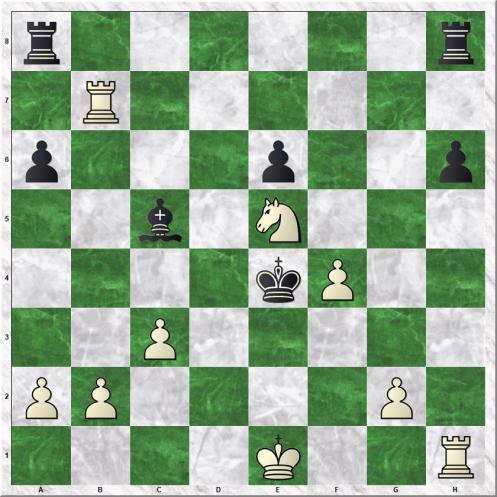


White to play and win
If our flights are on time, today my wife Jane and I will be in Moscow: fulfilling a life long ambition of mine to visit Russia. We are spending 3 days in Moscow, before travelling to St. Petersburg for a further 3 nights. I hope to play at least one game of chess, likely blitz, whilst in the home of chess.
Today I will post a game from an English victory in Moscow. And the Englishman chosen is, of course, my old teammate and school mate Nigel Short.
Since the start of 2018, I have decided to adopt the style of only saying which side is to play: and not giving an idea if the move wins or otherwise, unless on occasion I think signposting would be helpful. Instead, the problems are posed with the instruction to decide what you would play, as in a game.
White to play
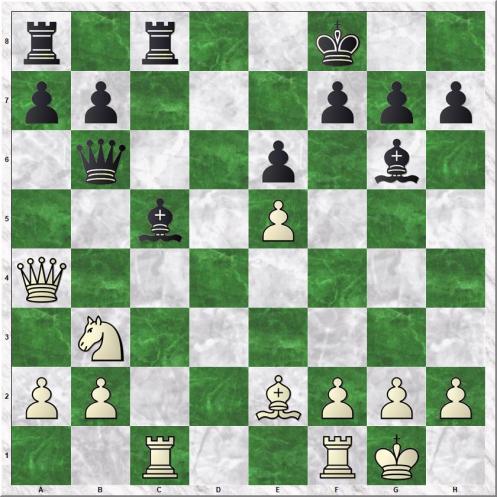
Short v Malisauskas, England v Lithuania, Moscow Olympiad 1994
Solution
1 Rc5!! Rc5[] 2 Qa3 pins and wins: 1-0.
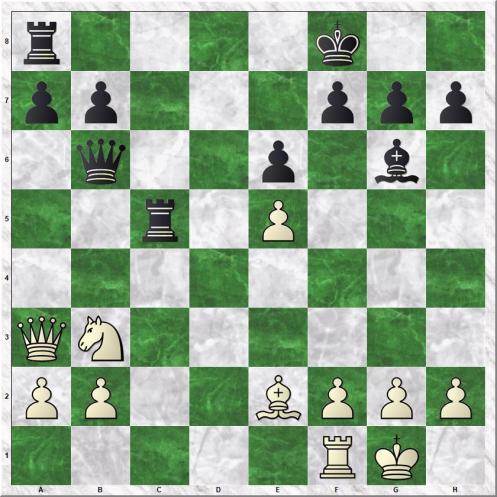
2…Rc8 3 Rc1 overcomes Black’s defences.
FEN
r1r2k2/pp3ppp/1q2p1b1/2b1P3/Q7/1N6/PP2BPPP/2R2RK1 w – – 0 19
Today’s problem is from the 1972 book “Chess Combination as a Fine Art”, a book based on articles published in the 1950s-1960s by Kurt Richter.
Since the start of 2018, I have decided to adopt the style of only saying which side is to play: and not giving an idea if the move wins or otherwise, unless on occasion I think signposting would be helpful. Instead, the problems are posed with the instruction to decide what you would play, as in a game.
White to play
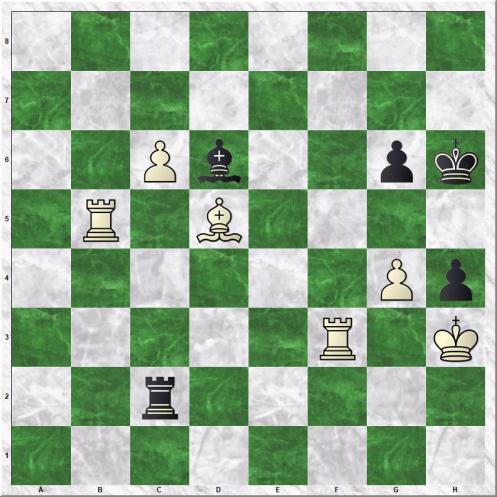
Shamkovich v Visier Segovia, Palma de Mallorca 1966
Solution
1 g5+! and if 1…Kg7, White’s King is free from the mating net.
1…Kg5?? is trivial: 2 Be4+ discovers check, hitting the LPDO Rc2, so 2..Rc5[] 3 Rc5+ Bc5[] 4 c7 and the pawn queens.
So 1..Kh5[]
And now the star move 2 Rg3!! (2 Rf4 also wins, still prettily, but in longer fashion.
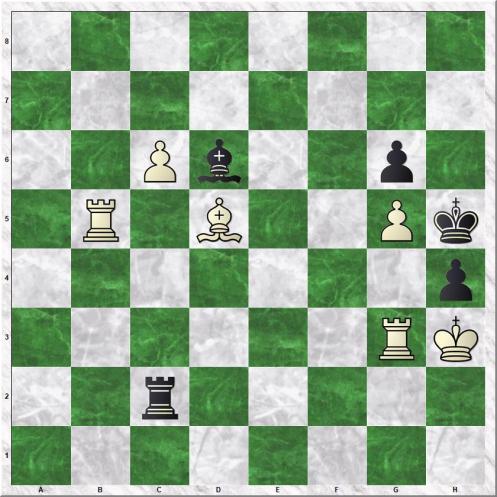
2 Rg3!! prevents 2…Rh2 mate and threatens 3 Bf3 mate, even if the rook is taken.
Lovely.
Megabase 2018
Gives an incorrect conclusion: 1 Rg3 resigns. But then 1…hg 2 g5+ and 2…Kg7 and the game goes on, and Black is not worse. My book shows the continuation as being 1g5+! and 2 Rg3!.
FEN
8/8/2Pb2pk/1R1B4/6Pp/5R1K/2r5/8 w – – 0 48
I found today’s problem whilst searching, without success for the previous game won by Bruce Hayden on Megabase and chessgames.com. Looking at his games on the latter, I found this sparkling attack. The full game is in the FEN section below.
Since the start of 2018, I have decided to adopt the style of only saying which side is to play: and not giving an idea if the move wins or otherwise, unless on occasion I think signposting would be helpful. Instead, the problems are posed with the instruction to decide what you would play, as in a game.
White to play: Black has just played Qe7-c7, keeping an eye on the Pe5. Evaluate
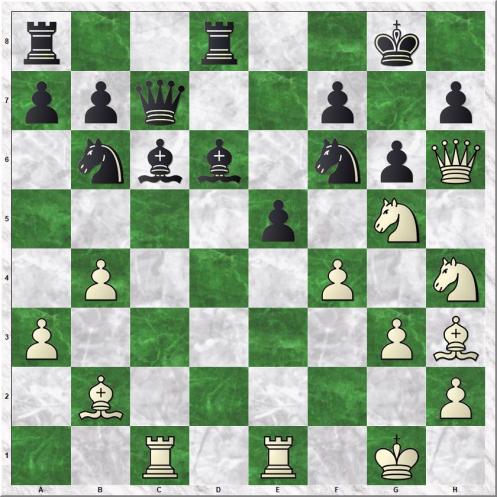
Hayden v Winser, Hastings 1947/8
Solution
1 Nf5!! is the sparking solution.
1…gf is trite: 2 Bf5 and 3 Bh7+ next. So 1…Bf8

2 Be5!! and if 2…Bh6 3 Nh6+ and 4 Qc7 and White emerges a lot of material up. Black played 2…Qd7 met with by 3 Bf6 Bh6 4 Nh6+ Kf8[] 5 Nh7 mate.

FEN
The whole game can be found here
http://www.chessgames.com/perl/chessgame?gid=1918419
Today’s problem is from the 1972 book “Chess Combination as a Fine Art”, a book based on articles published in the 1950s-1960s by Kurt Richter.
Since the start of 2018, I have decided to adopt the style of only saying which side is to play: and not giving an idea if the move wins or otherwise, unless on occasion I think signposting would be helpful. Instead, the problems are posed with the instruction to decide what you would play, as in a game.
White to play

Hayden v Winser, Hastings 1947/8
Solution
White’s best is 1 Be3!!, seeking to force Black’s Queen to no longer control h8, so that after the R on d7 is pinned by the Qg4, Rh8+ will mate.
After 1..Qe3 2 Qg4+ Rd7 (2…Nd7 3 Ra8 mate) 3 Rh8+ and mate after a couple of irrelevant interpositions.

And after 2 Qg4+ Qe6 3 Rf7 is the key move, reaching c7:

FEN
1nkr4/1pp2p1R/1P6/2b3P1/3q1P2/8/1P2Q3/R1B2K2 w – – 0 1
Today’s problem is from the 1972 book “Chess Combination as a Fine Art”, a book based on articles published in the 1950s-1960s by Kurt Richter.
Since the start of 2018, I have decided to adopt the style of only saying which side is to play: and not giving an idea if the move wins or otherwise, unless on occasion I think signposting would be helpful. Instead, the problems are posed with the instruction to decide what you would play, as in a game.
White to play
Hayden v Winser, Hastings 1947/8
Solution
Yesterday I looked at 1 Qg4, and found it somewhat wanting.
1 Qe6+!! looks likely
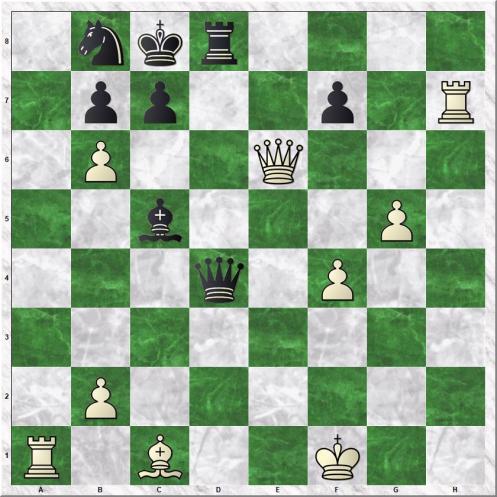
But it too is wanting: 1…Rd7[] again, as yesterday, and White’s best is a perpetual: Qe8+ Rd8[] Qe6+ Rd7=
White has much better, discussed tomorrow.
FEN
1nkr4/1pp2p1R/1P6/2b3P1/3q1P2/8/1P2Q3/R1B2K2 w – – 0 1
Today’s problem is from the 1972 book “Chess Combination as a Fine Art”, a book based on articles published in the 1950s-1960s by Kurt Richter.
Since the start of 2018, I have decided to adopt the style of only saying which side is to play: and not giving an idea if the move wins or otherwise, unless on occasion I think signposting would be helpful. Instead, the problems are posed with the instruction to decide what you would play, as in a game.
White to play
Hayden v Samuel, Brighton 1946
Solution
The most obvious move is 1 Qg4+; then 1…Qd7??
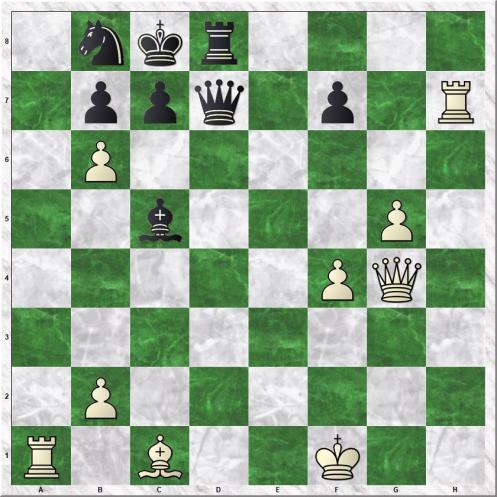
2 Rf7! Qg4 3 Rc7 mate.

This is the basic idea of the position: how to get the Rh7 to c7.
But 1…Rd7! is considerably tougher, since the Q controls h7.
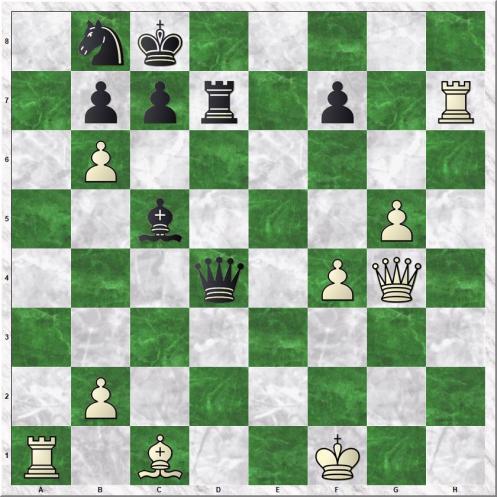
2 Be3? which was my first thought, diverting the Qe3 from looking at h8, is a mistake due to 2…Qd3+! hitting the LPDO Rh7. It is unclear: the Bc5 is also LPDO, and my engine suggests White is better.
But White has better than 1 Qg4; other options tomorrow.
FEN
1nkr4/1pp2p1R/1P6/2b3P1/3q1P2/8/1P2Q3/R1B2K2 w – – 0 1
Today’s problem is from the 1972 book “Chess Combination as a Fine Art”, a book based on articles published in the 1950s-1960s by Kurt Richter.
Since the start of 2018, I have decided to adopt the style of only saying which side is to play: and not giving an idea if the move wins or otherwise, unless on occasion I think signposting would be helpful. Instead, the problems are posed with the instruction to decide what you would play, as in a game.
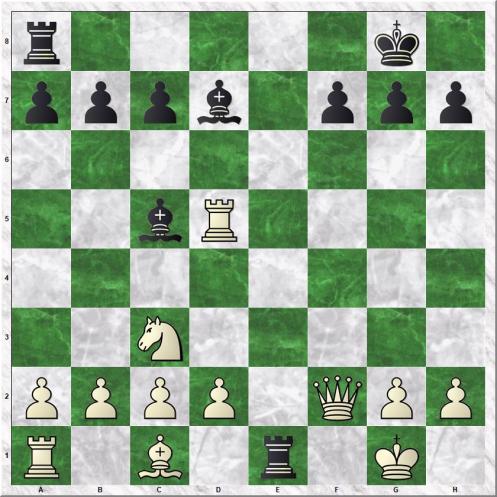
White to play: White played 1 Rd5, hitting the q and two bishops: examine
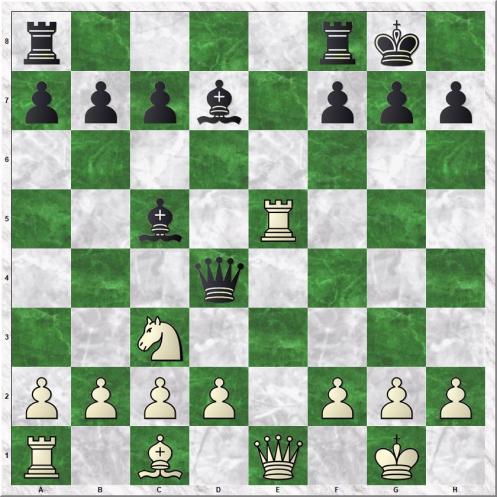
Danielsson v Blomberg, Sweden 1967
Solution
1 Rd5? is a losing mistake. 1…Rae8 or (as in the game) 1…Rfe8 wins; 2 Qf1 Qf2+! is the point.
3 Qf2 Re1 mate since the Q is pinned.
FEN
r4rk1/pppb1ppp/8/2b1R3/3q4/2N5/PPPP1PPP/R1B1Q1K1 w – – 0 1
 allanbeardsworth