Today’s problem is from the 1972 book “Chess Combination as a Fine Art”, a book based on articles published in the 1950s-1960s by Kurt Richter.
Since the start of 2018, I have decided to adopt the style of only saying which side is to play: and not giving an idea if the move wins or otherwise, unless on occasion I think signposting would be helpful. Instead, the problems are posed with the instruction to decide what you would play, as in a game.
White to play: examine 1 R1f7

Kornfilt v Hukel, corres 1965
Solution
1 R1f7 and Black holds the draw after 1..Qb2+ 2 Kg1 Na3! because if 3 Rfg7?? Rc1+ mates.

White has better: 1 R1f7 Qb2 2 Rf2+ keeps the game in play; but he has better still than 1 R1f7, as we shall see tomorrow.
FEN
2r1r2k/4R1pp/p7/1p6/2nqN1Q1/P5PP/1P5K/5R2 w – – 0 1
Today’s problem is from the 1972 book “Chess Combination as a Fine Art”, a book based on articles published in the 1950s-1960s by Kurt Richter.
Since the start of 2018, I have decided to adopt the style of only saying which side is to play: and not giving an idea if the move wins or otherwise, unless on occasion I think signposting would be helpful. Instead, the problems are posed with the instruction to decide what you would play, as in a game.
White to play: examine 1 Qe6
Kornfilt v Hukel, corres 1965
Solution
1 Qe6 Qd8!
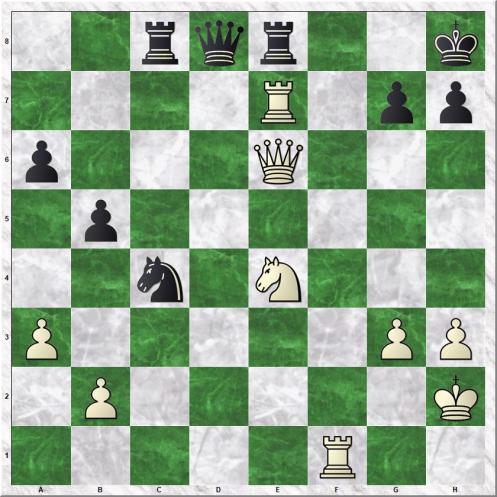
and Black defends, and the position is equal after 1 Re8+ Qe8[] 2 Qa6 Rd8 with enough activity to regain the b pawn.
FEN
2r1r2k/4R1pp/p7/1p6/2nqN1Q1/P5PP/1P5K/5R2 w – – 0 1
Today’s problem is from the 1972 book “Chess Combination as a Fine Art”, a book based on articles published in the 1950s-1960s by Kurt Richter.
Since the start of 2018, I have decided to adopt the style of only saying which side is to play: and not giving an idea if the move wins or otherwise, unless on occasion I think signposting would be helpful. Instead, the problems are posed with the instruction to decide what you would play, as in a game.
Black to play: evaluate 1…d5
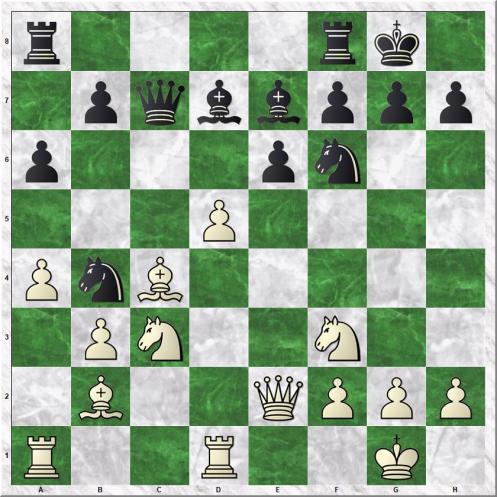
Gligoric v Myagmarsuren, Havana Olympiad 1966
Solution
1…d5? as played loses: 2 Qe7 Nc6 (the idea) 3 Nd5! zwischenxug and if 3…Nd5 4 Qg5! double attack wins: Black resigned here.
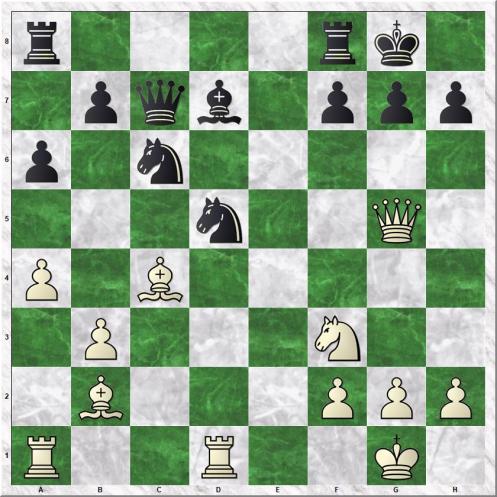
FEN
r4rk1/1pqbbppp/p3pn2/3P4/PnB5/1PN2N2/1B2QPPP/R2R2K1 b – – 0 14
Today’s problem is from the 1972 book “Chess Combination as a Fine Art”, a book based on articles published in the 1950s-1960s by Kurt Richter.
Since the start of 2018, I have decided to adopt the style of only saying which side is to play: and not giving an idea if the move wins or otherwise, unless on occasion I think signposting would be helpful. Instead, the problems are posed with the instruction to decide what you would play, as in a game.
Black to play: what is the problem with the moves given yesterday, the game continuation?
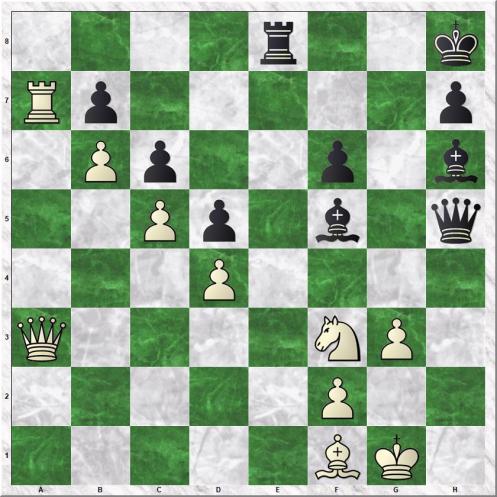
Kofman v Volovich, Tallinn 1965
1…Re3
2 Ra8+ Kg7
3 Qa7 Qf3
4 Qb7+ Kg6[]

5 Rg8+ Kh5[]
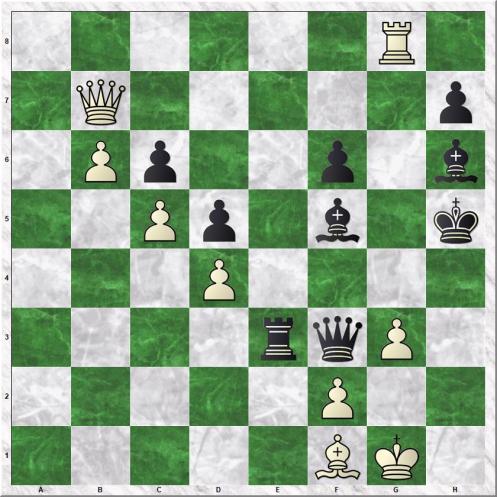
6 fe Be3+ 0-1

Solution
6 fe?? is the losing blunder.
6 Qf7+! Bg6[] 7 Qd7! threatens Qh3+ protecting the Bf1, so Black has no tactics to break through. So b7-b8(Q) is threatened.

If 7…Bf5 8 Qf7+ with a perpetual; if 7…f5 8 b7 Re1 9 b8(Q) Rf1+ is perpetual.
To make matter slightly worse, in the engine world, 7 g4+! is also apparently equal, but how would anyone human know that? 7…Bg4 8 Qh7 pins the Bh6 which is a factor: my engine shows numerous 0.00= lines.
FEN
4r2k/Rp5p/1Pp2p1b/2Pp1b1q/3P4/Q4NP1/5P2/5BK1 b – – 0 1
Today’s problem is from the 1972 book “Chess Combination as a Fine Art”, a book based on articles published in the 1950s-1960s by Kurt Richter.
Since the start of 2018, I have decided to adopt the style of only saying which side is to play: and not giving an idea if the move wins or otherwise, unless on occasion I think signposting would be helpful. Instead, the problems are posed with the instruction to decide what you would play, as in a game.
Black to play
Kofman v Volovich, Tallinn 1965
Solution
1…Re3!! disrupts White’s coordination.
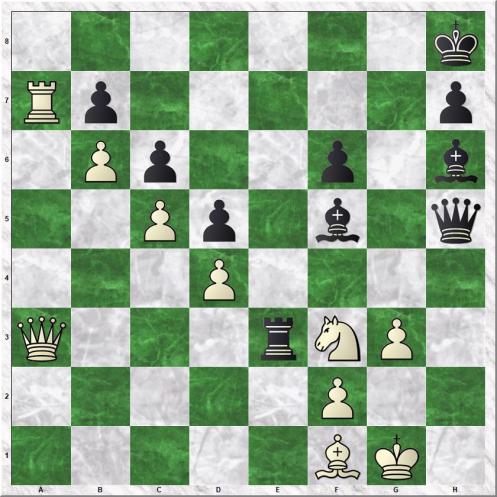
2 fe Qe3 and Black wins: Qg3+ Be3+ or Be4 follow (the latter after 3 Kh2.
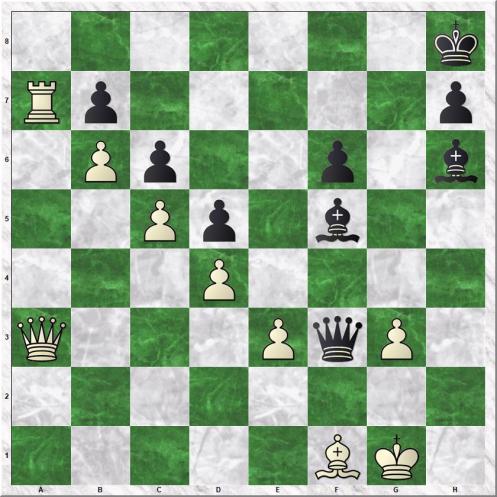
Position after 2…Qf3
2 Ra8+ is therefore best, and after 2…Kg7[] 3 Qa7 Qf3 4 Qb7+ Kg6
5 Rg8+ Kh5[] 6 fe Be3+ and White resigned.
After 7 Kh2[] Qf2+ 8 Bg2[] Qg1 mate.
But, Houston we have a problem : something is wrong with the last line, starting 2 Ra8+; something not spotted by the book’s authors. Finding the error will be tomorrow’s problem.
FEN
4r2k/Rp5p/1Pp2p1b/2Pp1b1q/3P4/Q4NP1/5P2/5BK1 b – – 0 1
Today’s problem is from the 1972 book “Chess Combination as a Fine Art”, a book based on articles published in the 1950s-1960s by Kurt Richter.
Since the start of 2018, I have decided to adopt the style of only saying which side is to play: and not giving an idea if the move wins or otherwise, unless on occasion I think signposting would be helpful. Instead, the problems are posed with the instruction to decide what you would play, as in a game.
Black to play: the game continued 1…Kd4 2 Qd3+: examine

Basman v Wallis, Eastbourne 1965
Solution
2 Qd3+ Kd3[] 3 Rd1+ Ke2! and Black wins. 4 Rd6[] gf+ 5 Kh2 f1(Q) and there is no fortress.

FEN
8/8/3qp2p/2k3p1/8/3r2pP/2Q2P2/4R1K1 b – – 0 1
Today’s problem is from the 1972 book “Chess Combination as a Fine Art”, a book based on articles published in the 1950s-1960s by Kurt Richter.
Since the start of 2018, I have decided to adopt the style of only saying which side is to play: and not giving an idea if the move wins or otherwise, unless on occasion I think signposting would be helpful. Instead, the problems are posed with the instruction to decide what you would play, as in a game.
The game continued 1… Bb3 2 Kd3: analyse

Taylor v Lamberti, Imperia 1961
Solution
After 2 Kd3 the wonderful 2… Re2!! wins. Wouldn’t it be nice to play such stunning moves?

3 Qe2 loses the Q after 3.. Bc4+, for insufficient compensation.
3 Ke2 loses fairly simply, by 3…Qc2+ 4 Ke1 Qd1+ or 4…Re8+
Therefore, 3 Ne2 when 3…Qc2+ 4 Ke3 Re8+ 5 Kf4 Re2 6 Qf1

And now 6…Kh6 is the move given in the book, which forces 7 Qe2 with a hopeless position for White. I found 6…Re4+ instead, the main line being 7 Kg5 Rg4+ 8 fg[] Qe4! with a nice final position.

9 gf or 9gh both lose to 9..Qg4 mate, whilst 9 Qf4 loses to the pretty smothering mate 9…Qe7.
FEN
4rr2/pp4k1/2p3p1/5p1p/2bP1N1P/2P2PP1/q1PK2Q1/3R3R b – – 0 1
Today’s problem is from the 1972 book “Chess Combination as a Fine Art”, a book based on articles published in the 1950s-1960s by Kurt Richter.
Since the start of 2018, I have decided to adopt the style of only saying which side is to play: and not giving an idea if the move wins or otherwise, unless on occasion I think signposting would be helpful. Instead, the problems are posed with the instruction to decide what you would play, as in a game.
White to play: White played 1 Qc7: analyse
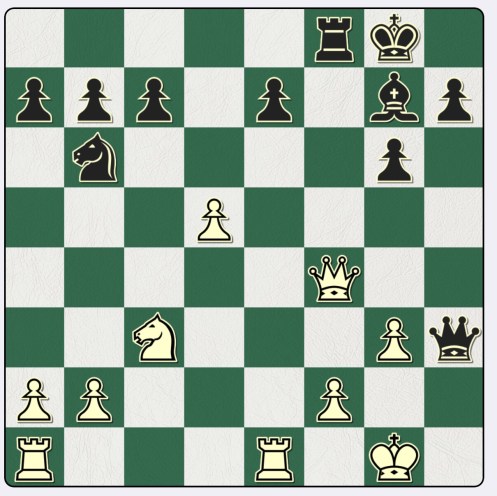
Haltgren v Henderson, California 1965
Solution
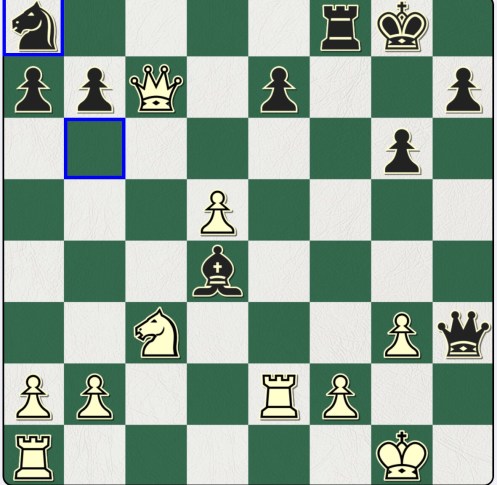
1… Bd4 2 Re2
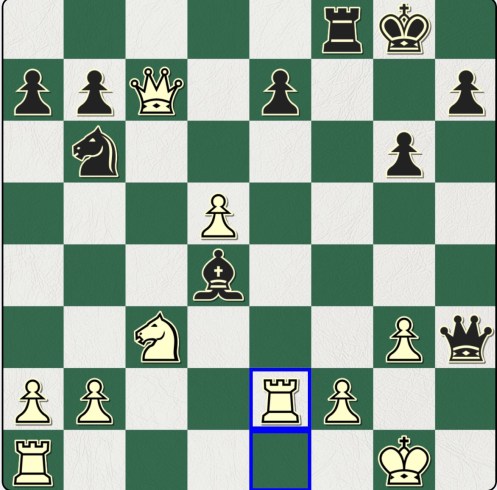
2…Na8! deflects the Queen so that it is no longer able to defend the Pg3: 0-1.
FEN
5rk1/ppp1p1bp/1n4p1/3P4/5Q2/2N3Pq/PP3P2/R3R1K1 w – – 0 1
Today’s problem is from the 1972 book “Chess Combination as a Fine Art”, a book based on articles published in the 1950s-1960s by Kurt Richter.
Since the start of 2018, I have decided to adopt the style of only saying which side is to play: and not giving an idea if the move wins or otherwise, unless on occasion I think signposting would be helpful. Instead, the problems are posed with the instruction to decide what you would play, as in a game.
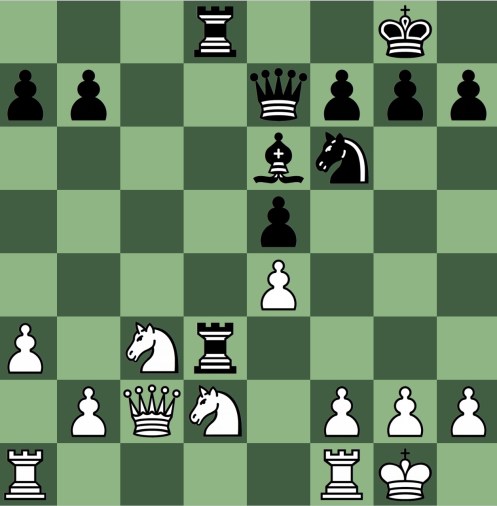
White played 1 Nd5: analyse
Zabalete v de Vicente, Madrid 1958
Solution
1 Nd5 leads to a very strong position for Black, winning by force in the main line.
1…Nd5 2 Qd3 Nf4 3 Qc2 Rd2!
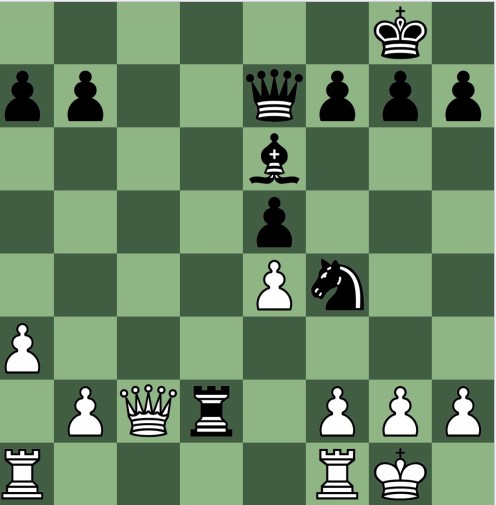
4 Qd2 Qg5 with a double attack. Mate on g2 is threatened, and also Nh3+ discovering on the LPDO Qd2.

Today’s problem is from the 1972 book “Chess Combination as a Fine Art”, a book based on articles published in the 1950s-1960s by Kurt Richter.
Since the start of 2018, I have decided to adopt the style of only saying which side is to play: and not giving an idea if the move wins or otherwise, unless on occasion I think signposting would be helpful. Instead, the problems are posed with the instruction to decide what you would play, as in a game.
Black to play: consider 1…e6 or 1…Re8
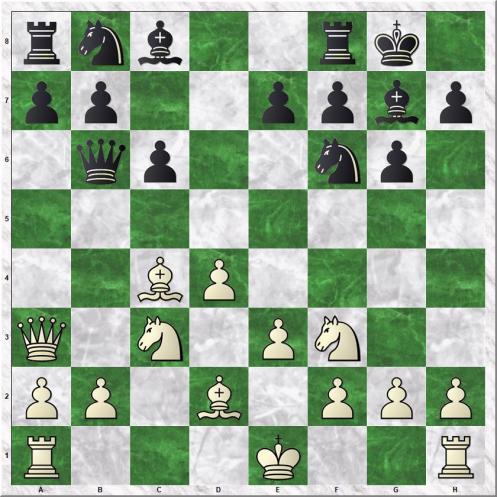
Starck v Muehlberg, DDR chmpships 1962
Solution
Black played 1…Qd8, and the game was a long fight. He avoided either of the two moves, say 1…e6, due to 2 Na4 Qc7 3 Nb6!!
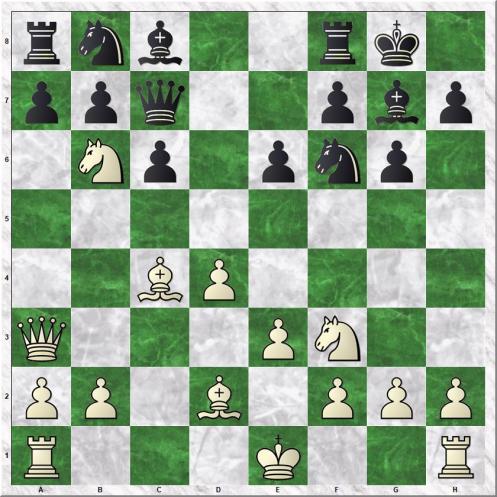
An unusual concept, which took me a while to find. The point is that if 3..Qb6 4 Ba5 wins the queen.
The position isn’t entirely simple since if 3…ab 4 Qa8 Na6 the Queen is somewhat trapped. But after 5 Rc1 or 5 Qa7 I can’t see a way of trapping it, and in the lines I have looked at, the Queen eventually gets out, with a big advantange to White.
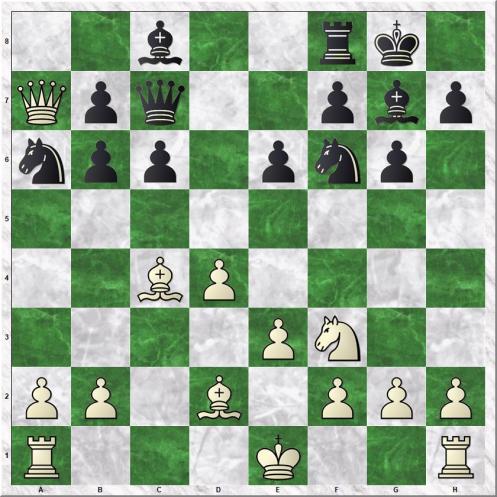
Position after 5 Qa7
FEN
rnb2rk1/pp2ppbp/1qp2np1/8/2BP4/Q1N1PN2/PP1B1PPP/R3K2R b KQ – 0 9
 allanbeardsworth