Today’s problem is from the 1972 book “Chess Combination as a Fine Art”, a book based on articles published in the 1950s-1960s by Kurt Richter.
Since the start of 2018, I have decided to adopt the style of only saying which side is to play: and not giving an idea if the move wins or otherwise, unless on occasion I think signposting would be helpful. Instead, the problems are posed with the instruction to decide what you would play, as in a game.
White to play: evaluate 1 Rc7, as played in the game
(note: don’t look for a win for either side, but do look for best play: I looked for a win, failed to find it, but had an enjoyable time finding good moves for both sides)
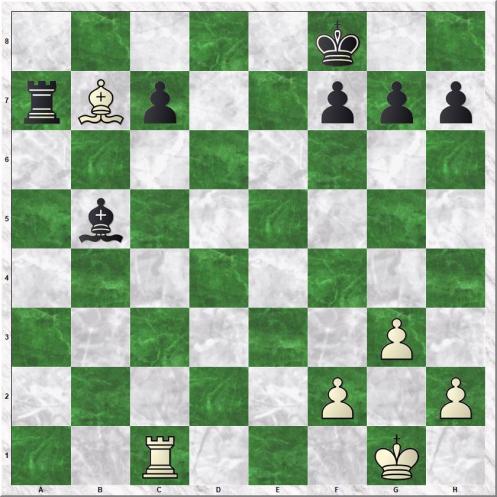
Lewis v Pines, Cape Town 1955
Solution
1 Rc7 leads to a (I think) drawn endgame. In the book/game, White mishandled it, putting his king on a white square from where the bishop can in a key line play an important discovered check. In my own analysis, I found the best line, but gave up, since it wasn’t winning, and then looked at the solution, and was slightly disappointed, thinking the problem was slightly “cooked”.
1…Be8! so that the Rc7 is properly pinned to the Bb7.
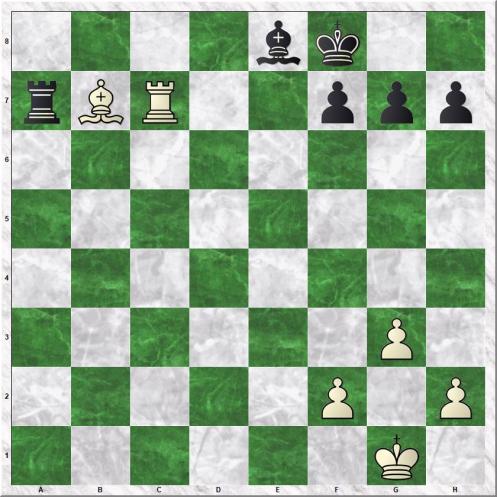
2 h4 (giving the King luft; in the game 2Kf1 was played) g6 (freeing the K) 3 Kh2! 3…Kg7 4 Rc8[] Bd7 5 Rb8
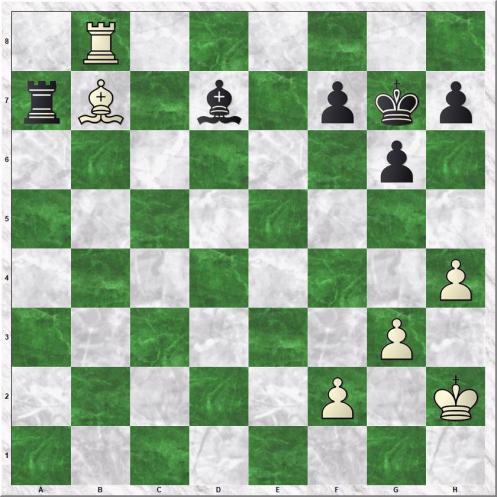
5…Ra2 6 Rd8[] Rf2+ 7Kg1 Rd2[] 8 Bc6 (an echo of the pin motif)
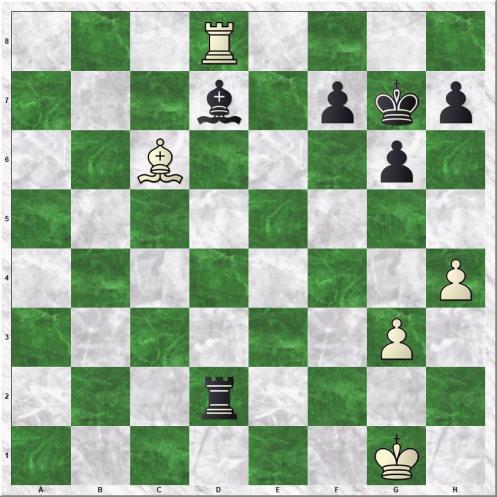
8….Rd1+[] 9 Kf2 Bg4[] 10 Rd1 Bd1
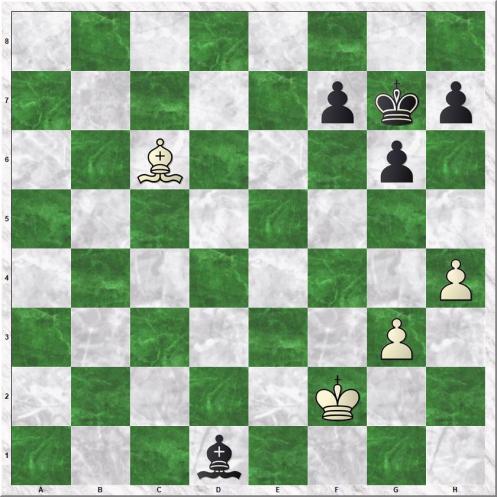
and I assume this position is drawn.
In the game, after 2Kf1? the similar line follows: 2..g6 3Ke1 Kg7 4 Rc8 Bd7 5 Rb8 Ra1+ 6 Kd2 Rb1 7 Ke3
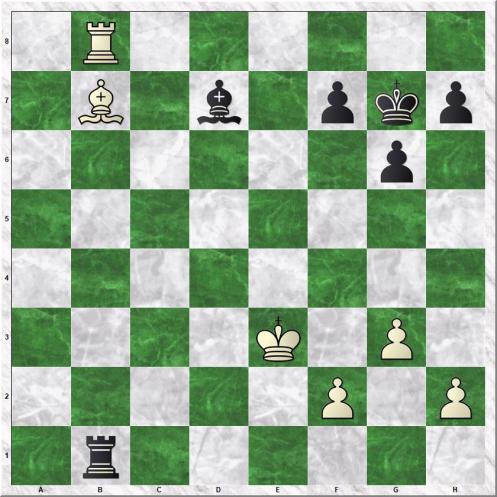
7…Bc6 (or 7…f5) 8 Bc6 Rb8 0-1.
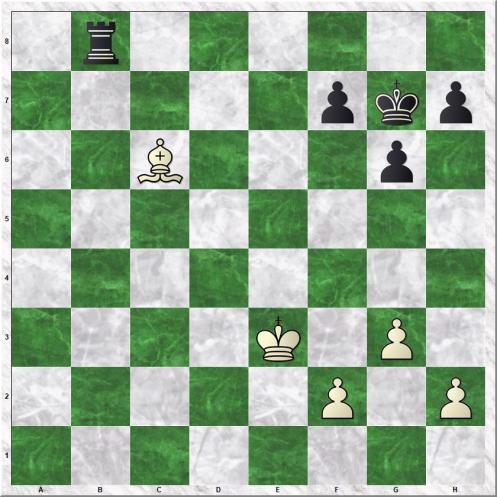
White resigned after 8…Rb8; I suspect a Carlsen or Caruana and many modern day players would carry on for some more moves. This last position is 1r6/5pkp/2B3p1/8/8/4K1P1/5P1P/8 w – – 0 9 if any reader wishes to play it on.
FEN
5k2/rBp2ppp/8/1b6/8/6P1/5P1P/2R3K1 w – – 0 1
Today’s problem is from the 1972 book “Chess Combination as a Fine Art”, a book based on articles published in the 1950s-1960s by Kurt Richter.
Since the start of 2018, I have decided to adopt the style of only saying which side is to play: and not giving an idea if the move wins or otherwise, unless on occasion I think signposting would be helpful. Instead, the problems are posed with the instruction to decide what you would play, as in a game.
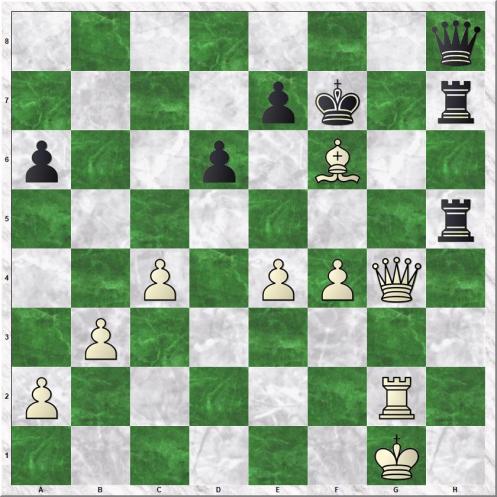
Black to play: evaluate 1…Qh8, as played in the game

Geller v Gurgenidze, Riga 1958
Solution
1…Qh8? was a mistake, met with by 1 Bf6! and the game is drawn by perpetual after 1…ef 2 Qd7+, Qd8+, Qd7+.
If 1…Qf6?? 2 Qg8 mate, and 1…Kf6?? 2 Qg6 mate.
FEN
1q6/4pk1r/p2p1p2/7r/2PBPPQ1/1P6/P5R1/6K1 b – – 0 37
Today’s problem is from the 1972 book “Chess Combination as a Fine Art”, a book based on articles published in the 1950s-1960s by Kurt Richter.
Since the start of 2018, I have decided to adopt the style of only saying which side is to play: and not giving an idea if the move wins or otherwise, unless on occasion I think signposting would be helpful. Instead, the problems are posed with the instruction to decide what you would play, as in a game.
White to play: evaluate 1 Rd4, as played in the game
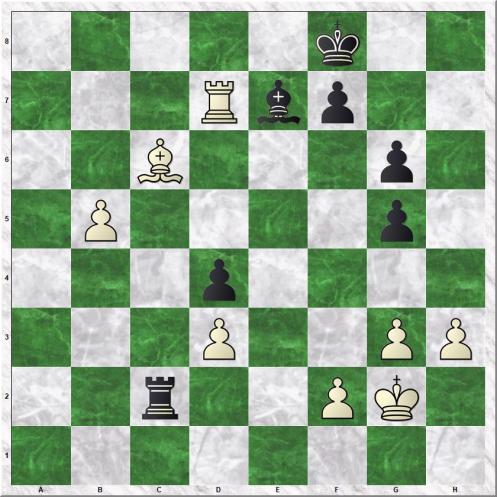
Uhlmann v Malich, Berlin 1968
Solution
1 Rd4? was met by 1…Rf2+! and after 2 Kf2 Bc5 was an unbreakable pin; or, at least, breaking it loses the rook, leading to an opposite colour bishop ending, which Black held.

1 Bd5 Rb2 2 Rb7 would presumably have been stronger. I suspect White would be winning, though am not sure.
Also, 2 Kg1 might have maintained winning chances, given two passed pawns: though, again I am not sure, and suspect Black has good chances to defend.
FEN
5k2/3Rbp2/2B3p1/1P4p1/3p4/3P2PP/2r2PK1/8 w – – 0 53
Today’s problem is from one of my recent 3min blitz games
Since the start of 2018, I have decided to adopt the style of only saying which side is to play: and not giving an idea if the move wins or otherwise, unless on occasion I think signposting would be helpful. Instead, the problems are posed with the instruction to decide what you would play, as in a game.
Black to play
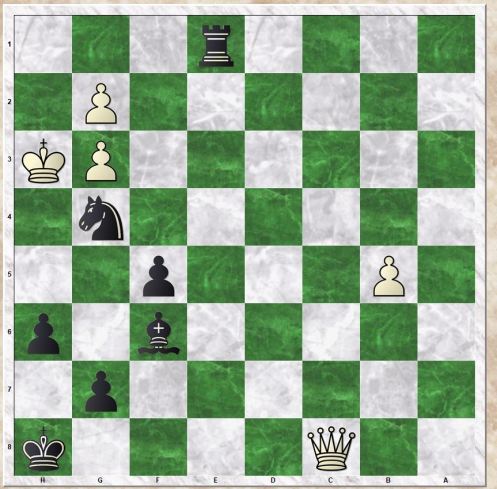
khair77 v allanbeard, chess24.com, 3-0 blitz
Solution
1…Bd8! deflecting the Queen. I chose to blog about this game since I have seen this deflection motif before, maybe on Chessbase.com or possibly elsewhere, as having a name; but can’t remember it; I vaguely recall some famous examples of this type of deflection. I am hoping a reader can help.
White played 2 Qd8+ and resigned after 2…Kh7, the Pb5 preventing any stalemate suicide’s by the Queen.
What is also nice is that 2 Qf5 loses in similar fashion: 2…Ne3! 3 Qf8+ Kh7[]

4 Kh2 Ng4+! 5 Kh3[] h5! is a nice echo of the mating net theme. Black eventually escapes the checks.
4g4 is similarly thematic: 4…Bc7 and if 5g3 Rh1 still mates the king.
FEN
2Q4k/6p1/5b1p/1P3p2/6n1/6PK/6P1/4r3 b – – 0 1
Today’s problem is from one of my recent games
Since the start of 2018, I have decided to adopt the style of only saying which side is to play: and not giving an idea if the move wins or otherwise, unless on occasion I think signposting would be helpful. Instead, the problems are posed with the instruction to decide what you would play, as in a game.
White to play
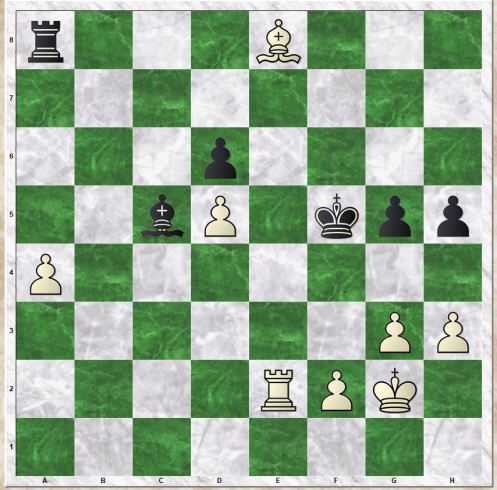
Allan Beardsworth v Alan Walton, Stockport v Marple 21/6/18
Solution
1 Re6! contains a nice mating net, which Black can’t avoid. 1…g5 2 h4 retains the trap with mate next move, unless Black plays the hopeless 2…Re8.

FEN
r3B3/8/3p4/2bP1kpp/P7/6PP/4RPK1/8 w – – 0 41
Today’s problem is from the 1972 book “Chess Combination as a Fine Art”, a book based on articles published in the 1950s-1960s by Kurt Richter.
Since the start of 2018, I have decided to adopt the style of only saying which side is to play: and not giving an idea if the move wins or otherwise, unless on occasion I think signposting would be helpful. Instead, the problems are posed with the instruction to decide what you would play, as in a game.
White to play: evaluate 1 Bb1
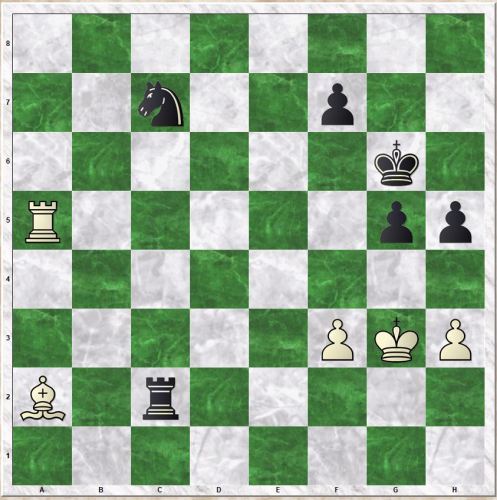
Tavernier v Grodner, Charleville 1952
Solution
Black unpins by 1…h4+ 2 Kg4[] f5+! 3 Rf5[], permitting 3…Rg2 mate.

FEN
8/2n2p2/6k1/R5pp/8/5PKP/B1r5/8 w – – 0 1
Today’s problem is from the 1972 book “Chess Combination as a Fine Art”, a book based on articles published in the 1950s-1960s by Kurt Richter.
Since the start of 2018, I have decided to adopt the style of only saying which side is to play: and not giving an idea if the move wins or otherwise, unless on occasion I think signposting would be helpful. Instead, the problems are posed with the instruction to decide what you would play, as in a game.
Black to play: evaluate 1…Bg8
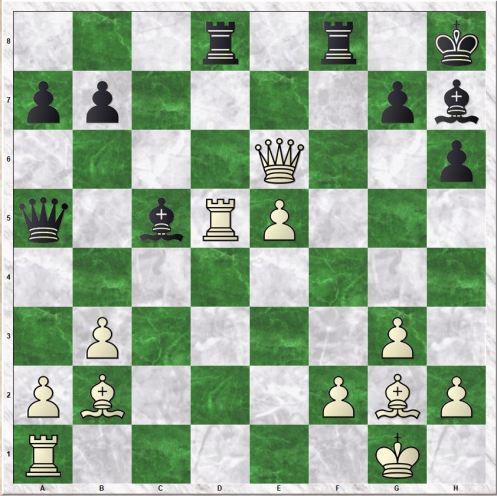
Burzlaff v Starck, Oschatz 1958
Solution
1..Bg8 loses to the pretty 2 Qh6+! (examine all biffs) 2…gh (2…Bh7 3 e6) 3 e6+ Kh7 4 Be4+ and mate.
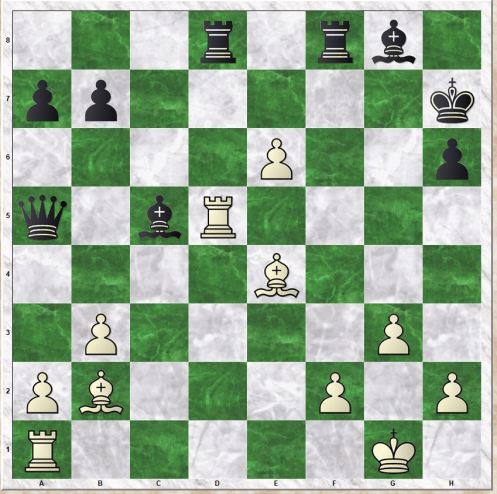
FEN
3r1r1k/pp4pb/4Q2p/q1bRP3/8/1P4P1/PB3PBP/R5K1 b – – 0 1
Today’s problem is from the 1972 book “Chess Combination as a Fine Art”, a book based on articles published in the 1950s-1960s by Kurt Richter.
Since the start of 2018, I have decided to adopt the style of only saying which side is to play: and not giving an idea if the move wins or otherwise, unless on occasion I think signposting would be helpful. Instead, the problems are posed with the instruction to decide what you would play, as in a game.
White to play: evaluate 1 Rc7, the move played in the game
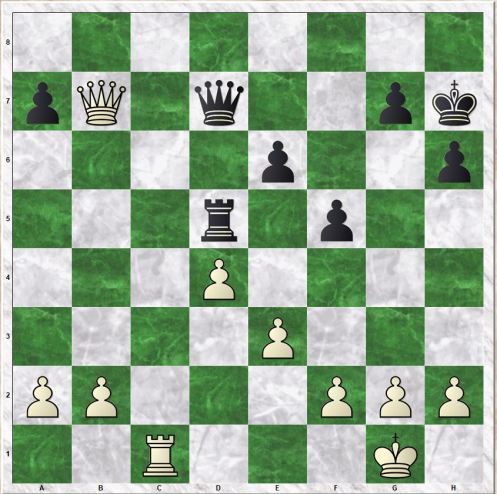
unknown players, Yugoslavia 1949
Solution
1 Rc7 is a blunder due to the pretty 1…Rc5! and White loses his Q for a rook. 2 de isn’t possible due to the back rank mate.

FEN
8/pQ1q2pk/4p2p/3r1p2/3P4/4P3/PP3PPP/2R3K1 w – – 0 1
Today’s problem is from the 1972 book “Chess Combination as a Fine Art”, a book based on articles published in the 1950s-1960s by Kurt Richter.
Since the start of 2018, I have decided to adopt the style of only saying which side is to play: and not giving an idea if the move wins or otherwise, unless on occasion I think signposting would be helpful. Instead, the problems are posed with the instruction to decide what you would play, as in a game.
Black to play: evaluate 1…Rc3

Thal v Bohnisch, Berlin 1969
Solution
1…Rc3?? loses, to either 1 Rd8+ Bf8[] 2 Bf4! or 1 Bf4. The engine prefers 1 Bf4, but both are overwhelmingly winning. I’ll give the diagram after the more natural human moves.
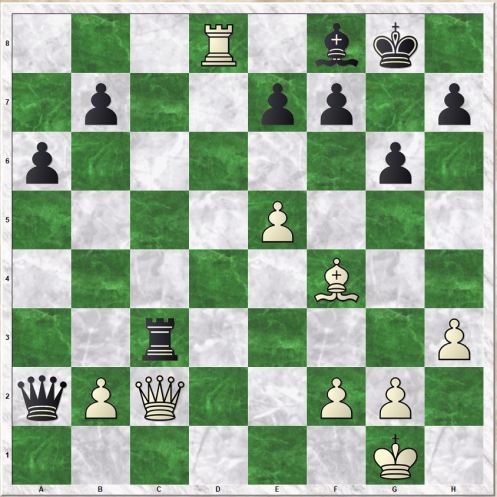
FEN
2r3k1/1p2ppbp/p5p1/4P3/3R4/2P4P/qPQ2PPB/6K1 b – – 0 1
Today’s problem is from the 1972 book “Chess Combination as a Fine Art”, a book based on articles published in the 1950s-1960s by Kurt Richter.
Since the start of 2018, I have decided to adopt the style of only saying which side is to play: and not giving an idea if the move wins or otherwise, unless on occasion I think signposting would be helpful. Instead, the problems are posed with the instruction to decide what you would play, as in a game.
White to play: assess 1 Bc7
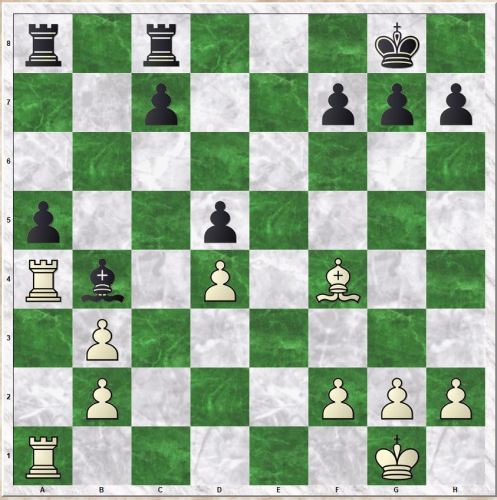
Tuk v Assenova, Lublin 1969
Solution
1 Bc7? is a losing blunder. 1…Rc7 2 Rb4 Rac8! is a double attack, threatening to mate on the first rank, so the Rb4 is captured next move.

FEN
r1r3k1/2p2ppp/8/p2p4/Rb1P1B2/1P6/1P3PPP/R5K1 w – – 0 1
 allanbeardsworth