Today’s problem is from the 1972 book “Chess Combination as a Fine Art”, a book based on articles published in the 1950s-1960s by Kurt Richter.
Since the start of 2018, I have decided to adopt the style of only saying which side is to play: and not giving an idea if the move wins or otherwise, unless on occasion I think signposting would be helpful. Instead, the problems are posed with the instruction to decide what you would play, as in a game.
The final position of the game I have been looking at during the last week.
Black to play
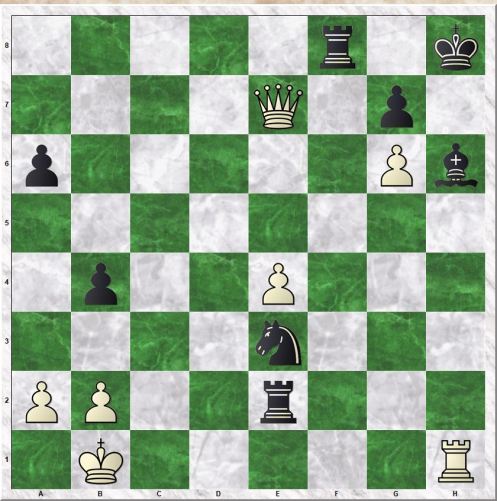
Huguet v Simonovic, Paris 1963
Solution
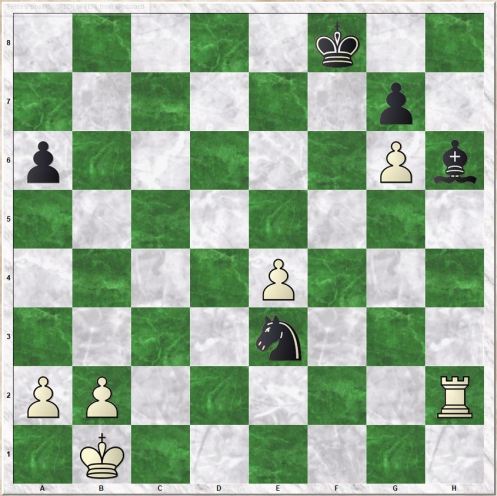
Black resigned, and I can see why. It took me a good while studying this position to see that Black’s position wasn’t hopeless, and that 1…Kg8[] still kept the game going.
The book, pre-engine era, doubts that White can win. But my engine, left running for a while, increases its assessment to +1.8 after 1 Qb4[] Rh2 2 Qf8+! Kf8 3 Rh2, when I can see that White will prevail with his too many pawns.
But in a human game, 1..Kg8 might have kept saved the game, since 2 Qe6+ with a repetition is what some players would do after such a great fight.
FEN
5r1k/4Q1p1/p5Pb/8/1p2P3/4n3/PP2r3/1K5R b – – 0 11
Today’s problem is from the 1972 book “Chess Combination as a Fine Art”, a book based on articles published in the 1950s-1960s by Kurt Richter.
Since the start of 2018, I have decided to adopt the style of only saying which side is to play: and not giving an idea if the move wins or otherwise, unless on occasion I think signposting would be helpful. Instead, the problems are posed with the instruction to decide what you would play, as in a game.
Black to play

Huguet v Simonovic, Paris 1963
Solution
After 1 Bf6, Black defends, and wins by the glorious 1… Kg8!!
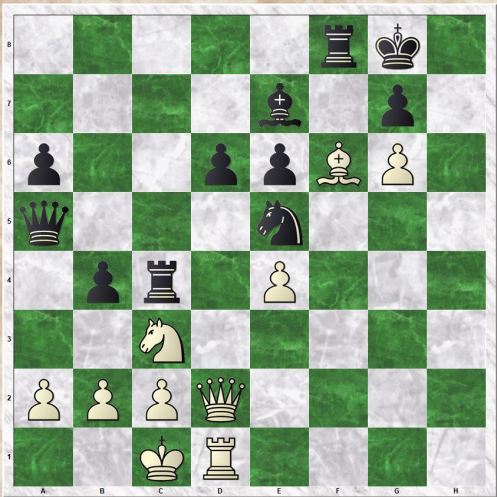
1..Ng4!! also saves Black, and wins; but not 1…Ng6?? because of 2 Qh6+: the g7 pawn is pinned by the Bf6.
FEN
5r1k/4b1p1/p2ppBP1/q3n3/1pr1P3/2N5/PPPQ4/2KR4 b – – 0 3
Today’s problem is from the 1972 book “Chess Combination as a Fine Art”, a book based on articles published in the 1950s-1960s by Kurt Richter.
Since the start of 2018, I have decided to adopt the style of only saying which side is to play: and not giving an idea if the move wins or otherwise, unless on occasion I think signposting would be helpful. Instead, the problems are posed with the instruction to decide what you would play, as in a game.
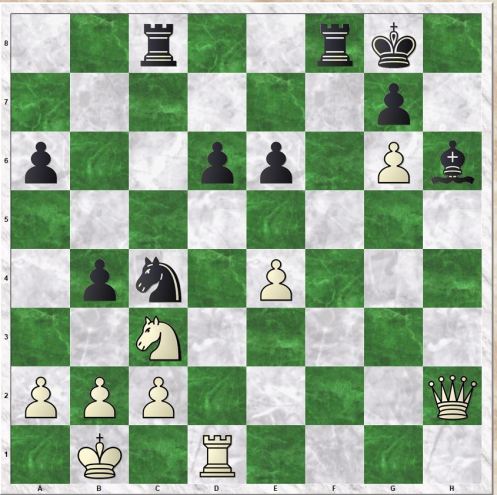
White to play: examine 1 Bf6

Huguet v Simonovic, Paris 1963
Solution
Yesterday I gave the solution, 1 Nd5!!, since 1 Bf6, the move I and most people would play without thinking- and which was played in the game, is met by the rocket 1…Qg5+!!
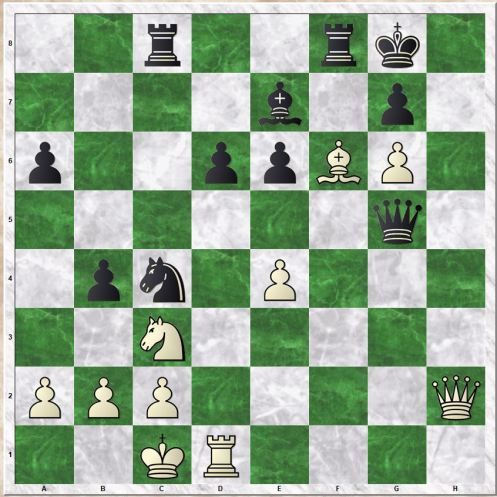
A tremendous response!
2 Bg5[] Bg5+[] 3 Kb1[] Bh6[] and the game goes on.
FEN
2r2rk1/4b1p1/p2ppnP1/q5B1/1pn1P3/2N5/PPP4Q/2KR4 w – – 0 4
Today’s problem is from the 1972 book “Chess Combination as a Fine Art”, a book based on articles published in the 1950s-1960s by Kurt Richter.
Since the start of 2018, I have decided to adopt the style of only saying which side is to play: and not giving an idea if the move wins or otherwise, unless on occasion I think signposting would be helpful. Instead, the problems are posed with the instruction to decide what you would play, as in a game.
White to play
Huguet v Simonovic, Paris 1963
Solution
1 Nd5!! and if 1…ed 2 Bf6 and mates in a few moves: Qh7+, Qh8+.
Black’s only try is 1…Qd5[] 2 ed Ne5 3 Bf6 Ng6 4 Be7 Ne7 but after 5 Qd6 it is a mop-up.

FEN
2r2rk1/4b1p1/p2ppnP1/q5B1/1pn1P3/2N5/PPP4Q/2KR4 w – – 0 4
Today’s problem is from the 1972 book “Chess Combination as a Fine Art”, a book based on articles published in the 1950s-1960s by Kurt Richter.
Since the start of 2018, I have decided to adopt the style of only saying which side is to play: and not giving an idea if the move wins or otherwise, unless on occasion I think signposting would be helpful. Instead, the problems are posed with the instruction to decide what you would play, as in a game.
White to play: examine 1 Bc4!! Nc4?
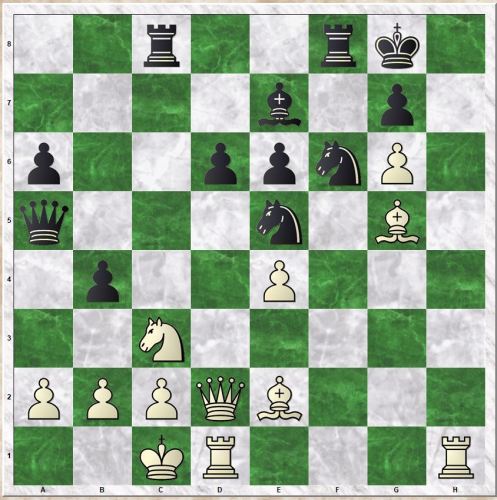
Huguet v Simonovic, Paris 1963
Solution
After 1 Bc4 Nc4
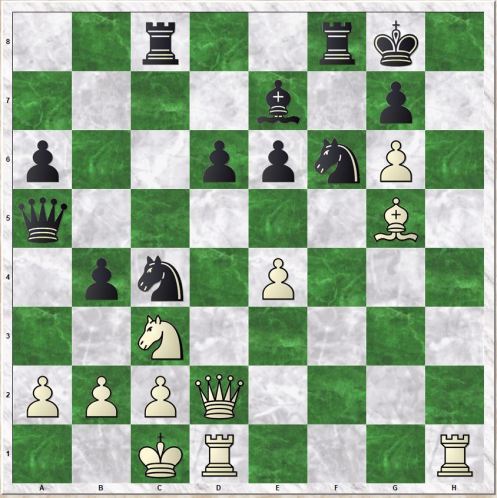
2 Rh8+! Kh8[] 3 Qh2+ Kg8[]
Now what?
Tomorrow I shall give more comments on this problem.
FEN
2r2rk1/4b1p1/p2ppnP1/q3n1B1/1p2P3/2N5/PPPQB3/2KR3R w – – 0 1
Today’s problem is from the 1972 book “Chess Combination as a Fine Art”, a book based on articles published in the 1950s-1960s by Kurt Richter.
Since the start of 2018, I have decided to adopt the style of only saying which side is to play: and not giving an idea if the move wins or otherwise, unless on occasion I think signposting would be helpful. Instead, the problems are posed with the instruction to decide what you would play, as in a game.
White to play
Huguet v Simonovic, Paris 1963
Solution
1 Bc4!!
1…Rc4! 2 Bf6! Ng6! is my engine’s “only moves” line.
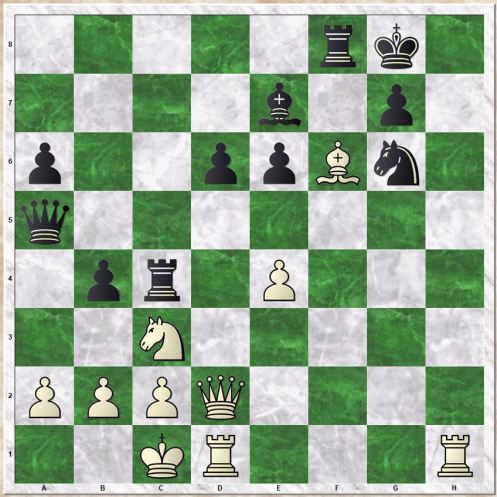
It suggests White is better after 3 Be7[] bc 4 Qd6, but the whole line is fraught.
Tomorrow I shall give more comments on this problem.
FEN
2r2rk1/4b1p1/p2ppnP1/q3n1B1/1p2P3/2N5/PPPQB3/2KR3R w – – 0 1
In similar vein to yesterday’s position, what was I hoping for, and what actually happened, in this game.
Black to play
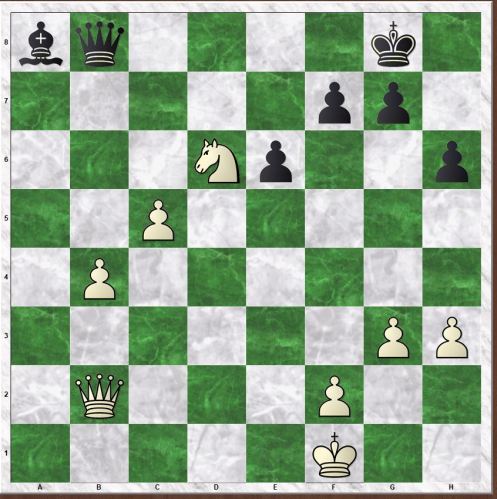
allanbeard v Aandrew Playchess, 3 minute blitz, 11/6/18
Solution
Black played, as I hoped, 1…Qc7, no doubt planning 2…Qc6; but it permitted 2 Qg7+!! and after 2…Kg7[] 3 Ne8+ forks the king and queen; 1-0.

Nice to be able to sac the queen; today’s problem, of course, is easier and more prosaic than yesterday’s.
Something slightly different today, because it is my birthday. A finish of a recent blitz game which caused me lots of pressure, since I saw the potential for the finish many moves before.
Black to play: White has just played 1 Rfc1, offering to swap rooks and take control of the c-file; noting that the Black Qd6 is tied to defending b4; and also noting that if Black’s rook moves, the c5 square looks convenient for White’s Rook.
What did I envisage might happen?
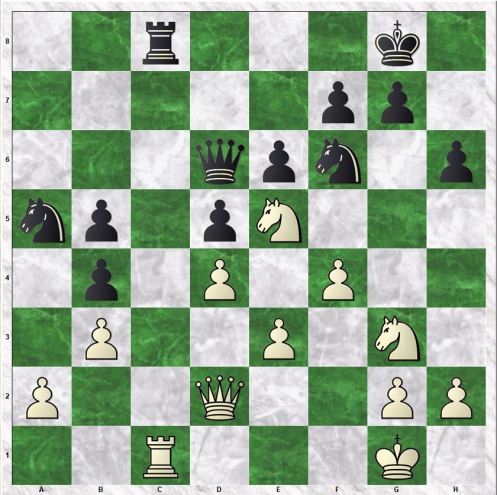
allanbeard v Kubinator, Chess.com 3 minute blitz, 9/6/18
Solution
The game finished as I had hoped: 1…Rc1+ 2 Qc1 g6 3 Qc8+ Kg7

4 Qh8+!!! (an extra exclam or two because its my birthday)

and the f7 pawn drops off, and for good measure and by good fortune, the b5 pawn too.
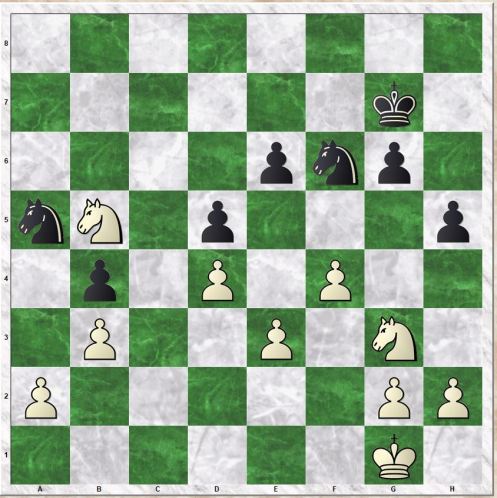
I had plenty of time to convert the ending.
Qh8+ reminded me of Petrosian v Simagin, Moscow 1956; during the game, even though it was 3 minute blitz, I thought of the motif of this game. Maybe my daily blogs do help.
FEN
2r3k1/5pp1/3qpn1p/np1pN3/1p1P1P2/1P2P1N1/P2Q2PP/2R3K1 b – – 0 1
A position from the recent tournament in Stavanger.
White to play: what was my engine’s first choice of move?

Nakamura v Karjakin, Stavanger 6/6/18
Solution
Most moves win, and Hikaru played 1 Rc4 and mopped up the Q side pawns. But the engine prefers 1 a4! which is a nice transformation of the advantage, from RvN to a simple K and P ending; since if 1…Nd5+ 2 Kd2[] Nb6 White has 3 a5 before eating the c pawns.
Therefore, 2…Nc3 3 Kc3-c4-c5 and the a pawn falls, without White’s king being trapped.

FEN
7k/p5p1/7p/2p5/1np5/2R1K1P1/P6P/8 w – – 0 31
wKe3,Rc3,Pa2,g3,h2/bKh8,Nb4,Pa7,c4,c5,g7,h6
Over the years – no, over the decades- I have cut and and kept numerous cuttings to ‘read later’. And they pile up, and up, and up.
I have decided the clutter is too much, and will, on an occasional basis when I have time, take a bundle, flick through them, discarding what is no longer of interest, and enjoy the rest, blogging some of them. Here is one of them
White to play

Skoberne v Sebenik, Bled, 1/7/16
Solution
Straight out of the London System, Black’s last move Bf8-d6 was a mistake, allowing 1 Ba6! and White wins a pawn. For instance, 1…Rb8 2 Bb7.

In the game, Black captured on a6, and played on a pawn down, and with his king exposed. 1-0, 25 moves.
FEN
r2qk2r/pp3ppp/2nbpn2/2pp4/Q2P1B2/2P1PN2/PP3PPP/R3KB1R w KQkq – 1 9
Source
Michael Adam’s column in the Daily Telegraph
 allanbeardsworth