Today’s problem is from the 1972 book “Chess Combination as a Fine Art”, a book based on articles published in the 1950s-1960s by Kurt Richter.
Since the start of 2018, I have decided to adopt the style of only saying which side is to play: and not giving an idea if the move wins or otherwise, unless on occasion I think signposting would be helpful. Instead, the problems are posed with the instruction to decide what you would play, as in a game.
White to play
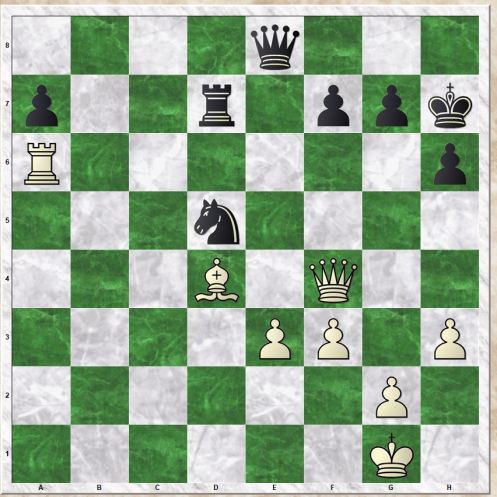
Furman v Kholmov, Leningrad, November 1963
Solution
Furman played 1 Qg4, and the game was eventually drawn.
Instead, 1 Rh6+! and if 1…Kg8, then 2 Rh8+!! is a standard tictac, 2…Kh8[] 3 Qh6+ and 4 Qg7 mate.
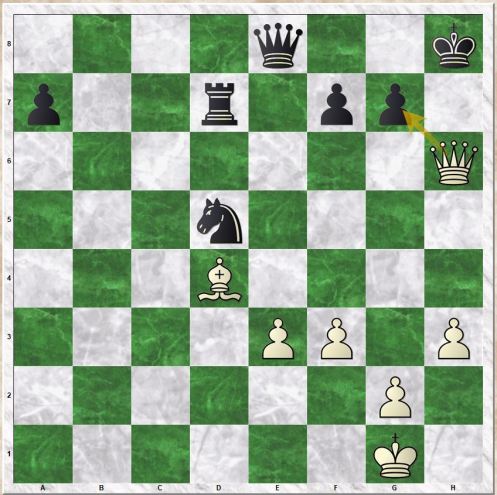
Therefore, 1…gh is better; 2 Qf5+ Kg8[] 3 Qg4+ Kf8

So far, so good: the rest took me a while to find.
4 Qg7+ Ke7[] 5 Qe5+ Kd8 (5…Kf8 6 Bc5+ Ne7 7 Qh8 mate; or 6…Re7 same; or 6…Qe7 same; or 6…Kg8 drops the Qd8) 6 Qb8+!
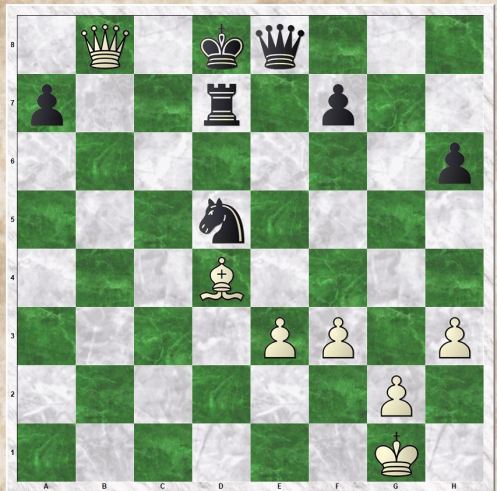
The key move, and hard to spot from the initial position. 6..Ke7[] 7 Bc5+ and the Q drops off, or Black is mated after 7…Rd6 8 Qd6 mate.

Very nice.
FEN
4q3/p2r1ppk/R6p/3n4/3B1Q2/4PP1P/6P1/6K1 w – – 0 30
Today’s problem is from the 1972 book “Chess Combination as a Fine Art”, a book based on articles published in the 1950s-1960s by Kurt Richter.
Since the start of 2018, I have decided to adopt the style of only saying which side is to play: and not giving an idea if the move wins or otherwise, unless on occasion I think signposting would be helpful. Instead, the problems are posed with the instruction to decide what you would play, as in a game.
White to play

Hepner v Goode, London 1963
Solution
In the game, White missed 1 Ng5+ and drew instead.
After 1 Ng5+, if 1..Kg6 then 2 Be4+ and 3 Rg7; if 1..hg 2 Be4+ Kh6 3 Rh8+! Bh8[] 4 Rh7 mate.

FEN
5R2/p1R3bk/1q2b2p/6p1/8/1P3NP1/P5BP/7K w – – 0 1
Today’s problem is from the 1972 book “Chess Combination as a Fine Art”, a book based on articles published in the 1950s-1960s by Kurt Richter.
Since the start of 2018, I have decided to adopt the style of only saying which side is to play: and not giving an idea if the move wins or otherwise, unless on occasion I think signposting would be helpful. Instead, the problems are posed with the instruction to decide what you would play, as in a game.
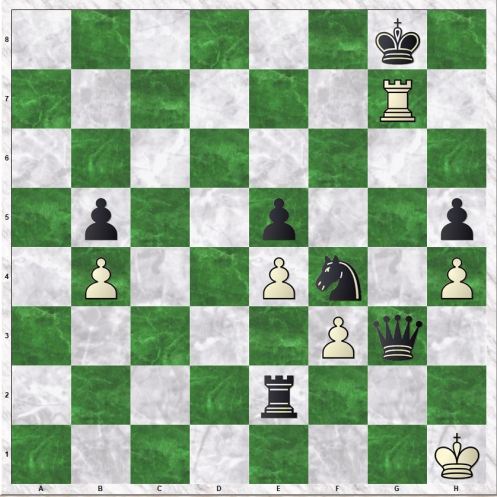
White to play Evaluate 1 Rf7 Re3 2 h4 Re2+ 3 Kh1 Qg3

Evans v Reshevsky, New York 29/12/1963
Solution
3…Qg3?? blunders away the win.

1 Qg8+! Kg8 2 Rg7+! and it is stalemate or perpetual check along the seventh rank.
FEN
2Q5/3R1ppk/8/1p2p1qp/1P2Pn2/4BPPP/7K/4r3 w – – 0 46
Today’s problem is from the 1972 book “Chess Combination as a Fine Art”, a book based on articles published in the 1950s-1960s by Kurt Richter.
Since the start of 2018, I have decided to adopt the style of only saying which side is to play: and not giving an idea if the move wins or otherwise, unless on occasion I think signposting would be helpful. Instead, the problems are posed with the instruction to decide what you would play, as in a game.
Black to play: 1..Qa3?? loses, as shown yesterday. What should Black have played instead?
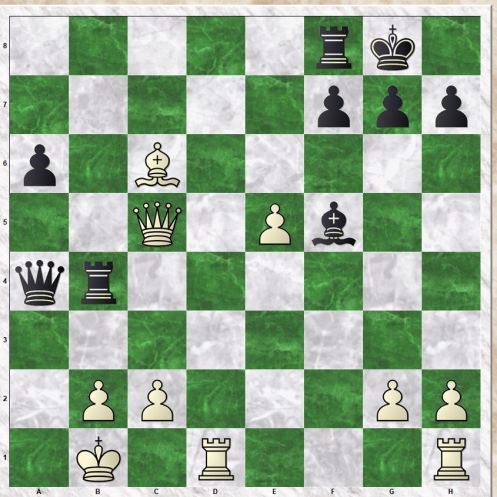
Westerinen v Loikkanen, Helsinki 1963
Solution
1..Qc2+! secures the draw. After 2 Qc2[] Bc2+ 3 Kc2[] Rc4+ the LPDO Bc6 drops off.

FEN
5rk1/5ppp/p1B5/2Q1Pb2/qr6/8/1PP3PP/1K1R3R b – – 0 1
Today’s problem is from the 1972 book “Chess Combination as a Fine Art”, a book based on articles published in the 1950s-1960s by Kurt Richter.
Since the start of 2018, I have decided to adopt the style of only saying which side is to play: and not giving an idea if the move wins or otherwise, unless on occasion I think signposting would be helpful. Instead, the problems are posed with the instruction to decide what you would play, as in a game.
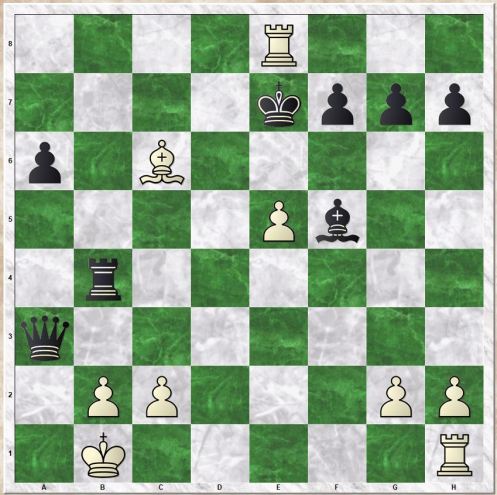
White to play, after Black plays Qa3 in this position:
Westerinen v Loikkanen, Helsinki 1963
Solution
Qa3?? is a blunder, losing quite prettily to
1 Qf8+! Kf8[] 2 Rd8+ Ke7[] 3 Re8 mate.
FEN
5rk1/5ppp/p1B5/2Q1Pb2/qr6/8/1PP3PP/1K1R3R b – – 0 1
Today’s problem is from the 1972 book “Chess Combination as a Fine Art”, a book based on articles published in the 1950s-1960s by Kurt Richter.
Since the start of 2018, I have decided to adopt the style of only saying which side is to play: and not giving an idea if the move wins or otherwise, unless on occasion I think signposting would be helpful. Instead, the problems are posed with the instruction to decide what you would play, as in a game.
White to play
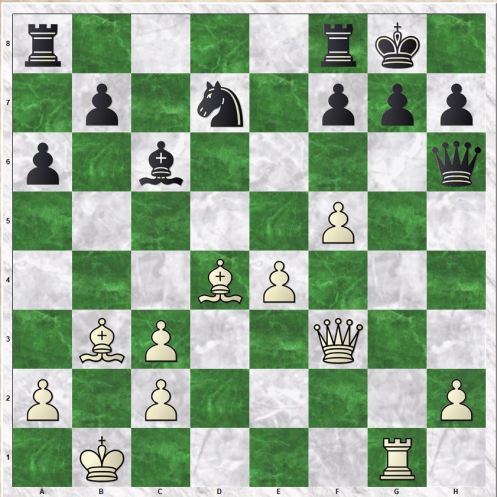
Beni v Schwarzbach, Vienna 1969
Solution
1 Qh3! and Black’s defences collapse
All he can do is 1..Qh3 when 2 Rg7+, 3 Rf7+, 4 Rg7+ and 5 Rg8 mate follows

FEN
r4rk1/1p1n1ppp/p1b4q/5P2/3BP3/1BP2Q2/P1P4P/1K4R1 w – – 0 21
Today’s problem is from the 1972 book “Chess Combination as a Fine Art”, a book based on articles published in the 1950s-1960s by Kurt Richter.
Since the start of 2018, I have decided to adopt the style of only saying which side is to play: and not giving an idea if the move wins or otherwise, unless on occasion I think signposting would be helpful. Instead, the problems are posed with the instruction to decide what you would play, as in a game.
White to play
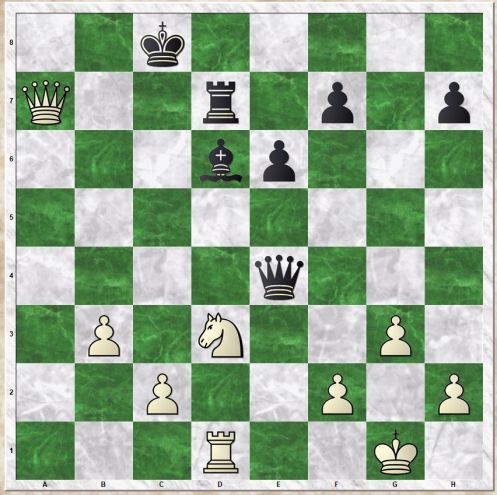
Estrin v Katalymov Barnaul 1969
Solution
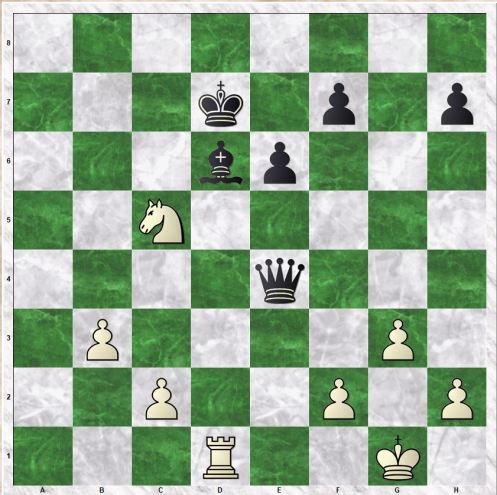
The end of the game featured in the last two days. 1 Qd7+! is the final petite combination and if 1…Qd7, 2 Nc5+ wins the Q: the Bd6 is pinned.
FEN
2k5/Q2r1p1p/3bp3/8/4q3/1P1N2P1/2P2P1P/3R2K1 w – – 0 29
Today’s problem is from the 1972 book “Chess Combination as a Fine Art”, a book based on articles published in the 1950s-1960s by Kurt Richter.
Since the start of 2018, I have decided to adopt the style of only saying which side is to play: and not giving an idea if the move wins or otherwise, unless on occasion I think signposting would be helpful. Instead, the problems are posed with the instruction to decide what you would play, as in a game.
White to play
Estrin v Katalymov, Barhaul 1969
Solution
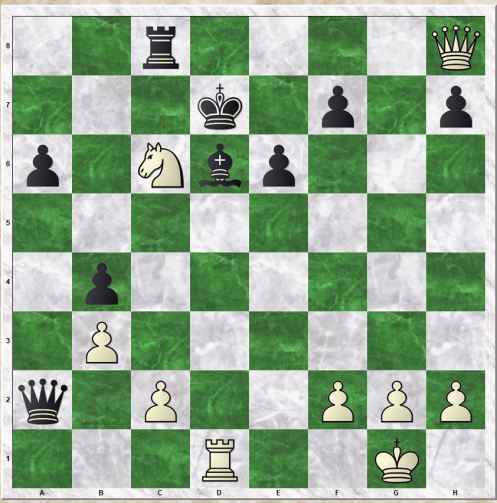
The position arose from yesterday’s puzzle, after 1 Re6+ de 2 Qf6 Bd6[] 3 Qh8+ Kd7
Here 4 Nb8+! saves the Nc6, since after 4…Kc7 5 Qd4! and the best Black can do is simplify to a lost Q+R ending, since his king is to exposed.

FEN
2r4Q/3k1p1p/p1Nbp3/8/1p6/1P6/q1P2PPP/3R2K1 w – – 0 22
Today’s problem is from the 1972 book “Chess Combination as a Fine Art”, a book based on articles published in the 1950s-1960s by Kurt Richter.
Since the start of 2018, I have decided to adopt the style of only saying which side is to play: and not giving an idea if the move wins or otherwise, unless on occasion I think signposting would be helpful. Instead, the problems are posed with the instruction to decide what you would play, as in a game.
White to play
Estrin v Katalymov, Barhaul 1969
Solution
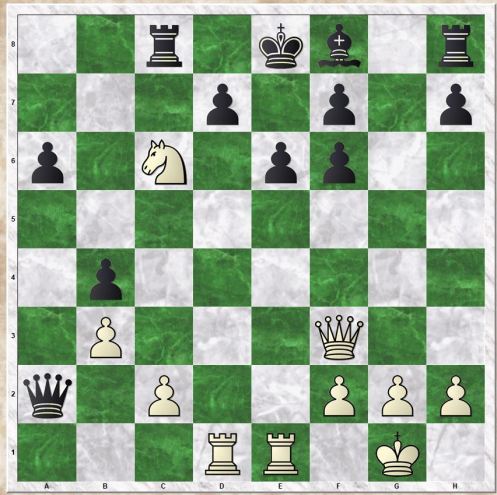
1 Re6+! and if 1…fe?? 2 Qh5 mate; so 1…de 2 Qf6!
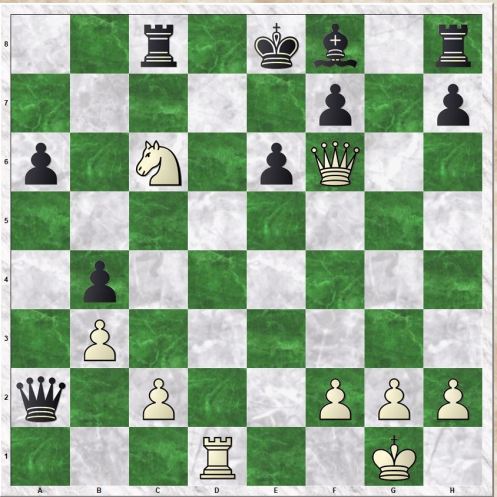
And the double attack on the LPDO Rh8 and on d8 wins the rook.
FEN
2r1kb1r/3p1p1p/p1N1pp2/8/1p6/1P3Q2/q1P2PPP/3RR1K1 w k – 0 19
Today’s problem is from the 1972 book “Chess Combination as a Fine Art”, a book based on articles published in the 1950s-1960s by Kurt Richter.
Since the start of 2018, I have decided to adopt the style of only saying which side is to play: and not giving an idea if the move wins or otherwise, unless on occasion I think signposting would be helpful. Instead, the problems are posed with the instruction to decide what you would play, as in a game.
White to play
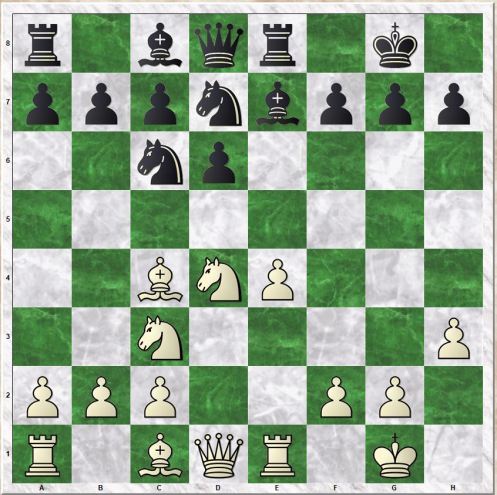
von Holzhausen v Tarrasch, Frankfurt 1912
Solution
1 Bf7+! Kf7 2 Ne6! 1-0 after a few more moves.

FEN
r1bqr1k1/pppnbppp/2np4/8/2BNP3/2N4P/PPP2PP1/R1BQR1K1 w – – 0 10
 allanbeardsworth