A change, for a few days, to celebrate and wish my old school mate Nigel Short success in his candidacy for FIDE President.
Rather than give a puzzle, today I will provide a link to one of my old blog postings about a game of Nigel’s which I found very instructive. I have looked back at it a few times over the years, and even, during 2018, played a game in which to some extent I benefitted from the lessons it provided me.
Today’s problem is from the 1972 book “Chess Combination as a Fine Art”, a book based on articles published in the 1950s-1960s by Kurt Richter.
Since the start of 2018, I have decided to adopt the style of only saying which side is to play: and not giving an idea if the move wins or otherwise, unless on occasion I think signposting would be helpful. Instead, the problems are posed with the instruction to decide what you would play, as in a game.
White to play
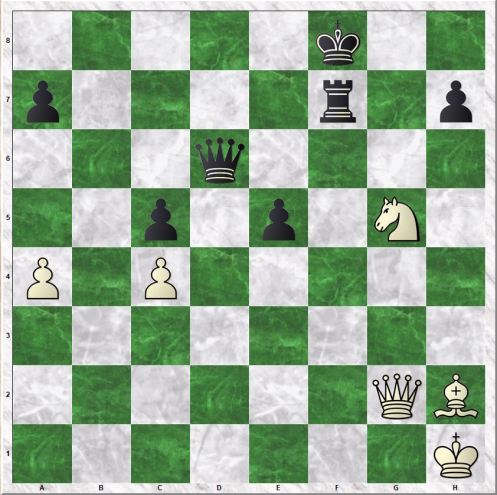
Petrosian v Simagin, Moscow October 1956
Solution
A well known position; with a beautiful finish which has occasionally recurred in other games.
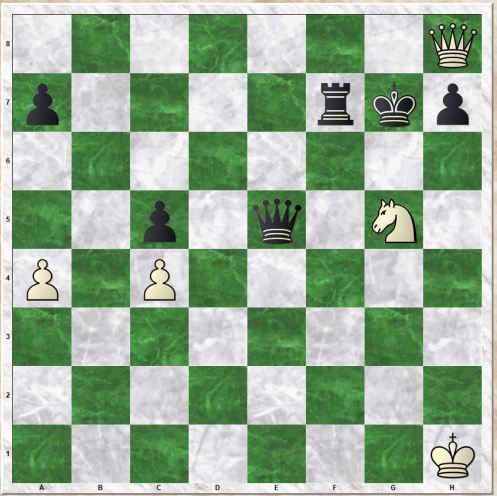
1 Qa8+! 2 Qh8+!! and the K-Q are skewered, so 2…Kh8[] 3 Nf7+ is a winning fork.
FEN
5k2/p4r1p/3q4/2p1p1N1/P1P5/8/6QB/7K w – – 0 44
Today’s problem is from the 1972 book “Chess Combination as a Fine Art”, a book based on articles published in the 1950s-1960s by Kurt Richter.
Since the start of 2018, I have decided to adopt the style of only saying which side is to play: and not giving an idea if the move wins or otherwise, unless on occasion I think signposting would be helpful. Instead, the problems are posed with the instruction to decide what you would play, as in a game.
White to play: position after Rd8-Rd6
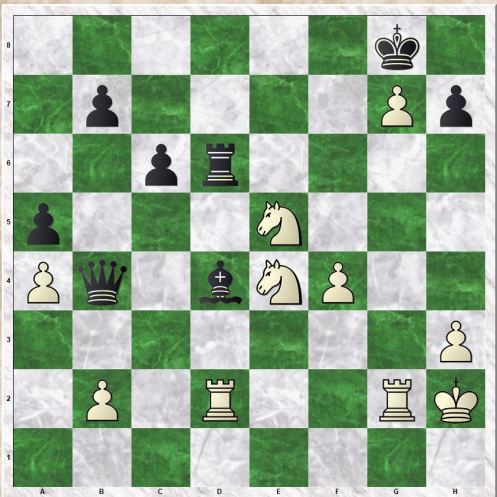
Lundholm v Aurell, Stockholm 1957
Solution
I would likely always play 1 Nd6 Qd6 “and hope”. The engines show 2 Rde2! with the idea of 3 Nf7!! – I wonder if any of my readers saw this?
Better than 1 Nd6 though is 1 Nf3!!: again, I wonder who saw this. I didn’t, and it took me a moment to see its point: 1…c5 would mean that the Qb4 no longer protects the Rd6, so the Rd6 becomes LPDO, and 2 Nd6 wins it for free.
FEN
6k1/1p4Pp/2pr4/p3N3/Pq1bNP2/7P/1P1R2RK/8 w – – 0 4
Today’s problem is from the 1972 book “Chess Combination as a Fine Art”, a book based on articles published in the 1950s-1960s by Kurt Richter.
Since the start of 2018, I have decided to adopt the style of only saying which side is to play: and not giving an idea if the move wins or otherwise, unless on occasion I think signposting would be helpful. Instead, the problems are posed with the instruction to decide what you would play, as in a game.
White to play
evaluate 1 f6 Be4
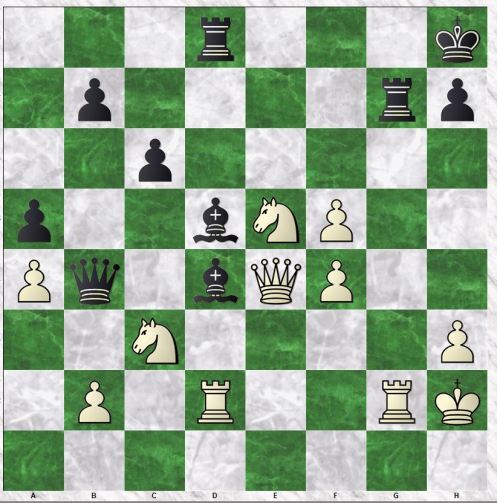
Lundholm v Aurell, Stockholm 1957
Solution
Continuing yesterday’s problem 1 f6 Be4 2 fg+ Kg8[] 3 Ne4:
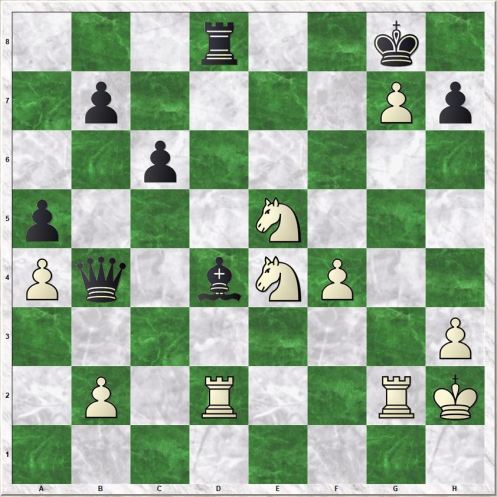
I found thinking about the follow up to this position hard to discern in my head from the opening position, thinking that maybe Black was better, if he survives, and I thought he did survive, not seeing a win. I also presumed that 3..Qe7 was forced, defending f6, because if 3…Rd6 4 Nd6. I will return to this tomorrow.
I think the evaluation for human purposes is unclear, but the engines show White is better, perhaps winning. The longer I leave Komodo 10 running, the higher its assessment; I suspect AlphaZero would show White is winning. After 3…Qe7 4 Rg5! is best; and is a move I might not have thought about.
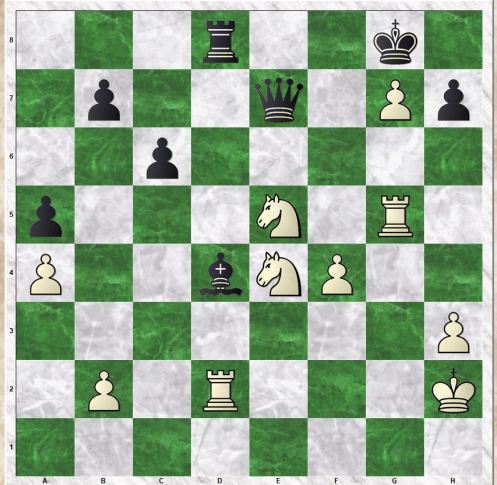
Even the idea of 4 Rg5! wasn’t obvious to me.
Query: what is the idea behind 4 Rg5
Solution
4 Rg5 plans Ne5-g4 heading for either f6 or h6; the rook move ensures the Ng4 doesn’t block the rooks protection of the Pg7.
FEN
3r3k/1p4rp/2p5/p2bNP2/Pq1bQP2/2N4P/1P1R2RK/8 w – – 0 1
Today’s problem is from the 1972 book “Chess Combination as a Fine Art”, a book based on articles published in the 1950s-1960s by Kurt Richter.
Since the start of 2018, I have decided to adopt the style of only saying which side is to play: and not giving an idea if the move wins or otherwise, unless on occasion I think signposting would be helpful. Instead, the problems are posed with the instruction to decide what you would play, as in a game.
White to play
evaluate 1 f6 Rg2+ 2 Rg2 Bc3
Lundholm v Aurell, Stockholm 1957
Solution
This was hard for my to visualise. Too many pieces en pris, centralised, LPDO…but I got there, more or less.
1 f6 Rg2+ 2 Rg2[] Bc3:
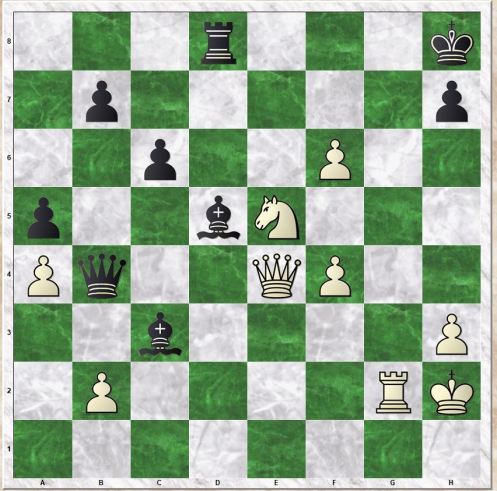
3 Qh7+!! Kh7 4 Rg7+ Kh6[] (4…Kh8 5 Ng6 mate)
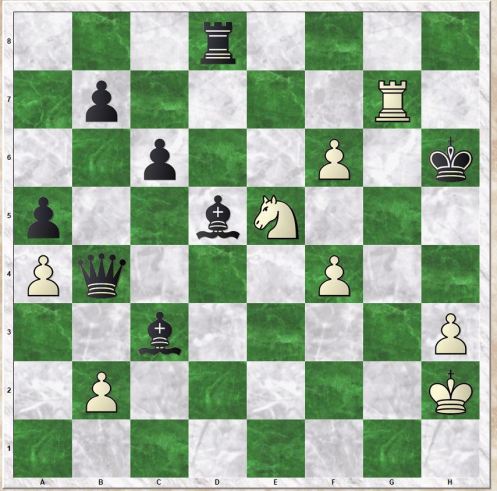
and now it is perpetual by repeated rook checks.
FEN
3r3k/1p4rp/2p5/p2bNP2/Pq1bQP2/2N4P/1P1R2RK/8 w – – 0 1
Today’s problem is from the 1972 book “Chess Combination as a Fine Art”, a book based on articles published in the 1950s-1960s by Kurt Richter.
Since the start of 2018, I have decided to adopt the style of only saying which side is to play: and not giving an idea if the move wins or otherwise, unless on occasion I think signposting would be helpful. Instead, the problems are posed with the instruction to decide what you would play, as in a game.
White to play
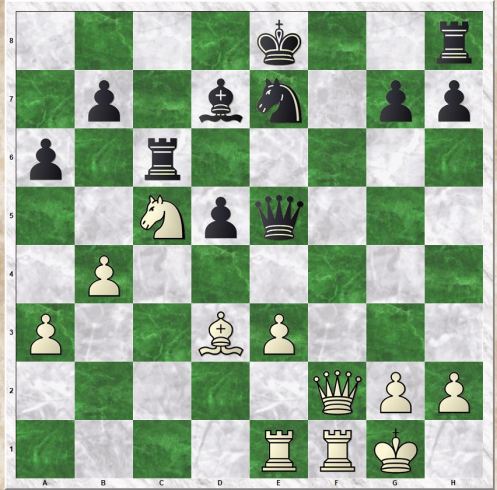
Momo v McGowan, Moscow Olympiad 6/9/1956
Solution
Not too hard today: examine all biffs leads to 1 Qf8+! and the N fork on d7 wins the LPDO Queen.

FEN
4k2r/1p1bn1pp/p1r5/2Npq3/1P6/P2BP3/5QPP/4RRK1 w k – 0 22
Today’s problem is from the new book “Let me ask you, do you know?” which I got a flyer from New in Chess about recently. Today’s puzzle is from the sample page.

Since the start of 2018, I have decided to adopt the style of only saying which side is to play: and not giving an idea if the move wins or otherwise, unless on occasion I think signposting would be helpful. Instead, the problems are posed with the instruction to decide what you would play, as in a game.
Today is a Bank Holiday in the UK, and this puzzle will give enjoyment for the whole day.
White to play

J Marwitz, 1937
Solution
1 Bd3!! (add more exclamation marks if you wish)
Fantastic. The cruel point is that White threatens 2 Bc4, entombing the Nc1; then gobbling the g pawn before eating the Nc1, and then promotion the e pawn. So the N must capture the Bd3, when it is on the wrong track to stop the Pe5.
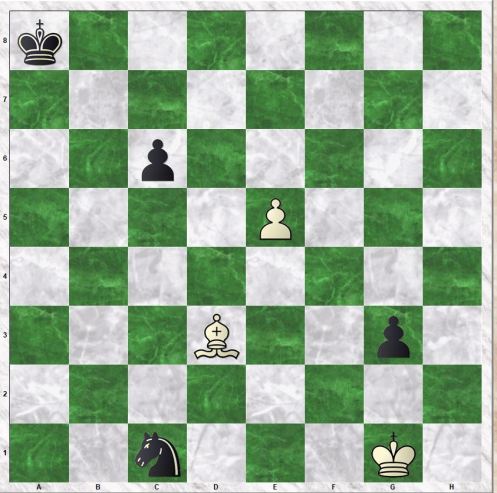
My engine spots 1 Bd3 instantly: but did it smile, as it solved the puzzle? If AI ever learns to smile, then the world will be a scary place.
FEN
k7/8/2p5/4P3/4B3/6p1/8/2n3K1 w – – 0 1
Today’s problem is from the recent Vugar Gashimov memorial in Shamkir, Ajerbaijan
Since the start of 2018, I have decided to adopt the style of only saying which side is to play: and not giving an idea if the move wins or otherwise, unless on occasion I think signposting would be helpful. Instead, the problems are posed with the instruction to decide what you would play, as in a game.
Black to play

Navara v Ding Liren, Shamkir, 26/4/18
Solution
1..b4!

I watched this game online, live, and didn’t appreciate the bite of this move.
2 cb Nd3!
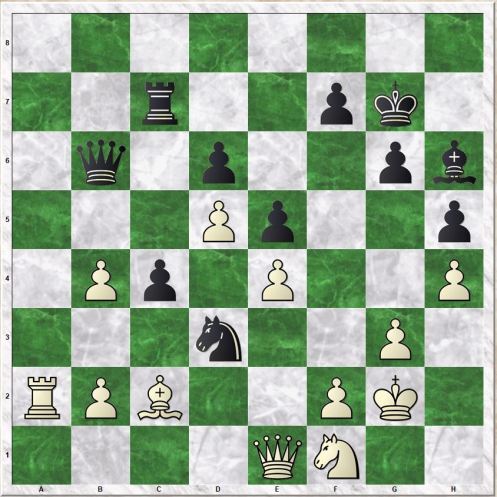
Now it became clear: not only is f2 targetted, but the Q is short of space, and can be trapped by Rc1, and also Nb4 will fork two LPDO pieces.
White resigned after 3 Bd3 cd 4 Ra1 Rc2 when Re2 and taking on f2 follows.
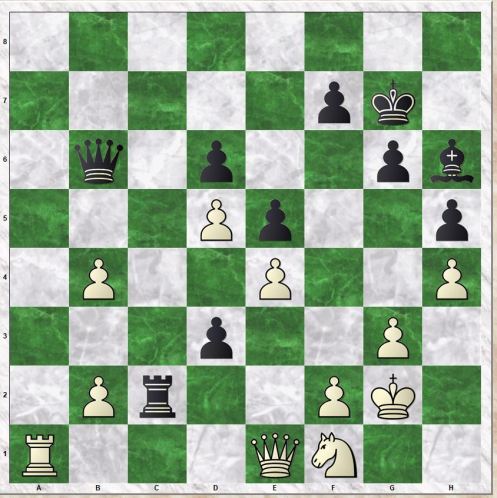
FEN
8/2r2pk1/1q1p2pb/1pnPp2p/2p1P2P/2P3P1/RPB2PK1/4QN2 b – – 0 33
Today’s problem is from the recent US Chess Championships, won by GM Sam Shankland
Since the start of 2018, I have decided to adopt the style of only saying which side is to play: and not giving an idea if the move wins or otherwise, unless on occasion I think signposting would be helpful. Instead, the problems are posed with the instruction to decide what you would play, as in a game.
Black to play: what would you play?; form a plan
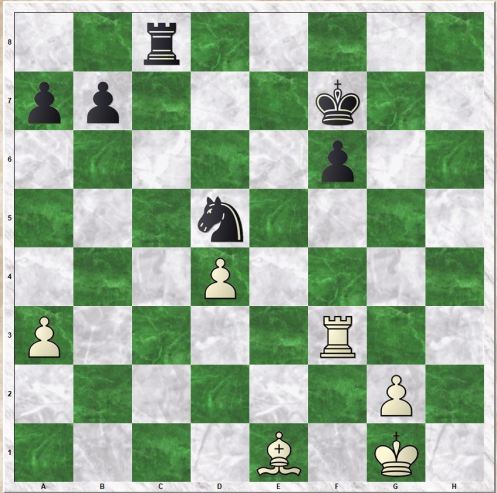
Onischuck v Shankland, St Louis 28/4/18
Solution
I watched this, and many of the US championship games live- on my new favourite app, Follow Chess: great for watching up to 6 games at once on the iPad.
Sam has just written a book for Quality Chess on pawn play, so in most of his games, I watched how he handled his pawns (his piece play was also great too).
This position impressed me. I would have played 1…Ke6 (which can’t be bad) and maybe 2…b5 (to create a passed pawn) but Sam played 1…b6! (exclam for the plan, not the move).
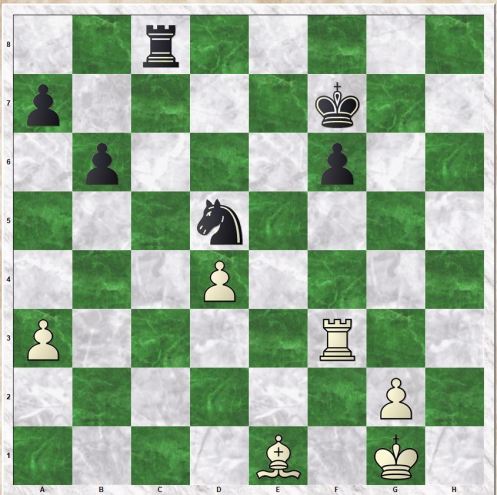
The move defends the b pawn, without causing a block. The K moved to c4:
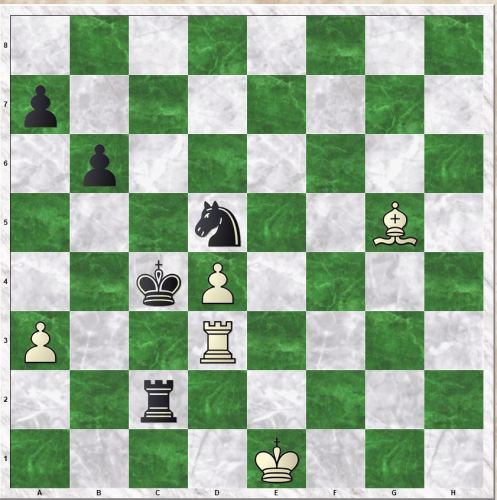
Black’s Q side pawns never moved: Black aimed to win the Pa3; White sacrificed the Pd4 to free up his bishop, but resigned when the position was hopeless.
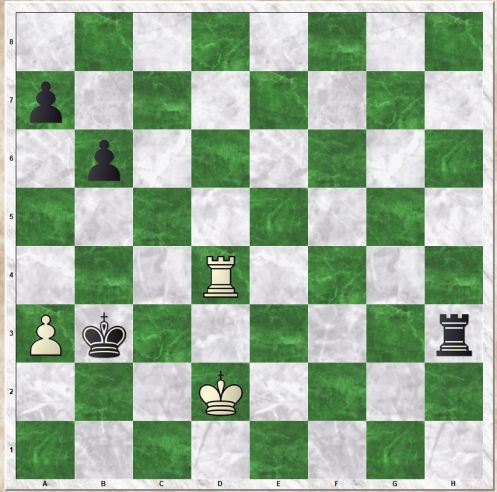
Classic endgame play: using the power of the King. 1…b5? would have blocked its access to c4.
FEN
2r5/pp3k2/5p2/3n4/3P4/P4R2/6P1/4B1K1 b – – 0 35
Today’s problem is from the 1972 book “Chess Combination as a Fine Art”, a book based on articles published in the 1950s-1960s by Kurt Richter.
Since the start of 2018, I have decided to adopt the style of only saying which side is to play: and not giving an idea if the move wins or otherwise, unless on occasion I think signposting would be helpful. Instead, the problems are posed with the instruction to decide what you would play, as in a game.
White to play: an ending to explore, to see what best play is after each of Black’s possible defences.

Ding v Mamedov, Shamkir 27/4/18
Solution
1 Kg3 is of course the first move.
1…Rff2
2 Rh8+ Kg5[] 3 h4+! Kf5 4 Rf8+ skewers the king and Rf2.

This skewer is a main motif.
1…g5
2 Re6+ Kh5 3 Rh7 is a pretty mate.
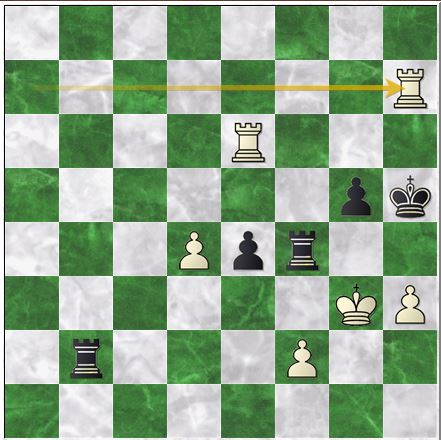
1..g5
2 h4+! and if 2…Kf5, 3 Rf8+ skewers as before, else if 2…Rh4 3 Ra5+ picks up the Rh4.
1…Rf6, as played in the game
2 h4!! not an obvious move, but once seen, its reason becomes apparent: a mating net.

2…g5 3 Rh8+! Kg6[] 4 Rg8+ Kf5 5 Rg5+ 1-0
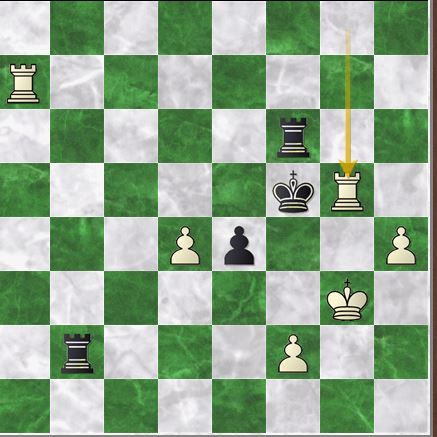
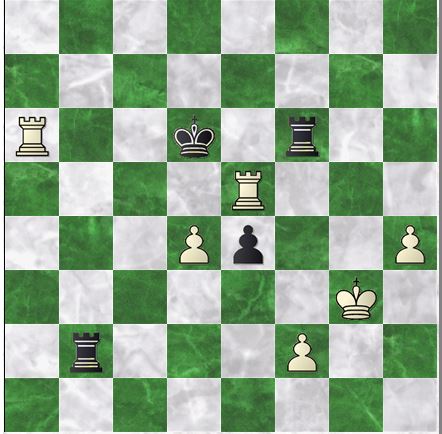
5…Ke6[] 6 Re5+ Kd6[] 7 Ra6+ skewers and wins the rook in a different way.
Very nice. For White. Not for Black.
FEN
4R3/R7/6pk/8/3Ppr2/7P/1r3PK1/8 w – – 0 38
wKg2,Ra7,e8,Pd4,f2,h3/bKh6,Rb2,f4,Pe4,g6
 allanbeardsworth