Today’s problem is from the recent Shamkir Chess. The post was written a few days ago, during the game.
Since the start of 2018, I have decided to adopt the style of only saying which side is to play: and not giving an idea if the move wins or otherwise, unless on occasion I think signposting would be helpful. Instead, the problems are posed with the instruction to decide what you would play, as in a game.
White to play
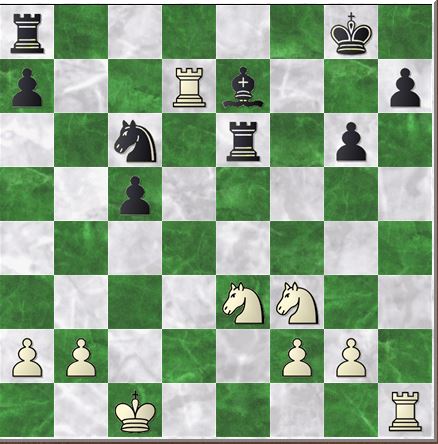
Mamedyarov v Navara
Solution
1 Rh7! was a lovely tactic, exploiting the pin of the Be7 so that 1…Kh7 2 Ng5+ picks up the LPDO Re7.
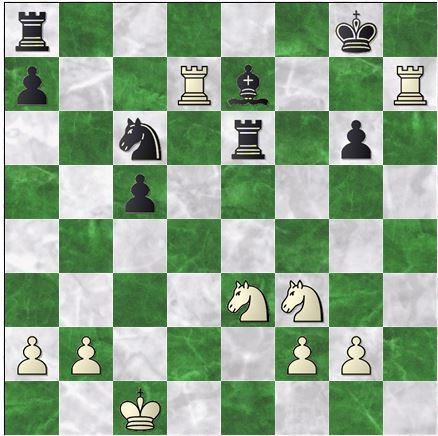
But it is richer than this. Black could try 1…Re3. but this fails to 2 fe Kh7 3 Rc7, and the LPDO Nc6 falls or has to move, when the LPDO Be7 is captured.
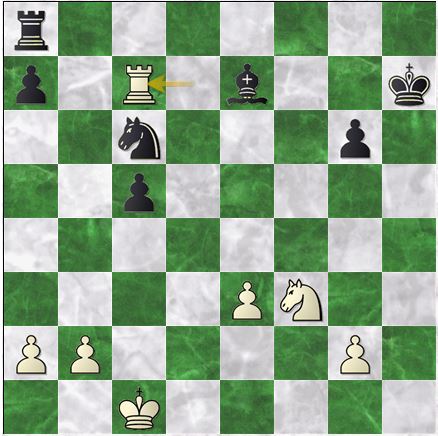
In the game, David Navara played 1…Rb8, and is a pawn down in the resultant ending.
FEN
r5k1/p2Rb2p/2n1r1p1/2p5/8/4NN2/PP3PP1/2K4R w – – 0 24
wKc1,Ne3,f3,Rd7,h1,Pa2,b2,f2,g2/bKg8,Nc6,Be7,Ra8,e6,Pa7,c5,g6,h7
Today’s problem is from the recent Shamkir tournament
Since the start of 2018, I have decided to adopt the style of only saying which side is to play: and not giving an idea if the move wins or otherwise, unless on occasion I think signposting would be helpful. Instead, the problems are posed with the instruction to decide what you would play, as in a game.
Black to play: what would you play?
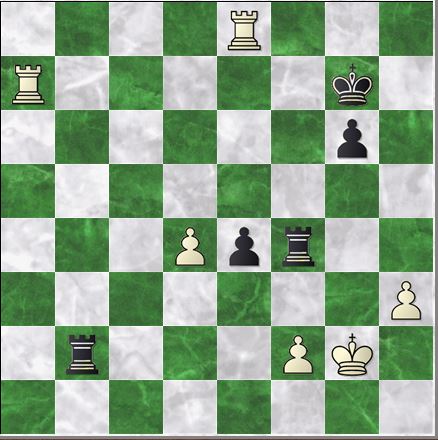
Ding v Mamedov, Shamkir 27/4/18
Solution
Mamedov had 9 minutes left on his clock to reach move 40: White has just played 37 Ra7+. Black only has three choices:
1…Rf7
If I were Black, I would rule out
1…Rf7 because of 2 Rf7+ Kf7[] 3 Re4
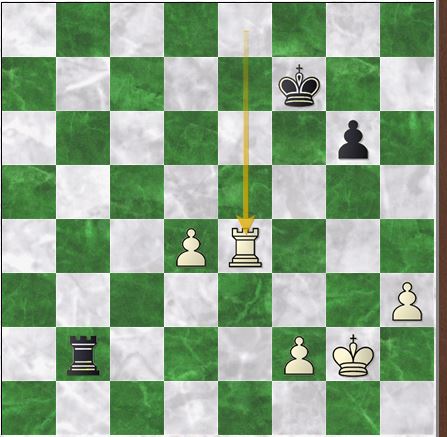
I don’t know if White is winning, but I wouldn’t like to defend. I don’t know enough about R+P endings to know if any of the simplified R+2P v R endings will be drawn or lost.
1..Kf6
I might play this, but I might not. On 50% of days I would play it, and go for “king in the centre” and on 50% of days, I would go for “king in the corner for safety”.
1…Kf6 happens to be best: the game goes on, with the Pf2 falling.
1…Kh6??
Is the move played, and now it is 1-0.

I will go through some of the lines tomorrow.
FEN
4R3/R5k1/6p1/8/3Ppr2/7P/1r3PK1/8 b – – 0 37
wKg2,Ra7,e8,Pd4,f2,h3/bKg7,Rb2,f4,Pe4,g6
I saw today’s problem in a recent edition of my favourite magazine, Chess.
Since the start of 2018, I have decided to adopt the style of only saying which side is to play: and not giving an idea if the move wins or otherwise, unless on occasion I think signposting would be helpful. Instead, the problems are posed with the instruction to decide what you would play, as in a game.
White to play

Milson v Burnett, Newcastle
Solution
Another lovely problem, which took me a while to solve; but once solved, a lot of satisfaction.
1 Ne7+ Kf8! (best) 2 Nc8!!

Defeating other defences by Black such as 1…Be7 or 1…Kf7 is trivial; but 2 Nc8!! is lovely. The Nc8 blocks the square e7, so 2…Qc8[] 2 Qh8+ and the Q is skewered.

FEN
4q1k1/1p4p1/3bp1N1/1b1p2P1/3P1P2/7Q/8/1B4K1 w – – 0 1
Today’s problem is from the 1972 book “Chess Combination as a Fine Art”, a book based on articles published in the 1950s-1960s by Kurt Richter.
Since the start of 2018, I have decided to adopt the style of only saying which side is to play: and not giving an idea if the move wins or otherwise, unless on occasion I think signposting would be helpful. Instead, the problems are posed with the instruction to decide what you would play, as in a game.
White to play: evaluate 1 Nf5+ Kf8
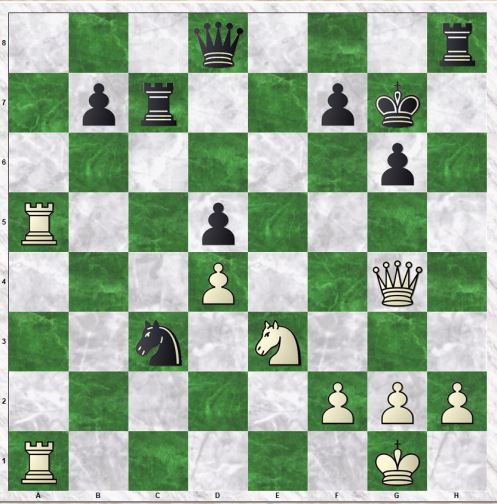
Padevski v Kolarov, Sofia 1955
Solution
Whilst the last two days’ puzzles were straightforward, today’s is anything but, and I failed to solve it: failed how to crack 1…Kf8.

I missed the lovely 2 Qg5!!, exploiting the fact that the Qd8 is tied to defending a8. Black’s best is 2…Rc8.

3 Qd8+ Rd8[] 4 Ra8 and the point is revealed: White emerges an exchange up: 4…Ke8 (or 4 …gf 5 Rd8+) 5 Rd8+ Kd8[] 6 Ra8+ skewers the Rh8.

FEN
3q3r/1pr2pk1/6p1/R2p4/3P2Q1/2n1N3/5PPP/R5K1 w – – 0 1
Today’s problem is from the 1972 book “Chess Combination as a Fine Art”, a book based on articles published in the 1950s-1960s by Kurt Richter.
Since the start of 2018, I have decided to adopt the style of only saying which side is to play: and not giving an idea if the move wins or otherwise, unless on occasion I think signposting would be helpful. Instead, the problems are posed with the instruction to decide what you would play, as in a game.
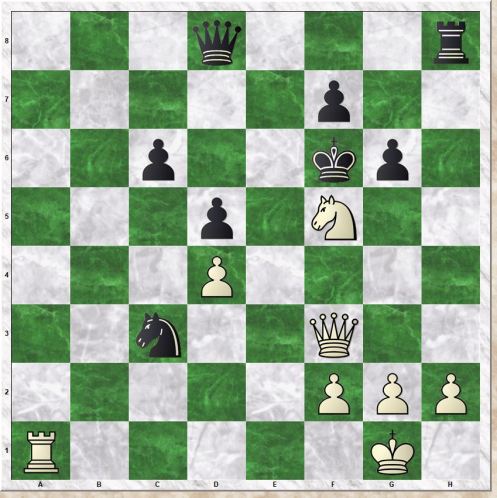
White to play: evaluate 1 Nf5+ Kf6
Padevski v Kolarov, Sofia 1955
Solution
The best move, and played in the game: I would have decided between 1…Kf6 and, as it happens, 1…Kf8??; and quite likely chosen wrongly. I did though see 1…Kf6 2 Ra6+!

the idea being 2…ba? 3 Ra6+ and mates. But 1…Rc6! defends, and after 2 Rc6+[] bc[] 3 Qf3 the game was soon drawn.
FEN
3q3r/1pr2pk1/6p1/R2p4/3P2Q1/2n1N3/5PPP/R5K1 w – – 0 1
Today’s problem is from the 1972 book “Chess Combination as a Fine Art”, a book based on articles published in the 1950s-1960s by Kurt Richter.
Since the start of 2018, I have decided to adopt the style of only saying which side is to play: and not giving an idea if the move wins or otherwise, unless on occasion I think signposting would be helpful. Instead, the problems are posed with the instruction to decide what you would play, as in a game.
White to play: evaluate 1 Nf5+ Kh7
Padevski v Kolarov, Sofia 1955
Solution
Again, 1…Rh7? is a blunder. 2 Ra8! and if 2….Rc8 3 Rc8 Qc8[] then 4 Qh3+ Kg8[] and the same N fork.

FEN
3q3r/1pr2pk1/6p1/R2p4/3P2Q1/2n1N3/5PPP/R5K1 w – – 0 1
Today’s problem is from the 1972 book “Chess Combination as a Fine Art”, a book based on articles published in the 1950s-1960s by Kurt Richter.
Since the start of 2018, I have decided to adopt the style of only saying which side is to play: and not giving an idea if the move wins or otherwise, unless on occasion I think signposting would be helpful. Instead, the problems are posed with the instruction to decide what you would play, as in a game.
White to play: evaluate 1 Nf5+ Kg8
Padevski v Kolarov, Sofia 1955
Solution
After 1 Nf5+ Kg8? 2 Ra8! sets up an evaluate fork: 2…Rc8[] 3 Rc8 Qc8 4 Ne7 mate.
Tomorrow, I will look further at this initial position.

FEN
3q3r/1pr2pk1/6p1/R2p4/3P2Q1/2n1N3/5PPP/R5K1 w – – 0 1
I saw today’s problem in a recent edition of my favourite magazine, Chess.
Since the start of 2018, I have decided to adopt the style of only saying which side is to play: and not giving an idea if the move wins or otherwise, unless on occasion I think signposting would be helpful. Instead, the problems are posed with the instruction to decide what you would play, as in a game.
White to play
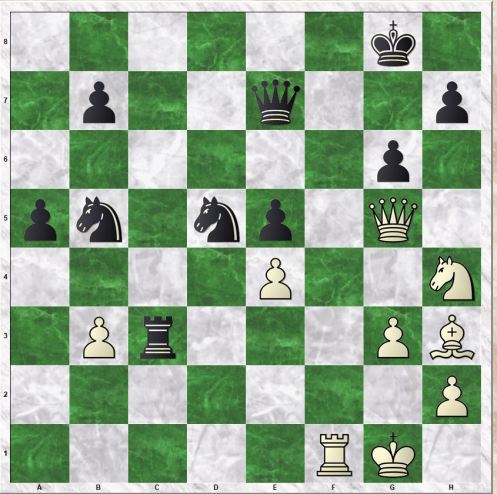
Vakhidov v Nasuta, Newcastle 15/2/18
Solution
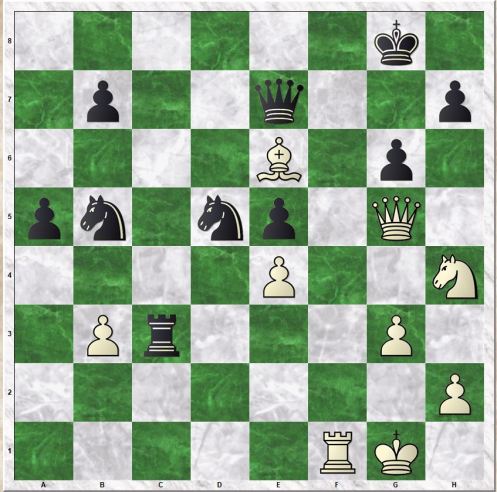
A beautiful first move: 1 Be6+!!; it took me a while, during a long walk in the Lake District, to solve this puzzle; but when I did, I was delighted.
I imagine if I had yet again remembered Purdy’s maxim about threats I would have found it far more quickly.
Imagine the threat could not possibly be executed. Then what would be my best move? Try out each attractive move separately, considering each one as follows. Visualise the whole position as it would be after this move of yours, and then work out whether the opponent would gain by executing his ‘threat’.
Or Purdy’s admonition to examine all biffs.
If 1…Be6 2 Qd8+ Kg7 3 Qf8 mate.
Or if 1… Kh8 2 Ng6+! hg 3 Qh6+ 1-0.
FEN
6k1/1p2q2p/6p1/pn1np1Q1/4P2N/1Pr3PB/7P/5RK1 w – – 0 33
Today’s problem is from the 1972 book “Chess Combination as a Fine Art”, a book based on articles published in the 1950s-1960s by Kurt Richter.
Since the start of 2018, I have decided to adopt the style of only saying which side is to play: and not giving an idea if the move wins or otherwise, unless on occasion I think signposting would be helpful. Instead, the problems are posed with the instruction to decide what you would play, as in a game.
White to play: evaluate 1 Rd7

Schultz v Teschner, West Berlin 1955
Solution
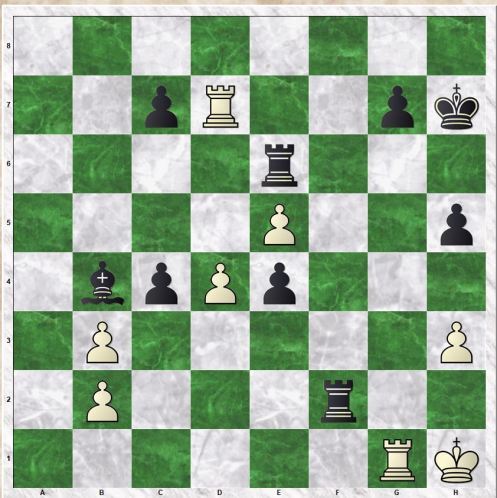
1 Rd7 Rf2+ is the natural move; but 2 Kh1!! and if 2…Re6 3 Rdg7+ Kh8[] 2 Rg8+ Kh7[] 3 Rg7 mate.
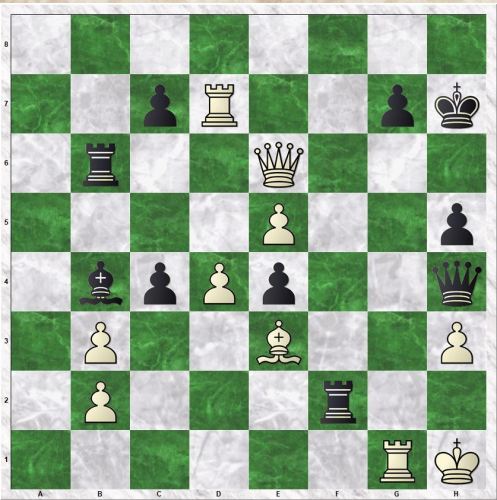
But 1 Rd7 Qf2+!! is a draw. 2 Bf2[] Rf2+ 3 Kh1 Re6 and there is only perpetual.
FEN
5r2/2p3pk/1r2Q3/3RP2p/1bpPp2q/1P2B2P/1P3P1K/6R1 w – – 0 1
Today’s problem is from the 1972 book “Chess Combination as a Fine Art”, a book based on articles published in the 1950s-1960s by Kurt Richter.
Since the start of 2018, I have decided to adopt the style of only saying which side is to play: and not giving an idea if the move wins or otherwise, unless on occasion I think signposting would be helpful. Instead, the problems are posed with the instruction to decide what you would play, as in a game.
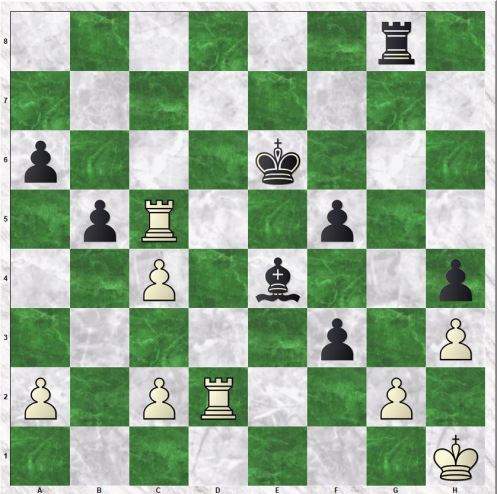
Black to play
Hansen v Moller, Denmark 1962
Solution
1…Rg2! 2 Rg2[] f2! and promotes. A little tictac.

FEN
6r1/8/p3k3/1pR2p2/2P1b2p/5p1P/P1PR2P1/7K b – – 0 1
 allanbeardsworth