Today’s problem is from the 1972 book “Chess Combination as a Fine Art”, a book based on articles published in the 1950s-1960s by Kurt Richter.
Since the start of 2018, I have decided to adopt the style of only saying which side is to play: and not giving an idea if the move wins or otherwise, unless on occasion I think signposting would be helpful. Instead, the problems are posed with the instruction to decide what you would play, as in a game.
White to play

Hennings v Walter, DDR 1964
Solution
White’s idea is 1 g7 and 2 Bh7+; but Black prevents that by 1..f5. So 1 Bg5! exploits the LPDO Bd8 and if 1….fg, 2 g7 and wins.

FEN
3b2k1/3b4/1p3pPK/p1p1p3/P1P5/1P2B3/2B5/8 w – – 0 1
Today’s problem is from the 1972 book “Chess Combination as a Fine Art”, a book based on articles published in the 1950s-1960s by Kurt Richter.
Since the start of 2018, I have decided to adopt the style of only saying which side is to play: and not giving an idea if the move wins or otherwise, unless on occasion I think signposting would be helpful. Instead, the problems are posed with the instruction to decide what you would play, as in a game.
White to play
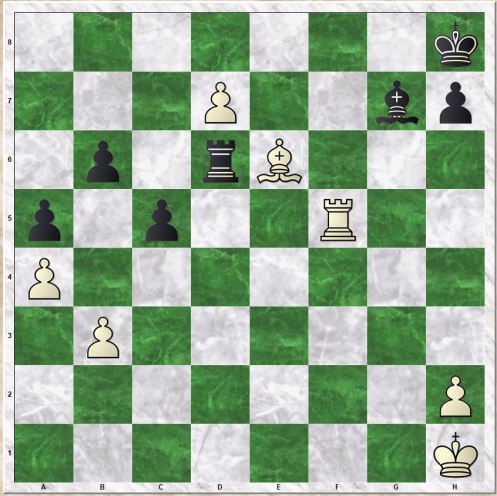
Gligoric v Szabo, Moscow 1963
Solution
An odd one: 1 h4! and Black resigned. Zugzwang.
1 Kg2 is also +-, and maybe other moves are too. The point, I think, is that after 1 h4, g5 is covered, so that after e.g. 1…Bh6 2 Rd5 Rd5[] 3 Bd5, Black can’t play 3…Bg5 defending d8.
FEN
7k/3P2bp/1p1rB3/p1p2R2/P7/1P6/7P/7K w – – 0 42
Today’s problem is from the 1972 book “Chess Combination as a Fine Art”, a book based on articles published in the 1950s-1960s by Kurt Richter.
Since the start of 2018, I have decided to adopt the style of only saying which side is to play: and not giving an idea if the move wins or otherwise, unless on occasion I think signposting would be helpful. Instead, the problems are posed with the instruction to decide what you would play, as in a game.
White to play : analyse 1 f5 ef 2 e6 d4
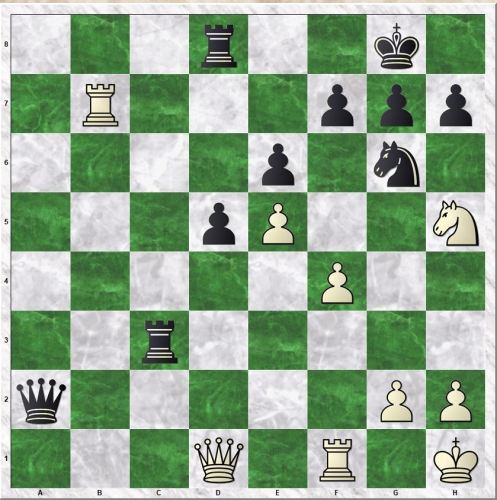
Neukirch v Malich, DDR 14.21962
Solution
Fairly simple today: after 1 f5 ef 2e6 d4 White wins by 3 Qd4, exploiting the back rank mate.
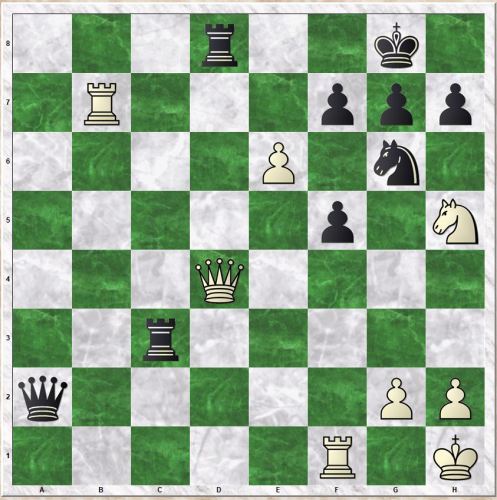
FEN
3r2k1/1R3ppp/4P1n1/5p1N/3p4/2r5/q5PP/3Q1R1K w – – 0 32
Today’s problem is from one of GM Simon William’s postings.
Since the start of 2018, I have decided to adopt the style of only saying which side is to play: and not giving an idea if the move wins or otherwise, unless on occasion I think signposting would be helpful. Instead, the problems are posed with the instruction to decide what you would play, as in a game.
White to play

Williams v Arkell, 2018
Solution
Simon says he learnt the technique from watching a Magnus Carlsen blitz game, he thinks on chess.com. I was impressed to see how such things are learnt.
1 Nc2! White promotes first, with the Black pawn on a2: then White checks and checks until the K is forced to a1 (or gives up the Pa2)
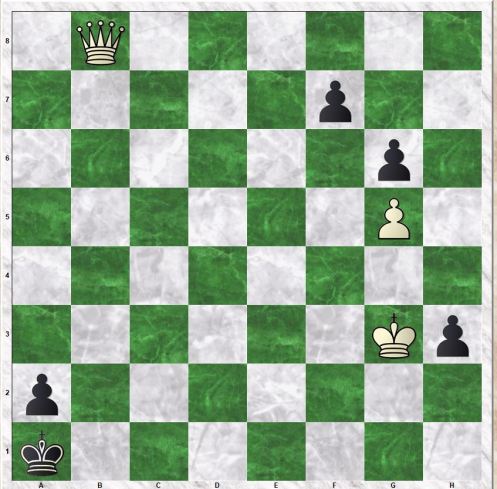
Then White stalemates the Ph2 by Kh2, forcing f5 or f6; gf, and the f pawn queens, in time because the g-pawn means there is no stalemate.
FEN
8/5p2/6p1/6P1/1N6/pPk3Kp/P7/8 w – – 0 1
Today’s problem is from the 1972 book “Chess Combination as a Fine Art”, a book based on articles published in the 1950s-1960s by Kurt Richter.
Since the start of 2018, I have decided to adopt the style of only saying which side is to play: and not giving an idea if the move wins or otherwise, unless on occasion I think signposting would be helpful. Instead, the problems are posed with the instruction to decide what you would play, as in a game.
White to play
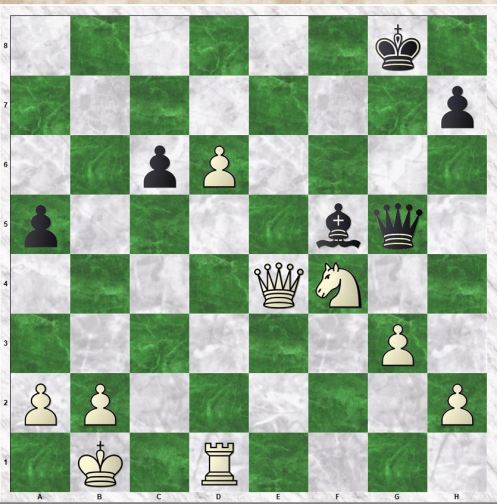
Skagiatmetov v Demin, Orenburg 1964
Solution
A perfect example of Purdy’s dictum on threats.
Imagine the threat could not possibly be executed. Then what would be my best move? Try out each attractive move separately, considering each one as follows. Visualise the whole position as it would be after this move of yours, and then work out whether the opponent would gain by executing his ‘threat’.
1 d7!! Be4+ 2 Ka1 Bd5

3 Ne6!! 1-0
Lovely.
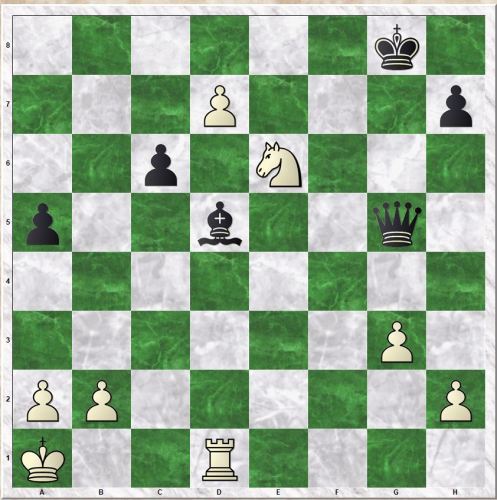
When entering the starting position into Chessbase, to print the diagrams, my engine says that 1 Ka1!! is equivalent- and, I would say, more stylish. And, strangely, it thinks 1 Qd3!! is strongest of all (+8 vs +7, so both overwhelmingly winning).
I wonder if any human would think of 1 Qd3 or 1 Ka1??
FEN
6k1/7p/2pP4/p4bq1/4QN2/6P1/PP5P/1K1R4 w – – 0 1
Today’s problem continues yesterday’s look at Caruana- Hou Yifan, Baden-Baden 6/4/2018.
Since the start of 2018, I have decided to adopt the style of only saying which side is to play: and not giving an idea if the move wins or otherwise, unless on occasion I think signposting would be helpful. Instead, the problems are posed with the instruction to decide what you would play, as in a game.
Black to play: White has just played 1 Pc2* Nd3

Caruana- Hou Yifan, Baden-Baden 6/4/2018
Solution
1…d4!! and a pawn promotes.

Beautiful; truly beautiful.
FEN
8/8/B7/1p1p4/2p5/P1PP4/1K1k4/8 b – – 0 66
Today’s problem is from the recent Grenke Classic.
Since the start of 2018, I have decided to adopt the style of only saying which side is to play: and not giving an idea if the move wins or otherwise, unless on occasion I think signposting would be helpful. Instead, the problems are posed with the instruction to decide what you would play, as in a game.
Black to play
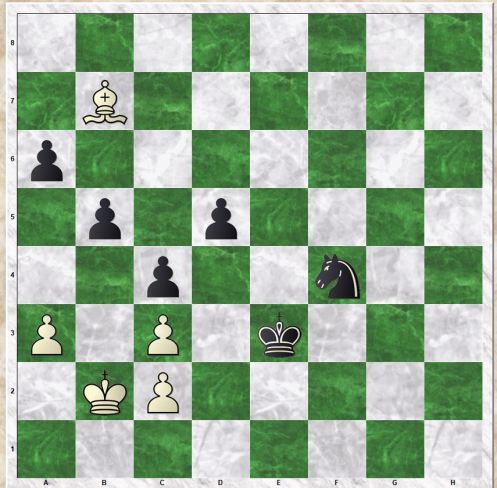
Caruana- Hou Yifan, Baden-Baden 6/4/2018
Solution
Hou Yifan played 1…a5 and the game was eventually drawn.
However, White’s last move (1 Bc6-b7) was a losing mistake; White should have played 1 Kb2-c1, when I don’t know if the ending is a win for Black after 1..Ne2+2 Kb2 Kd2 3 Bb7 Nc3 4 Ba6 -looks likely it is a win)
But after 1 Bb7 Hou Yifan missed a truly beautiful win, which I wonder if anyone would spot in a game, especially after the hours played before. 1…Kd2 2 Ba6 Nd3+!!

3 cd and…now what? Solution tomorrow.
FEN
8/1B6/p7/1p1p4/2p2n2/P1P1k3/1KP5/8 b – – 0 64
Today’s problem is from the recent Grenke Classic.
Since the start of 2018, I have decided to adopt the style of only saying which side is to play: and not giving an idea if the move wins or otherwise, unless on occasion I think signposting would be helpful. Instead, the problems are posed with the instruction to decide what you would play, as in a game.
White to play
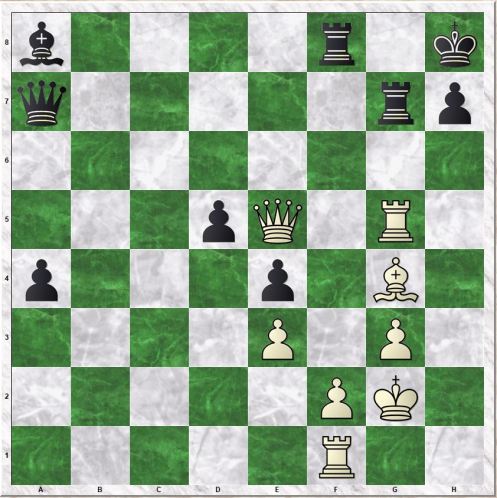
Georg Meier v Magnus Carlsen, Baden-Baden 5/4/18
Solution
I watched most of this game ‘live’, on my ipad; and by the latter stage, was playing “guess the move” and also wondering “how is Magnus going to win this?”, because I just assumed he would win, especially since he had managed to snaffle White’s pawn on a7 a move or two earlier. I thought he had done so at the expense of his king safety, but wasn’t sure, and just assumed he would consolidate, and then the a pawn would decide: typical Magnus.
Meier had about 3 minutes left (plus, I think 30 seconds increments-never sure with the clocks on Playchess) and I was choosing between 1 Rh1 and 1 Ra1; I wanted to play 1 Rh1 and say 1…Qe7 2 Rh7+ Kh7 3 Rh5+ but couldn’t make it work.
So, I played 1 Ra1, and not long later, so did Georg, and the game was drawn a few moves later.
But 1 Rh1! Qe7 2 Rh7+! Kh7 3 Rh5+ Kg6 does in fact win for White.
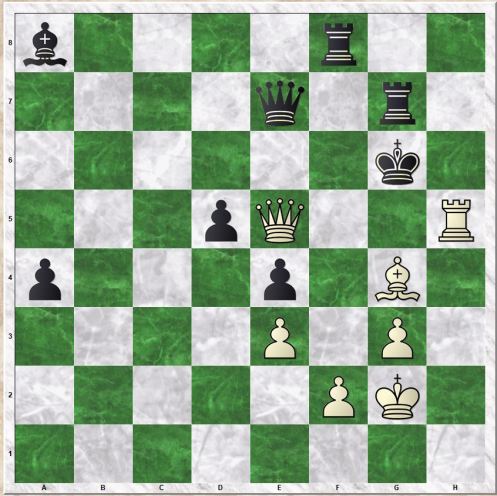
4 Rh6+!! the move I missed. Clearly, 4…Kh6 5 Qh5 mate.

So, 4…Kf7, but then still 5 Qh5+ and mate on g6 or h8 next move.

FEN
b4r1k/q5rp/8/3pQ1R1/p3p1B1/4P1P1/5PK1/5R2 w – – 0 39
Postscript
I have recently come across, thanks to someone posting on Twitter, the excellent Follow Chess app. Below is a screenprint I took, as is my habit when I get the time to watch live games, on which I scribbled 1 Rh1, being the move I wanted to look at later, to see if it won (as it did).
Follow Chess is the only app that I know that can let you see more than one game at a time on your ipad.

Today’s problem is from the 1972 book “Chess Combination as a Fine Art”, a book based on articles published in the 1950s-1960s by Kurt Richter.
Since the start of 2018, I have decided to adopt the style of only saying which side is to play: and not giving an idea if the move wins or otherwise, unless on occasion I think signposting would be helpful. Instead, the problems are posed with the instruction to decide what you would play, as in a game.
White to play : White played 1 d7, met by 1…Ng6. what follows?
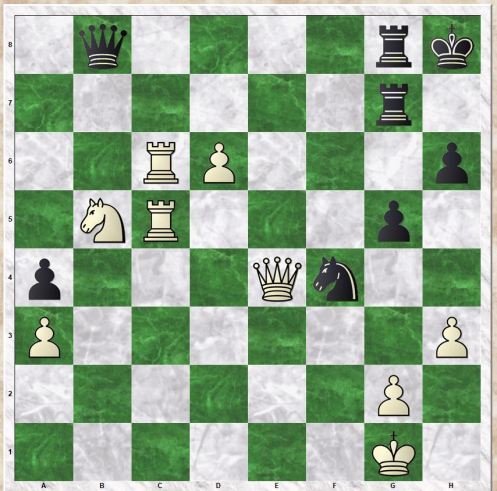
Hatjun v Ciric, Budapest 1957
Solution
The first few moves are easy, and since the line is forcing, it is not too hard to go quite deep, at which stage ‘the point’ needs to be found.
1 Rg6! Rg6[] 2 Qg6! Rg6[] 3 Rc8+ Rg8[] 4 Rb8 Rb8[]. All forced.
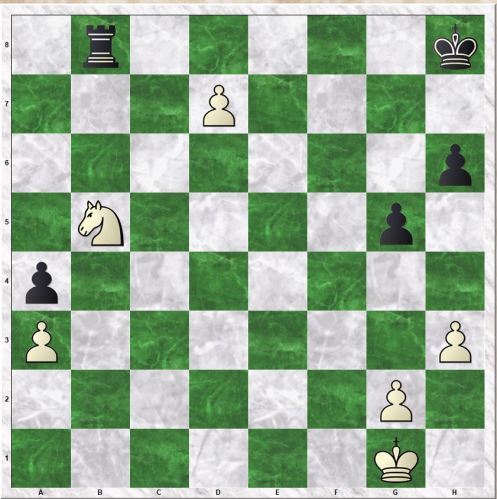
5 Nd6!
5..Kg7! (5..Rd8?? 6 Nf7+ forking)
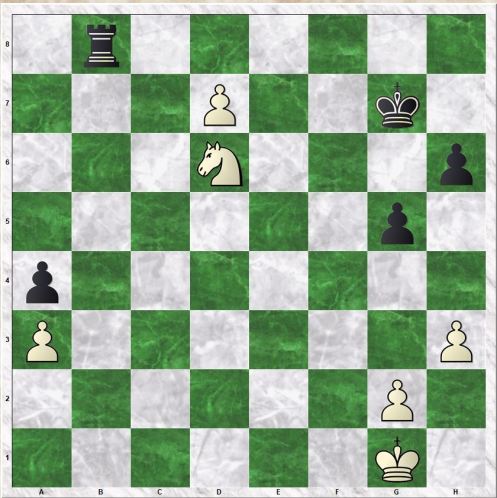
6 Nb7![] and not 6 Nc8?? Rc1+ and 7 Rd1 0-1.
Nice.
FEN
1q4rk/6r1/2RP3p/1NR3p1/p3Qn2/P6P/6P1/6K1 w – – 0 1
Today’s problem is from the 1972 book “Chess Combination as a Fine Art”, a book based on articles published in the 1950s-1960s by Kurt Richter.
Since the start of 2018, I have decided to adopt the style of only saying which side is to play: and not giving an idea if the move wins or otherwise, unless on occasion I think signposting would be helpful. Instead, the problems are posed with the instruction to decide what you would play, as in a game.
White to play

Gligoric v Averbach, Titovo Uzich 20/7/1966
Solution
The position looks bad for White, so almost out of desperation 1 Rh6!. A point being 1…gh? 2 Qd4+, 3 Qd5+ and 4 Q*c6.
And if 1…Kg8 2 Qd5+; so best is 1..Qd7 when 2 Re6!! is another “only move” but what a one!

2…Qe6 3 d7 Rd6[] 4 d8(Q)+ Rd8[] 5 Qd8+ Qg8[] 6 Qb6

and then the conversion phase commenced. Move 40; Averbakh resigned on move 87. I don’t know if the Q+P ending is theoretically won or lost. In the game, the Q side and the f5 pawn came off, leading to a 3v2 ending which Gligoric won.
FEN
3q3k/6pp/pprP4/5p2/P7/5P1R/1P4PP/3Q2K1 w – – 0 35
 allanbeardsworth