Today’s problem is from the 1972 book “Chess Combination as a Fine Art”, a book based on articles published in the 1950s-1960s by Kurt Richter.
Since the start of 2018, I have decided to adopt the style of only saying which side is to play: and not giving an idea if the move wins or otherwise, unless on occasion I think signposting would be helpful. Instead, the problems are posed with the instruction to decide what you would play, as in a game.
Black to play
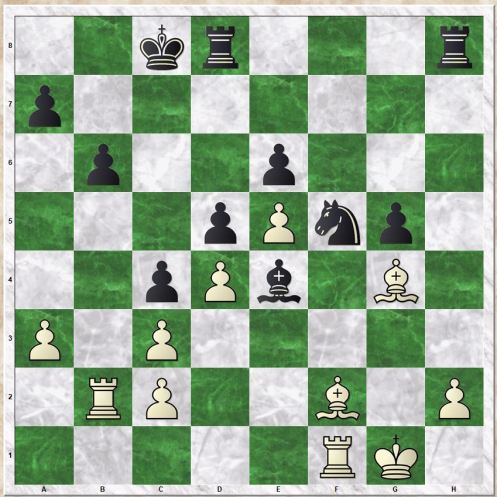
Vinagre v Durao, Ribeira 1956
Solution
Not too hard today. Examine all biffs means the first move your eye is drawn to is 1…Rh2!, with the follow up 2 Kh2[] Rh8+.
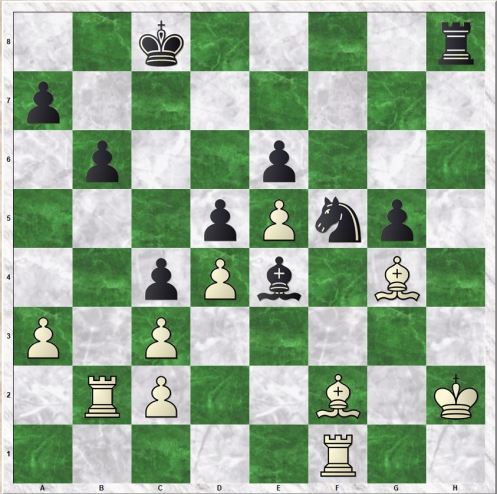
The, 3 Kg1? Rh1 mate, so 3 Bh3 g4 0-1. One line is 4 Be1 Rh3+ 5 Kg1[] g3! mating.
FEN
2kr3r/p7/1p2p3/3pPnp1/2pPb1B1/P1P5/1RP2B1P/5RK1 b – – 0 1
A nice, and I found difficult, position, seen in Malcolm Pein’s Daily Telegraph column.
Since the start of 2018, I have decided to adopt the style of only saying which side is to play: and not giving an idea if the move wins or otherwise, unless on occasion I think signposting would be helpful. Instead, the problems are posed with the instruction to decide what you would play, as in a game.
White to play

Rapport v Kollars, Grenke Open, 2018
Solution
I found this one tough, and needed to have it with me (in my head) on a long walk to eventually solve it.
At first I thought not 1 b5? because of 1…Qb5; so instead I looked at nearly all other moves, such as 1 Ne3, 1 Ra7, and others. Before reverting to the move I first thought of, 1 b5!, noticing that after 1…Qb5[] 2 Rc1 is a fatal overload of the Nc6 which is tied to defending the Rd8: 1-0

FEN
3r2k1/2Q2pp1/2n5/4p1p1/1Pq1P3/8/5PPP/R4NK1 w – – 0 1
Today’s problem is from the 1972 book “Chess Combination as a Fine Art”, a book based on articles published in the 1950s-1960s by Kurt Richter.
Since the start of 2018, I have decided to adopt the style of only saying which side is to play: and not giving an idea if the move wins or otherwise, unless on occasion I think signposting would be helpful. Instead, the problems are posed with the instruction to decide what you would play, as in a game.
White to play

Grynszpan v Kaminkski, Poznan 1961
Solution
The natural move is 1 e6! which Komodo says is also the strongest. 1…Ne6 2 Qe6!; though the book suggests that 1…f6 is tougher; but the engine says 2 Rg7+ is mate in 6 {Qg6+, Bf6+, Qf7+, Ng6 mate is the plan).
Instead the book offers 1 Ng5 hg[] 2 Ng6: this is good for White too, but the engine says 2…Qe8! when 3 Ne7+ Qe7[] 4 Re7[] gf is “only” +1.
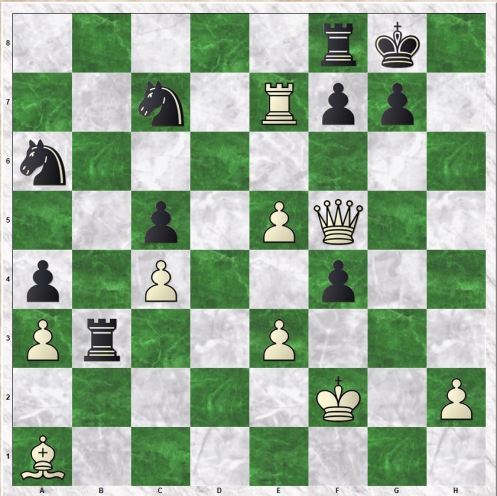
The book misses 2…Qe8 and Black succumbs to a flashy mate, along the same lines as 1 e6 2 Rg7+.
FEN
q4rk1/2nR1pp1/n6p/2p1PQ2/p1P2P1N/Pr2PN2/5K1P/B7 w – – 0 1
Today’s problem is from the 1972 book “Chess Combination as a Fine Art”, a book based on articles published in the 1950s-1960s by Kurt Richter.
Since the start of 2018, I have decided to adopt the style of only saying which side is to play: and not giving an idea if the move wins or otherwise, unless on occasion I think signposting would be helpful. Instead, the problems are posed with the instruction to decide what you would play, as in a game.
White to play
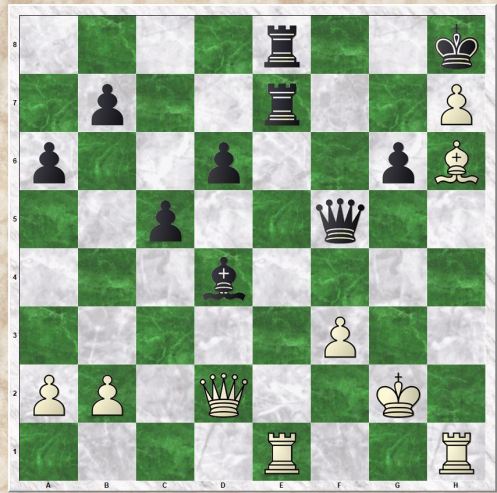
Patience v Tilson, England 1964
Solution
Easy enough as a problem, but in a real game, how easy would it be to sacrifice Q and B, and not worry that something had been missed?
But it is a problem, so, fearlessly, 1 Qd4+! cd 2 Bg7+!
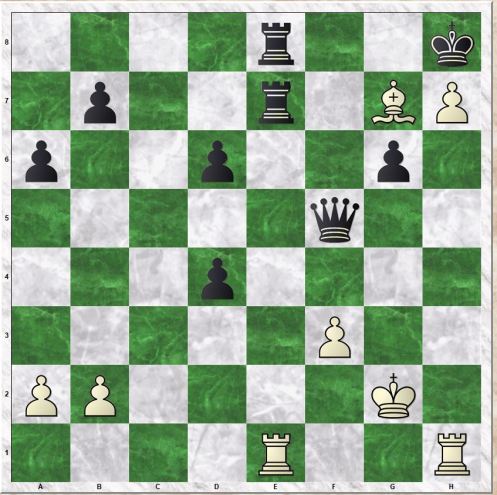
2…Rg7+ is trivial: 3 Re8+ and mates in a move or two. So 2…Kg7, when 3 Re7+, and the only thing to worry about is if 3…Kf6 4 Re8 gives Black a perpetual, but after 4…Qg5+ 5 Kf2 Qd2+ White interposes with 6 Re2 and it is game over.
Therefore, instead all one needs to calculate is if 3… Re7 4 h8(Q)+ Kf7[] is a win or a draw:
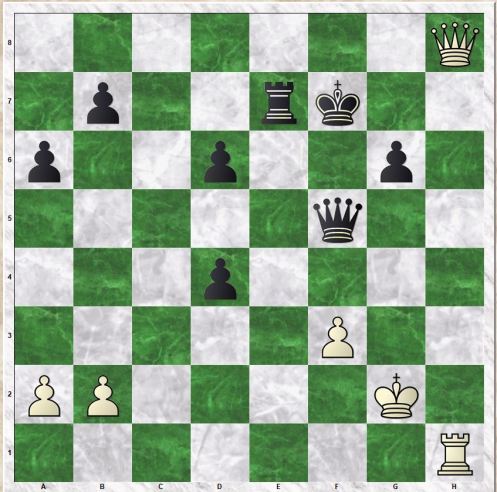
5 Rh7+ Ke6[] 6 Qc8+
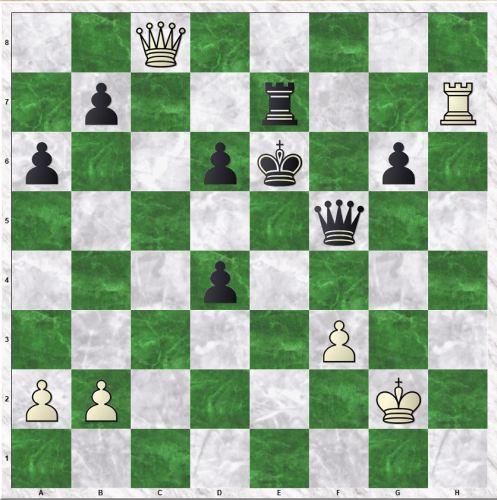
6…Kd5 drops the Re7 (aftr 7 Qf5+ first) so 6…Kf6 when 7 Qf8+ picks the rook up all the same.
Nice.
FEN
4r2k/1p2r2P/p2p2pB/2p2q2/3b4/5P2/PP1Q2K1/4R2R w – – 0 1
Today’s problem is from the 1972 book “Chess Combination as a Fine Art”, a book based on articles published in the 1950s-1960s by Kurt Richter.
Since the start of 2018, I have decided to adopt the style of only saying which side is to play: and not giving an idea if the move wins or otherwise, unless on occasion I think signposting would be helpful. Instead, the problems are posed with the instruction to decide what you would play, as in a game.
White to play

Szabo v Nikitin, corres 1964
Solution
Strangely, since it is a correspondence game, I had seen this before: don’t know where; likely in a puzzle book or magazine. Fortunately, I remembered the solution.
1 Rh7+! Qh7[] 2 f7! : the trick.

The Queen is pinned to the Qh1 and devastation follows.
Oddly, my engine gives 1 Be2 and 2 Rh7+ as better than 1 Rh7+: better in the sense +13 cf +12
FEN
6rk/2nbNq1p/3p1PpR/2pPp1P1/1nB1P3/2N3K1/1P6/2B4Q w – – 0 1
Today’s problem is from the presently ongoing Grenke Chess Classic. This posting was written mid-play on 4th April, astounded by the turn of events in the game Caruana-Naiditsch. The game had been level throughout, and I thought was heading for a draw, making it five draws in the round {and the other four games won’t be going into the anthologies).
Since the start of 2018, I have decided to adopt the style of only saying which side is to play: and not giving an idea if the move wins or otherwise, unless on occasion I think signposting would be helpful. Instead, the problems are posed with the instruction to decide what you would play, as in a game.
White to play

Caruana v Naiditsch, Grenke Classic, Germany, 4/4/18
Solution
Black has just played the losing move Qa4-a2. In a game, if I were White, I would have no idea whatsoever that I was winning, and would fear a loss by Black advancing his a pawn. My only hope would be his weakness on h6.
So, maybe 1 g4, perhaps? No, 1g4?? Nd3! 0-1
Therefore, maybe 1 Qe4 instead? No, 1…Qe6 2 Qc2 Qc4! and if 3 Qb2, 3…Qe4+ and picks up the Nf5.
Caruana played 1 Ne3! and somehow…he is winning.

It only slowly dawned on me that Black is in a form of zugzwang; 1 Ne3 controls the Nb2; and thus controls the Qa2; giving White time for a later g4 and Nf5, returning to the outpost once defended, and Black is defenceless. Often, when Black’s Queen retreats to defend the K, his Nb2 becomes LPDO and is lost.
In the game, Black resigned after 1…Kg7 2 Qb4! (further controlling key squares; or 2 Qb5) Qb1 3 g4! Kg8 4 Nf5 Qc2 5 Qb8+ Kh7 6 Qg7 Kh8 7 Qe7 1-0.

If say 7…Qc6+ then eventually a Qe5+ will fork K and Nb2.
Astounding. And (subject to the rest of the tournament, a marker laid down by Fabiano for Magnus in November!
FEN
8/pQ3p1k/7p/5Np1/8/6PP/qn3PK1/8 w – – 0 36
wKg2,Qb7,Nf5,Pf2,g3,h3/bKh7,Qa2,Nb2,Pa7,f7,g5,h6
Today’s problem is a snippet from the recent European Individual Championships. I typically glance at short decisive games in the major tournaments.
Since the start of 2018, I have decided to adopt the style of only saying which side is to play: and not giving an idea if the move wins or otherwise, unless on occasion I think signposting would be helpful. Instead, the problems are posed with the instruction to decide what you would play, as in a game.
White to play

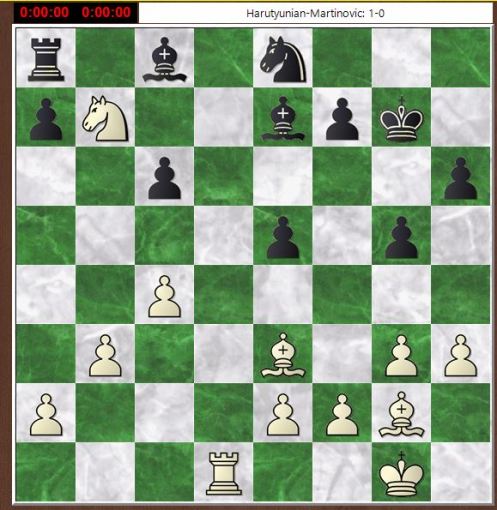
Harutyunian v Martinovic, Batumi 27/3/18
Solution
Examine all biffs as per the mandate of CJS Purdy. 1 Nb7! and if 1…Bb7, 2 Rd7 forks the two LPDO bishops.
FEN
r1b1n3/pp2bpk1/2p4p/2N1p1p1/2P5/1P2B1PP/P3PPB1/3R2K1 w – – 0 22
wKg1,Nc5,Be3,g2,Rd1,Pa2,b3,c4,e2,f2,g3,h3/bKg7,Ne8,Bc8,e7,Ra8,Pa7,b7,c6,e5,f7,g5,h6
Today’s problem is from the 1972 book “Chess Combination as a Fine Art”, a book based on articles published in the 1950s-1960s by Kurt Richter.
Since the start of 2018, I have decided to adopt the style of only saying which side is to play: and not giving an idea if the move wins or otherwise, unless on occasion I think signposting would be helpful. Instead, the problems are posed with the instruction to decide what you would play, as in a game.
White to play
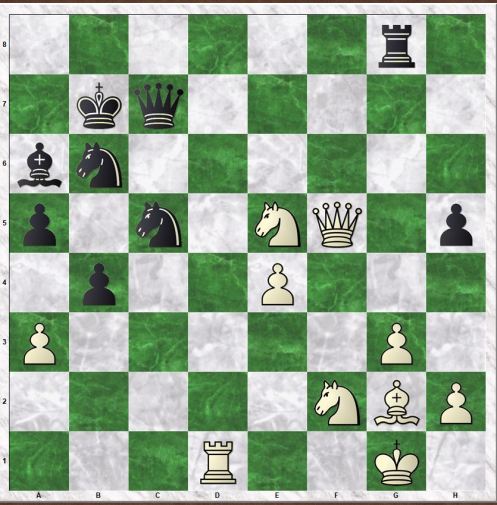
Zuckerman v Suttles, New York 1965
Solution
1 Nc6!! a real surprise move. I wondered if Duncan Suttles expected it, or was shocked by it?
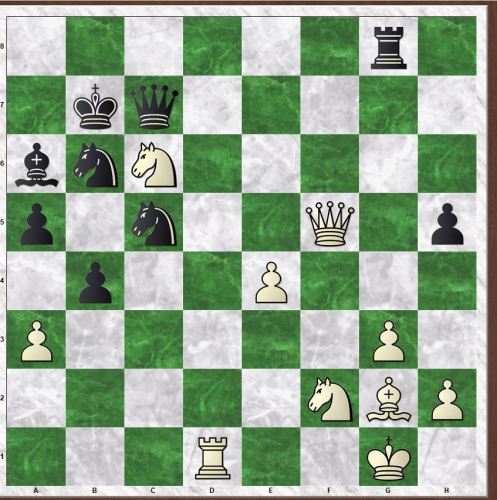
Black played 1…Nba4 and lost after 2 e5 and 3 Rd6 etc.
I spent more time on 1…Kc6 2 e5+ Kb5 3 Bf1+
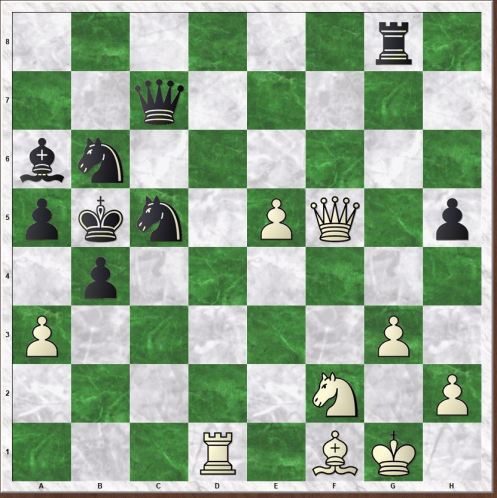
3..Ka4 (3…Nc4+ is also possible; at each turn, Black has several options. In Kotov’s terms, the tree of analysis is very thick and branched. 4 ab; and I got to my limit here, but felt White should have something (though, in practice, easy to throw everything away). My engine confirms White is winning.
One for my readers to explore by themselves, given the number of branches.
FEN
6r1/1kq5/bn6/p1n1NQ1p/1p2P3/P5P1/5NBP/3R2K1 w – – 0 30
Today’s problem is from the 1972 book “Chess Combination as a Fine Art”, a book based on articles published in the 1950s-1960s by Kurt Richter.
Since the start of 2018, I have decided to adopt the style of only saying which side is to play: and not giving an idea if the move wins or otherwise, unless on occasion I think signposting would be helpful. Instead, the problems are posed with the instruction to decide what you would play, as in a game.
White to play; after Black plays d4*c3 in the position below
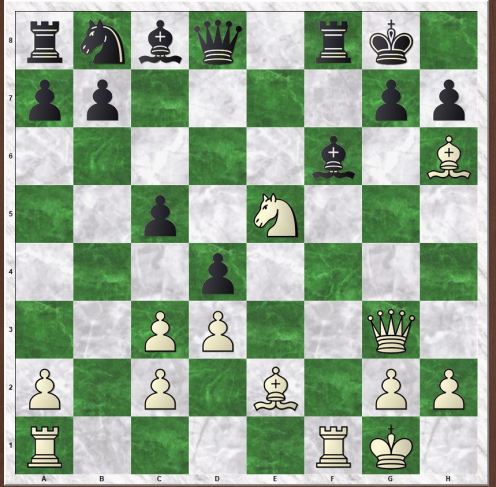
Anderson v Wilkinson, BCCA championships 1956-7
Black plays d4*c3
Solution
I found the main idea, but didn’t solve the problem fully. 1 d4! opening the a2-g8 diagonal for the Be2; 1…Be6, blocking it.
Whilst I also looked at 1 Rf6 Qf6 2 Bg5 (amongst other things) I didn’t see that after 1 d4 Be6 2 Rf6! is now a killer. 2…Qf6 3 Bg5! traps the queen.

Lovely.
FEN
rnbq1rk1/pp4pp/5b1B/2p1N3/3p4/2PP2Q1/P1P1B1PP/R4RK1 w – – 0 1
Today’s problem is from the 1972 book “Chess Combination as a Fine Art”, a book based on articles published in the 1950s-1960s by Kurt Richter.
Since the start of 2018, I have decided to adopt the style of only saying which side is to play: and not giving an idea if the move wins or otherwise, unless on occasion I think signposting would be helpful. Instead, the problems are posed with the instruction to decide what you would play, as in a game.
Black to play
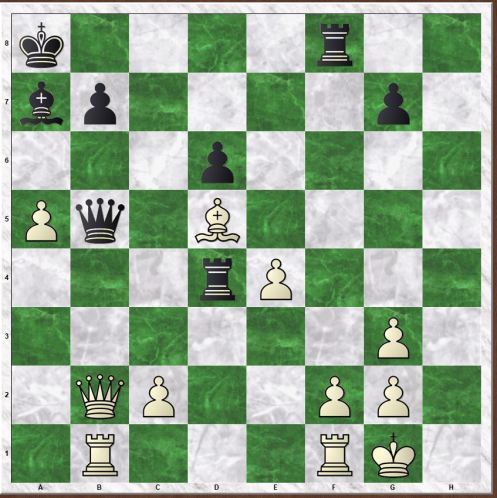
AN Other v Rossolimo, Paris 1957
Solution
1…Rd1! exploiting the fact that the Rb1 is tied to defending the Qb2, and the Rf1 is tied to defending f2.
2 Qb5 Bf2+! exploiting the fact that the Rf1 is pinned to the K by the Rd1. 3 Kh1 Rh8 mate.
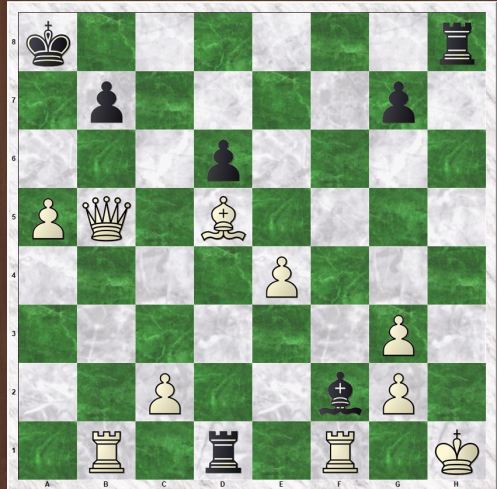
Not too hard, but pretty.
FEN
k4r2/bp4p1/3p4/Pq1B4/3rP3/6P1/1QP2PP1/1R3RK1 b – – 0 1
 allanbeardsworth