Today’s problem is from the 1972 book “Chess Combination as a Fine Art”, a book based on articles published in the 1950s-1960s by Kurt Richter.
Since the start of 2018, I have decided to adopt the style of only saying which side is to play: and not giving an idea if the move wins or otherwise, unless on occasion I think signposting would be helpful. Instead, the problems are posed with the instruction to decide what you would play, as in a game.
White to play

Mustonen v Olsson, corres 1953-54
Solution
No prizes for the first two moves: 1 Qc4 dc 2 d5+ e5[]

3 Ng5!
Black now played 3…Rf5? losing to 4 Re5!, although after 4…c3, even though engine’s say White has mate in 15, it could still go wrong in practice.
But 3…h6 is the engine’s preference. 4 Be5+ Qe5 4 Re5 hg 5 Reg5 Be8 and the game goes on.
FEN
2n2r1k/3b3p/1p2p3/pP1p4/P1rPNq1P/8/2Q2PR1/B3R1K1 w – – 0 1
Today’s problem is from the 1972 book “Chess Combination as a Fine Art”, a book based on articles published in the 1950s-1960s by Kurt Richter.
Since the start of 2018, I have decided to adopt the style of only saying which side is to play: and not giving an idea if the move wins or otherwise, unless on occasion I think signposting would be helpful. Instead, the problems are posed with the instruction to decide what you would play, as in a game.
White to play
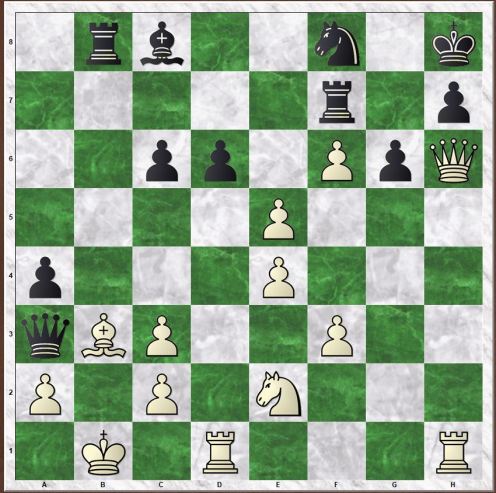
Skuja v Rosenberg, Riga 1962

Solution
A standard motif. 1 Qf8+! Rf8[] 2 Rh7+! Kh7[] 3 Rh1+ and 4 Rh3 mate.
FEN
1rb2n1k/5r1p/2pp1PpQ/4P3/p3P3/qBP2P2/P1P1N3/1K1R3R w – – 0 1
Today’s problem is from the 1972 book “Chess Combination as a Fine Art”, a book based on articles published in the 1950s-1960s by Kurt Richter.
Since the start of 2018, I have decided to adopt the style of only saying which side is to play: and not giving an idea if the move wins or otherwise, unless on occasion I think signposting would be helpful. Instead, the problems are posed with the instruction to decide what you would play, as in a game.
White to play

Plater v Piechota, Polish Championships 1956
Solution
Fairly easy today, though for some reason I had a blind spot and couldn’t see that 1 Ne7+and 2 Bh7+ win; I saw these moves immediately, and yet didn’t appreciate that they were winning. But they do. Whichever piece captures on e7 blocks Black’s escape. And if none do, and 1..Kh8 instead, then 2 Qh7+ and 3 Rh7 mate.

FEN
4rnk1/2nq1rpp/p3b3/1p1ppN1Q/2pP4/2P4R/PPBB2PP/5RK1 w – – 0 1
Today’s problem is from the 1972 book “Chess Combination as a Fine Art”, a book based on articles published in the 1950s-1960s by Kurt Richter.
Since the start of 2018, I have decided to adopt the style of only saying which side is to play: and not giving an idea if the move wins or otherwise, unless on occasion I think signposting would be helpful. Instead, the problems are posed with the instruction to decide what you would play, as in a game.
White to play
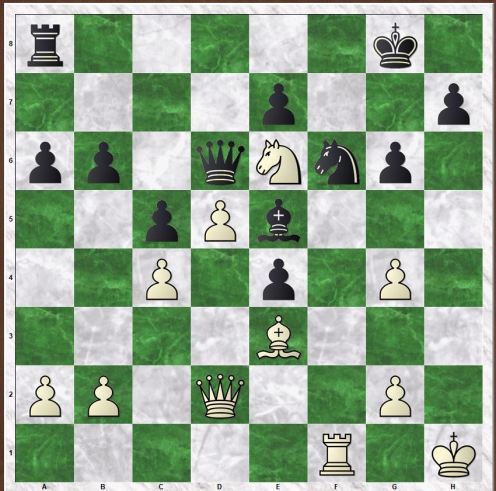
Graf v Wurm, Augsburg 1953
Solution
1 Bc5! – a standard clearance sacrifice 1…bc[] 2 Qh6

2..Nd7 (say; others lose easily) 3 Rf7!!

and mates. One line being 3…Kf7 4 Qh7+ Ke8 5 Qg6mate (and not 5…Qg8+)
FEN
r5k1/4p2p/pp1qNnp1/2pPb3/2P1p1P1/4B3/PP1Q2P1/5R1K w – – 0 1
Today’s problem is from the 1972 book “Chess Combination as a Fine Art”, a book based on articles published in the 1950s-1960s by Kurt Richter; well, actually it isn’t, but when I was trying to find yesterday’s game in Megabase (I didn’t find it) I found this game itself between the two players.
Since the start of 2018, I have decided to adopt the style of only saying which side is to play: and not giving an idea if the move wins or otherwise, unless on occasion I think signposting would be helpful. Instead, the problems are posed with the instruction to decide what you would play, as in a game.
White to play
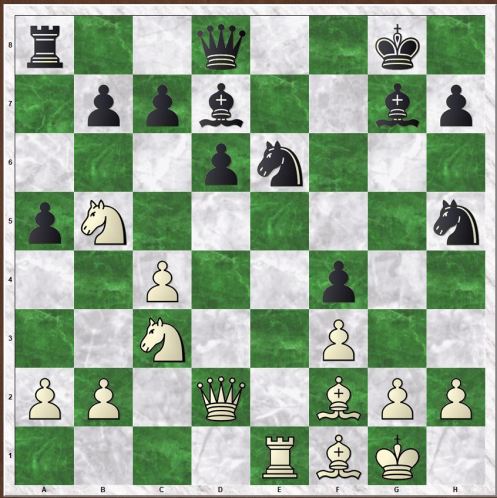
Barczay v Pribyl, Decin 27/6/1978
Solution
1 c5! opening c4 and the a2-g8 diagonal for the bishop 1…dc 2 Bc4 Qe7
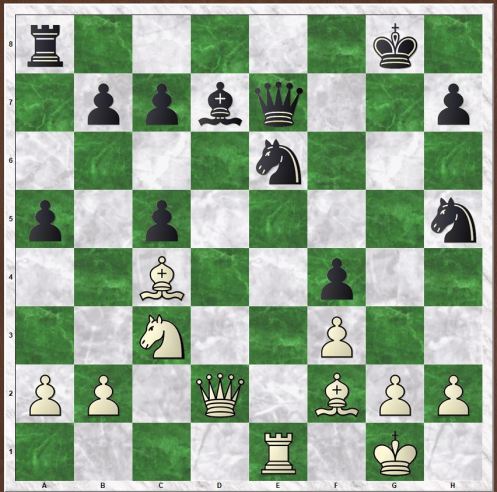
3 Qd7!! 1-0
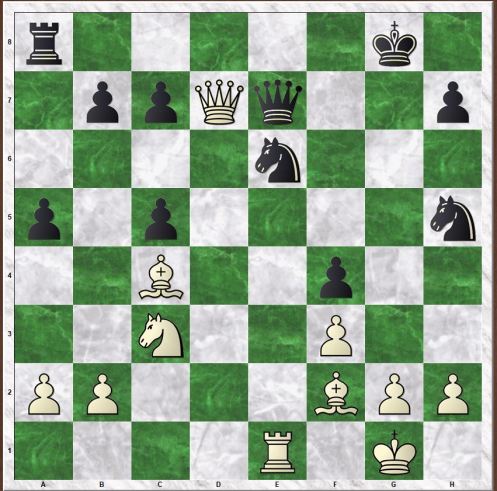
1…Bb5 2 Nb5 Nc5 loses to 3 Qd5+ forking the king and the LPDO Nh5; 2… Be5 3 cd cd 4 Nd6!
FEN
r2q2k1/1ppb2bp/3pn3/pN5n/2P2p2/2N2P2/PP1Q1BPP/4RBK1 w – – 0 21
Today’s problem is from the 1972 book “Chess Combination as a Fine Art”, a book based on articles published in the 1950s-1960s by Kurt Richter.
Since the start of 2018, I have decided to adopt the style of only saying which side is to play: and not giving an idea if the move wins or otherwise, unless on occasion I think signposting would be helpful. Instead, the problems are posed with the instruction to decide what you would play, as in a game.
White to play
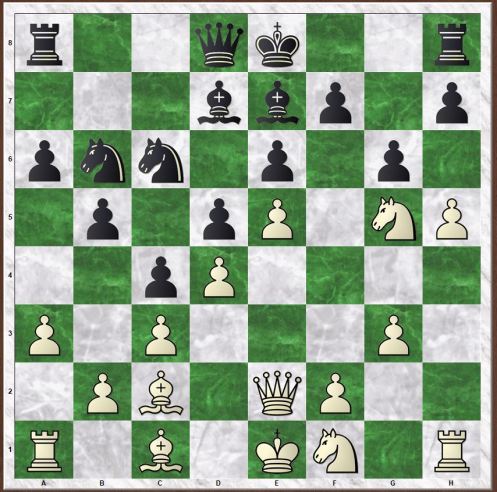
Barczay v Pribyl, Lublin 1969
Solution
1 hg! Bg5 2 Rh7! Rh7 (2…Rf8 3 gf+ or 3 g7) 3 gh Bf6

4 Bg5!! 1-0

FEN
r2qk2r/3bbp1p/pnn1p1p1/1p1pP1NP/2pP4/P1P3P1/1PB1QP2/R1B1KN1R w KQkq – 0 1
Today’s problem is from the 1972 book “Chess Combination as a Fine Art”, a book based on articles published in the 1950s-1960s by Kurt Richter.
Since the start of 2018, I have decided to adopt the style of only saying which side is to play: and not giving an idea if the move wins or otherwise, unless on occasion I think signposting would be helpful. Instead, the problems are posed with the instruction to decide what you would play, as in a game.
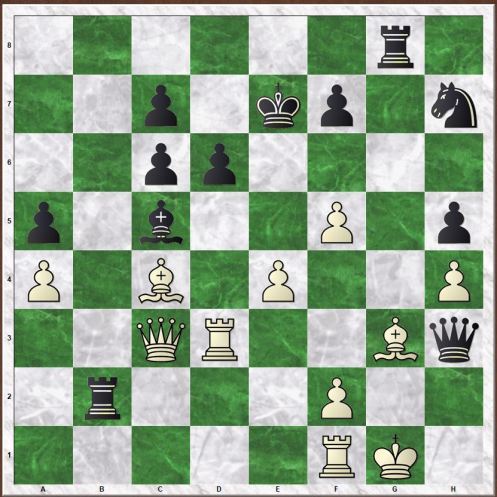
Black to play
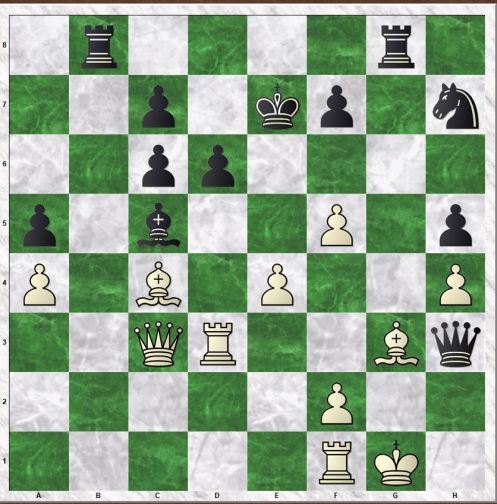
Gendel v Sushkevitz, USSR 1956
Solution
I completely missed the lovely solution to this puzzle.
1…Rg3+ (which of course I looked at, as my immediate, instinctive, move) 2 Rg3[]
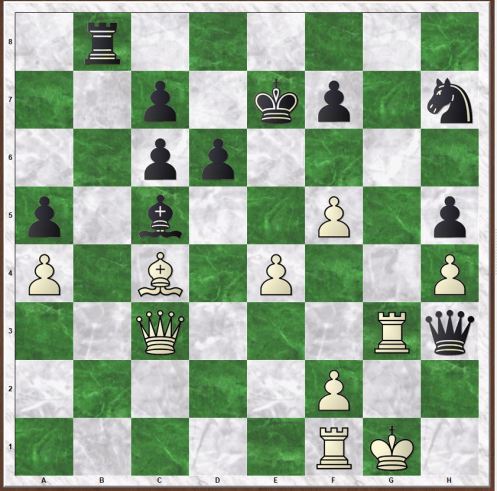
2…Rg8!! the move I missed.
Very nice.
The Qc3 is LPDO and is lost after 3 Rg8 Qc3.
3 f6+ Kd7[] 4 Be6+ fe[] 5 Rg7+! Rg7+[] 6 fg Qc3[] 7 g8(Q) is a computer resource not mentioned in the book. The book gives no analysis after 2…Rg8!!.
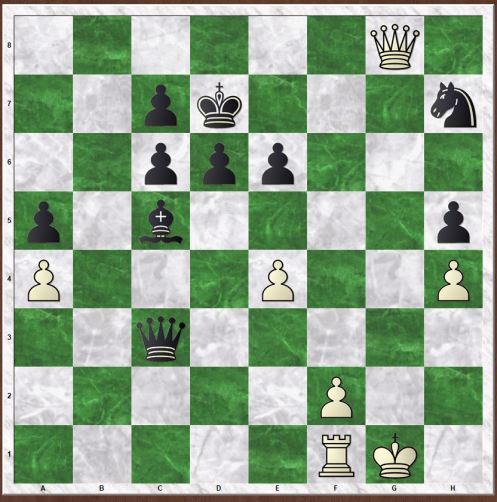
7…Nf6 and Black’s king can be checked away to the b file, where it is then nice and safe, with Bb6 always available. Then the N hops to g4 if needed, and f2 falls/everything is simplified if needs be to a won ending.
Alternative first move
My engine’s first preference is in fact 1…Nf6 (but only in the sense -7.91 cf -7.85, so no difference). After 2 Re1 it rates both 2…Rg4 (human) and 2…Rb1 (silicon) as overwhelmingly won for Black.
And another alternative
My choice of move was 1…Rb2!! the idea being that the Qc3 is overloaded. 2 Qb3 Rg3+ and White’s house falls in. Komodo pleases me by giving this move =7.
FEN
1r4r1/2p1kp1n/2pp4/p1b2P1p/P1B1P2P/2QR2Bq/5P2/5RK1 b – – 0 1
Today’s problem is from the 1972 book “Chess Combination as a Fine Art”, a book based on articles published in the 1950s-1960s by Kurt Richter.
Since the start of 2018, I have decided to adopt the style of only saying which side is to play: and not giving an idea if the move wins or otherwise, unless on occasion I think signposting would be helpful. Instead, the problems are posed with the instruction to decide what you would play, as in a game.
White to play
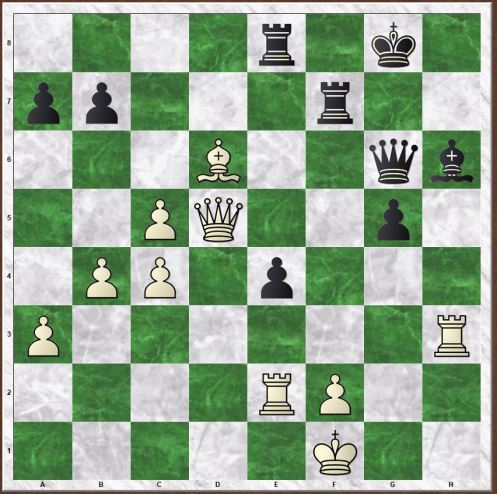
Suttles v Fleigel, Santa Monica 1965
Solution
Examine all biffs, checking for forks, nets and pins (the Rf7 is pinned) examining for jump-biffs and LPDOs means that 1 Rf3! has to be looked at (but see later).
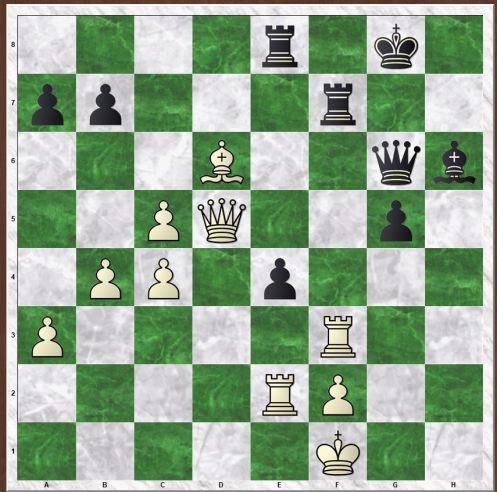
Black played 1…Qe6 met with by 2 Re4! and White won.
Better would have been 1…ef 2 Re8+ Kh7

White wins the ending; 3 b5 and if the Rf7 doesn’t move, likely 4 Qf7+ and 5 Re7 (though I think 3 Qf7+ is the move I would play in practice, thinking and hoping that the bishop ending is won)

Update
When loading the position into Chessbase, to produce these diagrams, my default engine Komodo thinks 1 Rf3 is less strong than other moves, since 1…Qh5 2 Qf7+ Qf7 3 Rf7 Kf7 is “only” +1.8; though, to my mind after 4 b5, all results would be still possible at my standard of play.
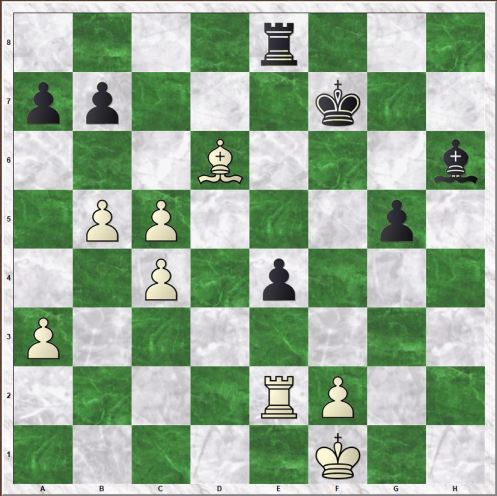
Komodo prefers 1 c6 and 1 Rhe3, both of which it says are “more” winning (higher evaluation) but there is nothing forcing.
FEN
4r1k1/pp3r2/3B2qb/2PQ2p1/1PP1p3/P6R/4RP2/5K2 w – – 0 1
Today’s problem is from the 1972 book “Chess Combination as a Fine Art”, a book based on articles published in the 1950s-1960s by Kurt Richter.
Since the start of 2018, I have decided to adopt the style of only saying which side is to play: and not giving an idea if the move wins or otherwise, unless on occasion I think signposting would be helpful. Instead, the problems are posed with the instruction to decide what you would play, as in a game.
White to play
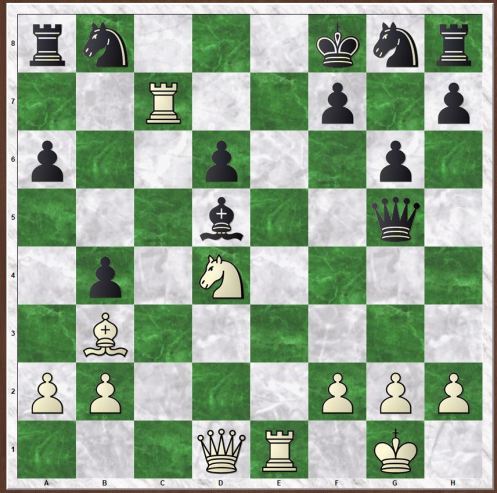
Tatarintsev v Tsemtov, USSR 1966
Solution
1 Qf3! breaking Black’s position. Quite simple, but there is a nice follow up after 1…Bb3

2 Rf7+! (2 ab, 2Qa8, 2 Qb3 also all win, prosaically) 2..Bf7[] 3 Ne6+ and the absolute pin means that the LPDO Qg5 drops off.
FEN
rn3knr/2R2p1p/p2p2p1/3b2q1/1p1N4/1B6/PP3PPP/3QR1K1 w – – 0 1
Today’s problem is from the 1972 book “Chess Combination as a Fine Art”, a book based on articles published in the 1950s-1960s by Kurt Richter.
Since the start of 2018, I have decided to adopt the style of only saying which side is to play: and not giving an idea if the move wins or otherwise, unless on occasion I think signposting would be helpful. Instead, the problems are posed with the instruction to decide what you would play, as in a game.
Black to play
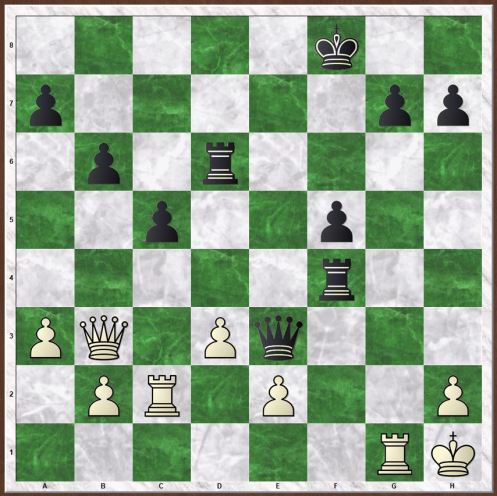
Gislason v Boey, Moscow Olympiad 11/9/1956
Solution
The last move of yesterday’s probem/
1..Qg1+! 0-1 since if 2 Kg1[] Rg8+ 3 Kh1[] Rf1 mate.

FEN
5k2/p5pp/1p1r4/2p2p2/5r2/PQ1Pq3/1PR1P2P/6RK b – – 0 32
 allanbeardsworth