Today’s problem is from the recent Aeroflot Open.
Since the start of 2018, I have decided to adopt the style of only saying which side is to play: and not giving an idea if the move wins or otherwise, unless on occasion I think signposting would be helpful. Instead, the problems are posed with the instruction to decide what you would play, as in a game.
White to play
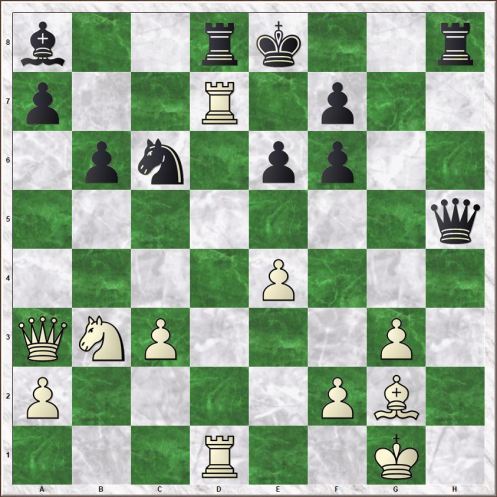
Esipenko v Salomon, Moscow 25/2/18
Solution
1 Qe7+!! wins immediately. The Nc6 is tied to defending the Rd8: so 1…Ne7 2 Rd8 mate.
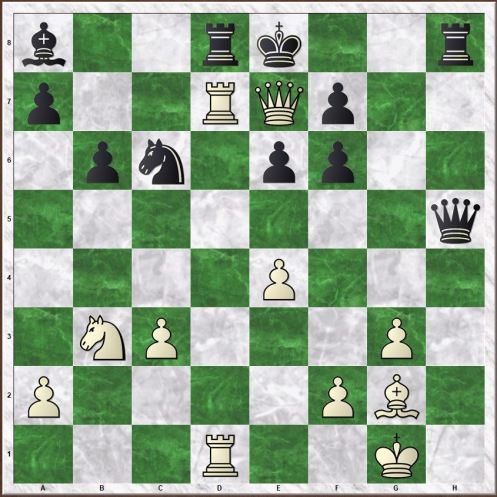
Black’s last move was Rc8-d8. My engine says that instead a5 would have left White with a good edge. I suspect if I left the engine on for a while, it would give White a bigger advantage.
FEN
b2rk2r/p2R1p2/1pn1pp2/7q/4P3/QNP3P1/P4PB1/3R2K1 w – – 0 26
Today’s problem is from the recent Aeroflot Open.
Since the start of 2018, I have decided to adopt the style of only saying which side is to play: and not giving an idea if the move wins or otherwise, unless on occasion I think signposting would be helpful. Instead, the problems are posed with the instruction to decide what you would play, as in a game.
Black to play
Could you (as White, of course: White has just played 118 N*c6) win this position in a tournament game? With sufficient time? Or with little time, perhaps only 30 seconds increments?
I suggest playing it against your favourite engine.
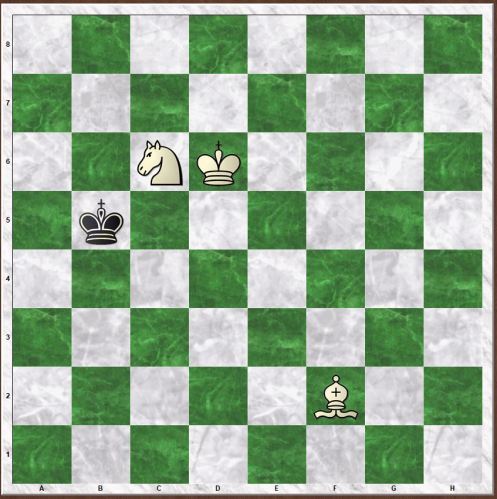
Gallego Alcaraz v Martirosyan, Aeroflot Moscow 26/2/18
Solution
White managed to win this position, after a further 32 moves.
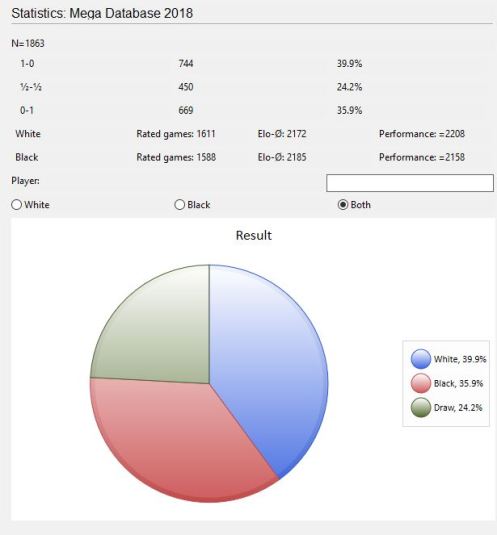
Looking at the statistics on Megabase 2018, the ending has occurred about 1,600 times, and has been won 76% of the time. Or, drawn 24% of the time.
The earlier part of the endgame, from about move 70 onwards, was interesting. A top class fight. The game, at the time of writing, is in TWIC; and I am sure will be in MegaBase 2018 in its not upload.
FEN
8/8/2NK4/1k6/8/8/5B2/8 b – – 0 118
Today’s problem is from the recent Aeroflot Open. I happened to look on Playchess at the some of the games played, and, as is my habit, looked first at the short 1-0s or 0-1s.
Since the start of 2018, I have decided to adopt the style of only saying which side is to play: and not giving an idea if the move wins or otherwise, unless on occasion I think signposting would be helpful. Instead, the problems are posed with the instruction to decide what you would play, as in a game.
White to play

Kamsky v Antipov, Moscow 27/2/18
Solution
Had I not seen the game, and had this been a problem, it would have been too hard. In a game, I would doubtless have played 1 Bg3, and the game would have gone on. 1 Re7+!! is of course a move I would have looked at, but the complications would have been too difficult for me.
(As an aside, the engine’s second choice is 1 Bf4!, the cute point being 1…Nf4 2 Re7+! and if 2…Qe7 3 Nf5+ and 4 Qg4+; 2…Be7 3 Nf5+ Kf8 and 4 Qh6+ picks up the LPDO Nf4).
But after 1 Re7:

We can discuss 1…Qe7?? 2 Nf5+ as trivial; but neither 1…Be7 (as played) or 1…Ne7 are easy. In fact, 1…Ne7 in particular is very difficult.
At each stage, there are lots of lines: rather than give them, today I will leave the positions after either sensible capture to my readers: it is, I think, a good task for thinking through with clock, set and board.
To maybe help, below is the final position in the game after 1..Be7 2 Nf5+

FEN
2r2b1r/1pBqn1kp/5pn1/1N1p3Q/P2P2pN/8/2P2PPP/R3R1K1 w – – 0 20
Today’s problem is a game I saw at the recent Aeroflot Open
Since the start of 2018, I have decided to adopt the style of only saying which side is to play: and not giving an idea if the move wins or otherwise, unless on occasion I think signposting would be helpful. Instead, the problems are posed with the instruction to decide what you would play, as in a game.
White to play, after Black’s last move, Ke7-f6
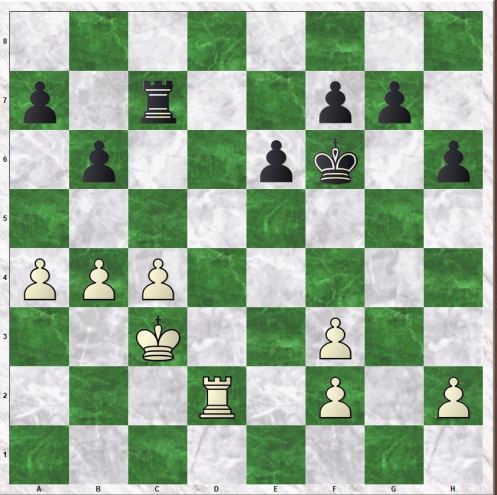
Hakobyan v Wien, Aeroflot, Moscow, 27/2/18
Solution
Kf6 seems to be the losing move: something which I found surprising. I think how White won is instructive.
1 c5! bc 2 b5[]

Black’s king advanced, as did White’s, and White played a5, before the instructive move 5 Rd8!
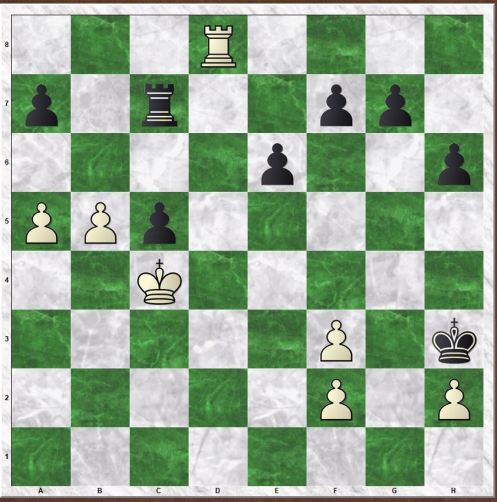
It threatens a manoeuvre I don’t recall seeing before, though I suspect I have just admitted to all my readers my lack of rook ending technique: the idea is a6, Rb8, Rb7, which happened in the game.

Black’s rook had to give way, permitting R*a7, and a few moves later Black resigned.
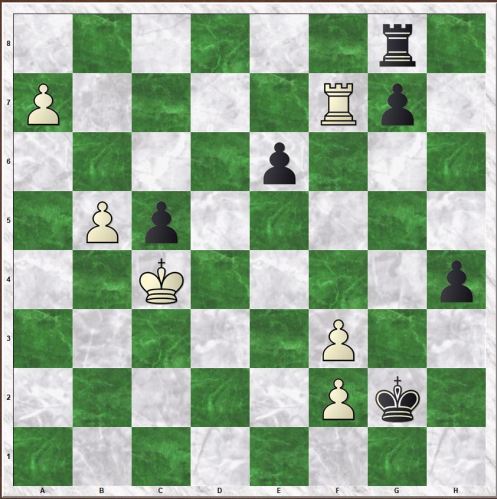
If here 10..h3, White plays 11 Rg7+ overpowering the rook.
Instructive.
The whole game was interesting. Pieces came off quickly; and here, White played 19 Bf3, ruining his pawn structure.
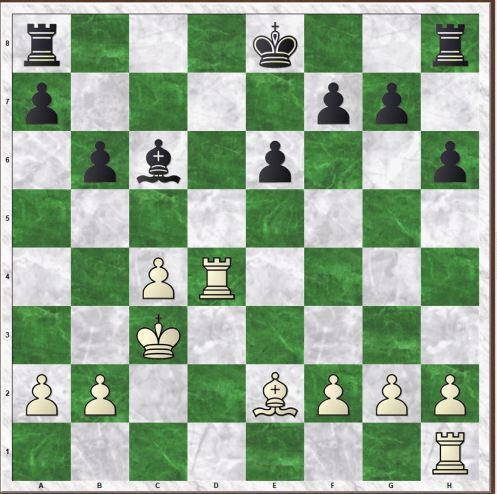
I would have always played 18 f3 here; this is my engine’s second choice, its first being 19 Rhd1 with the idea that 19..Bg2 20 Rg1 wins the g7 pawn. But after all three moves the engine appraises the position as equal. It was only Black’s Ke7-f7 which changed the assessment. Instead, Black should have swapped rooks, or advanced his king side pawns, in both cases keeping his rook near White’s majority.
FEN
8/p1r2pp1/1p2pk1p/8/PPP5/2K2P2/3R1P1P/8 w – – 0 26
Today’s problem is a position seen in a recent Daily Telegrah column by Malcolm Pein. Alas, the position stumped me, to my annoyance when I saw what Danny played. I should have been able to find the solution.
Since the start of 2018, I have decided to adopt the style of only saying which side is to play: and not giving an idea if the move wins or otherwise, unless on occasion I think signposting would be helpful. Instead, the problems are posed with the instruction to decide what you would play, as in a game.
White to play
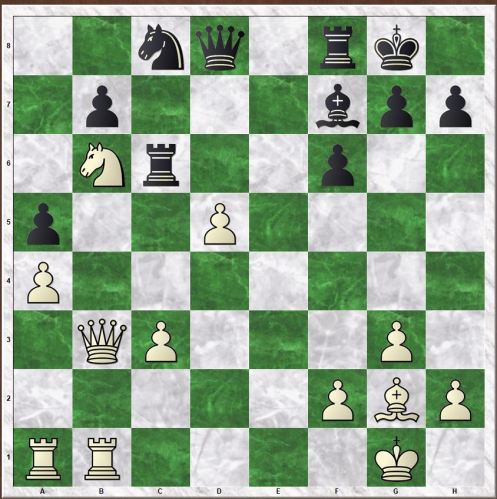
Gormally v Gourlay, Newcastle 15/2/18
Solution
If I had applied what I know, and particular the lessons from one of my favourite authors, CJS Purdy I would have examined all biffs and found 1 Nd7!!
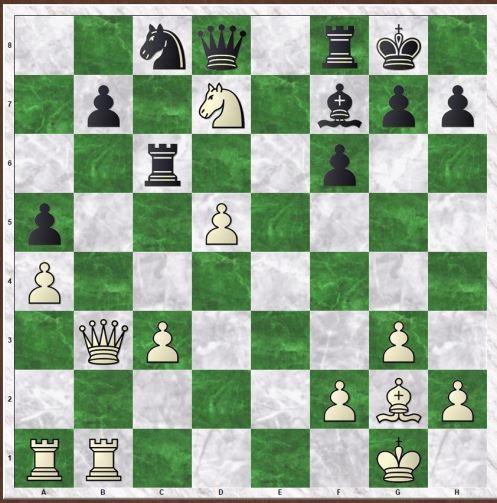
(had there been a piece on d7, I would have considered it; but Purdy’s examine all biffs mantra should have meant I looked at Nd7, which biffs the Rf8.
If 1…Re8 then 2 dc Bb3 3 cb and the pawn queens: the move Nd7 both hits the Rf8 and looks at the promotion square b8.
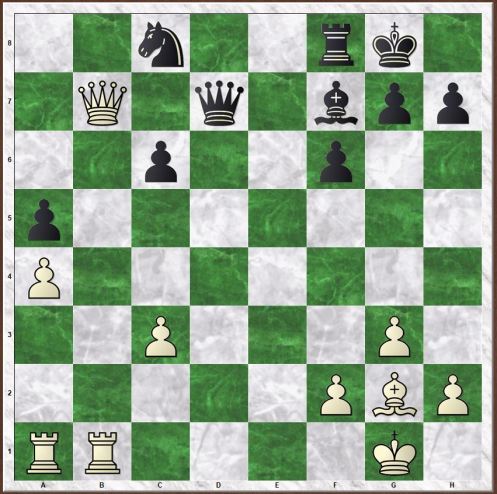
Black instead played 1..Qd7 met with by 2 dc bc 3 Qb7 1-0.
FEN
2nq1rk1/1p3bpp/1Nr2p2/p2P4/P7/1QP3P1/5PBP/RR4K1 w – – 0 23
Today’s problem is from the 1972 book “Chess Combination as a Fine Art”, a book based on articles published in the 1950s-1960s by Kurt Richter.
Since the start of 2018, I have decided to adopt the style of only saying which side is to play: and not giving an idea if the move wins or otherwise, unless on occasion I think signposting would be helpful. Instead, the problems are posed with the instruction to decide what you would play, as in a game.
Black to play

Solution
1…Rc1! exploits the fact that the Qc1 is unprotected; and the Rd2 is tied to defending g2.
2 Qc1 Ne2+ and Black won a few moves later.
FEN
2r2rk1/pb4pp/1p2p3/4Npq1/3P1n2/5P2/PP1R2PP/RB2Q1K1 b – – 0 21
Today’s problem is from the 1972 book “Chess Combination as a Fine Art”, a book based on articles published in the 1950s-1960s by Kurt Richter.
Since the start of 2018, I have decided to adopt the style of only saying which side is to play: and not giving an idea if the move wins or otherwise, unless on occasion I think signposting would be helpful. Instead, the problems are posed with the instruction to decide what you would play, as in a game.
Black to play

Stefanov v Andreyev, Bulgaria 1957
Solution
The first few moves are obvious; whether in an actual game I would have the confidence to see it through to the end/see the line sufficient to have a bale-out draw, I don’t know.
1…Qa2+ 2 Ka2 Bd3+ 3 Kb3 c4+ 4 Kb4

And now the engine shows what the book’s authors and the players didn’t see, that 4..Nc6+! is quicker than 4…Na6+. The latter eventually led to:
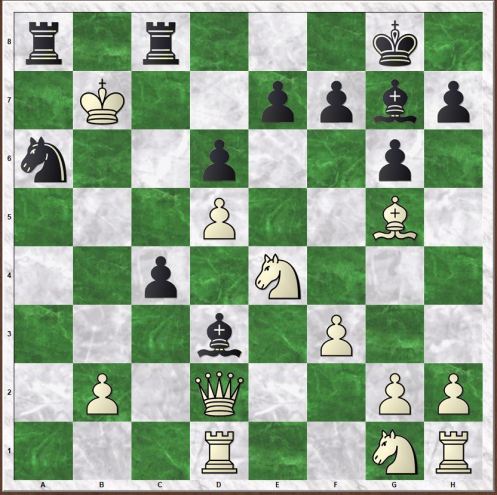
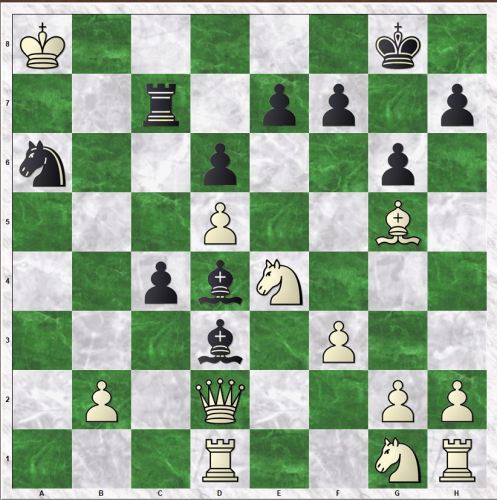
and Black found 7…Rc7+!! 8 Ka8[] Bd4! and mate (9…Ra7 ) next move.
FEN
rn3rk1/4ppbp/b2p2p1/2pP2B1/q3N3/5P2/PP1Q2PP/1K1R2NR b – – 0 1
Today’s problem is from the 1972 book “Chess Combination as a Fine Art”, a book based on articles published in the 1950s-1960s by Kurt Richter.
Since the start of 2018, I have decided to adopt the style of only saying which side is to play: and not giving an idea if the move wins or otherwise, unless on occasion I think signposting would be helpful. Instead, the problems are posed with the instruction to decide what you would play, as in a game.
White to play

Perez v Najdorf, Costa del Sol 1961
Solution
The solution is very hard: 2 Bd4+!! is the key first move; 2…Kd4[] 3 Qd2+. If 3…Ke4 4 Rf4+ and a mating check-check routine, Qd4+ Rf6+ Qd6+ etc; and similarly with 3…Ke5. So 3…Rd3 4 Qb4+ Ke3 5 Qf4+ Ke2 6 Qe4+…actually, mating with Q+R is a difficult task; and rather than show too many lines, I will leave it to the reader to consider as much as he or she wants.
According to the book, Black’s king moved in a different way e5-d5-e4-d5-e5-d4-c3-b2-a3 before being mated by Qe1-e7+
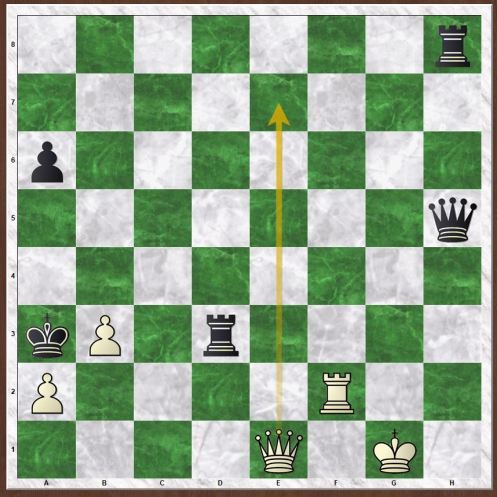
However, I have my doubts. The sequence is fantastic, problem like; and also Megabase shows Najdorf winning, with White missing the Nc3!! idea. So, I suspect the puzzle is a post mortem or later analysis.
FEN
7r/8/pB1p1R2/4k2q/1p6/1Pr5/P5Q1/6K1 w – – 0 37
Today’s problem is from the 1972 book “Chess Combination as a Fine Art”, a book based on articles published in the 1950s-1960s by Kurt Richter.
Since the start of 2018, I have decided to adopt the style of only saying which side is to play: and not giving an idea if the move wins or otherwise, unless on occasion I think signposting would be helpful. Instead, the problems are posed with the instruction to decide what you would play, as in a game.
White to play

Perez v Najdorf, Costa del Sol 1961
Solution
1 Rf6+ Kd5

2 Nc3+!!
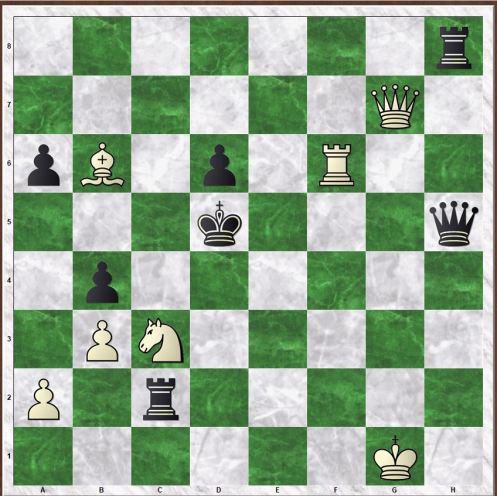
2…bc 3 Qb7+ and Black can’t interpose Rc6: so 3…Ke5 and 4 Qe7+ starts a check, check, mate sequence.
2…Rc3 3 Qg2+ Ke5
and White mates. How? – I will post tomorrow.
FEN
7r/6Q1/pB1pkn2/7q/1p6/1P6/P1r5/1N3RK1 w – – 0 34
Today’s problem is from the same game as yesterday’s. Seeing the ending on YouTube, I recalled I saw Jon’s fine game when it was played, thirty years ago.
Since the start of 2018, I have decided to adopt the style of only saying which side is to play: and not giving an idea if the move wins or otherwise, unless on occasion I think signposting would be helpful. Instead, the problems are posed with the instruction to decide what you would play, as in a game.
Black to play
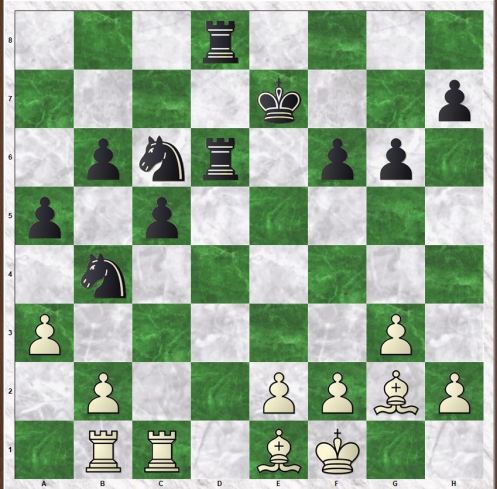
Psakhis v Speelman, Hastings 1987
Solution
Well, I would never, ever, play the move Jon played. I would always meekly move back 1… Nd5 or 1…Na6 but Jon played the stunning 1…Na2!!
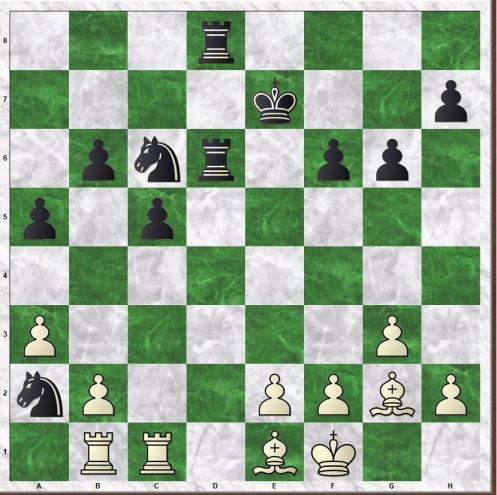
One point is 1 Rc2 Nd4 2 Rd2 Nb3, and the Na2 won’t be trapped. Lev played the stronger 2 Rc4 met with by 2…Nd4
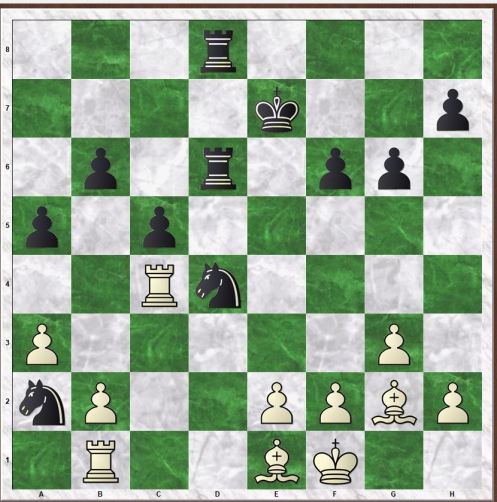
White played 3 b3, and eventually the game reached the position in yesterday’s puzzle. My engine tells me that, contrary to what I thought, 3 Ra1 is winning: 3…Nb3[] 4 Ra2 Rd1 5 Re4+! Kf7
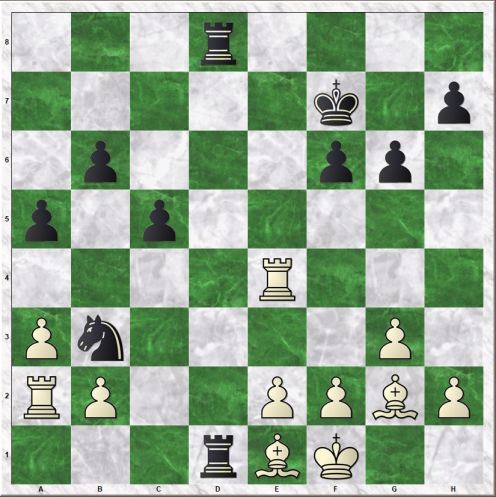
6 f4; and now the point of 5 Re4+ is revealed: 6…Nd2+ 7 Kf2[] Ne4 and the Re4 is protected, 8 Be4.
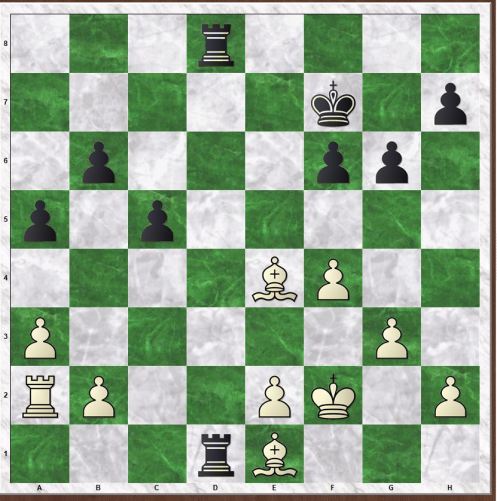
And the engine gives +2, which means White must be able to untangle.
FEN
3r4/4k2p/1pnr1pp1/p1p5/1n6/P5P1/1P2PPBP/1RR1BK2 b – – 0 21
 allanbeardsworth