Circular motion, and banking of roads: help with homework
This blog comes from a question my fifteen year old daughter, Sophie, asked me about her physics homework last week. The answer to it has taken about 35 years, so either find something else to do, or settle down for some maths, physics, and revelations about my psyche; and a bit of Latin thrown in for good measure.
First, praise where it is due to Wikipedia, which has helped me where Bolton School and Cambridge University didn’t – or maybe, I didn’t let them. A lot of what follows starts from reading various Wikipedia articles, together with thinking during an hour in the gym yesterday, and thinking during dog-walking. That is what comes from ‘helping with homework’. [Sophie just wanted the answer, as I did at her age].
Centripetal force
Why does the Moon orbit the Earth, a ball on a string circle, a car go round a roundabout? Inertia would make the body go in a straight line where it not something, be it gravity, tension or engine power which causes rotation- the centripetal (petere, to go to, or to seek, Latin) force.
I was also taught at school, and university (where I read Engineering) to think in terms of there also being a centrifugal (fugere, to flee, Latin) force pushing the object out; never quite explained why, never quite understood, but, and this is an important point, accepted and as a practical tool for analysis, very useful- I think during university I understood that centrifugal forces weren’t real, but were a mathematical trick to turn a dynamic problem into a statical one, but I also think there was some conning going on, the teachers or lecturers knowing it worked in practice for analysis…a sort of simplification. Perhaps sometimes it is not worth thinking too hard.
Now, in 2013, there are various pages on Wikipedia explaining that how circular motion is taught has moved on, and now (ignoring something different, the reactive centrifugal force in some motion) there is no attempt to pretend that centrifugal forces exist. I do like this honesty: maybe it is because the audience of Wikipedia is wide, comprising both readers who want an appreciation, to those who want a true understanding.
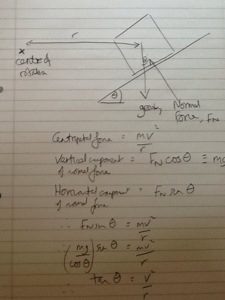
It is quite hard to show, but I think fairly understandable, that the centripetal force is mv^2/r, where m is the body’s mass, v it’s velocity, and r the radius of the circle. This is the maximum speed a car can go round a bend. If it were to go any faster, it would spin out of control, moving outwards…the centripetal force provided through the engine/traction/friction being overcome by inertia.
Normal force
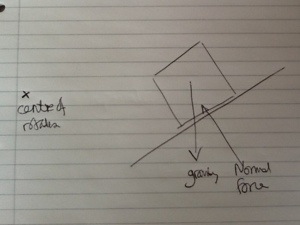
Two touching bodies exert a so called normal force on each other: the reasons vary depending on circumstance: gravity being the most common. I am writing this blog on my iPad on the kitchen table. Gravity presses the iPad down onto the table, and the table exerts an upwards force on the iPad, stopping it falling: Newton’s third law.
With my iPad, and with a car banking on a flat road, the Earth’s normal force is vertically upwards, equalling the gravity and other forces pushing the car down (the other forces being the aerodynamic ones, which can push a car up or down, just like a plane’s lift).
The diagram above shows an object, say a car, moving round on a sloped bank. Here, the normal force can be seen to push the car both upwards and leftwards, leftwards being towards the centre of rotation. This leftwards (horizontal) component of the normal force is an additional source of centripetal force (additional to that provided by the car’s engines through it’s tyre’s contact with the road) thereby increasing the maximum velocity.
Real life examples
A miscellany of things follow on from this, such as:
Cars with tyres with good tread can go faster round bends, since the better tread gives higher centripetal force, through traction/fraction;
Cars must go round icy bends slower, for the opposite reason;
Motorbikes or even cars can circle Walls of Death, providing they go fast enough. If you look at videos such as this one on YouTube, http://m.youtube.com/watch?v=fNM9GFV9adg I think it is no coincidence that they have thick tyres (please don’t try this at home, and no, I don’t want a Wall of Death experience voucher as a present, ever))The spinning ball on a roulette wheel goes round and round until friction and air resistance slow it down, after which the slope of the wheel means it collapses into its final resting place (I hope it is your number).
Maths
To end with a bit of maths, have a look at the second diagram below, which annotates my earlier diagram. The maths shows that v^2/rg=tan Θ. So, the maximum speed is independent of the mass of the object (which makes sense, ignoring things like air resistance), decreases with reduced radius (which is why ice skaters narrow themselves when spinning, to go ever faster, and then widen themselves out, to gracefully slow down), and really high speeds are needed to do the Wall of Death, since tan 90 is infinity.
Help with homework
Does this help with your homework, Sophie? Is there anything more that I can help you with please?
 allanbeardsworth
Nice. But the g got dropped. It will be tan Θ = (v^2)/rg.
Thank you for pointing out the typo. I have corrected it in the posting.