Cordingley puzzle 30
White to play and win
(one worth studying and when you find a good line, find a better one)
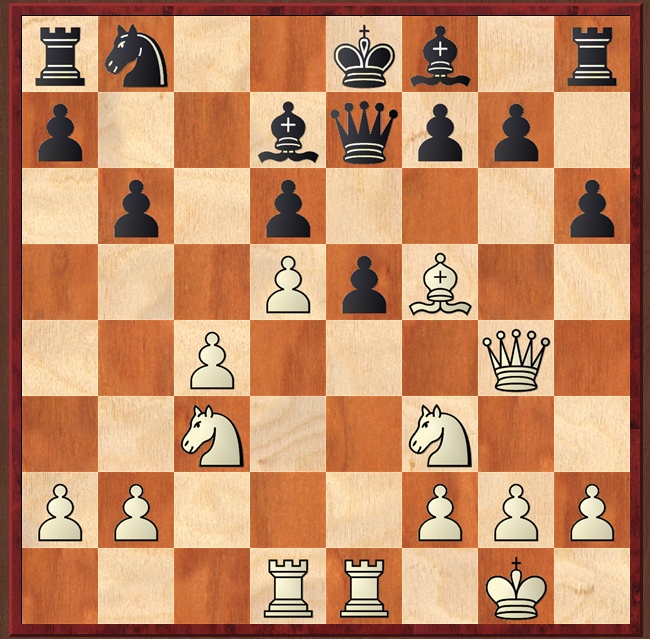
Solution
The first move I thought of, 1 Nd4, playing on the white squares, is sufficient for a good advantage. However, I quickly landed on 1 Ne5!, which was the move played in the game; and I was pleased with myself that I analysed it pretty well, including finding good lines against black’s various defences. The single exclamation mark is important, as we shall see below.
Once I felt I had explored enough I started to write it up in the Chessbase database that I have created for this project. It became a Kramnik-Leko moment (from the 8th game of their 2004 World Championship match, a Marshall, where Kramnik lost right from the opening, due to the same issue: leaving the engine on longer in his preparation would have flipped its evaluation from = to loss. Below is the evaluation after a short while of computation.
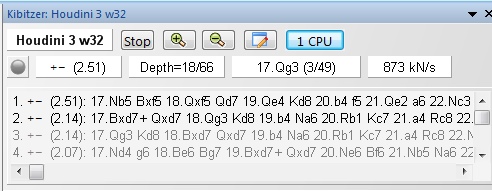
I decided to give Houdini, on my four year old PC, some more time to think. What better than to go and make a cup of tea, the traditional British way to permit time to pass: to see whether 17 Ne5! would appear, and if it didn’t, plan to understand why not. I also at this stage checked the game continuation, and it was indeed 17 Ne5!.
Tea cup in hand, this was now the evaluation:
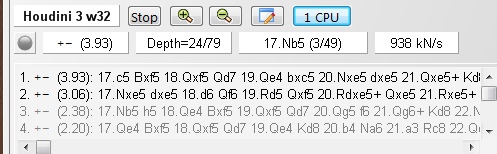
So, 17 Ne5! has appeared, and wins, but a totally new move, 17 c5!! is even stronger. I have written up some analysis in the attached PDF (and also included some light comments on the earlier parts of the game- white could have played even better a move or two before the diagram) and think the position is worthy of further self study and reflection.
I think the reason, of the reasons, why 17 c5!! is strong is quite deep and multi-faceted: and can be used as examples of several features of chess.
When you see a strong move (Ne5), look for an even better one.
Examine all biffs (CJS Purdy) – here Ne5
LPDO (Nunn)- it is clear from a cursory analysis that the Ra8 is in danger of LPDO; but the other rook is also in LPDO danger, and had I focussed on this, then I would realise that if ever black played …g6, biffing what was on f5, then a Ne5 and Qe5+ combination would win the rook
c5!! also creates a weakness on c5, once the b pawn has taken it, and after the following Ne5 combo; the Nc3 will come to e4 or a4 with force; and
c5!! also opens the fourth rank, for white’s queen to come over to a4, for the decisive pin in the main variation.
The last point is very deep, too deep for me to spot without an engine: maybe, stronger players would see it by looking generally at opening lines, for urgency, before black can develop.
 Posted with Blogsy
 allanbeardsworth