Karjakin- Topalov: a hidden tactic, and comments on the endgame.
I have just been looking at the current postings on yesterday's last round in the Norway Chess 2013 tournament. Chessbase's just has its express report, but Chessvibes has some analysis. I was struck by Topalov's comment in the diagram below.
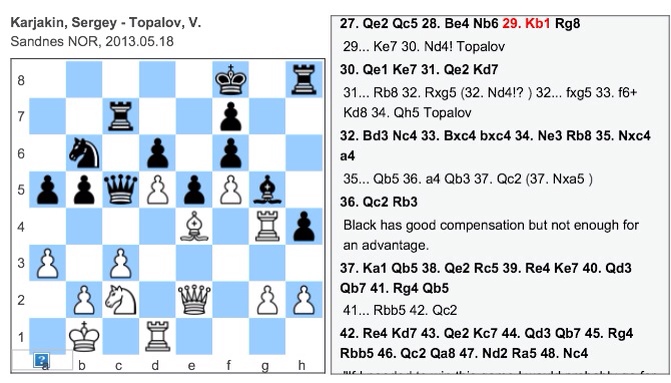
Why does 29…Ke7 permit 30 Nd4! ?
This stumped me for a while. Clearly, the knight has to be taken- it would be a monster if it reaches c6; but (after 30…ed4) 31 Bd3+ isn't anything, but instead 31 cd forces Qd3, after which 32 Bd3+ picks up the queen.
But why is 30…Ke7 possible? (After 29…Rg8 30 Qe1)
Because now, after 31 Nd4 ed 32 cd black isn't forced to play 32…Qc4?? but can instead play 32…Qc1+!!, and now with the white queen on e1, all it becomes is a piece swap.
Comment
This tactic reminds me, once more, how much there can be in such 'fiddling about' positions. It is so easy to think 'nothing is happening' and walk into a trap: and of course sometimes one's opponent will instead be the hapless victim.
Further detail
I was pleased to be able to find the small nuance that makes all the difference: the geometric alignment of the Kb1 and Qe1 makes Qc1+! succeed, when otherwise it would fail, and also note that white can't fiddle his K out of the way, since a1 is still on the first rank, and a2 permits Qc4 with check. But in pondering all this, I wondered 'is it clearly level even after the pawn swap?' I decided to set the position up:
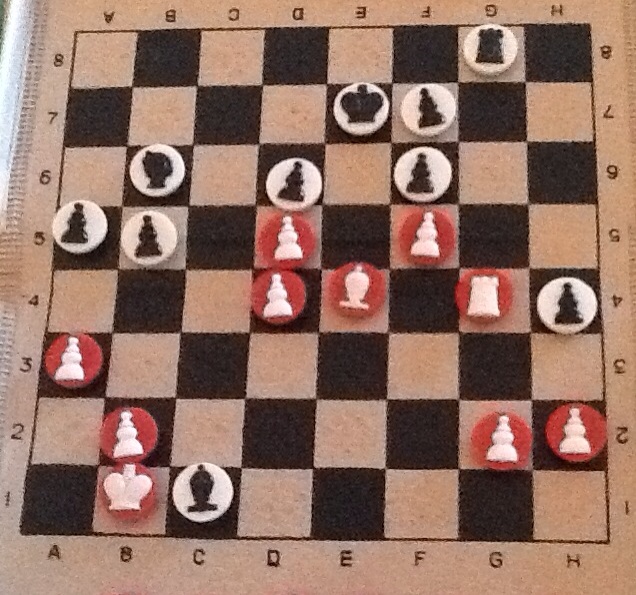
(position after 32…Qc1!! 33 Rc1 Rc1+ 34 Qc1 Bc1). White's best is clearly 35 Rg8, when he is the exchange up: my first thought was that 35…Bg5 holds, but then 36 Rb8 and after 36…Nc4 37 Bd3! (37 Rb5? Nd2+ picks up the LPDO Be4, though I suspect even then white might be winning: black's bishop is 'a pawn' and the Ne4 can't get over to the queenside fast enough). However, 35…Be3! is the move: 36 Rb8 Bd4 or 37 Rh8 Bf2.

I would suspect this position is tending to a draw: but isn't drawn for sure. White might first play b3, seeking to keep the Nb6 out of c4; with the hope of Kc2-d3. But black can play a4, either before or after white has played b3: and later, in some lines, Kc3 can be answered by Be1+, keeping white's king away from b4.
However, maybe white is better: Bd3, perhaps prefaced by b3, exchange the b5 and d5 pawns (if black does play a4 in response to b3, white doesn't exchange pawns, leaving that option to black, so black has to retain his weak pawn on b5). White has more shuffling around possibilities than black, with black's freedom being harmed by his king being locked in, so that sometimes Be4-d3-b5 comes with check. There's even a mate in one line:
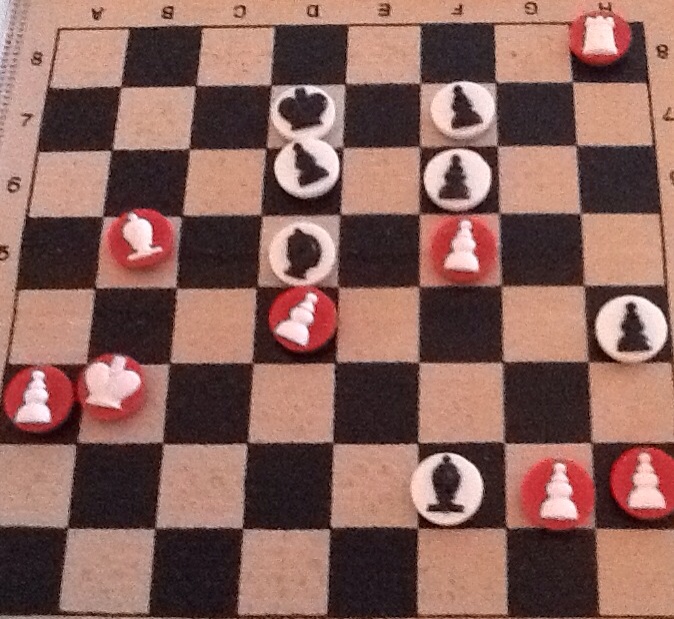
(Position after b3 a4 Kc2 Kd7 Bd3 ab+ Kb3 Nd5 Bb5+): if Ke7?? Re8 mate, so Kc7 is forced: white might then be winning, first improving his bishop, say to f3 or e4, though black's knight does cause problems, for instance on e3, hitting f5 and g2; and if white plays the prophylactic Rg8, then Ne7 forces mass exchanges.
Magnus Carlsen would win the position after 34…Bc1 in practice; Karsten Mueller would be able to work out if it was winning in theory. Maybe it is true to say that the position after 34…Bc1 is an improvement for him when compared with the game continuation, and he can hardly be losing….so maybe (ending with doubts of my analysis/abilities, and not wanting to check with engines) I have simply missed something. Perhaps others will comment on the game.
 Posted with Blogsy
 allanbeardsworth
After 29…Rg8 30 Qe1 Ke7 31 Nd4 exd4 32 cxd4 Qc1 doesn’t this line leave a black rook hanging on g8? Or am I missing something here?
Great post as always!
Yes, indeed, it leaves the Rg8 hanging; but my reason for looking at the resultant position was to see if, despite this, it was a draw: white’s Be4 is (at present) blocked in, so it could have been that black had just enough for a fortress.
In fact, he doesn’t; see my next post. The Be4 improves itself, Be4-d3; threatening b5, and it is soon over.
In my next post I explained some of this, and also showed Houdini’s immediate bust of my line.