Cordingley puzzle 118 #chess
White to play and do something
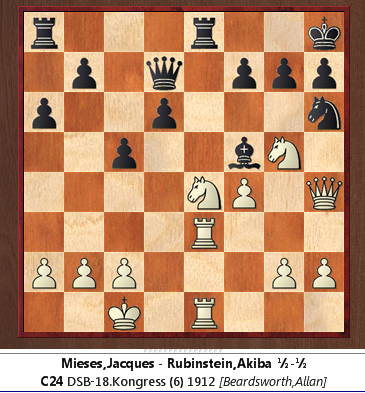
Solution
I thoroughly enjoyed this one. My first thought was 1 Nf6, but I didn't have great confidence in it, so I also looked at 1 Nc5, 1 Nd6 and even 1 Qh6, all to no avail. Since I loaded several games at once into my Chessbase file I am preparing for the Cordingley puzzles, I noticed that this game was drawn, so I was somewhat puzzled, but- I don't know why, it just did, the puzzle appealed to me.
I quickly returned to 1 Nf6 and tried to make it work, eventually seeing 1…gf 2 Qh6 fg 3 Qf6+ Kg8 4 Re7 and considered it to be very painful for black. I eventually saw that 4…Bg6 might not be losing, and 5 Rd7 Re1+ 6 Kd2 Rae8 was a position I couldn't properly evaluate, but I thought that white probably wasn't losing, and might be better by swapping a pair of rooks off with 6 Rd8. In fact, Houdini tells me this position is more or less equal.
Cordingley was double-wrong in his analysis. Firstly, he thinks the above line wins for white, only going as far as 4 Re7; instead, he prefers the game continuation, 2…Bg6 when after the obvious continuation 3 Nh7! Bh7 he gives 4 Rg3, when black can force a draw by perpetual, as in the game, but in fact white can improve by 4 f5!!, a move which Houdini found: it looks like white has an advantage in all lines, but I for one would find the variations impossible to fathom with confidence, and impossible to play with any precision. But, technically, this puzzle is double cooked: the drawing line doesn't draw, and the losing line doesn't lose.
 Posted with Blogsy
 allanbeardsworth