Cordingley puzzle 130 #chess
A double puzzle day (explained below)
White to play and win
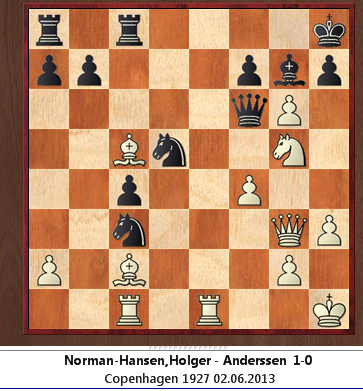
White to play and win
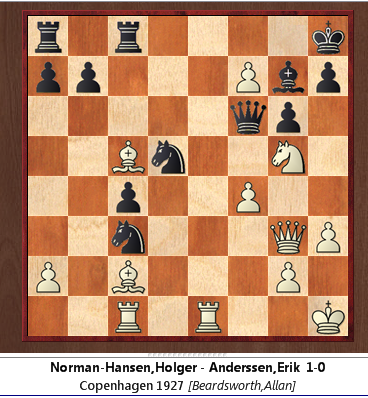
Solution
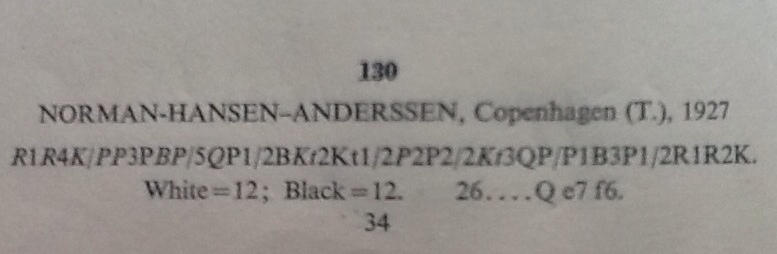
It had to happen. Since this puzzle's number ends in 0 (or 5), I had to either set the position up on the board, or find it in Megabase or by googling. In this particular case, the game isn't in Megabase 2012 and nor could I find it online, so I had to set the pieces up, and in so doing, set it up as in the first diagram. This then was the problem I tried to solve. Note that when using the FEN diagram, I do a piece count check, Cordingley helpfully stating how many pieces each side has: twelve each.
Alas, the FEN description is wrong, and I also misread one piece- I do find, with my eyesight, that distinguishing between his italicised and straight letters somewhat hard, but the first diagram is not unbelievable, the g6 pawn could have got there somehow, and the K could be on h8.
So, I have spent a few sittings trying to solve the first diagram. It took me a while, longer than it should, to find 1 Nf7+ Kg8 2 Bd6!, coming to e5, and demolishing black; I also then found the flashier move 1 Bd6!, but rejected it, not properly delving into it: 1…fg 2 Re6! or 1…fg 2 Qh4! h6 3 Be5 are terminal.
Happy, turned to the solution, and found a nonsensical line: and then found that the pawn on f7 is a white one, which is what Cordingley's FEN actually shows, and I suspect that his error is that the g6 pawn is black.
Alas, I therefore haven't been able to attempt to solve the game position, diagram two. I hope readers did, because it is quite pretty. The Bd1! deflection isn't entirely new to me, but isn't easy to see, and the Bg7+! ending is also nice.
 Posted with Blogsy
