A challenging problem #chess
White to play and win
The following is a position which really interested me, and I would suggest is worth exploring.
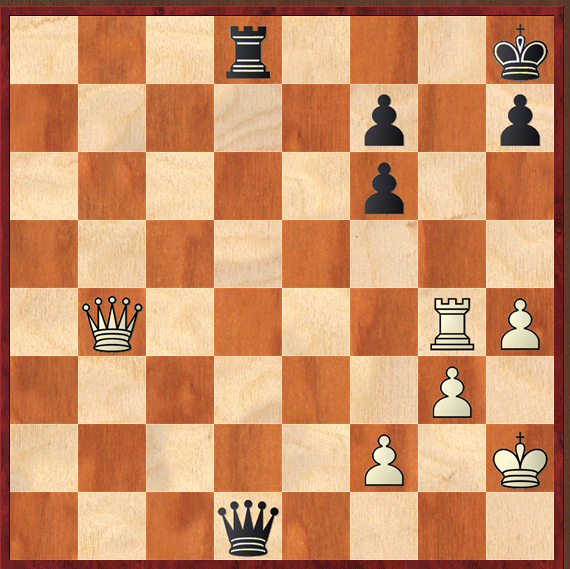
Source: Chess Today, issue 4715; Gunina (2506) – Goryachkina (2436), 63rd Rus ch. w, Nizhny Novgorod (1) 5/10/13
Solution
From time to time, I get behind with my daily reading of ChessToday, and this has happened recently. In such cases I try to take a bundle with me when on a trip or holiday, as last week. I enjoy many aspects of this daily newsletter but particularly the problems. On the bunch of papers I took away with me this time, most I solved with little difficulty, but the attached position stumped me. I cut the position out, and had it with me for my flight home.
The move I wanted to play was the terrible 1 Rd4, which only works against the equally terrible 1…Rd8: when 2 Qf8mate follows. But the motif of back rank mate proves illusory, and eventually I settled on 1 Qe7! being the solution, which indeed it was. The main sideline is 1….Qd6 2 Qf7 Qf8[] 3 Rg8+! which is a pretty way to emerge two pawns up in a pawn ending; but the main continuation is 1…Qg4 2 Qf6+ Kg8 3 Qd8+ Kg7 when the question is 'to exchange queens or not'?
To swap or not to swap?
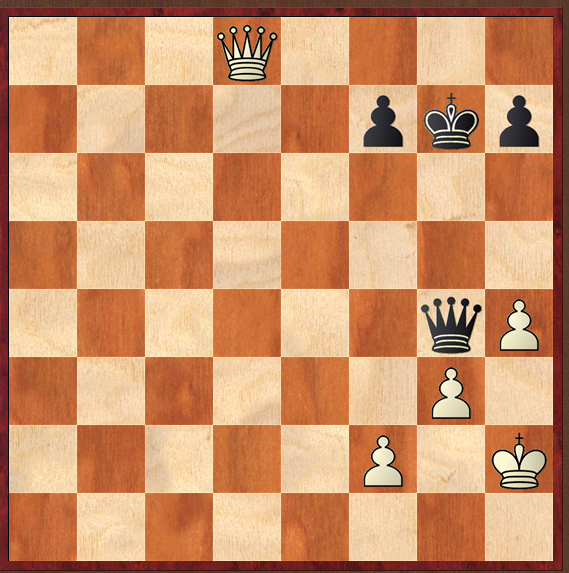
I intuitively knew the best move had to be 4 Qg5+! swapping queens off, but was also aware of the advice to never simplify to a pawn ending unless you can calculate it to the end. And yet I couldn't calculate it precisely, and not being a Russian schoolboy, has some doubts that the position with 3P v 2P was a win, with one pawn being doubled. However, I also sensed that keeping queens on by say 4 Qd5 might not be sufficient for a win: eventually black would have a checking field day. So I plumped for 4 Qg5+!, calculated ahead a bit further- 4….Qg5[] 5 hg[] Kg6 6 f4[] h6 7 fh[] Kh6 and stopped: this was about all I could see from the initial position in my head, and there was no way I could be sure that it was winning.
White to play: is it a win?
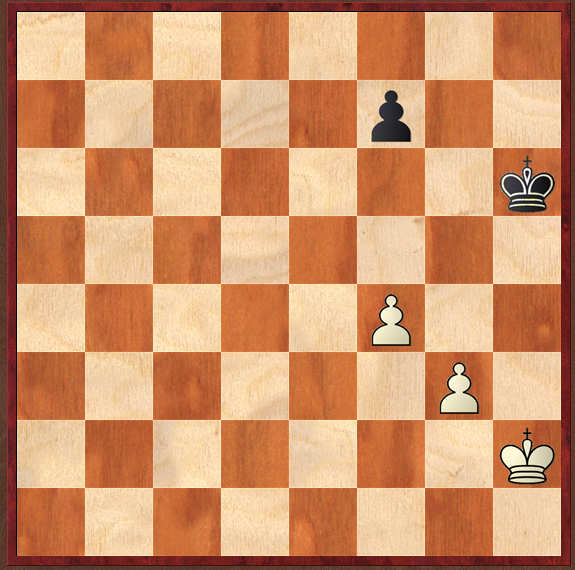
So, I looked at the solution, saw I was spot on, and was pretty pleased with myself. White won the above ending sure enough.
The pawn ending
I think it is a sign of age, but in recent years I have become more interested in studying endgames, including basic ones: alas, never having had a trainer or anyone to guide me, my childhood talent developed in a totally unstructured way, and apart from a cursory dipping in to Reuben Fine's Basic Chess Endgames- the only endgame book I had as a child- my knowledge of endgame theory is woeful. But I decided to play the pawn ending out against Stockfish- I was on a plane journey returning from holiday in Turkey, and it seemed a good way to pass away some of the flight.
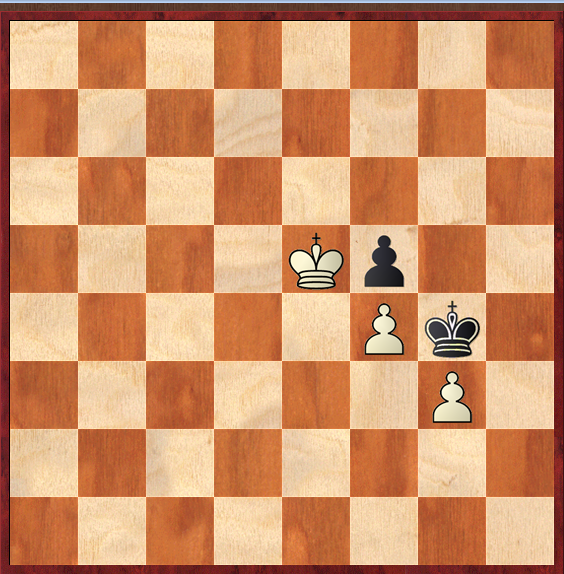
So 8 g4, a few other natural moves, and, suddenly, draw! Or 8 Kh3, a few moves, and again draw! I played Stockfish many times, got plenty of draws, and not many wins (fortunately I never lost to it). What was going on? I do have some vague recollections of the theory of corresponding squares, but very woolly. Eventually I got the main things in my head: eg to wait for black to occupy h5 before playing Kf3; the need to go around- to the centre/queenside, rather than try to squeeze through on the h file (there is no room) and some nuances about placement of king, and some tricks black has such as f5! In the position Ke4 Pf4 Pe4 ke6 pf6 with black to play. In many lines, there is also the winning motif of waiting for black's king to be adjacent to his pawn before bringing the white queen in, as in the following diagram: whoever attacks the pawn first, loses.
I then looked at the game continuation again, and seeing that the players' both did many things different to what I expected, decided to look with Houdini, and my attempts at an annotation are in the attached PDF .
If I am right, and I may not be, the pawn ending was a catalogue of errors, and the last error was in this position.
The last blunder
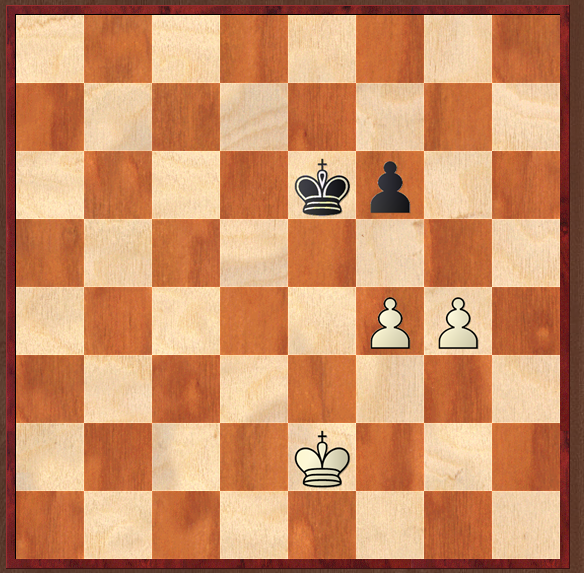
Black played Kd5?? whereas Ke7! I think draws. Black mirrors white's king, so if eg then 2 Ke1, then Ke8!.
I wonder if my analysis is right?
 Posted with Blogsy
 allanbeardsworth