Cordingley puzzle 223 #chess
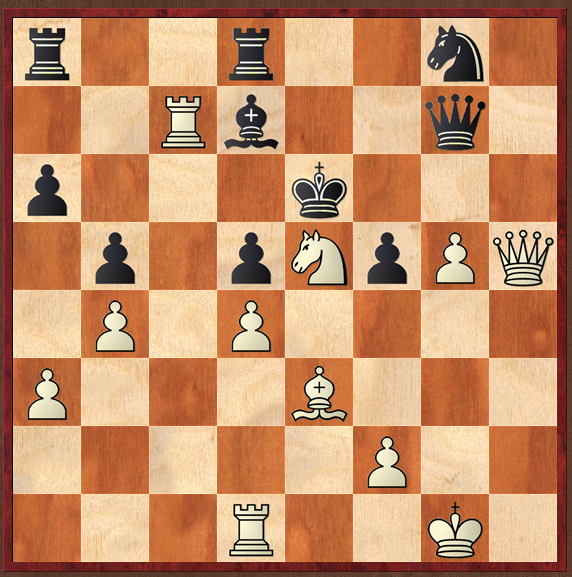
White to play and win
(one to try hard on: it will repay studying, looking for hidden depths)
Solution
A really tough, good, puzzle: a gem. I spent a good whole on it, got two good enough solutions, one of which is the prophylactic 1 Kf1! preventing 1…Nf6; the other, 1 Rdc1! being the move I plumped for 'since it was a puzzle' (I think I would play prophylactically in a game). Both of these win, as does the move Vidmar saw (as I did) 1 Nc6, when Tarrasch could have struggled on with 1…Nf6 sacing the exchange- the reason why I didn't opt for Nc6.
Houdini, by contrast, suggests two even stronger first moves. 1 Re1! and 1 Bf4!!- both have the same idea, to sac on e4 when black plays Nf6-e4, the idea I missed.
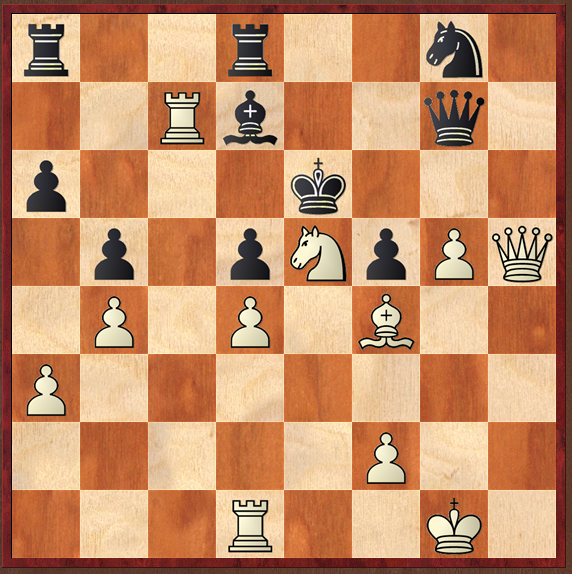
Houdini's preference 1 Bf4!!
After 1 Bf4 Rdc8 2 Re1! Nf6 3 Nc6+ Ne4 4 Re4+!! was the move I missed and why I didn't opt for 1 Bf4. It wins after 4…de 5 d5+! and 6 Qd1+.
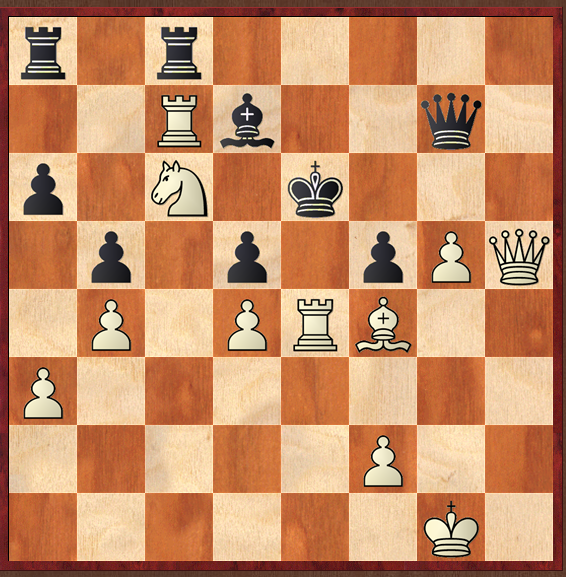
Extensive analysis
I give some fairly extensive, and at times beautiful, analysis in the attached PDF. The geometrical motifs are very noticeable. The pieces are used to best effect, for instance with moves like Qh2! eyeing c7/d6/e5; Qh3! pinning the f pawn and also threatening to swing over to b3; Qd1! also heading for b3.
I was pleased with my attempt at this puzzle, not that I saw everything, and upsetting that I didn't see the Re4+!! biff which is central to many of the lines. But I saw a good amount, including the prophylactic move Kf1, and Makagonov's 'improve your worst placed piece' principle which led me to two strong moves.
My analysis also makes brief comments on earlier parts of the game (a Tarrasch defence, played by the man himself). Houdini gives various earlier improvements for white.
 Posted with Blogsy
 allanbeardsworth