Easy or hard? #chess
The following position, from the game Banusz-Pap, ch-HUN 26/11/12 stumped me. From time to time I get very behind with my reading of Chess Today, keep old issues in a drawer, and then pull them out in preparation for a journey or other spare time. This puzzle was in CT4414 last year.
White to play and win
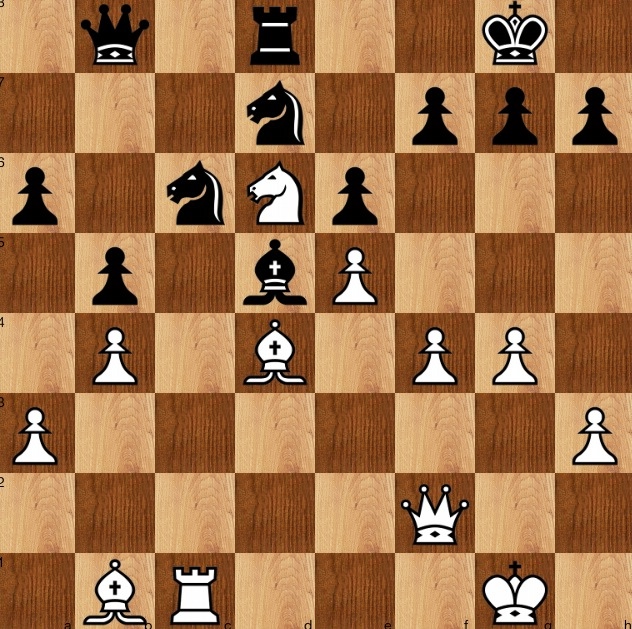
Solution
Now that I have solved it, I think is easy enough, but it took me two sittings.
I got distracted by the lure of complexity. 1 Rc6 Bc6 2 Qh4 when black has several ways to defend, ..h6, …g6 for instance. And I got excited by 2…g6 3 Nf7!! being pleased with myself to find 3…Kf7? 4 Qh7+ Kf8 5 Bg6 when black is helpless, and can't prevent mate- if Ne5 to free up the second rank then white has Bc5+.
I got drawn in to solving more variations. What if 2…h6? Should white then play 3 Qe7 or f5?
I went round in circles. Is 1 Rc6 necessary? Could the rook be used in another way?
I imagine and believe that I have read that pro golfers have a thinking routine, and a shot routine, which they train themselves never to vary even on the simplest of shots. Do the pro chess players? If I had slowed down, re-focussed, I could have followed Purdy's maxims, of which I have written several times, and which I know inside out.
Examine all biffs would have led to 1 Rc6!, which is intuitively obvious to me anyway. Then, after 1…Bc6, the same maxim, including examining all threats to biff would have led to 2 Qc2! which hits both h7, with carnage, or the LPDO Bc6. Solution found, and it was simple.
 Posted with Blogsy
 allanbeardsworth
Unfortunately as a beginner it’s probably beyond my skill level to work out, but I have to say straight away that 1. Rc6 Bc6 seems the obvious starting point. the c6 night just seems to be begging to be taken.