Test your chess: Reitstein problem 40
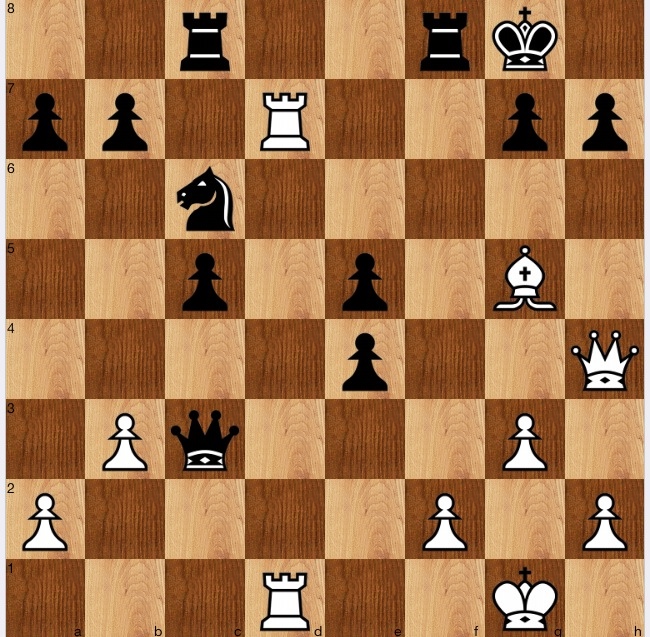
White to play and win
Solution
A calculation exercise, but not too hard. The first move is obvious, the biff 1 Rg7+, when 1…Kg7 is forced, and then 2 Rd7+. Putting a knight in the way is trivially bad, and doesn't change anything, so the only moves to look at are 2…Kg6, to check that it loses, and the probably better 2…Rf7.
So, 2…Kg6, and how to win? I sometimes find these hard, especially with bishop and queen, which can get in each other's way, but here the rook is in play too. So 3 Qh7+ Kg5[] 4 Rg7+ Kf6[] 5 Qg6 mate is in this case not too hard to find.
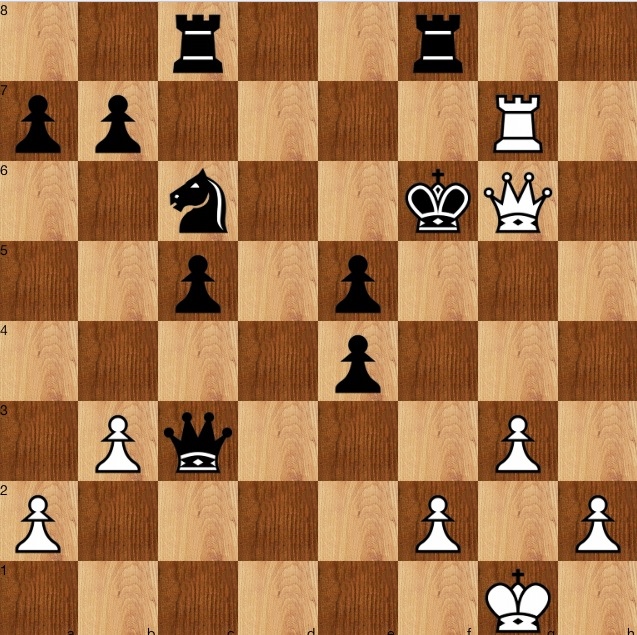
The better defence is 2…Rf7, and this requires some calculation. However, when you see that 3 Bh6+ forces black's king to move away from its defence of the rook, you realise it is not too hard: there is no need to look to far. 3 Bh6+ Kg8 (3…Kg6 4 Qg5 mate) 4 Qg5+ Kh8 5 Rf7 1-0.
Also, 3 Qh6+ wins, too, and this was the line I calculated: I think I have a general fault of often checking with the bigger piece (here, queen rather than bishop) and of thinking closer to the king is always good- it is better to examine all checks, and consider respective merits-but here, I was ok: 3…Kg8[] 4 Rf7 Kf7 5 Qf6+ and white is mating by force.
White to play and win (by force)
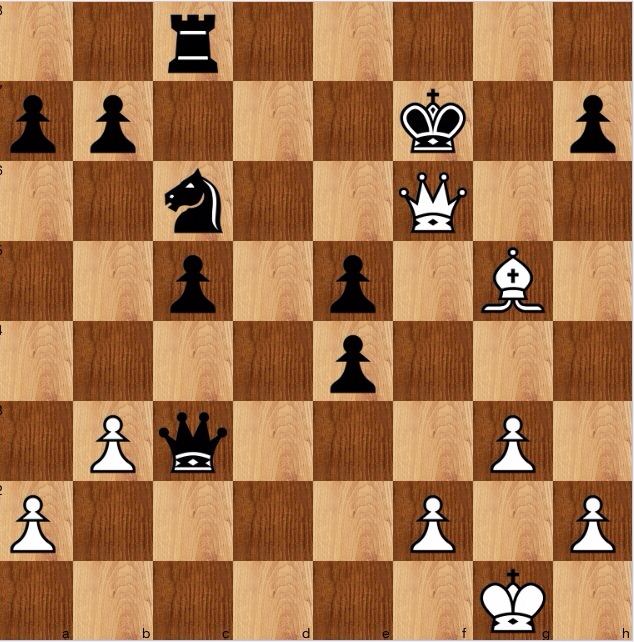
When I was solving the problem, and found Qh6+ rather than Bh6+, around here is as far as I got, but I did note that the Rc8 was LPDO and would fall after Qe6+: that, plus the fact that black had only one check, and no perpetual, gave me comfort, a 'stepping stone' to rest/end my analysis.
In fact, white has a forced mate: again, I find it not too easy to visualise. I also recall from ages ago a quote from Kasparov that Q+N combine better than Q+B, but here the Q+B does the job. 5…Kg8 6 Qe6+ Kg7 6 Bh6+ etc is one line, or 5..Ke8 6 Qe6+ Kf8 7 Bh6 mate.
 Posted with Blogsy
 allanbeardsworth