Another puzzle for an easy Reitstein day
White to play and win
(I found this difficult: before I give the solution, I also give below the 'hint' in the book in which I found this one, not that the hint made it any easier for me. But good to try first without the hint, and then if not solved, try again with the hint. It is worth spending a good amount of time, but not a great deal of time, on this one).
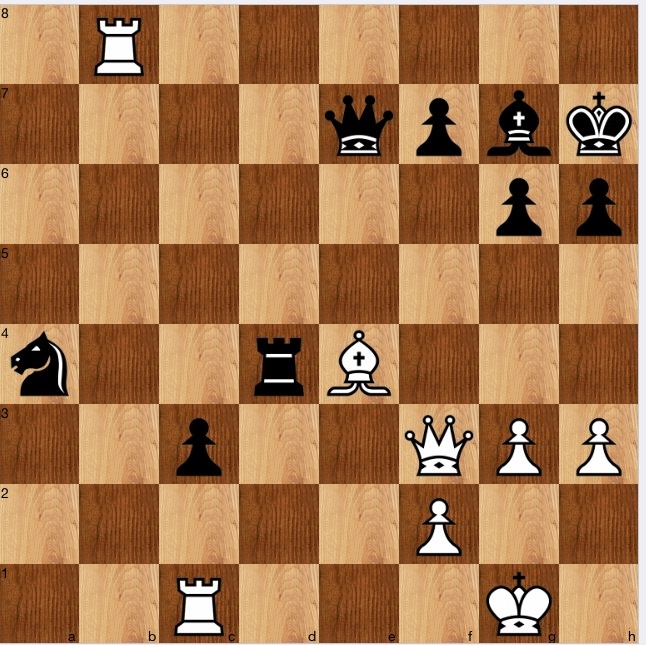
Viktor Korchnoi v Yuri Saharov, USSR championships, Kiev, 1964
Hint
The hint in the book in which I found this puzzle was as follows. 'Black's passed pawn on c3 seems to give him good chances, but he is destroyed by a steam of combinations'.
Solution
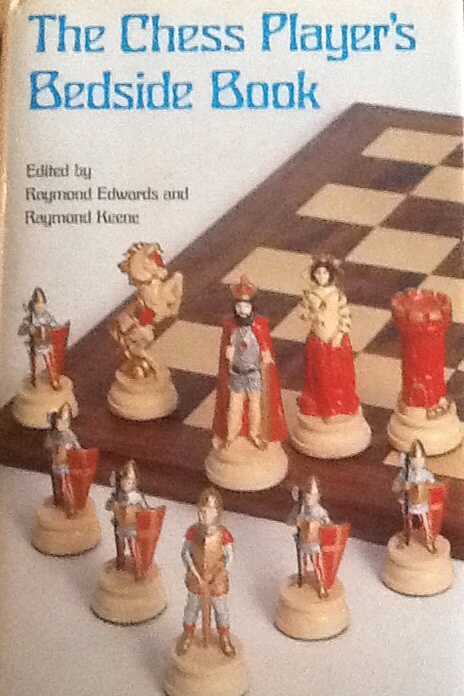
This was another puzzle in the chapter about Viktor Korchnoi in Raymond Edward's and Raymond Keene's 'The Chess Player's Bedside book', a lovely old book, a pot pourri of things for chess lovers.
I found this puzzle hard. In fact, the hint didn't help, and probably wasted my time, since it made me look for things that weren't there.
First of all, I tried various biffs, such as 1 Bg6+?? and threats to biff like 1 Re1, in that case trying to make something out of 1…f5 2 Rb7, to no avail. Before too long, I found 1 Rb7, but this is when my troubles began.
Firstly, I quickly saw 1…Qe4? 2 Qf7 when 2…Qe5 is forced, and 3 Re7 forces black to take the rook, and see if he can cobble together a defence. I suspected, but wasn't sure that white might have enough, with the combination of a weakness on g6 and a misplaced Na4, but with the worry of an advanced passer. However, on balance I felt this was the solution,
However, I couldn't solve 1…Rd7! trying 2 Re1?? (2…Rb7 3 Bg6+ fg 4 Re7 Re7, and black has too much booty: 0-1), 2 Bc6?, 2 Bg6+?? before quickly seeing that the line had to be 2 Rd7 Qd7 3 Bc6 Qa7 (or, Qd4) 4 Ba4 Qa4 5 Qf7.
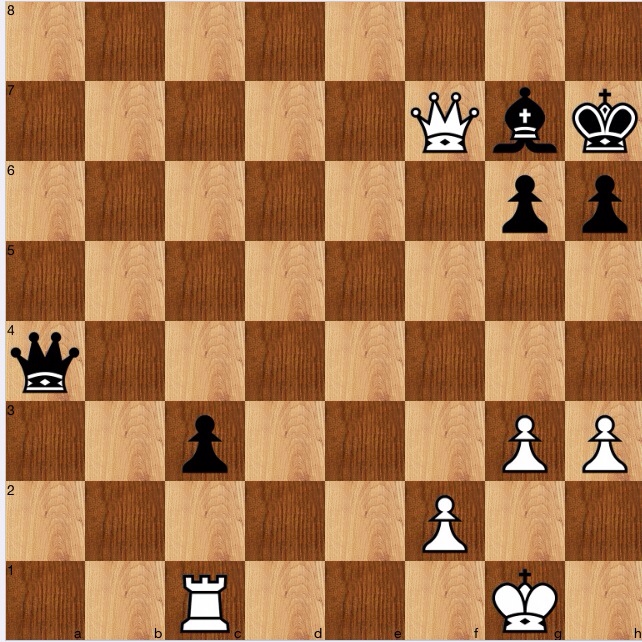
Problem was, I couldn't properly assess this position. I wasn't sure if the strength of the c pawn gave black sufficient to hold. Since (with some effort) I could hold this position in my mind, I was able to feel that eventually I could rearrange my pieces to give the Q the responsibility of guarding c2, so that the rook can be activated, but wasn't sure if that would be sufficient, with black always playing h5 to give luft and to prevent white from playing h4-h5. Now that I have played through the line with an engine, I see that the position is winning, with engine like accuracy by white, and, also, there is no need to proceed slowly: by clever heavy piece play, hitting the weakness on g6 and/or doubling on the seventh, eventually there is a zugzwang, forcing c3-c2, after which the pawn can be rounded up, some piece play to get back to zugzwang, and then it is game over. But this insight took me time with an engine to get confident about. (Of course, in a practical game, I would play the line down to Qf7 and then play on for two results.
Similarly, the moved played in the game, 1…Re4, is similar after 2 Re7 Re7 3 Qc6! Nb2, though it takes a Korchnok to then play 4 Rc3! Bc3 5 Qc3 and know it is winning. In practice, if I were white in such a position, it would be 50:50 that I could win, and it wouldn't take many less than perfect moves by me as white to fritter away the advantage- partly because I would be scared of releasing the rook by eg Rc1-a1-a6 up in case the c pawn were freed, but in the lines I have looked at the speed of white's double attack on g6 is overwhelming.
A game file, generated with Chessbase 12, with annotations, is here.
 Posted with Blogsy
 allanbeardsworth