An instructive position from Tromsø Olympiad
One of the players who I most like following is Matthew Sadler. His book, Study Chess with Matthew Sadler is excellent: written from the heart, written for the reader. One reason I enjoy watching his games are that he has returned to competitive chess after a long professional career: and he is competing again at the highest levels. Secondly, I like his style: he seems to be able to place his pieces well, apply pressure, find tactics. The sort of player I wish I could emulate.
Last night, I played through his round 9 game. Watching it live, I thought it was a tough, close battle: I couldn't see how Matthew (on the white side of what turned out to be a typical closed Ruy Lopez) would break through, and in fact, I feared that black's position was better, with white having a bad bishop. In the game, towards the end it still looked to me as if it was equal at best, when suddenly, tactics!, and it was all over: 1-0 to Matthew.
What has I misunderstood?
My appraisal of the position was in fact accurate: white was worse, and it was only a blunder by black (on move 47, so not in time trouble) changed everything. The reason for this blog posting is that the blunder is not obvious and is instructive.
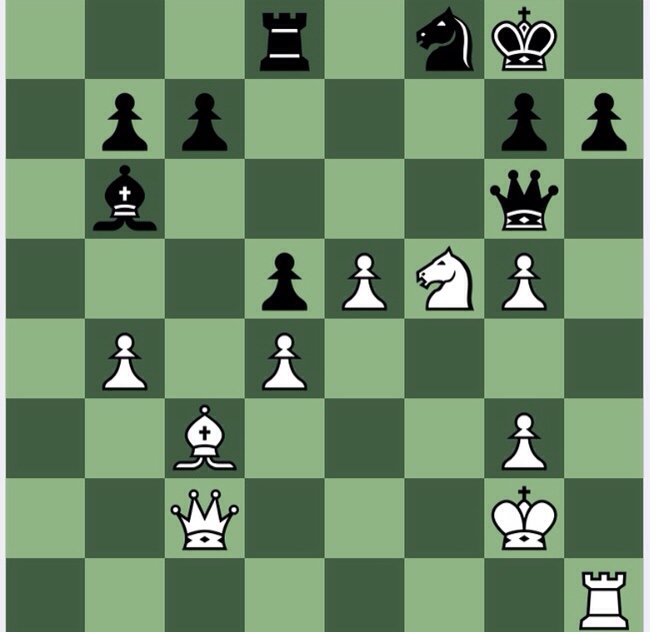
Black to play
Black has everything protected, by which I mean h7. All he has to avoid is the Ne7+ fork. Using the rook would be to waste it, king to the corner moves it away from where it would be needed in an endgame, so black played 47….Qg5??: a very natural move, starting to collect booty in readiness for the next phase of the game.
In fact, 47…Kh8! , with the idea of following up with Ne6 hitting d4, is very strong. The g5 pawn is not going anywhere, the Nf5 is pinned against the LPDO Qc2: black is better, and I would hazard near winning.
However, after 47…Qg5??, white is winning. 48 Bd2! reveals two things: taking on g5 as improved white's bishop considerably, and also black's queen is now in a net. 48..Qg4 is forced, since g6 is hit by the Ne7+ fork. Then, white has the rocket 49 Bh6!! and the game is over.
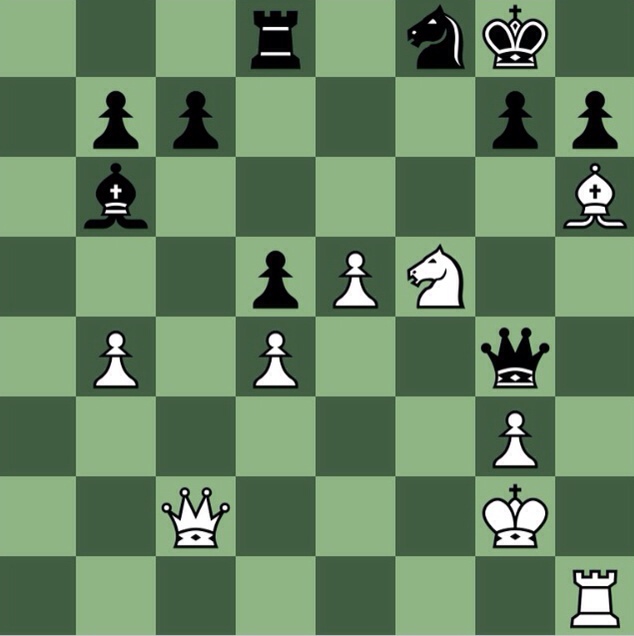
The bishop move has two motifs: the obvious one, is its aggression: hitting g7, and if the B is captured, then there is a Nh6+ fork. The hidden motif if that it threatens to trap the netted queen by Rh4 – so Bh6 also clears the second rank so that ….Qe2+ is not possible.
If 49…g6 black at best has created horrible black squared weaknesses in his king's defences. But 49 Ne7+ Kf7[] (49…Kh8 50 Bf8 and Ng6+) 50 Rh4 and white is dominant: if say 50…Qe6 then Bf8 and Rh7+
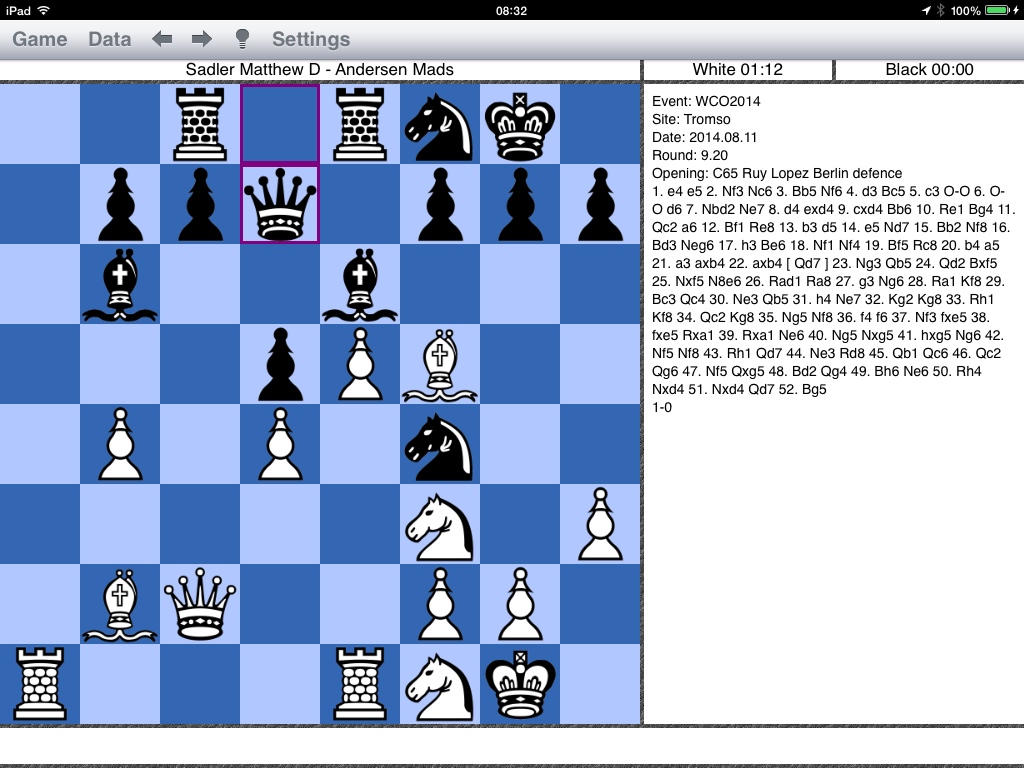
In summary, it is noteworthy how the capture results in a 360° change in the position. Playing more slowly, Kh8 and Ne6, would have been far stronger: the g5 pawn can be taken whenever: and the removal of the g5 pawn creates both a net for the black queen and new lines for the white bishop.
Instructive.
 Posted with Blogsy
 allanbeardsworth
Reblogged this on Chess Musings.