Test your chess: daily chess puzzle # 90
White to play and win, lose or draw?
Evaluate 1 Rg7
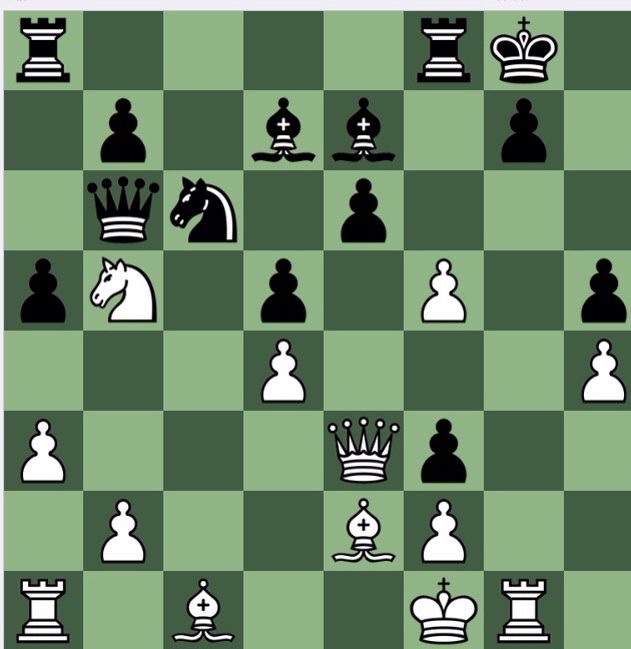
D Morschel v D Friedgood 1966
Solution
This problem is both easy and hard.
The hard element, to me at least, is looking forward far enough to see 'is there a win'.
There are two easy elements:
I) white's position is loose, and if black has a move or two to shore up his defences, such as Bf6 (which also attacks the key Pd4), then it will soon be 0-1;
2) it is easy to see that there is at least a draw.
So, 1 Rg7+ Kg7[] 2 Qh6+ Kg8 (2…Kf7 3 Qg6 mate) 3 Qg6+ and if nothing else, Qh6+ Qg6+ forever.
So, the position below is a stepping stone.
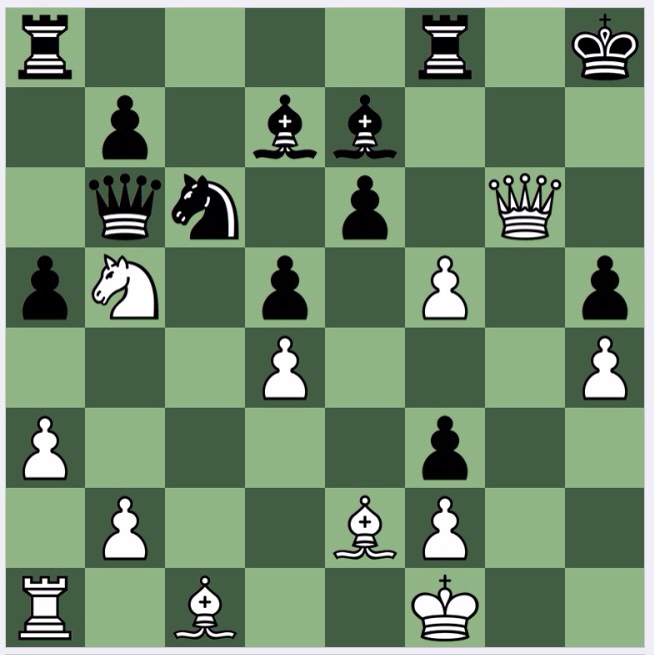
Win or draw?
The first line I looked at was 4 Bh6, with the idea of 4…Rg8 5 Qh5 with the hope of Bf8 mate, or similar. However, 5…Be8 kills the idea, so 4 Bh6 is a blunder, 0-1
The only other move is 4 Bd3, or to show better technique, first insert 4 Qh5+ and 5 Qg6+ to gobble a perhaps important pawn. So, 6 Bd3. My first try for black, 6…Nd4, got me excited for white, since 7 f6! Nf5 8 Bf5 (threatens both Qh7mate and Qg7 mate) forces 8…Qb5+ 9 Bd3[] (9 Ke1?? Qe2mate; 9 Kg1 Rg8 pins and wins) 9…Qd3+[] 10 Qd3[] Bf6 11 Qf3.
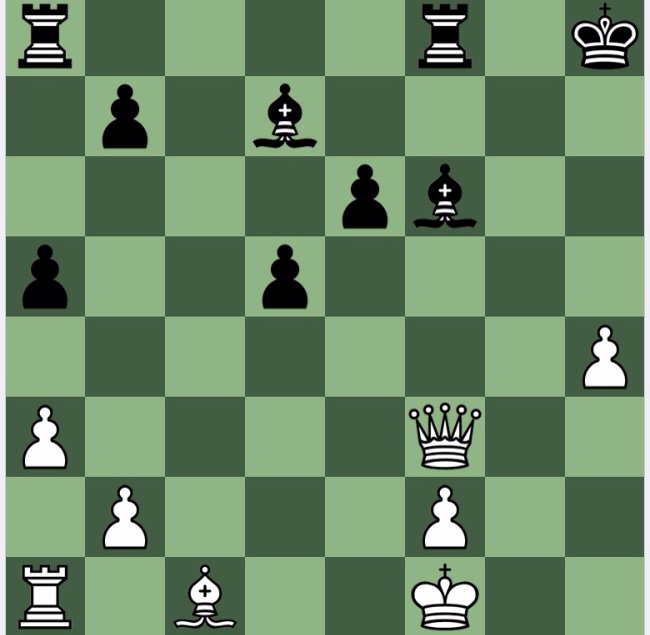
This was the limit of my calculating vision, and I couldn't evaluate it in my head properly. In fact, the engine says it is +2, though I suspect the human evaluation is lower: all three results are possible.
A small point on technique: if white stupidly doesn't bother with the free checks picking up the h5 pawn, then in the above position, plus a Ph5, black is closer to equality: Be8 defends.
However, after 4 Bh6, both 4…Ne5! and 4…Rf6 preserve equality.
So, in fact, the position is drawn after 1 Rg7.
A good work out.
 Posted with Blogsy

Reblogged this on Chess Musings.