I will start the New Year with a fairly random selection of moves seen during 2016: skewed to the last few months, since I only thought of making such a selection in December, and then had to try to recall some of my favourite moments.
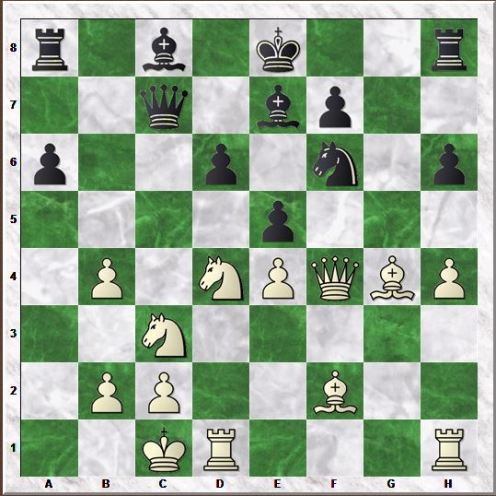
Solution
1 Qf6!!
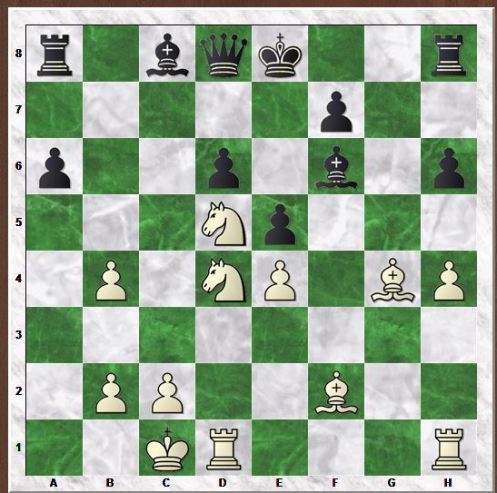
FEN
r1b1k2r/2q1bp2/p2p1n1p/4p3/1P1NPQBP/2N5/1PP2B2/2KR3R w kq – 0 19
I will start the New Year with a fairly random selection of moves seen during 2016: skewed to the last few months, since I only thought of making such a selection in December, and then had to try to recall some of my favourite moments.
White to play and win
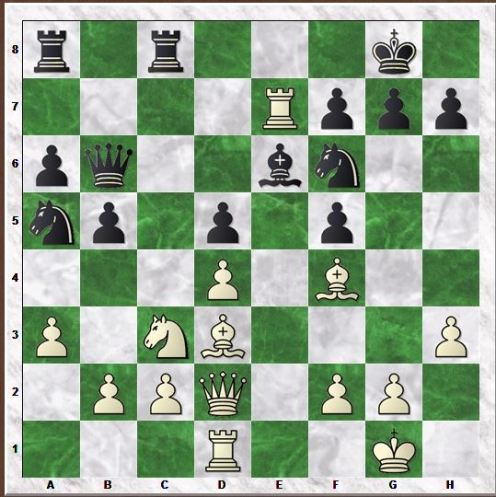
Jobava-Ponomariov, Baku Olympiad 10/9/16
Solution
1 Bh6!!
Incredible: what class to think of such a move. For the game continuation, see my Cloud Database (the game file it includes was, I think, but am not sure, pasted from Chessbase.com, my main source of chess news).
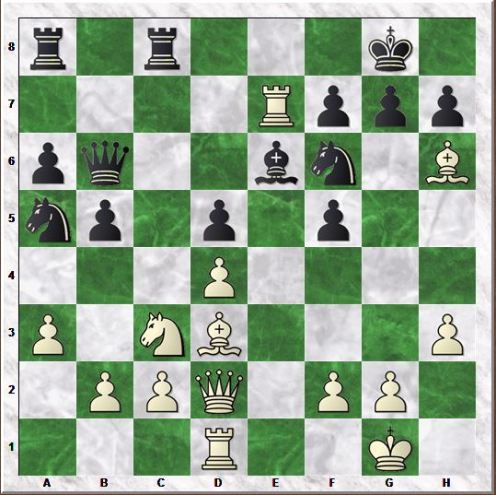
FEN
r1r3k1/4Rppp/pq2bn2/np1p1pB1/3P4/P1NB3P/1PPQ1PP1/3R2K1 b – – 0 17
ChessBase Cloud
http://cloudserver.chessbase.com/MTE3NjQ2/replay.html
Another puzzle from Dragoslav Andric’s 1981 book “Matni Udar”.
Black to play and mate White
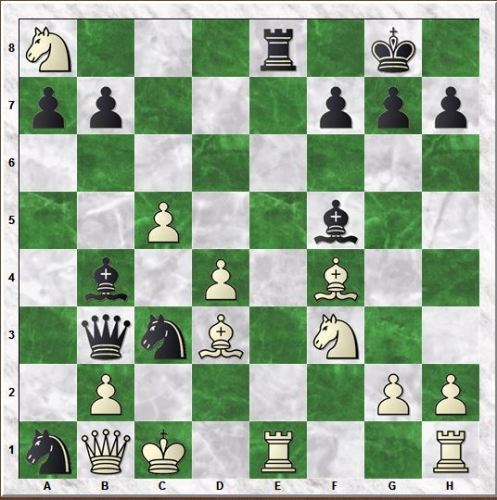
Druganov v Panteleev, correspondence 1956
Solution
It is fairly ‘easy’ to see what must be done: find a way to clear the b1-h7 diagonal and the b3 square, so that Nb3check can be mate: but how to do it? Especially because White threatens mate in 1.
Eventually I saw the one and one path
1…Qd1+! 2 Rd1[] Ne2+! 3 Be2[] Nb3 mate.
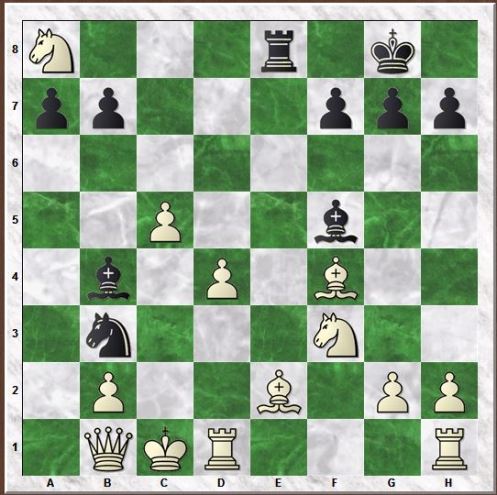
Pretty.
FEN
N3r1k1/pp3ppp/8/2P2b2/1b1P1B2/1qnB1N2/1P4PP/nQK1R2R b – – 0 1
ChessBase Cloud
I have recently upgraded to ChessBase14, and from now, will add puzzles to a Cloud database- or, at least, will give it a try, to see if it works.
http://cloudserver.chessbase.com/MTE3NjQ2/replay.html
A follow on from yesterday’s puzzle.
Why doesn’t 1…f4 win, when 1…Bg3!, with the same idea, does?
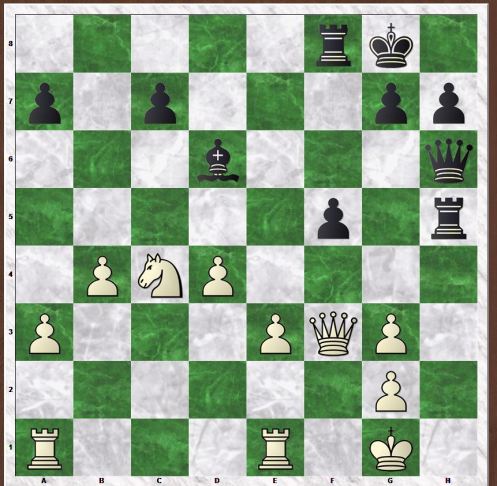
Kramnik v Bareev, Kazan 29/12/1997
Solution
The position is all about move orders. 1…f4? is similar in intent to 1…Bg3, to bust open the f file, but 1…f4 2 ef (or 2gf, transposes) Bf4 3 ef Rf4
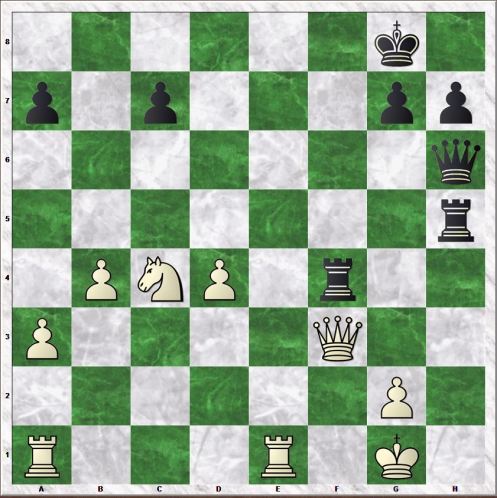
4 Re8+ Kf7
The critical position
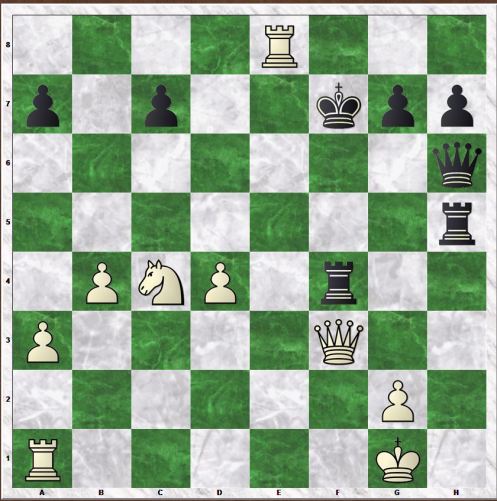
And it is all going so well for Black, except for 5 Nd6+!!, the move I missed, and at best it is a draw. Black can easily lose, either his Rf4 or be mated.
My analysis, using the more colourful, readable design of the new ChessBase 14, is shown below. 5 Nd6+ is a desperado, and so in practice many people would find it if faced with the position, but its strength was a surprise to me. Black has a narrow path to a drawn Q+P ending.
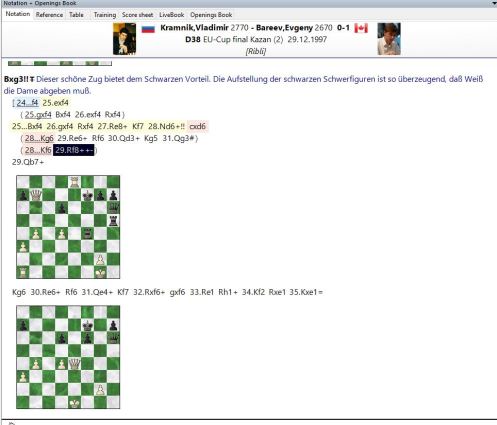
FEN
5rk1/p1p3pp/3b3q/5p1r/1PNP4/P3PQP1/6P1/R3R1K1 b – – 0 24
A break from my daily series from my present book, Matni Udar.
Today, a puzzle first seen in a recent edition of Chess Today. I failed to solve the puzzle, and couldn’t see what was wrong with my solution. I have chosen to post the puzzle on the 20th anniversary of the game having been played.
There is a follow up question below the solution.
Black to play and win
Kramnik v Bareev, Kazan 29/12/1997
Solution
Bareev played 1…Bg3! to which Kramnik replied 2 Qg3 f4 3 Qg4 (3ef Rf4 4 Re8+ Kf7 0-1) fe.
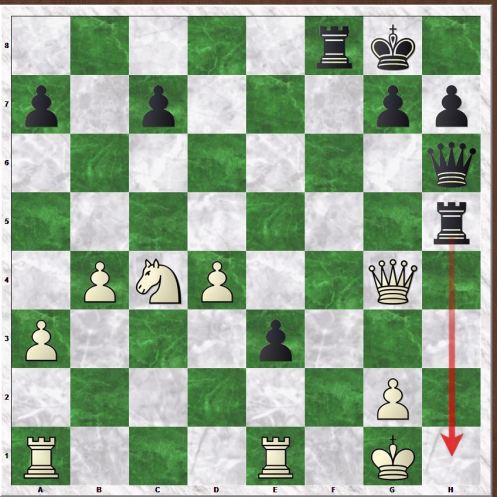
White had nothing better than 4 Qh5 after which Black won fairly easily, if any victory from any position against Kramnik could ever be easy (I can only write easily in the safety of my desktop, Fritz booted up).
Question
Why doesn’t 1…f4 win? Its intentions are the same, and some lines are similar, but with best place it leads to equality.
Solution
I will post the solution tomorrow.
FEN
5rk1/p1p3pp/3b3q/5p1r/1PNP4/P3PQP1/6P1/R3R1K1 b – – 0 24
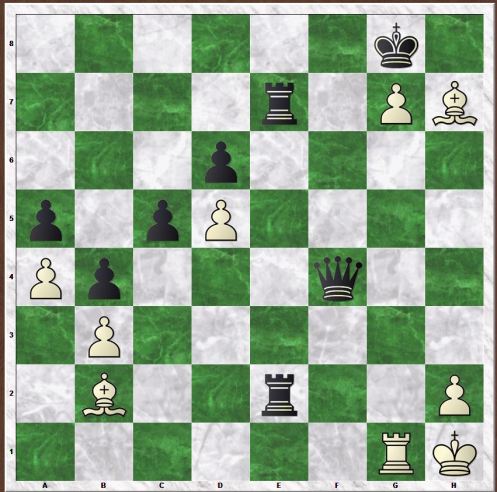
Another puzzle from Dragoslav Andric’s 1981 book “Matni Udar”.
White to play and mate Black
Nikitin v Butkevic, Moscow 1955
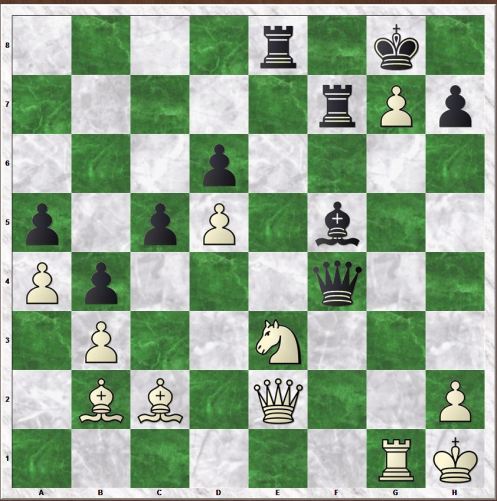
Solution
White’s position is quite desperate, so desperate measures are needed: and the only try is to play Bh7+ and promote.
So, 1 Nf5! Re2[] 2 Ne7+, 3 Bh7+ etc 1-0.
FEN
4r1k1/5rPp/3p4/p1pP1b2/Pp3q2/1P2N3/1BB1Q2P/6RK w – – 0 1
Another puzzle from Dragoslav Andric’s 1981 book “Matni Udar”.
White to play and mate Black
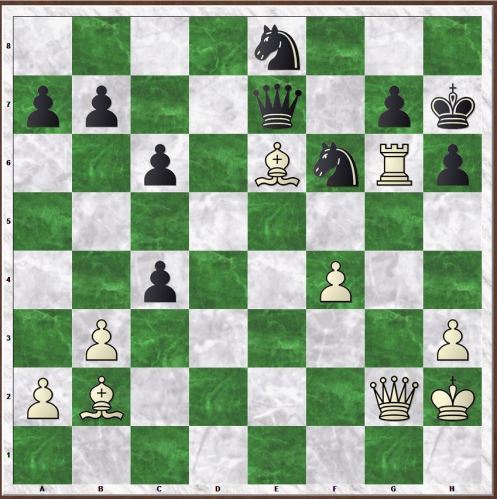
Bauer v Gellner 1955
Solution
A nice puzzle, with some cute features.
1 Rh6+!
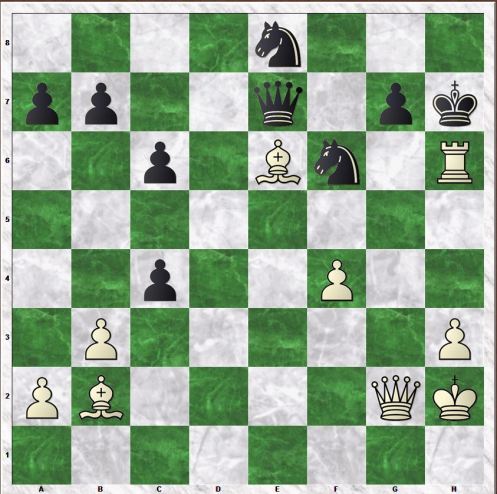
1…gh loses prettily to 2 Qg8+!! Ng8[] 3 Bf5
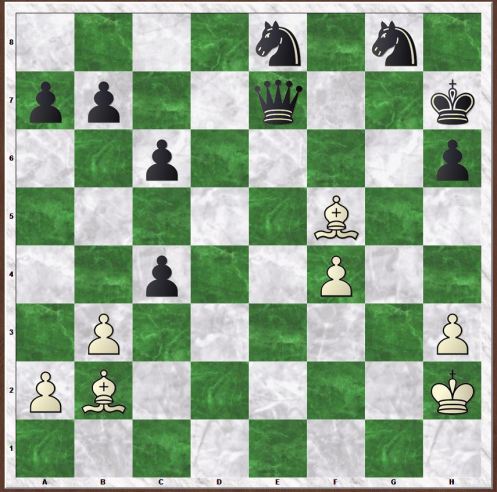
So, 1…Kh8 2 Qg5+ Kh7 and now 3 Qh4+ and 4 f5 mate.
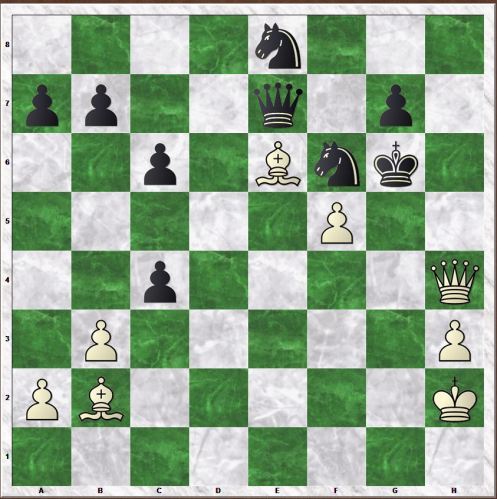
FEN
4n3/pp2q1pk/2p1BnRp/8/2p2P2/1P5P/PB4QK/8 w – – 0 1
Another puzzle from Dragoslav Andric’s 1981 book “Matni Udar”.
Black to play and mate White
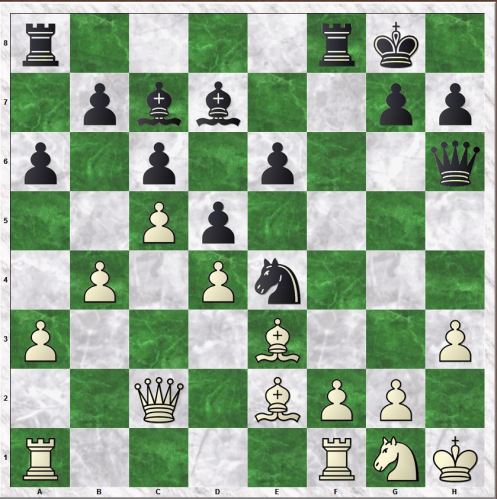
Solution
The first few moves are obvious, and Black also has the crutch of a perpetual check to rely on, if he wants to.
So, 1…Qe3 2fe Ng3+ 3 Kh2[] Nf1++ 4 Kh1[]
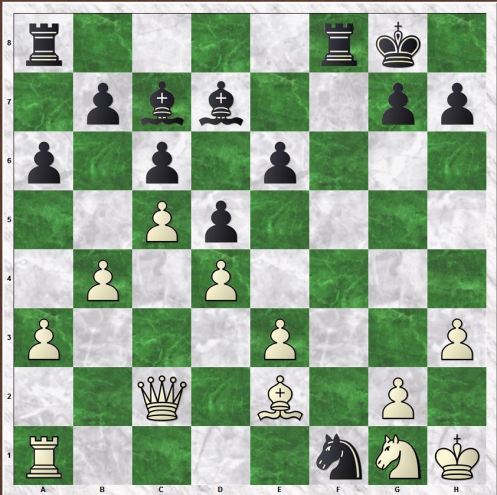
That’s as far as Black needs to visualise, since he can now Ng3+ Nf1+ Ng3+ to his heart’s content; but it isn’t too hard to see that moving the N to e4 also threatens Nf2 mate, so forcing g2-g3:
4…Ng3+ 5 Kh2[] Ne4+ 6 g3
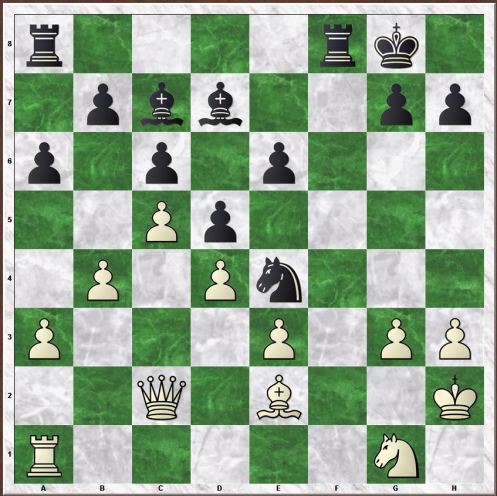
and now Rf2+ and Ng3 mate.
FEN
r4rk1/1pbb2pp/p1p1p2q/2Pp4/1P1Pn3/P3B2P/2Q1BPP1/R4RNK b – – 0 1
Another puzzle from Dragoslav Andric’s 1981 book “Matni Udar”.
White to play and mate Black
Mista v Kloza, Poland 1955
(same players as yesterday, same year, it seems)
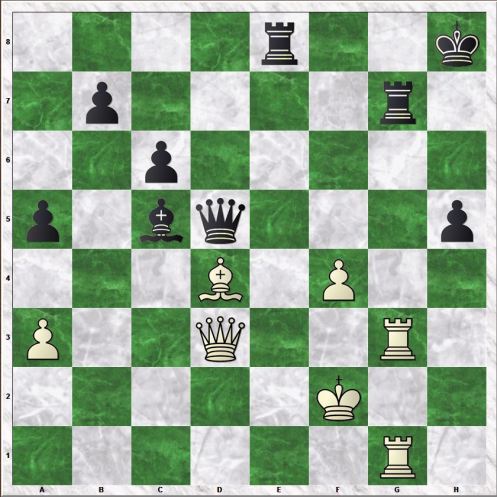
Solution
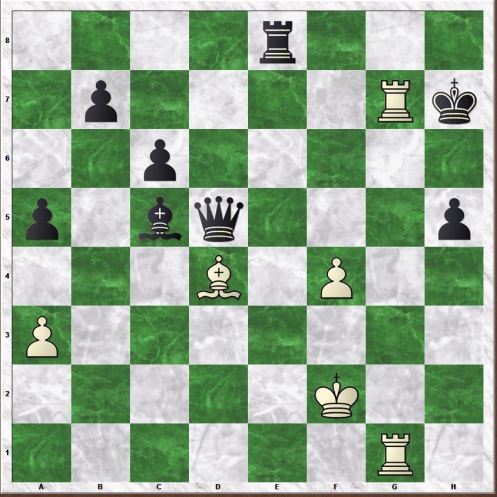
Another forcing line, also starting with a queen sac on an empty square next to the king: I wonder if they are made up positions?
Anyway, 1 Qh7+ forces 1….Kh7[] when 2 Rg7+ and check check check until mate.
FEN
4r2k/1p4r1/2p5/p1bq3p/3B1P2/P2Q2R1/5K2/6R1 w – – 0 1
Another puzzle from Dragoslav Andric’s 1981 book “Matni Udar”.
White to play and mate Black
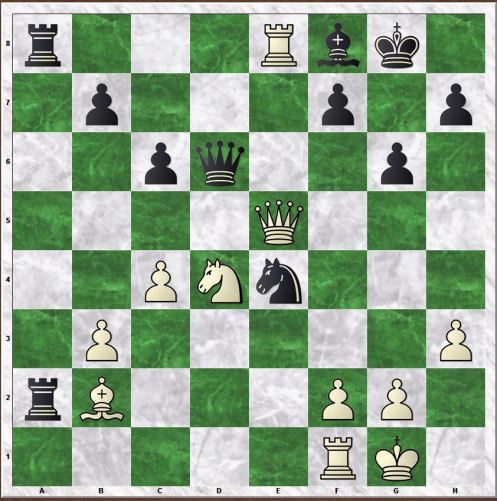
Mista v Kloza, Poland 1955
Solution
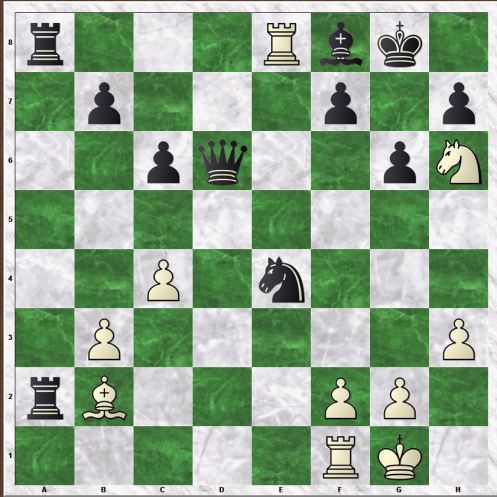
A forced line: 1 Qg7+ 2 Nf5+ 3 Nh6 mate.
FEN
r3Rbk1/1p3p1p/2pq2p1/4Q3/2PNn3/1P5P/rB3PP1/5RK1 w – – 0 1
 allanbeardsworth