Another puzzle from Dragoslav Andric’s 1981 book “Matni Udar”.
And not just another puzzle, but a gem of a puzzle, and really hard: or I found it so. But all the more enjoyable when solved.
White to play and mate Black
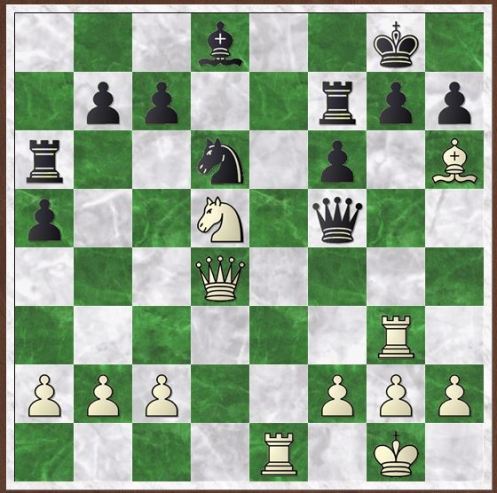
Efim Korchmar v Abram Poliak, Ukraine 1931
Solution
After looking and looking, and putting the pieces out on the board, I tried most moves, without success. I then did a Purdy based analysis, also noting John Nunn’s LPDOs, thinking (correctly) that the first move must be a double attack. See my anecdote about what Levon Aronian told me about double attack.
So, 1 Nb4! and then it started to come into place.
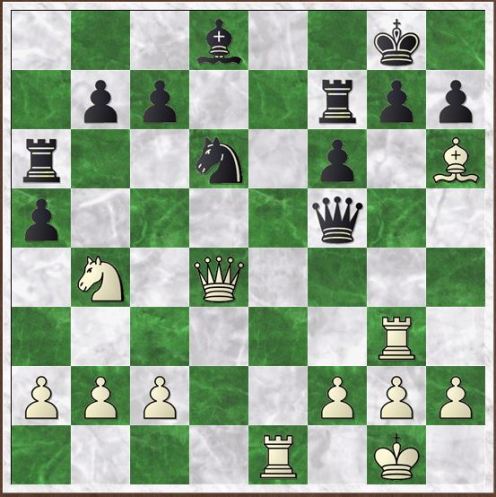
Black can avoid mate by for instance 1…Rd7, but is clearly lost after 2 Na6 ba and 3 c4 or 3 Bf4; but the fun begins after 1…ab, when 2 Qd6! is the point, removing the defender of e8: the N was tied to defending e8 in the opening position.
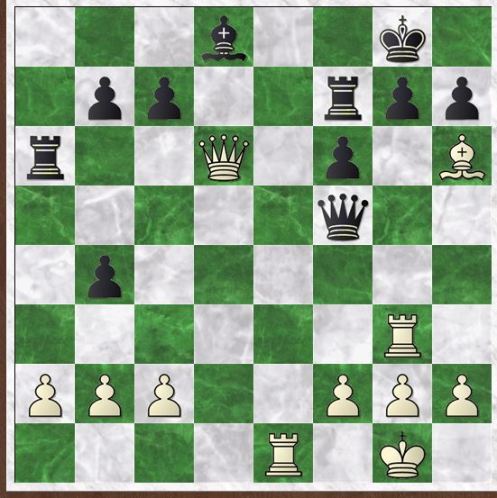
Black’s best is 2…Qd7, since taking the Queen loses to 3 Re8+ Rf8[] 4 Rg7+ Kh8[] 5 Rf8 mate. After 2…Qd7 I was delighted to find the magical move 3 Qd5!!, exploiting the fact that the Qd7 is now tied to e8.
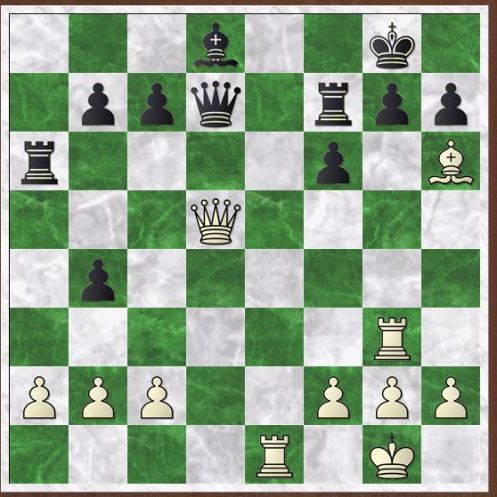
The fun doesn’t stop here. White threatens 4 Rg7+, and if 4….g6 5 Rge3! 1-0, so 4…Kf8 when the lovely 5 Rg7! breaks through nevertheless.
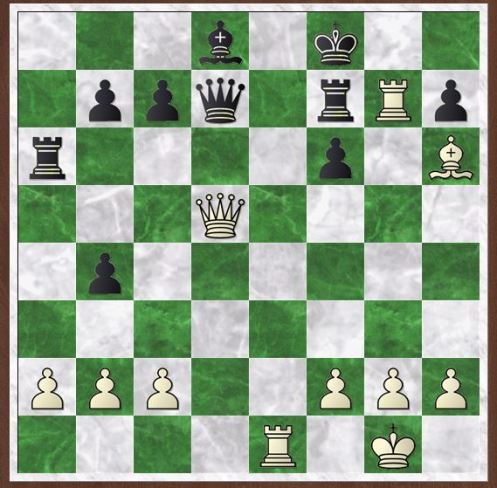
The Black Q is LPDO if 5…Rg7, so instead 5…Qd5 but then 6 Rg8+! and 7 Re8+ mating.
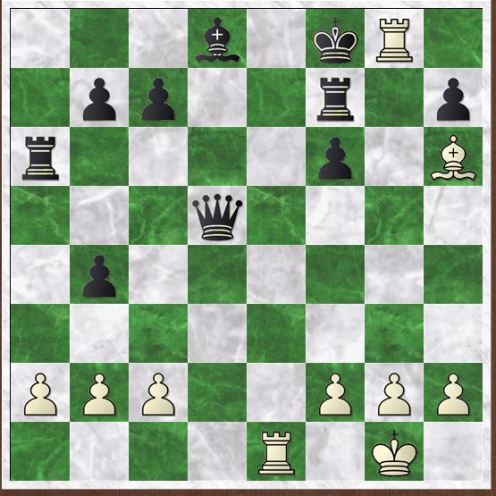
Lovely: great piece play.
Probably my favourite puzzle in the book so far.
The game isn’t in Megabase 2012 (my latest version of Megabase) but I have uploaded it here. It is a nice game to play through, to see how White’s attack in the Ruy Lopez Steinitz defence developed so ‘easily’.
FEN
3b2k1/1pp2rpp/r2n1p1B/p2N1q2/3Q4/6R1/PPP2PPP/4R1K1 w – – 0 19
Another puzzle from Dragoslav Andric’s 1981 book “Matni Udar”.
White to play and mate Black
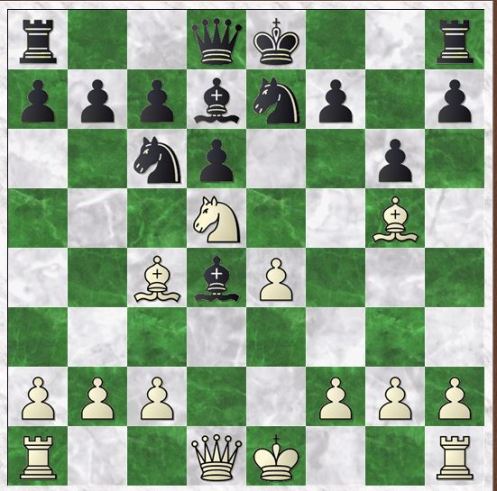
Znosko-Borowsky v unknown, 1937
Solution
Elementary today (but: forewarning: tomorrow’s will be far harder). 1 Qd4! and if 1…Nd4, 2 Nf6+ and 3 Bh6 mate.
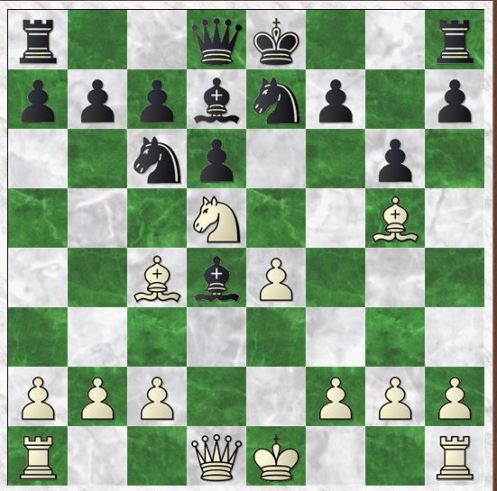
Best to take a rest, and get ready for tomorrow’s puzzle, which I found extremely tough, but very satisfying when solved…
FEN
r2qk2r/pppbnp1p/2np2p1/3N2B1/2BbP3/8/PPP2PPP/R2QK2R w KQkq – 0 1
Another puzzle from Dragoslav Andric’s 1981 book “Matni Udar”.
White to play and win
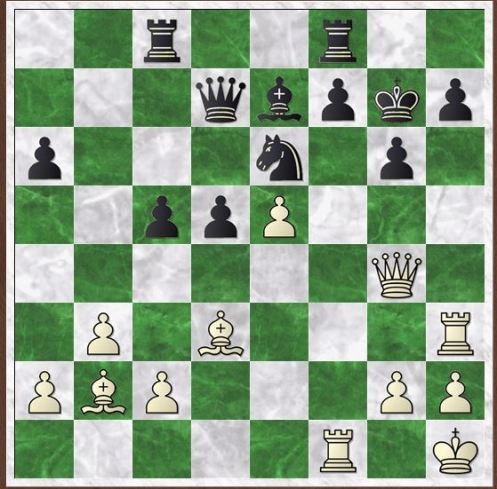
Solution
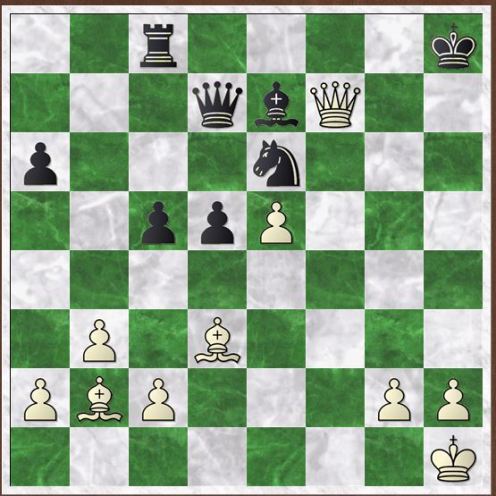
Straightforward today. 1 Rh7+ Kh7 (else 2 Rff7) 2 Rf7+ Rf7 3 Qg6+ Kh8[] 4 Qf7 and the fact that Black’s Queen is LPDO means the Be7 is fatally pinned, and if e.g. 4…Ng5, 5 e6+ wins.
FEN
2r2r2/3qbpkp/p3n1p1/2ppP3/6Q1/1P1B3R/PBP3PP/5R1K w – – 0 27
 Posted with Blogsy
Another puzzle from Dragoslav Andric’s 1981 book “Matni Udar”.
Black to play and mate White (though White can prolong the game, with a lost position)
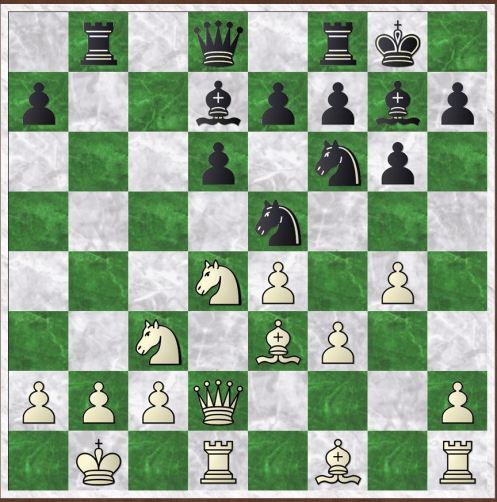
Zuravljev v Koskin, SSSR 1936
Solution
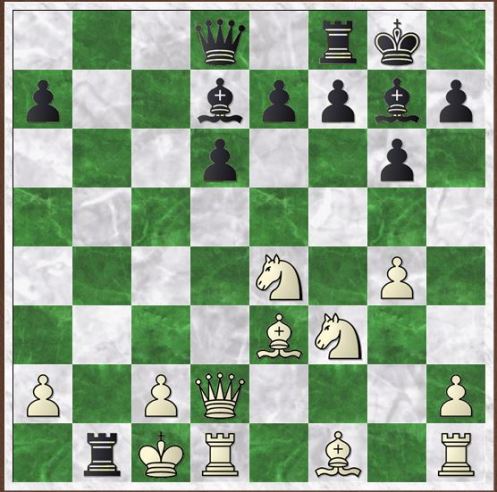
Fairly standard Dragon stuff: 1…Nf3! 2 Nf3 (2 Qg2 say would prolong the game, but 0-1 with two pawns down) Ne4 (or 2…Rb2+ 3 Kb2 Ne4 and the pin decides)
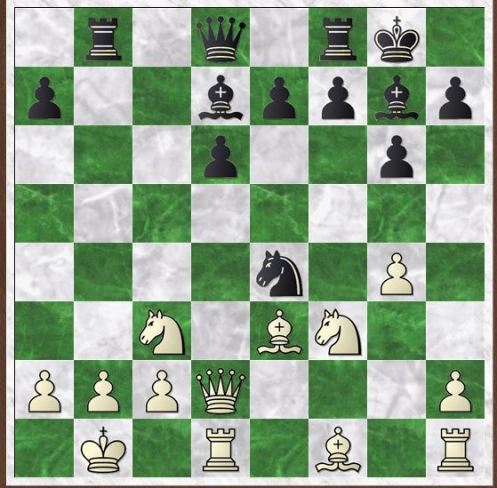
3 Ne4 Rb2+ 4 Kb1, and now the pretty move 4…Rb1+! 0-1
FEN
1r1q1rk1/p2bppbp/3p1np1/4n3/3NP1P1/2N1BP2/PPPQ3P/1K1R1B1R b – – 0 13
Another puzzle from Dragoslav Andric’s 1981 book “Matni Udar”.
Black to play and mate White
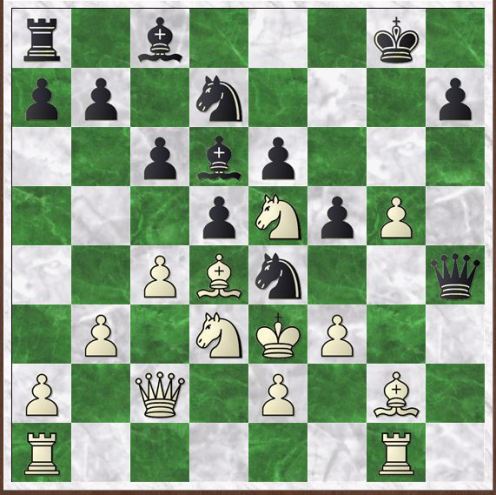
Kotov v Bondarevsky, Leningrad 136
Solution
I find such positions, where the pieces are all tangled and confused, difficult. Therefore, mainly by elimination, looking at all other moves (mainly captures and checks) I found the correct move 1…f4! when 2 Nf4 is forced, letting the Queen in, 2….Qf2+ when White again has a forced reply, 3 Kd3.
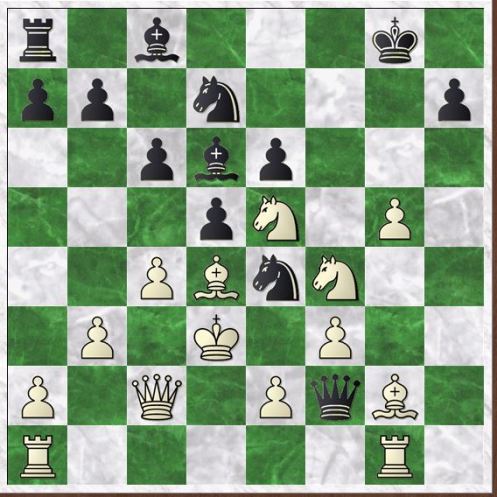
I then found the prosaic, and winning, 3…Ne5+ 4 Be5[] Be5[] , and also noted that 3…Ndc5+ 4 Bc5[] Bc5 is overwhelming, but the move I missed is 3…Qd4+! and mates: 4 Kd4[]
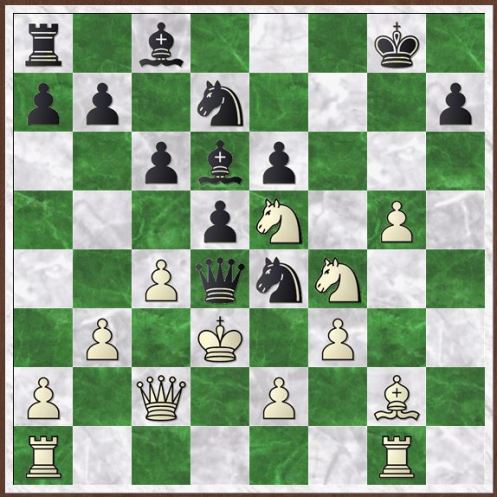
4…Bc5+ 5 Kd3 Ne5 mate.
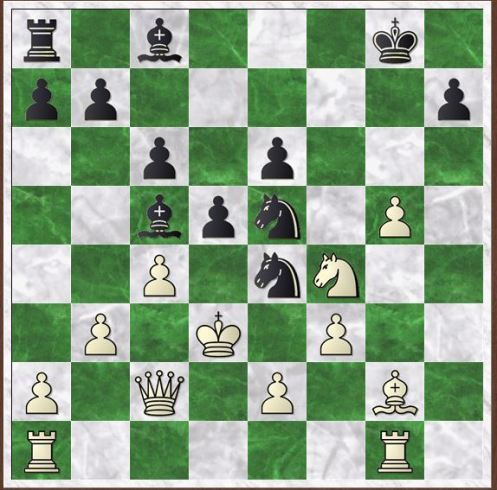
FEN
r1b3k1/pp1n3p/2pbp3/3pNpP1/2PBn2q/1P1NKP2/P1Q1P1B1/R5R1 b – – 0 1
A break from my daily puzzle from Matni Udar. Today, an occasional one: I have long (decades) had a habit of cutting out, tearing out, photocopying…puzzles I can’t solve, and saving them for a rainy day, dog walk, hill walk…
I came across today’s problem a while ago, and it really stumped me. I eventually solved it, but only by setting the pieces out and moving them around: I would never have found the win in a game.
White to play and win
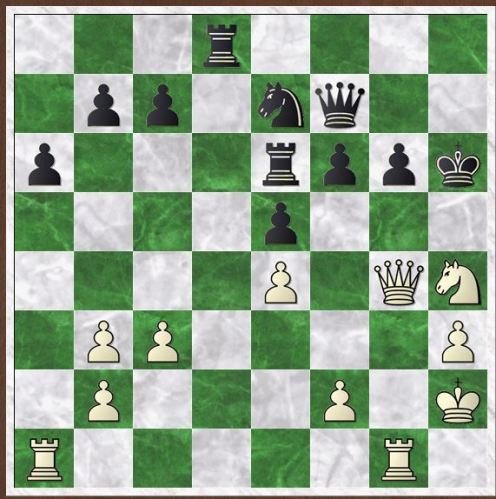
B Socko v S Brunello, Italian Team Championships, 2015
Solution
I looked at the problem many times, each time my first thought being 1 Nf5 gf 2 ef, but not being able to crack 2…Rd6
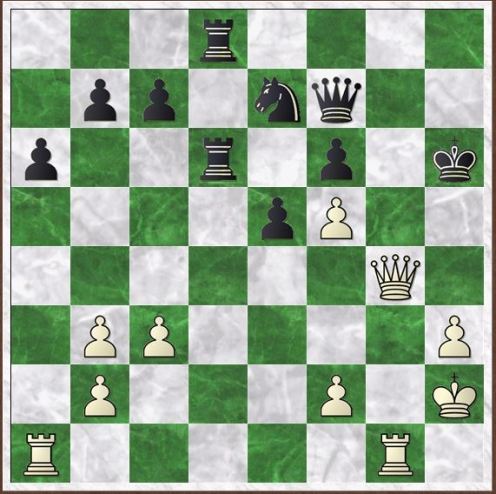
I also looked at 1 Ng6, finding it insufficient, and 1 f4, which I thought was strong.
1 f4
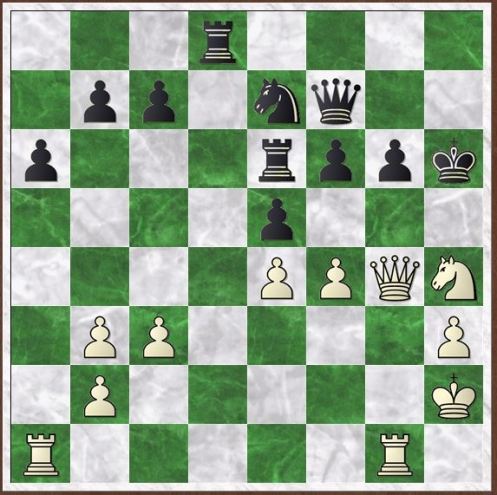
In fact, 1 f4 leads to some White advantage, but not much. The key is noting that the Rd8 is LPDO.
1…ef 2 Qf4+ Kh7
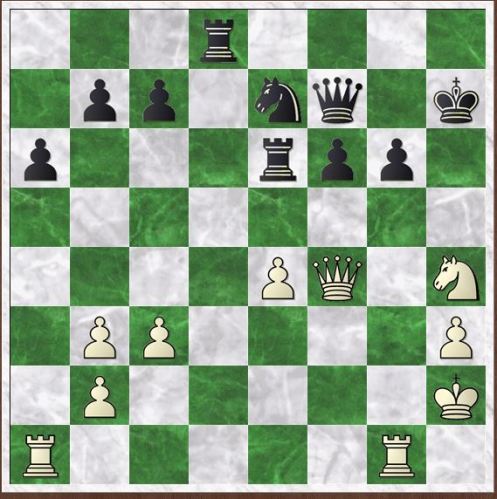
3 Ng6! Ng6 4 Rg6 Qg6 (4…Kg6 5 Rg1+ Kh7 6 Rg4! mates, a computer line)
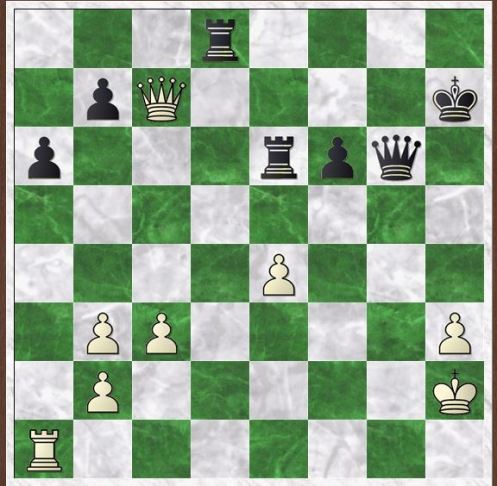
5 Qc7+ with a double attack on the King and LPDO Rd8: the game is equal, with White a pawn up but his King exposed after 5…Kh6 6 Qd8 Qe4 7 Qd2+
So, my judgement on 1f4 was sour: maybe White is a pawn up, but the opening up of his King should dissuade White from entering the line.
Back to 1 Nf5!
1 Nf5!
In a game, I would have tried, tried and tried again to make 1 Nf5 work; I would have failed, and then reluctantly made a lesser move. But this is what I should have seen:
1…gf 2 ef Rc6 (the move played in the game: 2…Rd6 or 2…Rb6 are the same).
3 Ra4! – as far as I could see, but I felt that Black had sufficient resources.
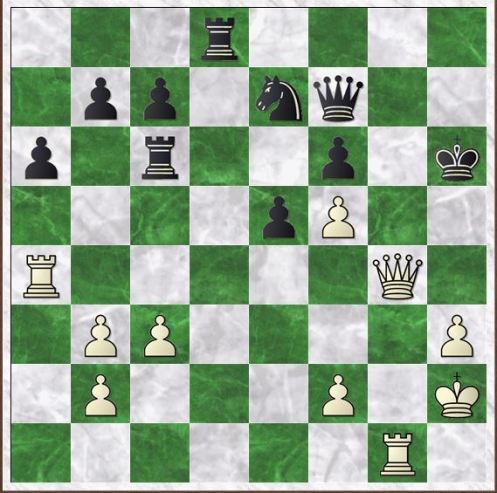
In fact, I was wrong: Black is lost, with White having multiple threats.
The easy one first 3…Qh5?? 4 Qg7 mate.
The harder one next: 3…Rg8. Evenually, by setting up the pieces in this position, I found 4 Qh4+ Qh5[] 5 Rg8! Ng8 6 Qg3!
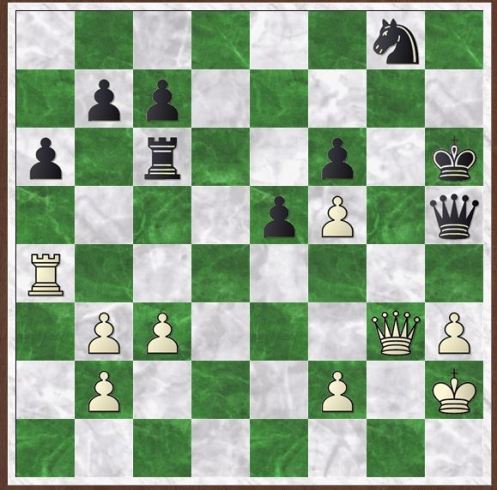
and, to my surprise, found that it is 1-0: Black can’t stop 7 Rh4 winning the Queen: if 6…Qg5 then 7 Rh4+ Kg7 8 Rg4 wins the Queen all the same.
But there is even better after 3…Rg8: 4 Qg8!!
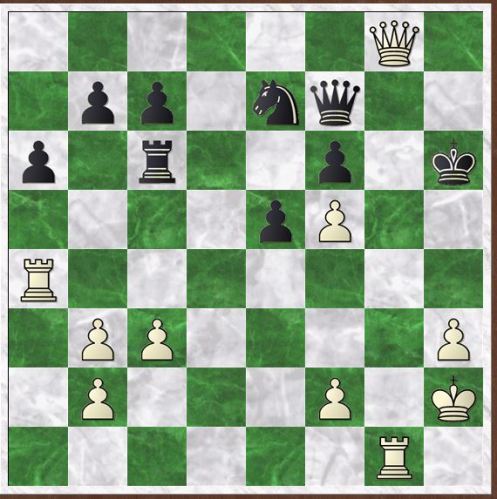
Black’s Queen is tied to defending h5 (against Rh4+) so 4…Ng8[] 5 Rh4+ Qh5[] and now a move I missed, 6 Rg6+!
The prettiest one: 3… Rd2, played in the game, 4 Qg7+!! and after 4…Qf7, 5 Rh4 mate: the LPDO Queen makes this tactic work.
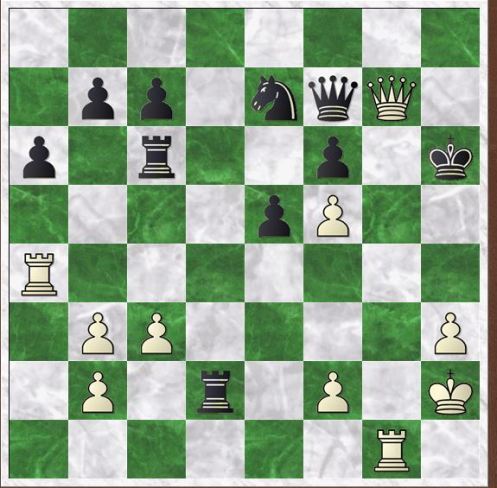
So, wonderful play by Socko, and, alas, an example of how the depth of calculation and evaluation was beyond me. I hope I have learned the lesson of how defenceless Black was with his King on the open g and h files.
FEN
3r4/1pp1nq2/p3rppk/4p3/4P1QN/1PP4P/1P3P1K/R5R1 w – – 0 30
Another puzzle from Dragoslav Andric’s 1981 book “Matni Udar”.
White to play and mate Black
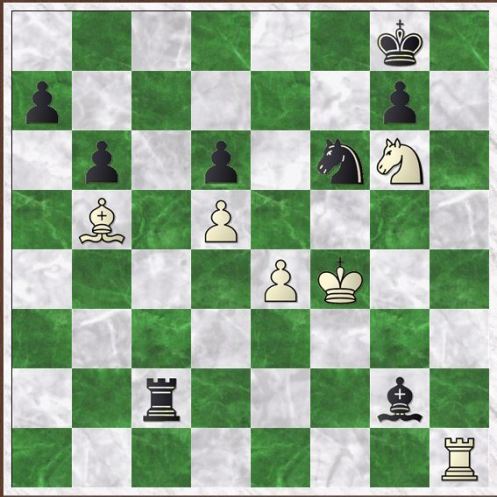
Bondarevesky- Ufimeev, Leningrad 1936
Solution
My long standing readers (and this daily blog has lasted longer than I might have expected) might just remember this position.
I did, because it was the front cover of Cordingley, the first puzzle book I serialised, and I tried then, unsuccessfully, to find the game score.
Please see my April 2013 posting for the solution.
FEN
6k1/p5p1/1p1p1nN1/1B1P4/4PK2/8/2r3b1/7R w – – 0 1
Another puzzle from Dragoslav Andric’s 1981 book “Matni Udar”.
White to play and mate Black
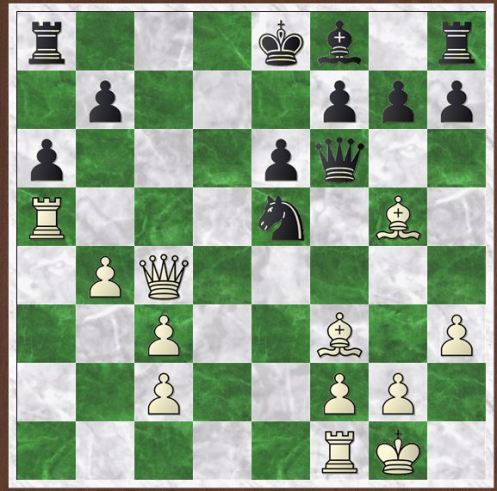
Keres-Gauffin, Helsinki 1936
Solution
Fairly easy today, but still pretty. 1 Re5! Qe5[] 2 Qc6+! and mate next move.
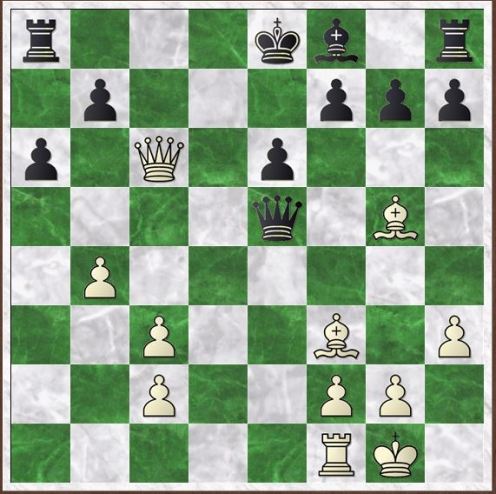
Not for the first time in this book, the puzzle isn’t an actual game position, but a variation from the game: the book makes no mention of this, which is a pity.
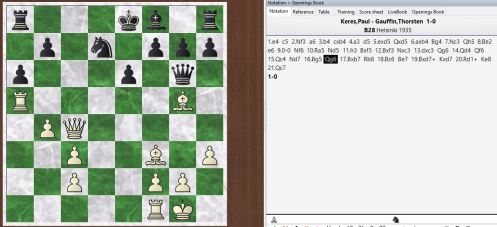
This screenprint from Megabase shows that Black might well have seen the denouement and so played 16…Qg6 rather than 16…Ne5.
FEN
r3kb1r/1p3ppp/p3pq2/R3n1B1/1PQ5/2P2B1P/2P2PP1/5RK1 w kq – 0 17
Postscript
I haven’t heard of Thorsten Gauffin, the Finnish player who lost this game, but Megabase showed he played Paul Keres twice, the second time in the 1937 Stockholm Olympiad. Thorsten won in a steady, controlled, convincing manner, after Keres had his N stranded on a5, having then to sacrifice it for only two pawns; and White then kept control.
Another puzzle from Dragoslav Andric’s 1981 book “Matni Udar”.
Black to play and mate White (and there is a second puzzle below)

O’Kelly v Defosse
Solution
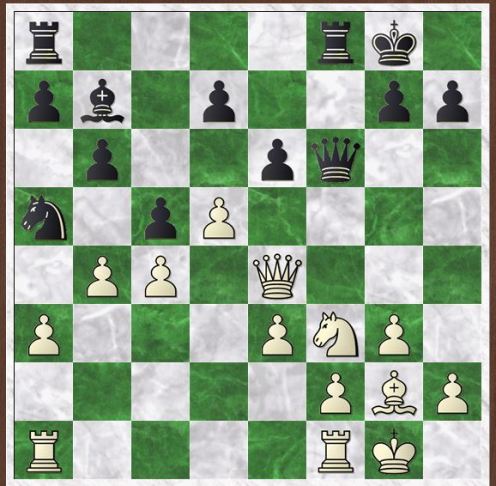
This looks like an English opening gone wrong, and gone wrong it has since 1…Qf2+! forces the King out so it can be checked, checked and mated.
2 Kf2[] Ng4+ 3 Kf3 (3 Kg1 Be3 mate), and now the next move is key:

3..e4+! 4 Ke4 (4 Nde4 or 4 de both met by 4…Nde5 mate)

4…Ndf6+ (not 4…Re8+, since the King escapes to d5 and then squirrels away to c4)
5 Kf3[] Ne5+ 6 Kf2 Nfg4+ 7 Kg1 Be3 mate.

The whole line is more or less capable of being visualised from the start- I got there, with fairly high confidence: but partly because I knew there was a solution. Whether I would be confident enough in a game to sacrifice my queen, I don’t know: if I did, it would be with a big gulp for confidence and hope.
My engine tells me that in the opening position the only winning move is 1…Qf2: and that all other moves lose. That led me to another puzzle:
Second puzzle
What were the last few moves to arrive at the problem position? It is not obvious to me what they might have been (and the game isn’t in Megabase 2012)
FEN
r4rk1/ppRn1p2/6pb/2P1pq1p/3N4/P1QPn1Pb/1B1NPP1P/4R1KB b – – 0 1
Another puzzle from Dragoslav Andric’s 1981 book “Matni Udar”.
Black to play and mate White

Gerasimov v Smyslov, Moscow 1935
Solution
This has shades of the famous Rubinstein ending vs Rotlewi : 1….Rd3! 2 Qb6 Rh3!

3 Bd4 (3 Qc6 Bh2+ 4 Kh1[] Nf2 mate, so the B must defend f2) Bh2+ 4 Kh1 Be5+ 0-1, because the Bh2+ check and discovery will repeat, next being Bc7 and then Bb6.
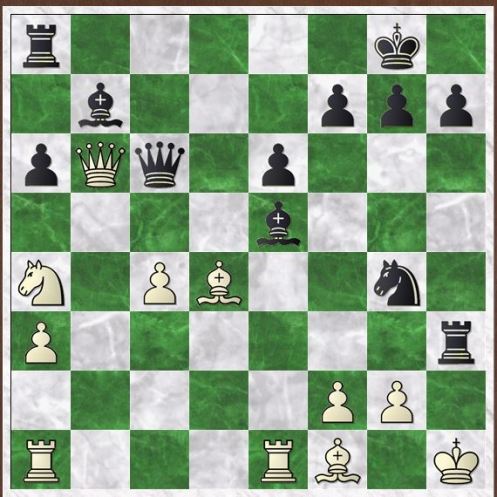
The game, which was a casual game, is deeply annotated in Megabase. Smyslov crunched the Colle in convincing style.
FEN
r2r2k1/1b3ppp/ppq1p3/4P3/N1P2bn1/PQ5P/1B3PP1/R3RBK1 b – – 0 19
 allanbeardsworth