Another puzzle from Dragoslav Andric’s 1981 book “Matni Udar”.
White to play and mate Black
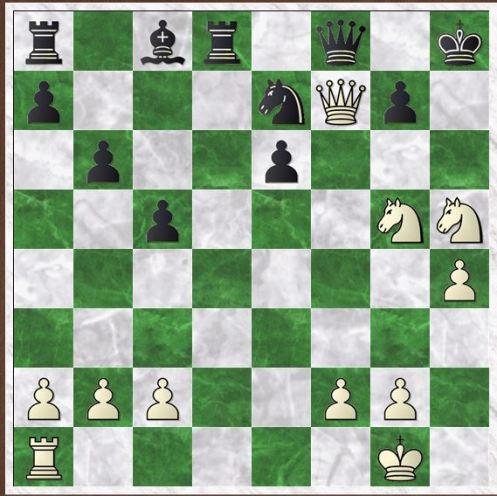
Capablanca v unknown
Solution
Another nice puzzle.
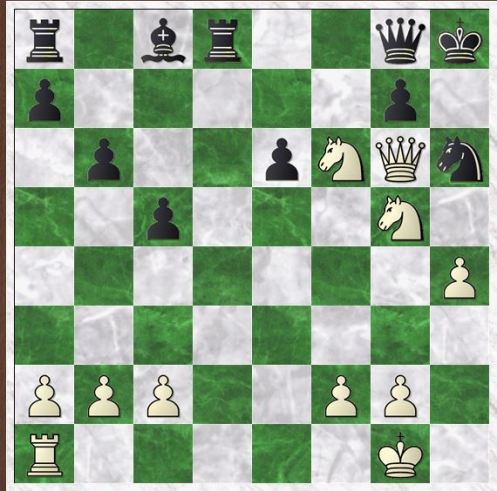
1 Nf6! and the Q can’t be taken because of 2 Nf7 mate; and the N can’t be taken because of 2 Qh7 mate, so 1…Ng8, when 2 Qh5+ Nh6[] 3 Qg6!
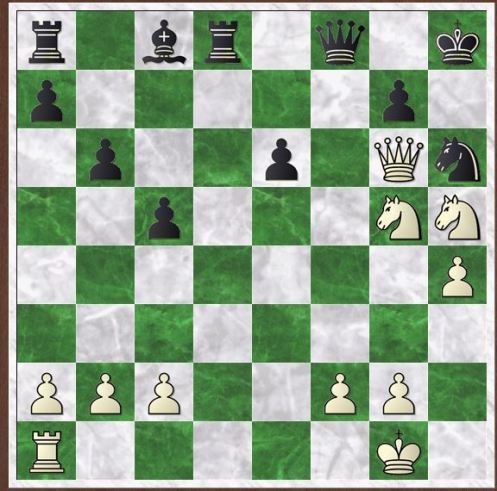
and 3..Qg8[] 4 Nf6! is a nice echo.
FEN
r1br1q1k/p3nQp1/1p2p3/2p3NN/7P/8/PPP2PP1/R5K1 w – – 0 1
Another puzzle from Dragoslav Andric’s 1981 book “Matni Udar”.
White to play and mate Black
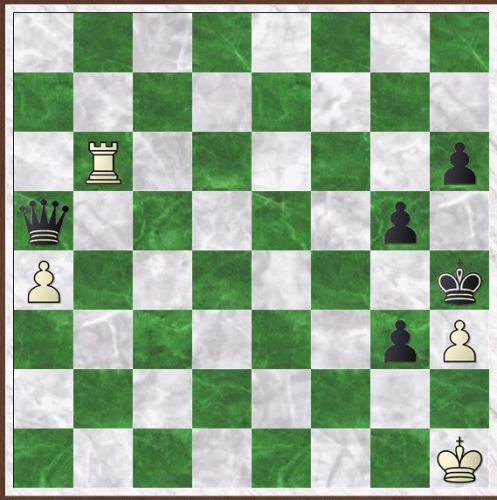
Mieses v unknown, Metz 1935

Solution
An elegant one today.
1 g4+! fg

2Rh4+!

2…gh
3 Rb5+ and wins.

If 1…Kh4, 2 Kh2 followed by Rh6 mating; If 2…Kh4 3 Rh6 mate.
FEN
8/8/1R5p/q5pk/PR3p2/7P/6P1/7K w – – 0 1
Another puzzle from Dragoslav Andric’s 1981 book “Matni Udar”.
White to play and mate Black
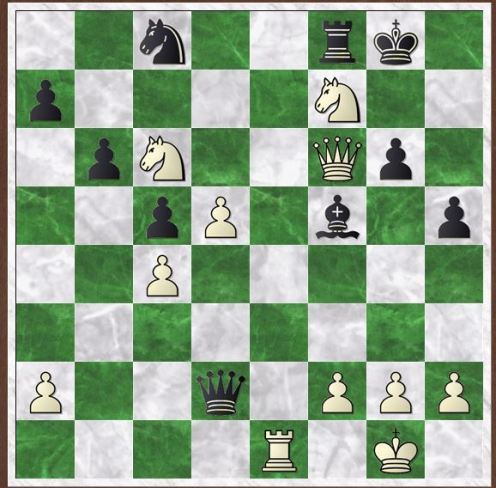
Burzlaff v Hiller, Leipzig 1934
Solution
1 Qh8+ Kf7[] is obvious, but then 2 Qh7+? permits 2…Kf6, and Black wins. So what next? I don’t know the name of the technique, but 2 Re7+! is the key:
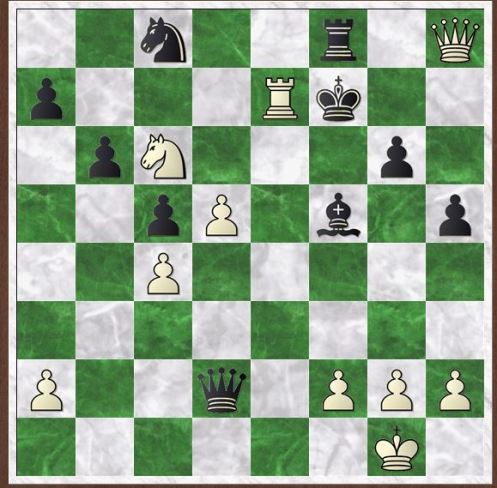
Then when 2…Ne7[] happens, the N is no longer defending e7, but occupies it, so that it can be captured, with mate, after 3 Qh7+ Kf6 (or 3…Ke8) 4 Qe7 mate.

Nice.
FEN
2n2rk1/p4N2/1pN2Qp1/2pP1b1p/2P5/8/P2q1PPP/4R1K1 w – – 0 1
Another puzzle from Dragoslav Andric’s 1981 book “Matni Udar”.
Black to play and mate White
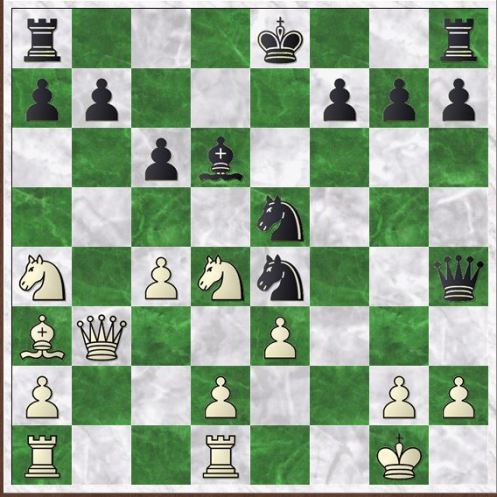
consulting partners v Schories, Berlin 1034
Solution
Fairly standard today: 1…Qh2+ 2 Kh2 Nf3++ 3 Kh1 (or 3 Kh3) Nf2 mate.

FEN
r3k2r/pp3ppp/2pb4/4n3/N1PNn2q/BQ2P3/P2P2PP/R2R2K1 b kq – 0 1
Another puzzle from Dragoslav Andric’s 1981 book “Matni Udar”.
White to play and mate Black; and
Black to play and mate White (depends on who is to move: i.e. find both)
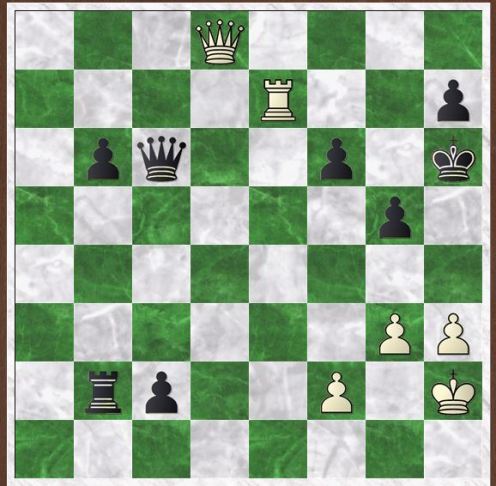
Rosengarten v Schlamer, Solingen 1934
Solution
As I’ve previously mentioned, the book I am presently covering omits to say which side is to play and win. Rarely a problem: often one side is attacking; sometimes one player is well known, and the other is “amateur” or “unknown”.
Occasionally, as here, it is a bit closer.
If White were to play and win, it is easy: 1 Qf8+ and say 1…Kg6 2 Qg7+ Kf5 3 Qh7 mate.
So, the puzzle must be Black to play and win, and here it is pretty: 1…Qh1+!

2 Kh1[] c1(Q)+ 3 Kg2 (3 Kh2? Rf2 mate) Qc6+

A very similar position to the starting one, the sole difference being the removal of the Pc2. This makes all the difference: 4 Kh2 Rf2+ and mate; 4 Kg1 or 4 Kh1, 4…Rc1+ and mate.
Nice and clean.
FEN
3Q4/4R2p/1pq2p1k/6p1/8/6PP/1rp2P1K/8 b – – 0 1
Another puzzle from Dragoslav Andric's 1981 book “Matni Udar”.
White to play and mate Black
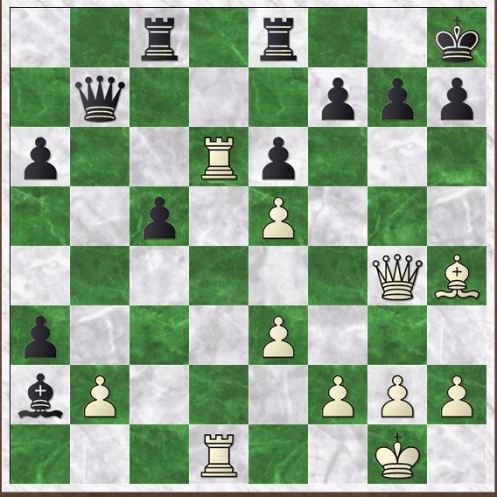
Havasi v Sacconi, Folkestone Olympiad, 1934
Solution
I suspect I have seen this position before, because the whole line was immediately obvious to me. Maybe I haven't, and the motifs were just known to me. 1 Bf6 gf (1…Rg8 is no different, though White could vary by 2 Qg7+! or 2 Rd8+, both 1-0) 2 ef Rg8[] 3 Rd8 and 4 Qg7 mate next move.
White resigned after 1 Bf6.

FEN
2r1r2k/1q3ppp/p2Rp3/2p1P3/6QB/p3P3/bP3PPP/3R2K1 w – – 0 24
Postscript
I haven't heard of Kornel Havasi, but he has 25 years of games in Megabase, from 1912 to 1937. He has a Wikipedia page, and was clearly a strong player, from Hungary, playing in many Olympiads. Alas, he died in 1945 after having to do forced labour in Austria for the Nazis.
Flicking through some of his games at great speed, I like his style of play: I wonder if I am showing my ignorance, and he is better known to others?
I see that there are also J Havasi and G Havasi with many games in Megabase.
 Posted with Blogsy
Another puzzle from Dragoslav Andric’s 1981 book “Matni Udar”.
Black to play and mate White

consulting partners v Rellstab, Berlin 1933
Solution
The sort of position which often occurs in consultation games: a spectacular finish: 1…Rd4+! 2 cd Qe1+!!
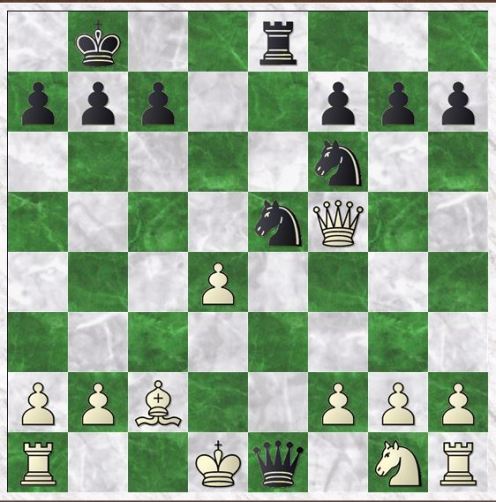
3 Ke1 Nf3+ 4 Kd1 Re1 mate.

Not hard; pretty enough, but ‘seen the type before’.
FEN
1k1rr3/ppp2ppp/5n2/q3nQ2/3P4/2P5/PPB2PPP/R2K2NR b – – 0 1
Another puzzle from Dragoslav Andric’s 1981 book “Matni Udar”.
White to play and mate Black
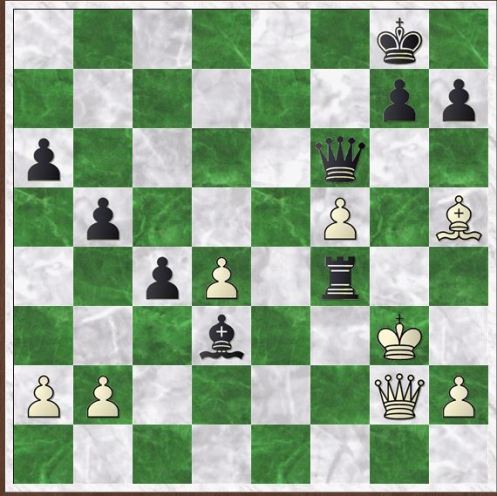
Cost v Kruger, Konstanza 1933
Solution
I think this puzzle is a gem
The sheer efficiency of Q and B mating when Black has a Q defending, is artistry. Also, at each move, White has only one winning move, no deviations permitted.
I’ll just give a lot of diagrams to help my readers enjoy the ballet of the pieces.
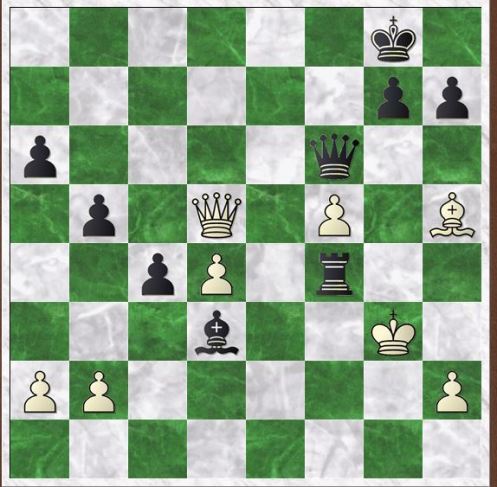
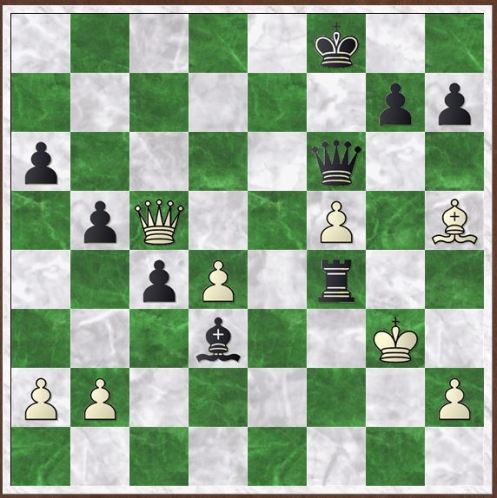
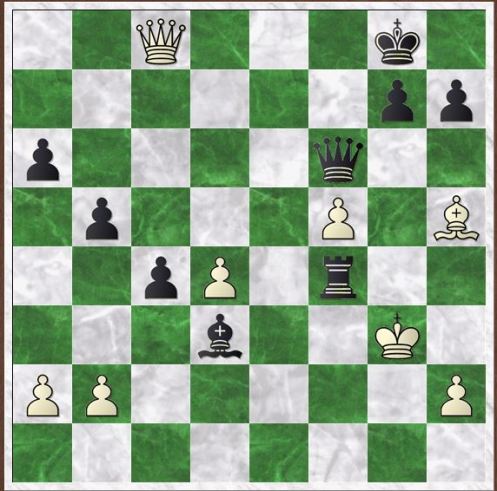

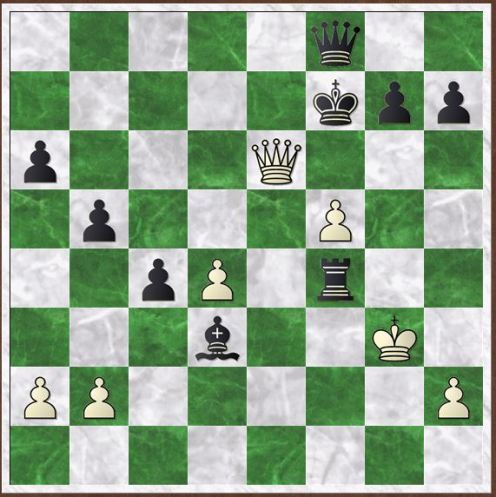
Beautiful.
FEN
6k1/6pp/p4q2/1p3P1B/2pP1r2/3b2K1/PP4QP/8 w – – 0 1
Another puzzle from Dragoslav Andric’s 1981 book “Matni Udar”.
White to play and mate Black
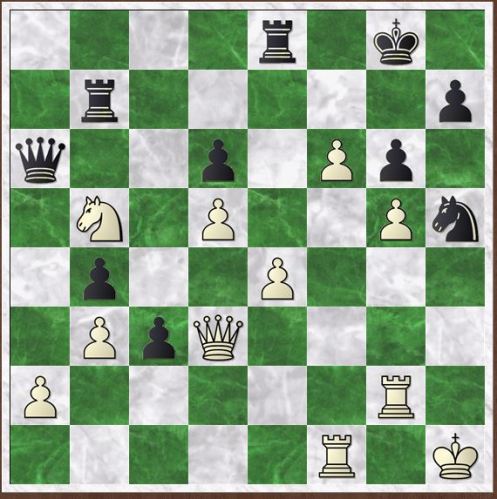
Schories v Leonhardt, Bad Pyrmont 1933
Solution
Again, as yesterday, optically hard, but, once seen, very pretty.
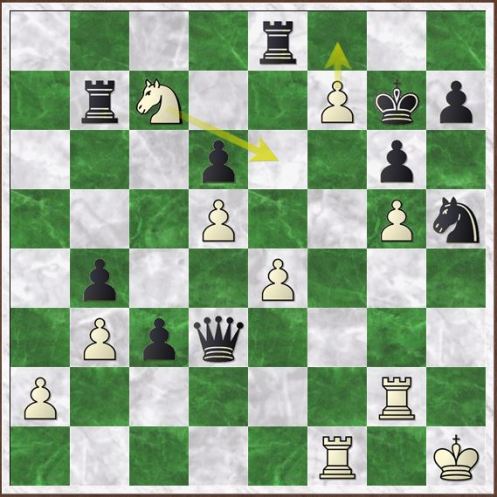
1 Nc7! and the LPDO Qa6 forces 1…Qd3, when 2 f7+ mates, because the Nc7 cuts off the Rb7.
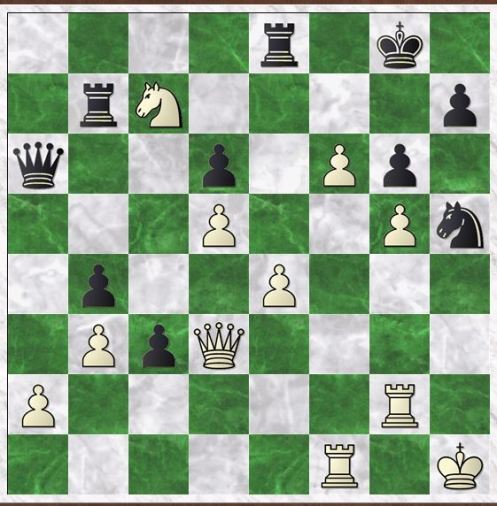
The game continued 2…Kg8 3 Ne6+! Re6[] 4 Qf8 mate which is pretty; my solution was 3f8(Q)+! Rf8[] 4 Ne6+ Kg8 5 Rf8 mate, which is also pretty, but one more move.
FEN
4r1k1/1r5p/q2p1Pp1/1N1P2Pn/1p2P3/1PpQ4/P5R1/5R1K w – – 0 40
Another puzzle from Dragoslav Andric’s 1981 book “Matni Udar”.
White to play and mate Black
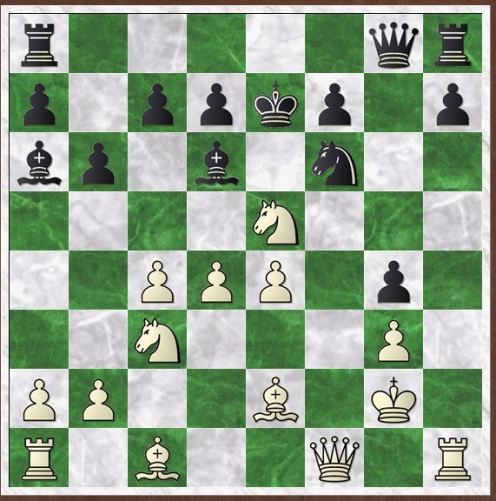
Keres v Feldschon, correspondence 1932
Solution
Not too hard today, especially if after yesterday’s puzzle you are happy to throw away your queen (examine all biffs, Purdy tells us).
1 Qf6+!
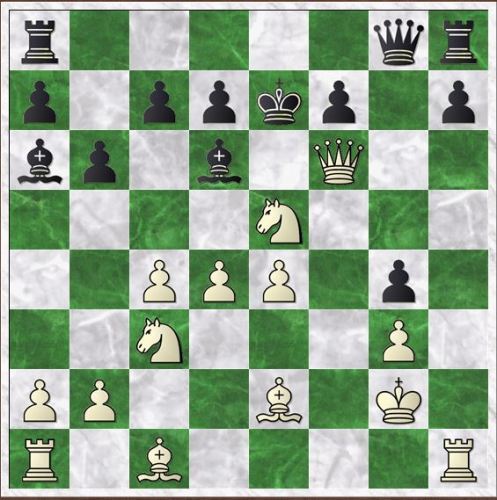
1….Kf6[] (else he is just a piece down) 2 Nd5+ Ke6 (2…Kg7 3 Bh6 mate) 3 Rh6+ f6[] 4 Rf6 mate.
FEN
r5qr/p1ppkp1p/bp1b1n2/8/2PPP1p1/2N3P1/PP2B1K1/R1B2Q1R w – – 0 1
 allanbeardsworth