White to play and win
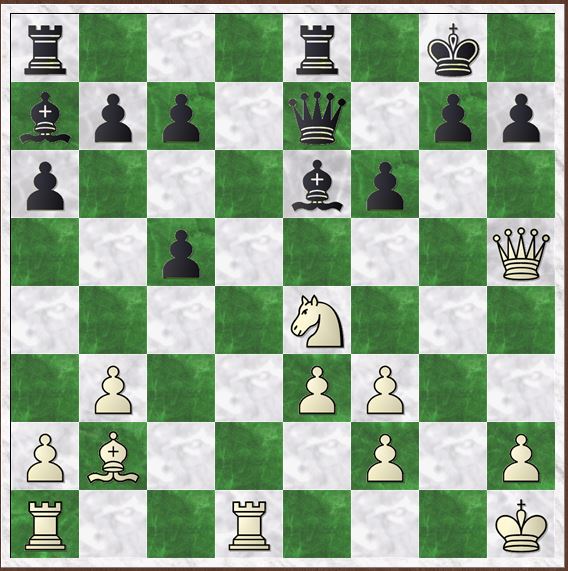
Sigurjonsson v Segal, Ybbs 1968
Solution
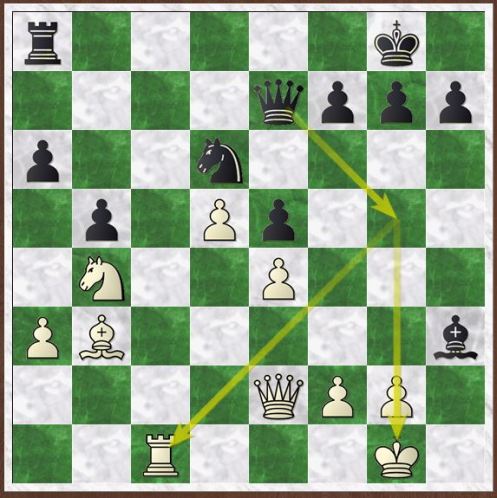
This being a problem, the first moves are obvious. Whilst from the initial diagram I for one can’t see all lines to the very end, it is easy to be confident to enough to play it: Black will soon be trussed up, with the opposite colour bishops advantaging the attacker: Black’s black squared bishop is not in the game.
So, 1 Nf6+ gf[] 2 Rg1+ Kh8[] 3 Qh6
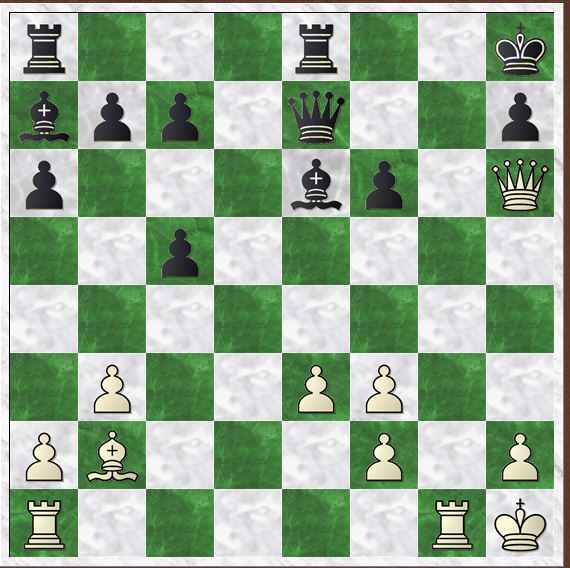
3…Rf8[] and now 4 Rg6! (examine all biffs) is stronger than the next best, 4 Rg3, because from g6 the rook hits the Pf6, and Black can’t add more defenders.
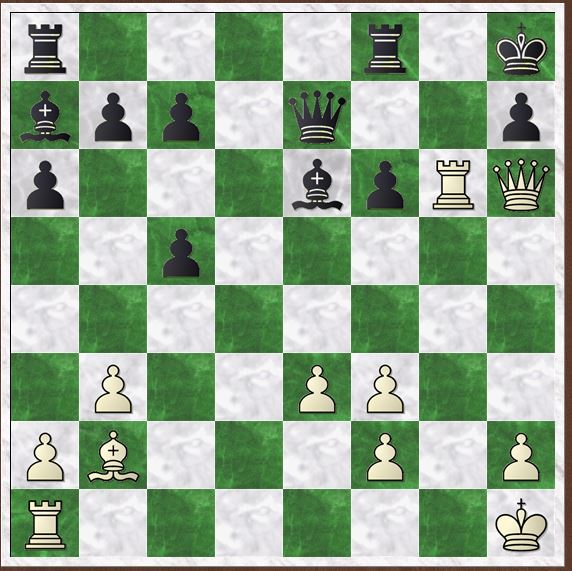
All Black can do is grovel, and try to close the lines, without success: 4.. Bf5 5 Rf6 Kg8 6 Rg1+ Bg6[] 7 Rgg6+ and mates: 7…hg 8 Qg6+! since if 8…Qg7, 9 Rf8+ discovers an attack on the Q by the Bb2.
Black to play and win, after White plays 1 d5?
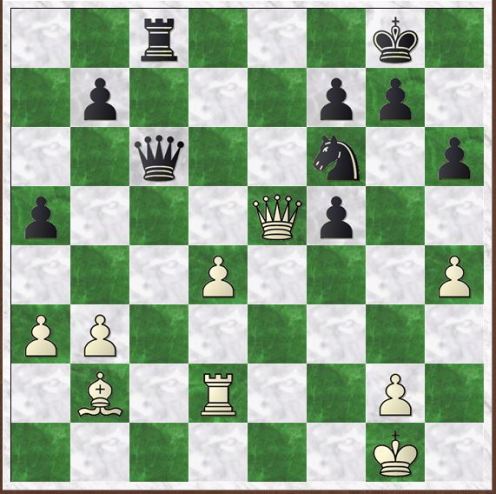
Sirkia v Eichhorn, Ybbs, 1968
Solution
Straightforward today: 1…Qc1+ and either before or after exchanges, when White plays Kf2 or Kh2, Ng4+ forks the king and queen.
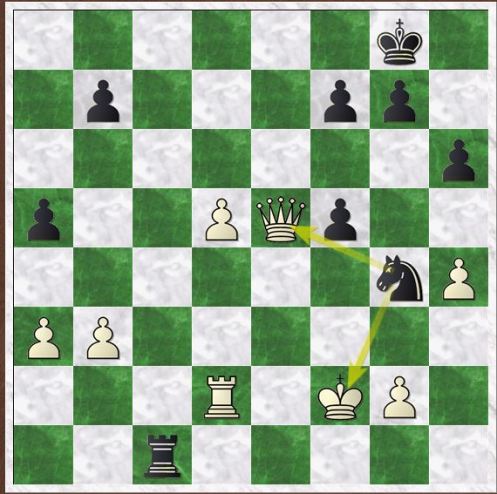
Black to play and win
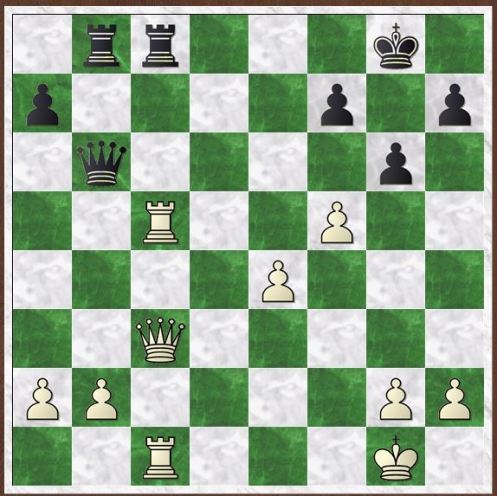
Donner- Hubner, Busum 1968
Solution
Another fairly standard motif: 1…Rc5 2 Qc5[] Rc8!! and after 3 Qb6 the zwischschach 1..Rc1+ decides.
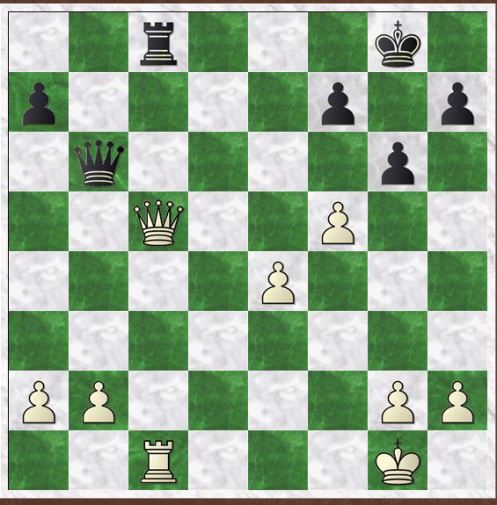
White to play and win after:
1…Bb2, as played; or
1…Re8
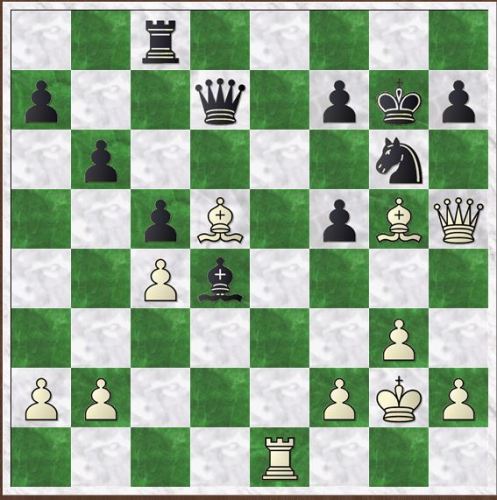
Tringov v Donner, Busum 1968
Solution
1…Bb2 loses simply to 2 Re7! since the Ng6 is pinned to the f7 pawn: in Purdy terms, there is a jumpcheck Qh5-f7+ in the initial position.
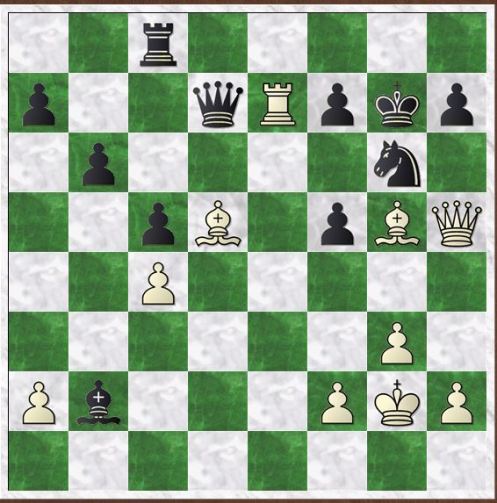
After 1..Re8, the motif is overload: 1 Bh6+ Kg8 (1…Kf6? 2 Qg5 mate) and 2 Qf5!! overloads the Queen, due to the back rank mate. Very conveniently, White’s king is on g2, not g1, else the combination wouldn’t have worked.
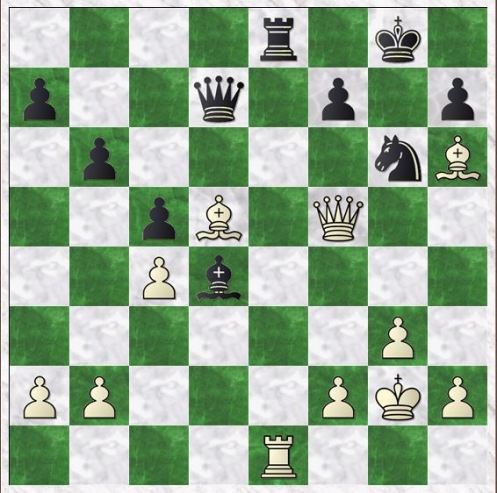
Black to play and win

Solution
So, as of Megabase 2012, this position has been played 30 times, including three by Efim Geller in 1968.
Amazingly, White won 5, drew 6; losing the others. The highest ranked Black loser was Sergey Movsesian, at a time when he was 2380. The most instructive game is when the highest ranked White fell for the line, Yuri Kuzubov- it is worth playing through, to show how he created counterplay. I won’t include the game here, since the version in Megabase is annotated- but, as said, well worth looking at.
Black to play and win
Holm- Geller, Lugano 1968
Solution
Amazingly, this game took place two rounds after the Adamski-Geller game. Here, Holm resigned immediately.
See the earlier posting for the solution, if needed!
Black to play and win
Adamski -Geller, Lugano 1968
Solution
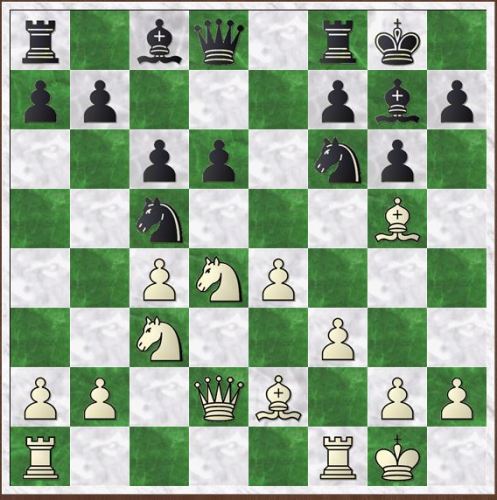
A standard motif: perhaps a standard motif because of Efim Geller. 1..Nfe4 and the Qd2 is overloaded: it can’t defend both the Bg5 and Nd4.

Black emerges a pawn up, though in the game Black didn’t take the Pe4 (after Qg5 Qe3+) instead developing his pieces: White’s c4 and e4 pawn might his bishop weak, and one of the pawns falls.
Because it is Christmas Day (but please note, I write these blogs days in advance) I will add some further puzzles.
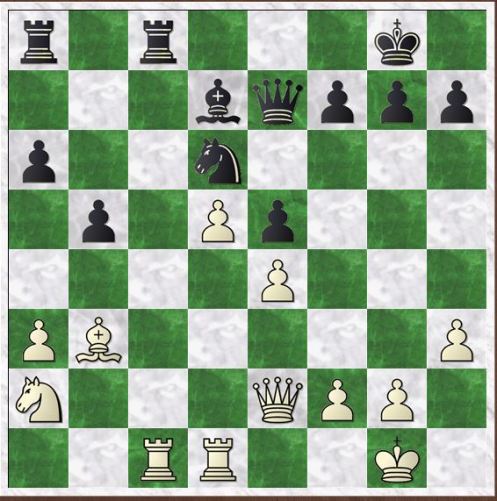
Black to play and win, after White plays 1 Ng4
Reshevsky- Larsen, Lugano 1968
Solution
This was either simple, or a position lodged in my memory- I have been a great fan of Larsen since my teenage years, especially since the only chess books, other than beginner’s books, in my local library then were the collected games of Paul Keres and of Bent Larsen: I devoured and redevoured these books.
So, 1 Nb4? Rc1 2 Rc1 Bh3! and the threat of Qg5+ with a double attack on the LPDO Rc1 wins an important pawn.
Maybe not “and win” especially since my engine gives only -0.5 after my move order, or the alternative 1…Bh3! (the idea being 2 Rc8+ Bc8)
White to play and win
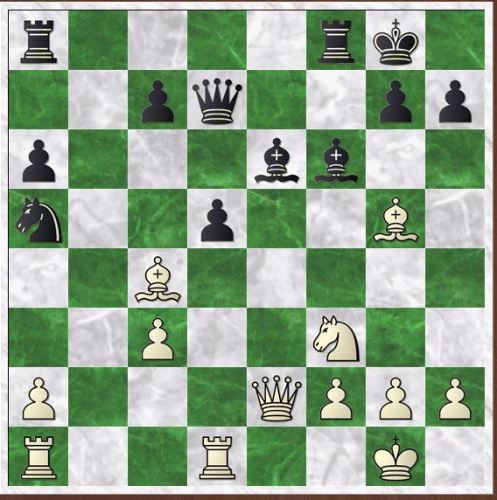
Fischer- Ree, Netanya 1968
Solution
Not hard today: 1 Qe6+ Qe6[] 2 Bd5 and White remains a pawn up after 2…Qd5 3 Rd5
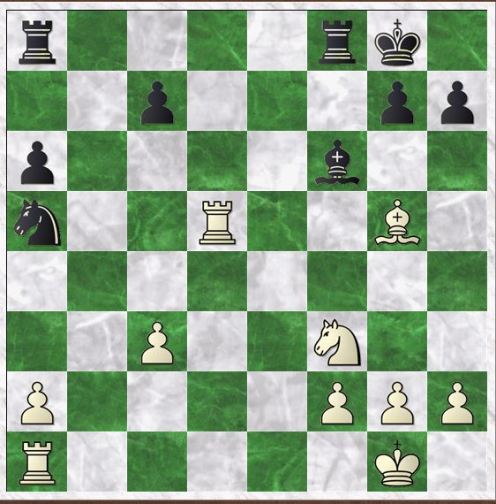
Continuing slightly further, if 3…Bc3 4 Rc1 wins the c7 pawn, so is just an exchange of pawns, and White’s rook reach the seventh rank. Since the Bg5 and Nf3 defend c1 and e1 respectively, there are no back rank mating saves for Black.
White to play and win
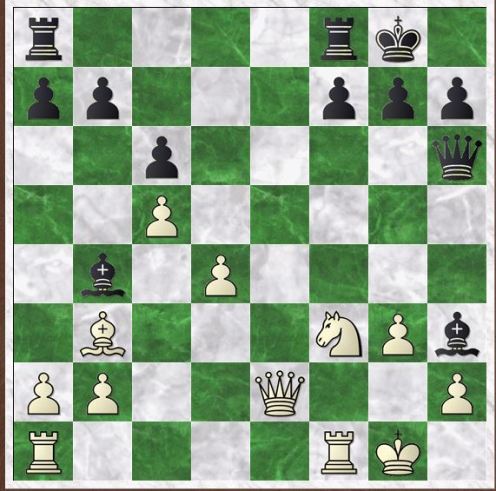
Fischer v Minic, Vinkovci, 1968
Solution
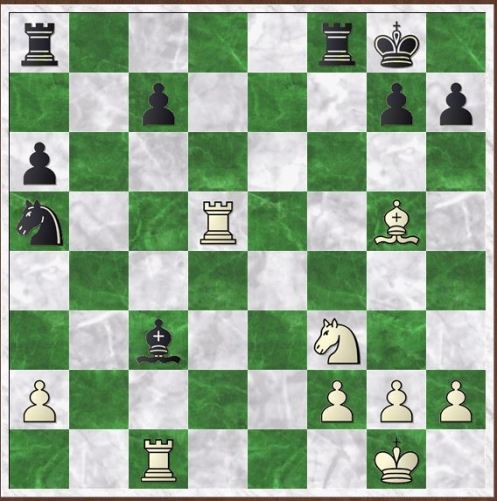
White’s position is quite loose, and Black has the two bishops, so it is clear that urgent action is needed, and it has to be against f7: so 1 Ne5.
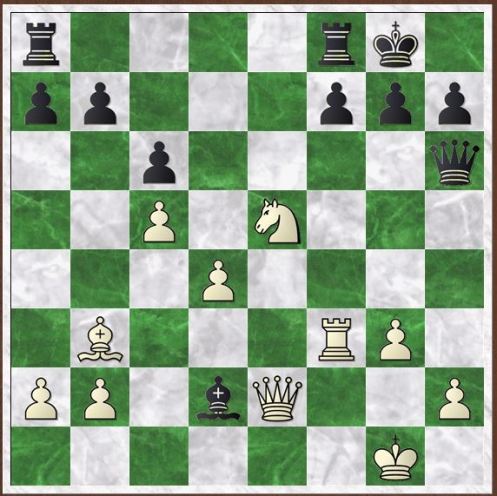
Then 1…Bf1 2 Rf1 Bd2 is the game continuation, when 3 Rf3! keeps the bind.
And next move, something nasty happens on f7.
So, instead, 1..Be6 when 2 Nf7!
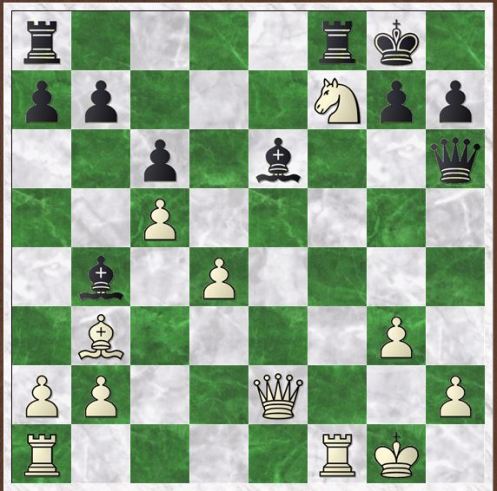
And similar play ensues. My engine tells me that relatively best is 1…Qd2 2 Qd2 Bd2 3 Rf3
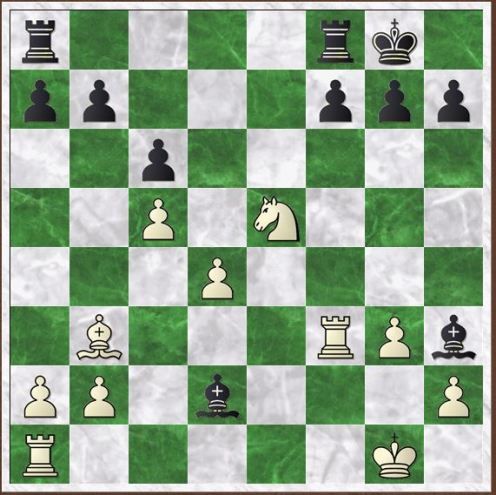
When Black’s best is probably 3…Be6 4 Be6 fe 5 Rb3 when it turns out Black is in peril: his Pb7 is impossible to defend without trussing himself us by Rfb8 (due to Rab8 Nd7 pinning and winning).
 allanbeardsworth