White to play and win
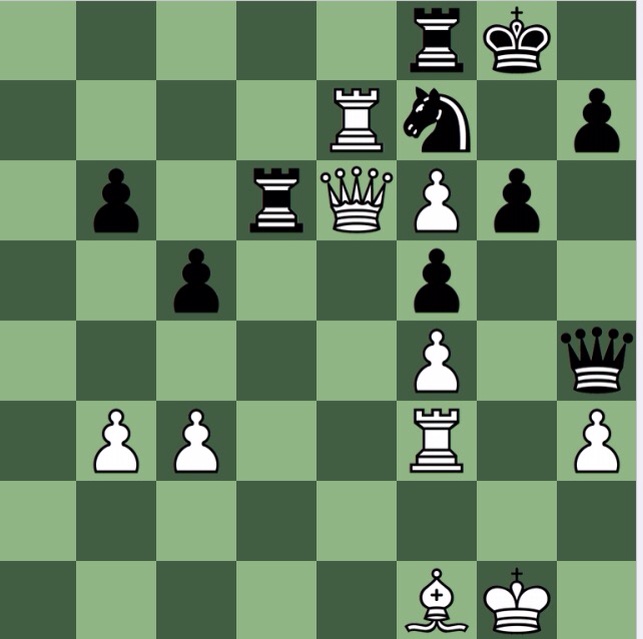
Hammacher v AN Other, Essen 1962
Solution
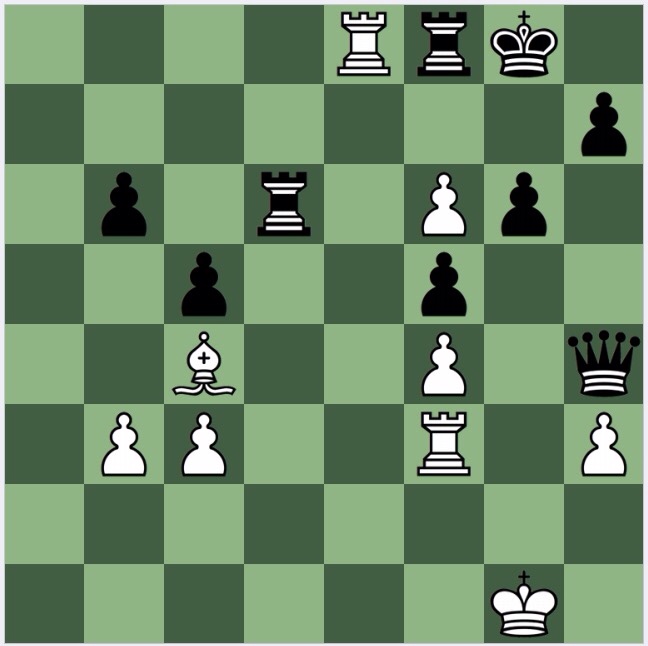
Examine all biffs combined with black's king being in a net (threat of back rank mate) are the two CJS Purdy themes here. 1 Qf7+ Rf7[] 2 Re8+ Rf8[] 3 Bc4+ and mates.
 Posted with Blogsy
White to play and win
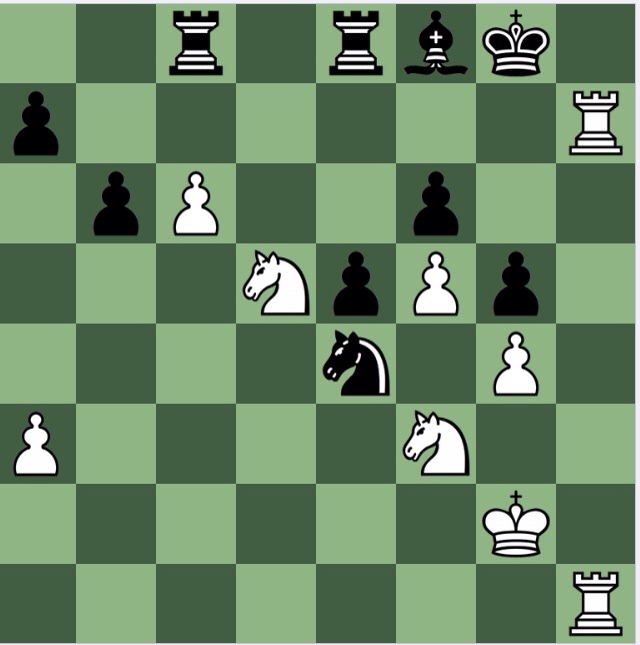
Neukirch v Uhlmann, Leipzig 1962
Solution
I am not sure whether this is easy or hard. For me, it took me ages (half a dog walk, to be precise) until the doh! moment, when I reflected, reconsidered…and looking at 'functions' or in Purdy terms, nets, pins and ties.
Here, the Ne4 is tied to the Pf6, which, if it falls, is game over. So 1 Nd2! and since the Ne4 is LPDO, it is game over.
Why is it so hard to follow the 'rules' that you know: a check for LPDOs, a check for nets, pins and ties, examine all biffs …will get you a long way in chess, or solving chess problems, and yet it is so hard to follow a routine.
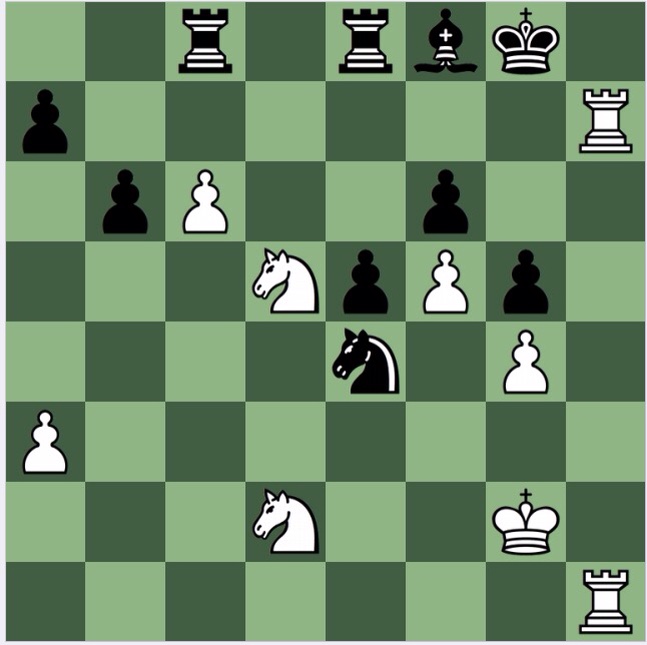
Black to play and win
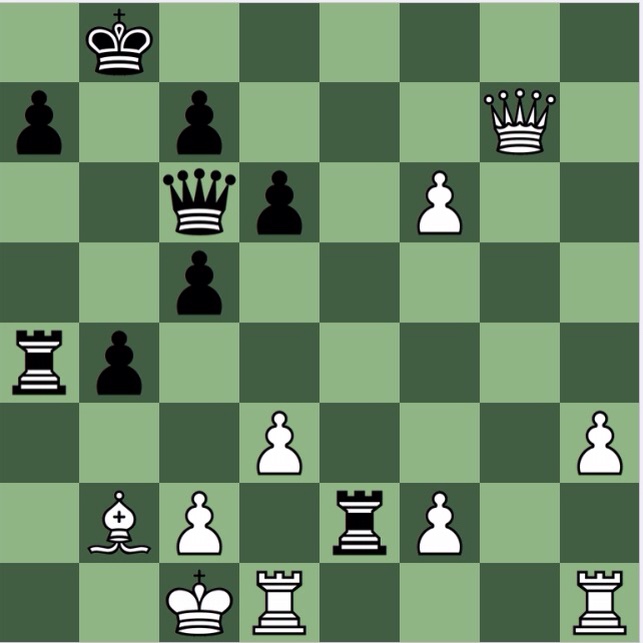
Redeli-Barati, Budapest, 1949
Solution
A very pretty puzzle, especially once you defeat the best defence.
Firstly, time is of the essence: white has Qg8+ followed by Qb3, securing most things. So, examine all biffs and 1…Ra1+!! comes to mind, forcing 2 Ba1[] when 2…Qa4 is a double attack on Ba1 and Pc2. But white has the aforesaid 3 Qg8+ Kb7 4 Qb3:
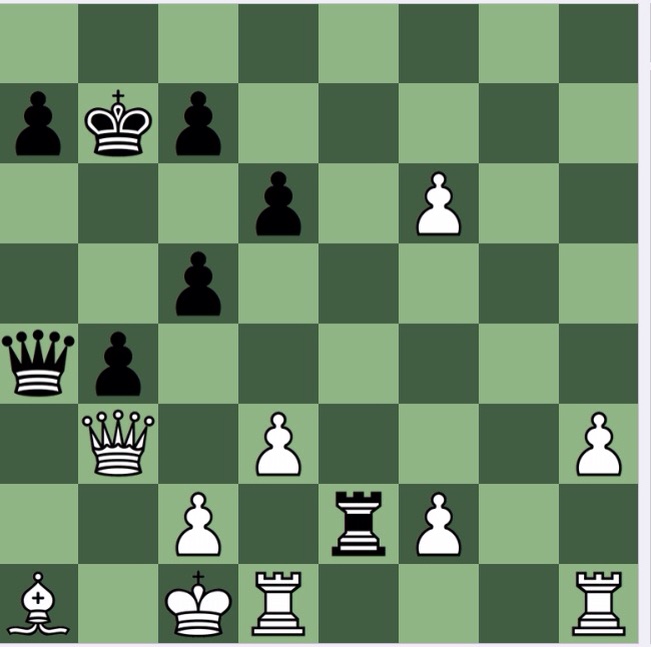
At first, it might be thought white is in time, and will emerge with a rook extra, and a passed f pawn too, but no, black has the pretty 4…Qa1+ 5 Qb1:
Black to play and win
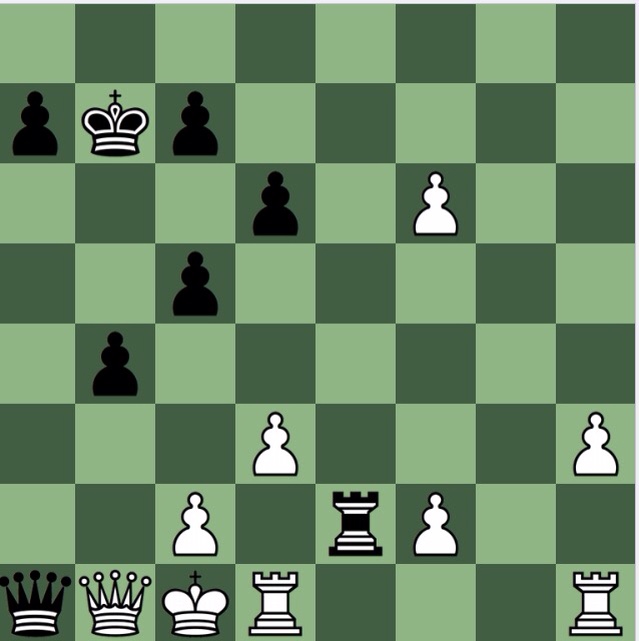
5…Rc2+!
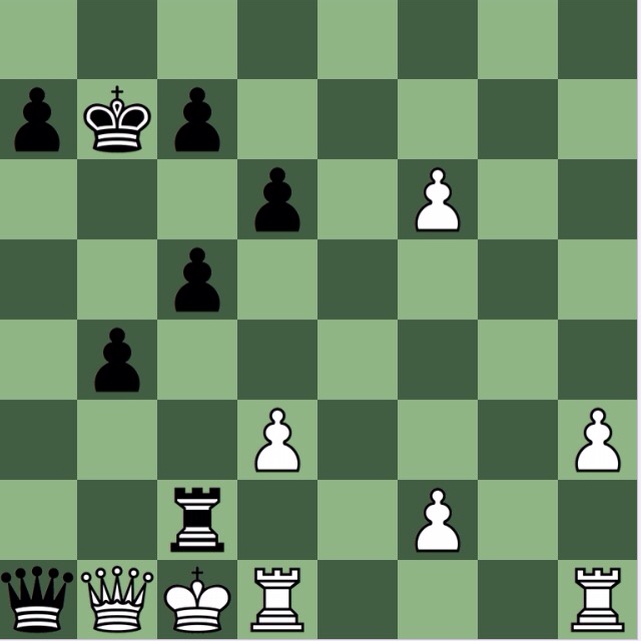
6 Kc2 Qc3 mate. Pretty.
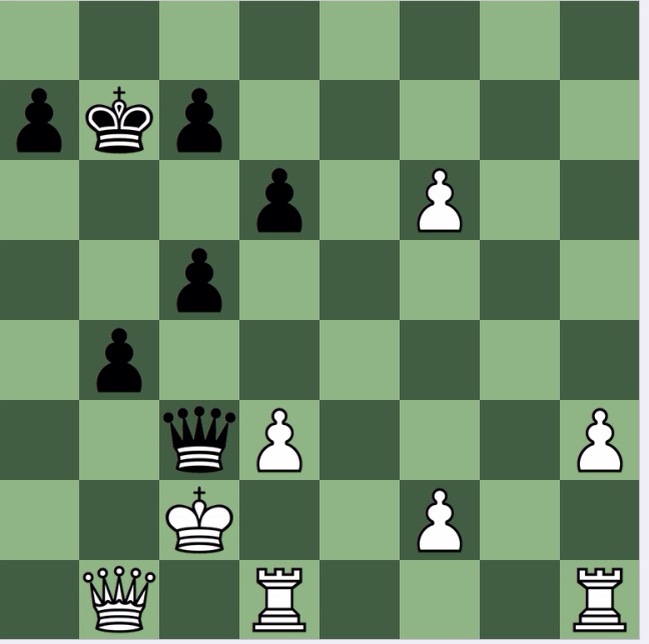
White to play and win
Ardoino v Dekeyser, Italy-Belgium corres 1961-2
Solution
Teschner's book gives the rubric 'white stops the diversionary action in a problem-like manner'. I am not sure if that is a clue or not; or, if it is for the right problem.
The position has multiple solutions. White's position is overwhelming. The principal aim is to move the black queen from c6 to anywhere else, since from c6 it controls e8, preventing Qe8 mate. So 1 Ne5! springs to mind, as does 1 Nd4!; the former has the benefit of being more powerful, threatening 2 Ng6 mate; and if 1…fe, then the Rf1-f7 jump check becomes a real check, and mate.
In addition (1 Ne5 being +30, 1 Nd4 +16, whatever these scores mean) 1 Rc8 is also +12, since 1…Qd7 falls to 2 Qg7+ Kd6[] 3 Rd1+ skewering.
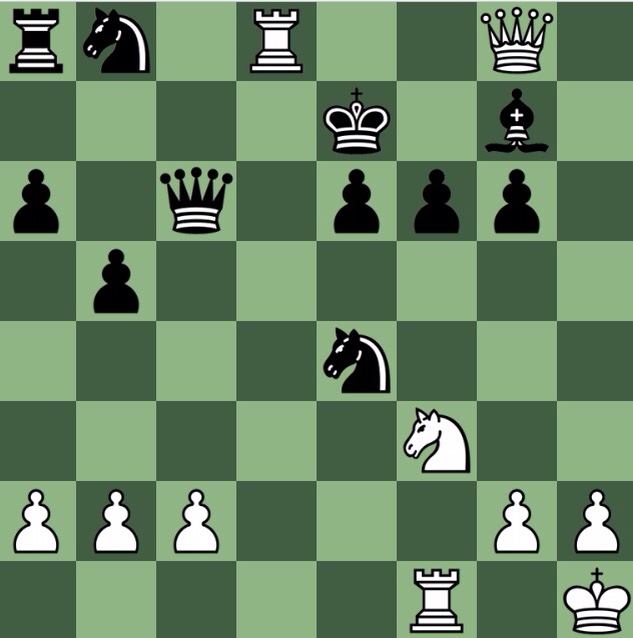
White to play and win

Olsson v Buskenström, Dalarna 1962
Solution
The solution is almost forced upon white, since black has copious threats against the white's king. All white must do is make the most of the threat of back rank mate: so, specifically, the Re8 is tied to the eighth rank, so that 1 Ne7+! forces a king move.
If black moves his king to the f file, white takes on g6, and then checks away with his bishop or rook to improve his pieces, eventually closing the e file. So instead 1…Kh8 2 Ng6+ hg 3 Bg2!
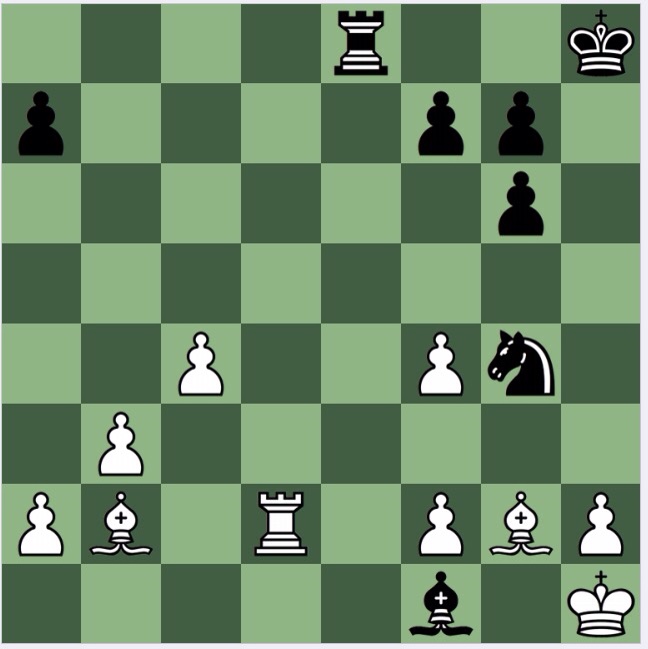
White is able to keep control. There are some further minors tactics: 3…Bc4! 4 bc Re1+ 5 Bf1 Rf1+ 6 Kg2

and White wins: he is a passed pawn up, with the better minor piece.
White to play and win
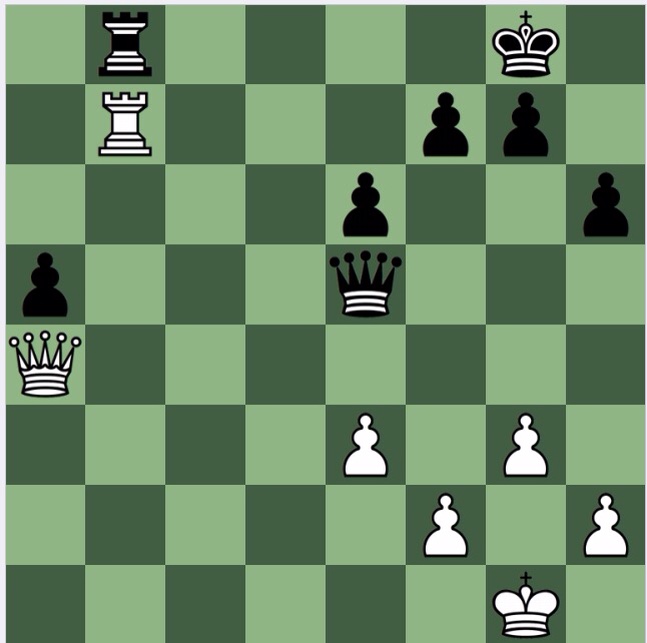
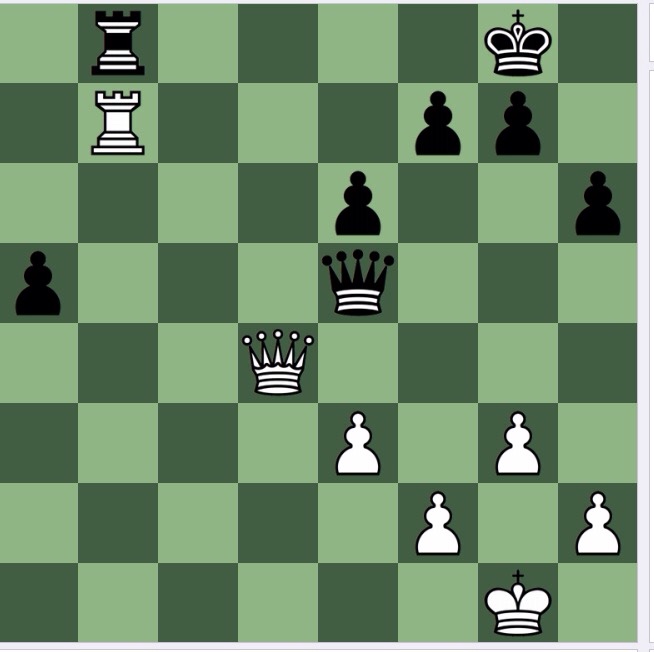
Schuster v Schurr, Stuggart 1962
Solution
A fairly standard problem, one of overload, or the black queen being tied to the defence of the Rb8. So 1 Qd4! (not 1 Qf4? Qa1+) and after 1…Qd4 the zwischenschach 2 Rb8+ wins. Note that as well as Purdy's concept of tie being a motif, the combination also works because the black queen is a LPDO. If the Qe5 had been defended, e.g. by a Pf6, the combination wouldn't have worked.
Sometimes I read articles which are full of insight; often I keep them, knowing or thinking I might want to refer back to them, other times I hope that I will remember their principal points.
One recent article really impressed: so much, that I want to share it, and comment on it. Firstly, the disclaimer: I have known its author, John Timpson, for many years, being lucky enough to be professionally associated with him and his eponymous business (well known for its pioneering employment of ex prisoners and for support of adoption, amongst other things); and I have read his books (reading his first one long before getting to know him); and reading his Daily Telegraph columns for more years than I can imagine. The beauty of his writing is that it is always clear and common sense. The unusual thing about his writing is that common sense is anything but common. I don't always agree with him, but predominantly do, and I would recommend his books and his articles to anyone wanting to learn about business. Over time, a young person reading them is bound to soak up a lot of business knowledge. A more experienced person will sharpen or refresh their thinking, too.
Now the article.
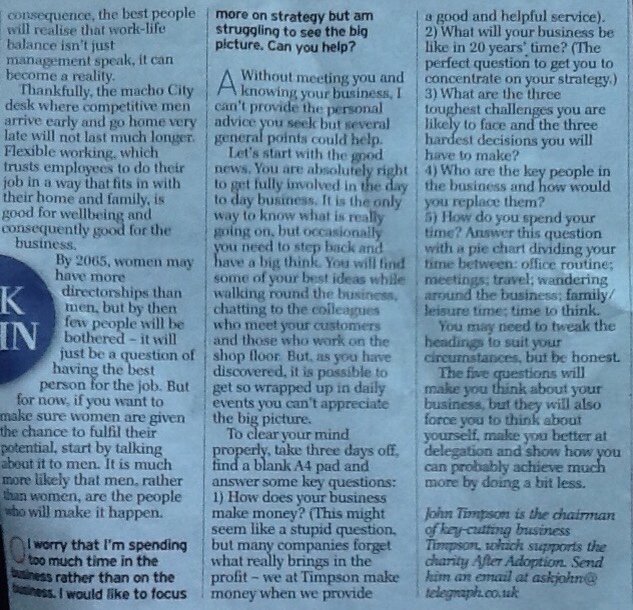
I love his suggestion to answer five questions.
How does your business make money?
What will your business be like in 20 years time?
What are the three biggest challenges, and three hardest decisions you face?
Who are the key people in your business and how would you replace them?
How do you spend your time?
John quite rightly says that these questions may have to be flexed. Personally, having thought about what he wrote for the last week or so, and considered how it could be applied to my old firm, my clients, and my current roles (I have started applying it to my charity trustee roles- the 'how do you make money' needs to be morphed to 'how do you succeed in your charitable aims', for instance), I would actually add a sixth
Who are your key suppliers or what are your key resource needs?
Probably there is nothing new in John's article. But his articulation is excellent, and it is either a reminder or a lesson to concentrate on key questions. Each question will have greater or lesser importance for different businesses. My sixth is (for instance) because one of my clients is dependent on timber prices; another needs access to copious amounts of water; in other cases, a key factor is risk of change or new legislation. (So, maybe, it should be John's five plus a flexible further one).
Personally, for more years than I can remember, and even in my previous career as a tax partner, I have habitually used a combination of PESTI, Porter's five forces and the BCG cash cow/star etc matrices, to help my understanding of clients' businesses, partly to help inform myself about their businesses, partly because insights gained can help with the giving of informed tax advice. Now, I have a new weapon in my armoury, John's 5+1 questions. I recommend people give them a try: I already have.
White to play and win

Unzicker v Botvinnik, Oberhausen 1961
Solution
The first move, 1 e6! is an obvious biff to try, and is the move I would hopefully have played. Black then resigned, because I suspect at top GM level the result is clear, but for me, there is a lot of calculation left, and, in my case, I couldn't quite break 1…Rd6 (delete the word quite…you either break a defence, or you don't).

1…fe is easiest: 2 Qg7+ and the LPDO Rh8 drops off;
1…Rd6 and (the engine showed me) 2 Qb7+ Ke6 3 Rd6+ Qd6 4 Rb6 pins and wins;
1…Rc7 2 Rf1 Qg5 3 Qd5 threatens to fork and win the LPDO Rc7.
—
Above written up, having checked Teschner's solution. Then load Stockfish, to enter the position for the blog, and…instantaneously, 1 Re6+! flashes up, mate in 6.
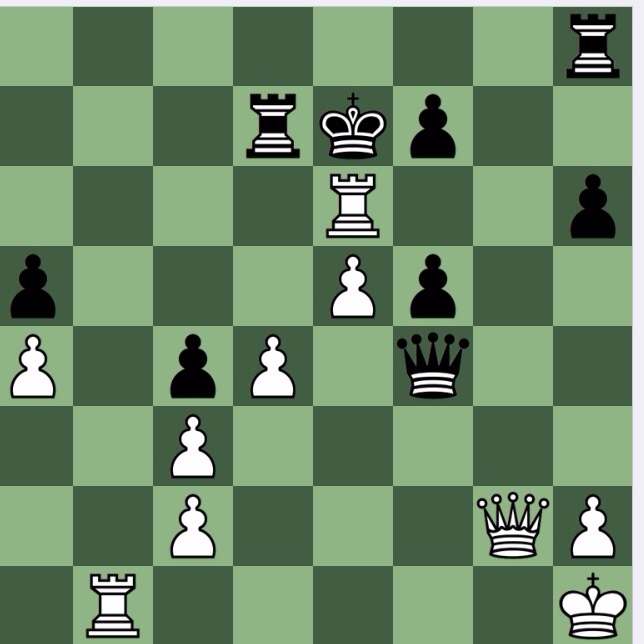
Once seen, it is 'obvious': Checking on the black squares gets the king (one line being 1…fe 2 Qg7+ Kd8 3 Qh8+ Kc7 4 Qb8 mate)
Black to play and win
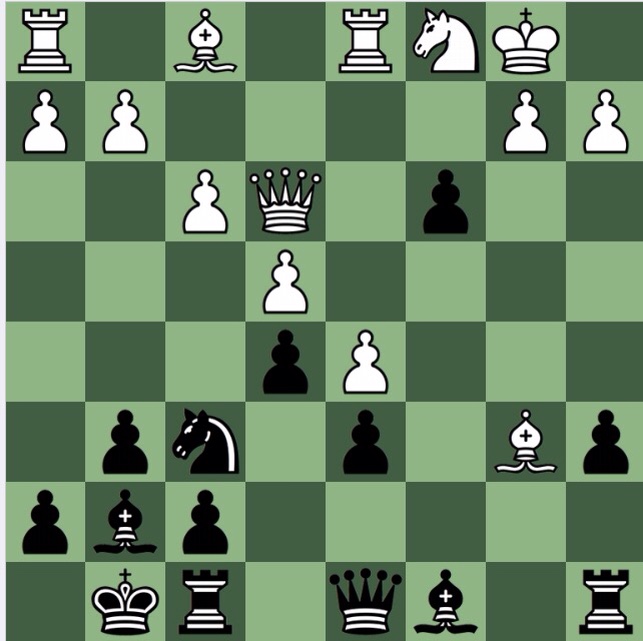
Novosibirsk v Saratov, 1960
Solution
A lovely puzzle, and a prime example of CJS Purdy's maxim to ignore threats: imagine they can't possibly happen, and decide what you would wish to play.
1…Rb8!! is the star move, ignoring the threat of 2 Bd8; then 2….Rb2+ 3 Ka1[] c2 is another of Purdy's themes, in fact the moniker which when I read it in his book (The Search for Chess Perfection) I found it one of the deepest, most profound, and yet simple ideas, potassium cyanide. The c2 pawn hits d1 and b1 (Rb1 mate).

Then 4 Kb2 cd+(N)! and picks up the queen, plus the knight can't be trapped, because at worse it can be defended by Bh6.

White to play and win
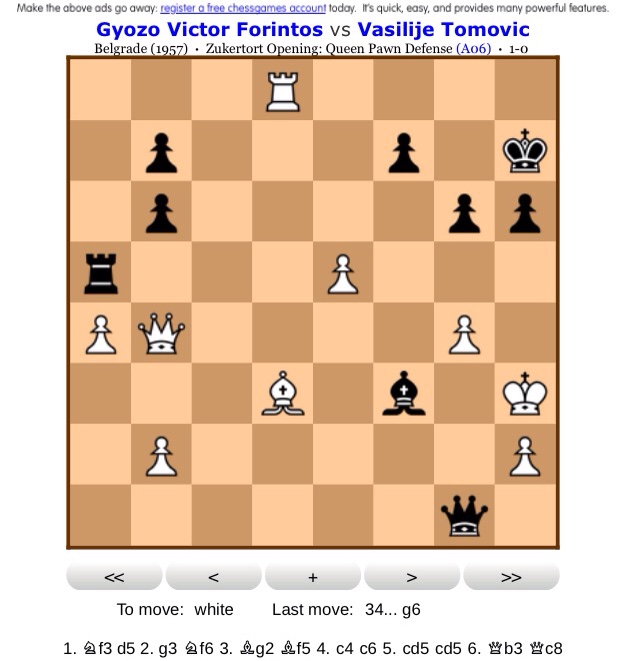
Solution
Yesterday's puzzle from Teschner's book featured GM Gyozo Forintos, and in writing the blog, I had cause to google him, and read his Wikipedia entry. It contained two featured games of his, the first of which I have played through, and is a gem: a controlled, positional middle game, culminating in winning a shaky extra pawn, retaining it with skill and care, followed by a lovely tactical conclusion.
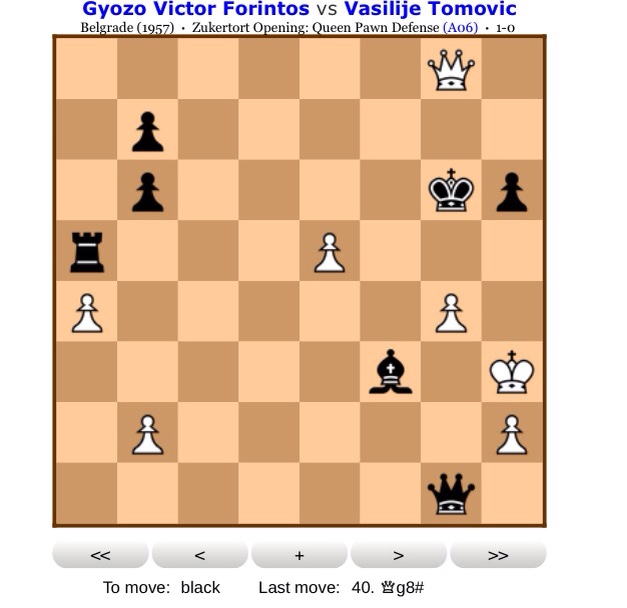
1 Rh8+! Kh8 (1…Kg7 2 Qf8 mate) 2 Qf8+ Kh7[] 3 Qf7+ Kh8[] 4 Qf8+ Kh7[] 5 Bg6+! pretty Kg6[] 6 Qg8 mate.
 allanbeardsworth