I recently played a blitz game, the finish to which was a poor version of one of my all time favourite games, Nigel Short’s king march victory over Jan Timman in Tilburg in 1991.
After my game (see below) I decided to blog it in my homage to my school friend. Then, I realised that Nigel is fifty on 1st June. So happy birthday, Nigel.
Here is my game, 3-0 blitz; I am white. The green arrows show my imminent Shortian king march.


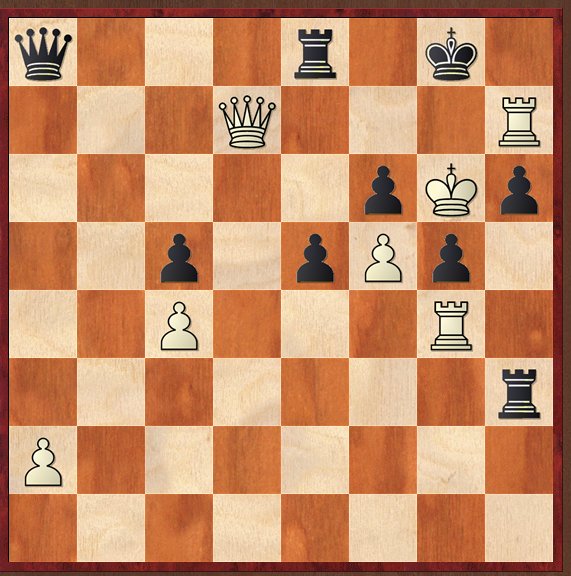
…and mates. Of course, my play was not entirely safe, and near the end Black could have drawn, but still pretty.
Below is Nigel’s masterpiece.
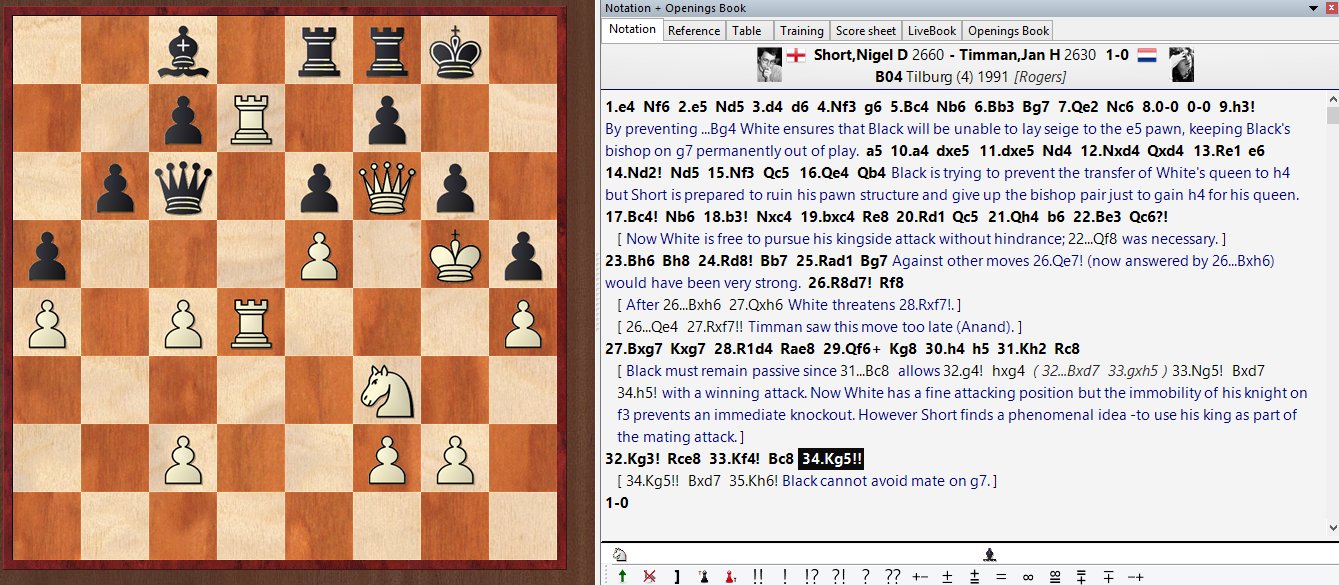
 Posted with Blogsy
Today is my lfe-long friend's, Nigel Short, 50th birthday, and I am looking forward to reading the report Chessbase will produce today to commemorate the occasion.
In the run up, I have looked back at my old scrapbooks, and taken a very happy trip down memory lane. Nigel and I first met in the summer of 1972, shortly after I had taken up chess, and got the bug, in the media storm which culminated in Fischer-Spassky.
Our respective parents, not finding chess clubs in our home villages of Culcheth and Atherton, independently found a miners' social club in Golborne, near Wigan, Lancashire, and each week drove us there. Nigel was seven, I was ten, and the miners more or less just left the two of us to play each other, which we did each week.
Later, I don't quite remember when, Golborne has a match against Bolton chess club, one of whose players, the late Mike O'Hara, when strolling around, saw the two kids playing, and realised that we were both better than any of the adults. He took us away, I think at first to Bolton chess club, but quickly he formed Atherton chess club. Mike shepherded the two of us around the country, for no recompense: we were fortunate that Mike was a tireless supporter of English junior chess. Atherton soon became a formidable force in England club chess.
No mobile phones, and I suspect I didn't even have a camera then, so no pictures from the earliest days. The earliest picture I have (though, to be honest, I am now going to trawl through old photo albums and other papers) is from the Bolton Evening News, 29th November 1976. By then Nigel had joined me at Bolton School, where we spent our senior school years together (winning the National Schools chess tournament). Our first win was the Lancashire team Lightning (10seconds a move) with our colleagues Jonathon Bergwerk and Kim Harris (the article has his name wrong as Tim).

Lancashire Teams Lightning Tournament 27/11/76
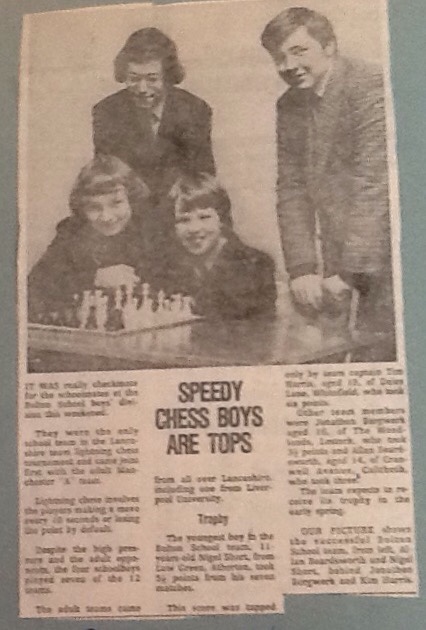
Bolton Evening News 29/11/76
Happy birthday, Nigel!
White to play and win

A challenging puzzle today, one well worth solving.
Shirov v Sjuurigov, Russian Teams 2015
Position seen in Malcolm Pein's Daily Telegraph column
Solution
A break from Teschner; a lovely puzzle, with, for me, an unusual piece placement. The problem took me half a dog walk to solve…so I would rate it is 'very difficult'.
Examine all biffs and reviewing for pins, nets and ties leads to the realisation that the solution must be something to do with the two black rooks being tied to defending each other, so 1 Rc8+! has to be tried. When you realise that the simple 1…Rc8? loses, routinely, to 2 Qc8+ Kg7 3 Qc7+ with a double attack, picking up the now LPDO Rc8, the task becomes 'how to break 1…Kg7’ (or Kh7). I should also mention that 1…Bd8+ loses simply to 2 Rd8+.

Eventually the solution dawned on me: 2 Qa7+! forces a rook to intervene, else 3 Rb8 wins a rook, but then 3 Rc7+! is the unusual point of the combination. Whether or not black takes the rook, both of his rooks are lost. An unusual finale, worth remembering.
White to play and win
The initial move is fairly obvious, the precise follow up being impossible, at least for me: Spassky shows his class. This is a tough puzzle, worth trying to see how much you can see, especially since black has several defences.

Spassky v Darga, Varna Olympiad 1962
Solution
1 Ne6! fe 2 Qa4+ Ke7

3 Qg4! (a move I failed to see- I played Rd7/Rf7 and tried to pick up the LPDO Bc5). I would not have the guts to trust that such a position was winning, and so would be scared of sacrificing the Ne6: except in a blitz game. I suspect, though, that stronger players 'feel' that's white's development advantage counts. Studying such unbalanced positions would I suspect pay dividends (note to myself: go study)
Or, if 2…Qb5, 3 Qg4!

Then 3…Qc6 4 Qg7 Rf8 5 Qh7 and it seems (so say the engines) that white's attack is winning.
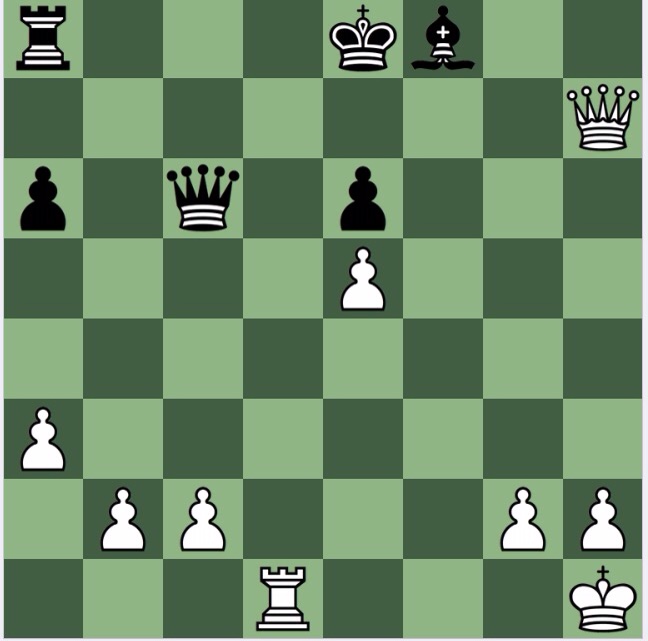
White to play and win
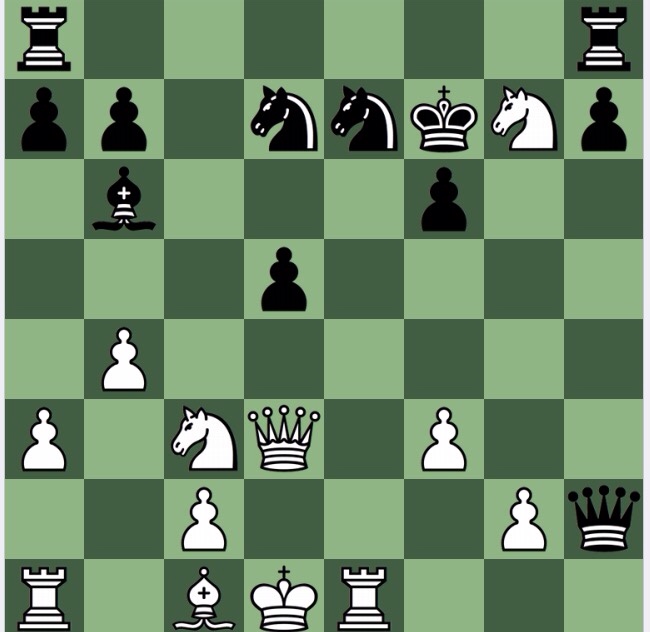
Teschner v Zbikowski, Berlin 1963
Solution
There is nothing clear cut (in the sense of decisive, unless you are an engine) but instead the developing move 1 Bf4! Is pretty and strong. The f4 square is mined, the point being that if 1…Qf4 then 2 Re7+! and if 2…Ke7, 3 Nd5+ picks up the queen.
So, instead, black must play something like 2…Qg2 when 3 Nf5 regroups, and white is better.
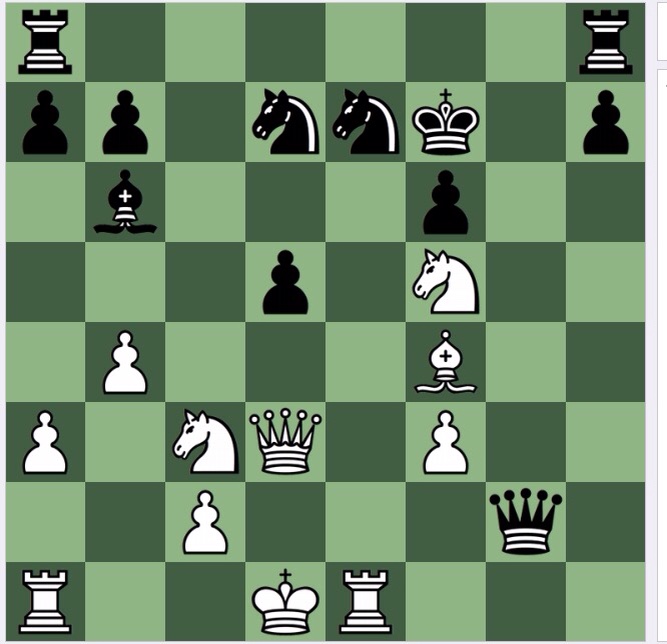
White to play and win
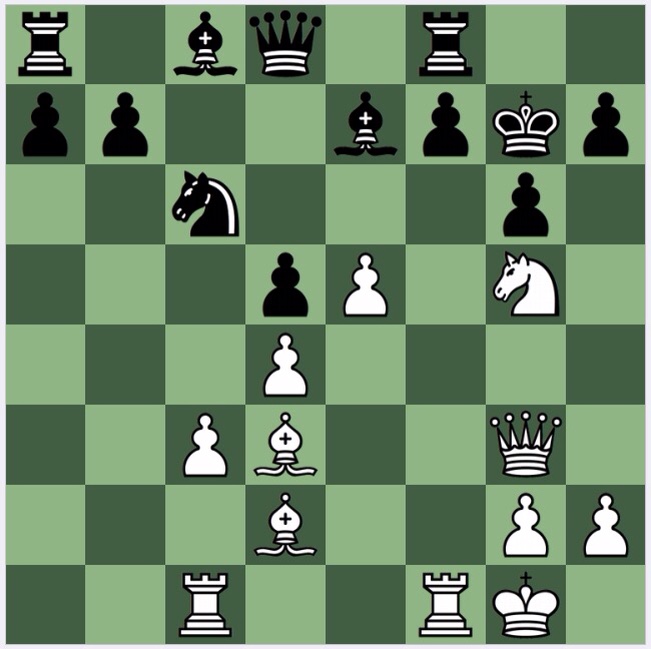
Szczepaniec v Serwa, Poland 1962
Solution
Examine all biffs again, here the typical sacrifices 1 Nh7! Kh7 2 Rf7+! doing the trick.
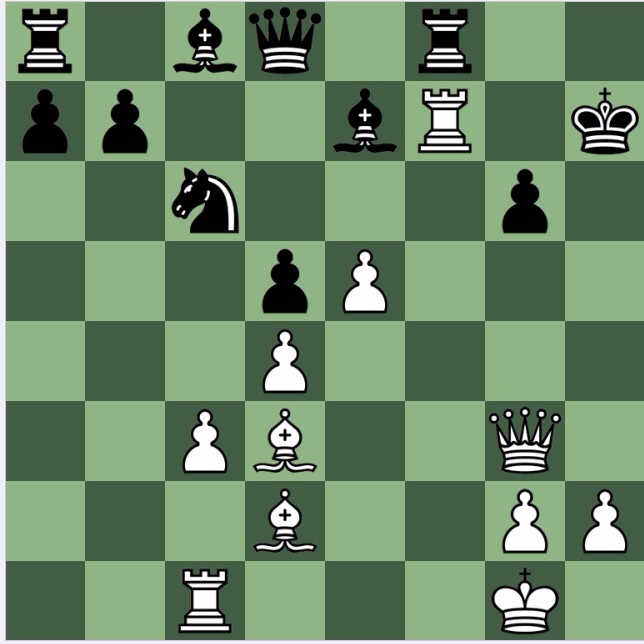
Black to play and win
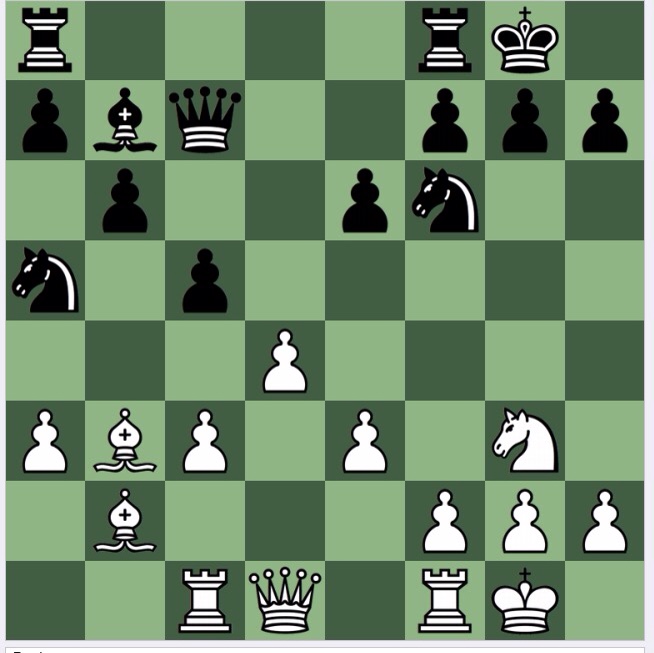
Rivera-Fischer, Varna Olympiad 1962
Solution
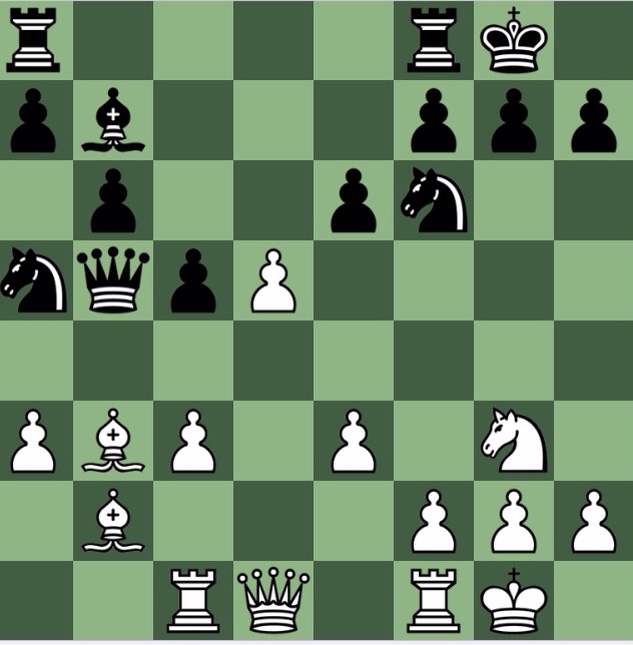
One of the Bobby Fischer classics: 1…Qc6 hits g2, and after day 2 d5, Qb5 hits both loose bishops.
(The blog heading is meant to be a better lede than 'the tax case Terence Hill (Berkeley) Limited)
We recently watched the film The Social Network again, the story of the creation of Facebook by Mark Zuckerberg and others, notably Cameron and Tyler Winklevoss. It was Friday night relaxation, but, maybe there was still a hint of tax in my brain since at a certain moment there was a telling line.

Jesse Eisenberg
There was a long part of the film held in lawyers' offices in which Jesse Eisenberg, playing Mark Zuckerberg, did a sterling job of making his character appear obnoxious and too clever by half. Then, end of the evening, just Jesse and Rashida Jones, the actress playing Marilyn Delpythe junior lawyer are left behind in the office; he suggests they go out for something to eat, she says she has to decline as to do so would be unprofessional, and then, and here's the crunch, she tells him “you're going to lose; you're going to pay something”; telling him that litigation is all about character, and a jury will side with the Winklevoss.

Rashida Jones
(It's amazing what you can google; this is an extract from a webpage on some legal aspects from the film.
“I invented two characters–one was Rashida Jones's 'Marilyn,' the youngest lawyer on the team and a far cry from the other women we see in the movie. She's plainly serious, competent and, when asked, has no problem speaking the truth as she sees it to Mark,” Sorkin writes.
I've not found a webpage on the tax aspects, though. {Starter for ten: had it been a UK case, the Winklevi would have paid tax on their compensation}
Where is this leading? Well, the bald fact about litigation being character critical was very evident in the recent case Terrace Hill (Berkeley) Limited v HMRC [2015] UKFTT 75.
Until the end of December 2014, when I retired from being a partner at Deloittes, one of my favourite roles in my job was doing regular internal tax updates, often principally focussed on tax cases; selecting cases because of their importance, amusement, general principles or topicality; including each year naming a case of the year. Alas, I can no longer do that, but I haven't lost my keen interest in tax cases and so, on occasion, when I think it appropriate, I will blog about cases, my first being Terrace Hill.
The caveats
I've only read the case a couple of times, on a wet Bank Holiday. I haven't gone to Companies House to look at the accounts of Terrace Hill (Berkeley) Limited, nor done any formal research. I just found the case interesting, and chose to blog about it.
Main points to take away from the case
A large part of many First-Tier Tribunal decisions are based on the credibility or otherwise of the witnesses;
First-Tier Tribunals are decided on the balance of probabilities;
The burden of proof is on the taxpayer;
HMRC can seek, and sought here, penalties of £1m.
The judgment
HMRC lost; the taxpayer prevailed on the balance of probabilities, and therefore paid the lower amount of tax it had self assessed as its liability, and the penalty fell away.
Another day, another taxpayer, another decision
It could so easily have gone the other way with the same facts but less strong witnesses. HMRC will be very disappointed to have lost; it probably doesn't create a significant precedent, though.
The facts
The Terrace Hill group had a 50% stake in an SPV which in August 2000 bought a property in Mayfair; by December 2000 the tenants had all left. The site was demolished and a grade A 35,000 square foot office property was constructed. The construction was completed in September 2013. The property was substantially let by September 2014, fully let by May 2015 and sold by July 2015. In the intervening years, 9/11 had happened, causing a fall in the London property market.
The property was sold for £39.4m. I infer that the total project cost were somewhat north of £28m (para 80) but can't be certain. Hence the taxable profit is in the region of £11m, and corporation tax around £2.5m. In parenthesis, a £1m penalty on this level of tax is plausible; perhaps coloured (increased) by the use of a scheme, but also of course my figures are estimated. (By coincidence, another case I have been reading, Romie Tager, HMRC successfully levied a £1m penalty on an 'irresponsible' taxpayer. Penalties aren't just £100 but can be very serious nowadays)
KPMG had promoted a capital loss scheme to both Terrace Hill and their JV partners. The judgment said that HMRC eventually conceded that the scheme was effective, if the profit was a capital gain.
The key question therefore was “was Terence Hill's profit arising from a trade, or from realising an investment” (para 113).
Discussion
The Terrace Hill group was at the time substantially held by family trusts connected to a Mr Robert Adair. The group had both developed and invested in property, so was a 'mixed beast' like, in my experience, many property groups. Mr Adair is a qualified accountant, and a chartered tax advisor, and the tribunal found him to be an impressive, honest and knowledgeable witness”. One of his CEOs during the relevant period, Nigel Turnbull, also an accountant, was also held to be an 'honest and knowledgeable' witness. The third taxpayer's witness, Philip Leech, a highly experienced property man, was similarly found to be “an honest and very impressive witness, and a man of considerable integrity”.
My reading is that the strength of these three witnesses was decisive in this case.
HMRC sought to discredit Mr Turnbull who had told Bank of Scotland in July 2004 that they intended to realise their investment as quickly as possible (para 36). In his oral evidence, Mr Turnbull said that in fact they had never intended to do this, and that he had written to the Bank in this way as part of the game playing with lending bankers. HMRC's Barrister sought to put weight on this, either to show true intention, or to discredit Mr Turnbull.
Fortunately for the taxpayer, there was much contrary evidence, pointing to the investment motives. I won't paraphrase them, since they are lengthy, but there was consistency in other facts, such as evidence from the auditors, and the oral evidence of all three witnesses. Ultimately, one blot didn't spoil the copybook. For those professionals and others who act for property cases, or on other cases regarding trade or investment, the whole case is worth a read. In my reading of the case there was also one more weakness of the taxpayers' contention, but Counsel for HMRC didn't take it, and nor did the Tribunal judges, which I choose not to relay.
The judgment is well written. At para 118, they say that the critical question is weighing up the respective cases in relation to factual intention. In general, there was consistency from the witnesses and evidence; a major weakness for the taxpayer was 'fibbing to the bank' but, weighing matters up, they say their judgement was finely balanced, but to decide against the taxpayer would involve accepting that the witnesses had been lying in relation to all the critical evidence (para 126), which they couldn't do.
So, on the balance of probabilities, the taxpayer had done sufficient to establish their case. Accordingly, the profit was chargeable to corporation tax and thus, but not a matter for the judgment, the capital losses were available for offset.
Conclusion
The case won't be a leading precedent in future cases; it was decided on its facts. A different tribunal might have decided against the taxpayer due to the mis-leading of the bank (or, the evidence that the letter to the bank gave) so in part the taxpayer was lucky, and HMRC unlucky. But the case should be of interest to tax practitioners as being a typical examination of tax borderlines. As said, it is clear, well set out, and well written and argued.
Oh, and The Social Network is well worth watching too. It doesn't contain anything else about tax (and maybe Marilyn wasn't thinking about tax when she advised Mark) and not much about the other love of my life (though the Facemash algorithm, which got Mark into trouble/notoriety at the start of the film, is based on the ELO rankings).
Black to play and win
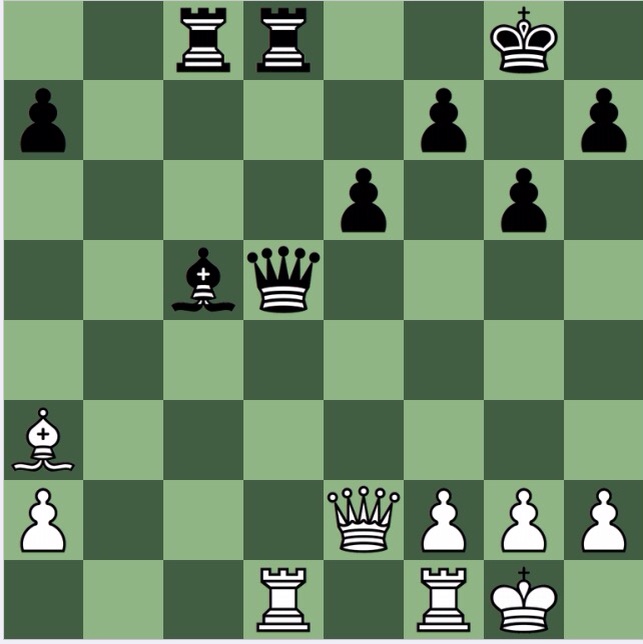
Rickers v Warnken Bremen, 1962
Solution
Examine all biffs leads to 1…Qd1! when there is the forced sequence 2 Rd1[] Rd1+[] 3 Qd1[] Ba3, but the resultant position is…won for black, due to the back rank mate threat and the threat of a queen and king skewer.
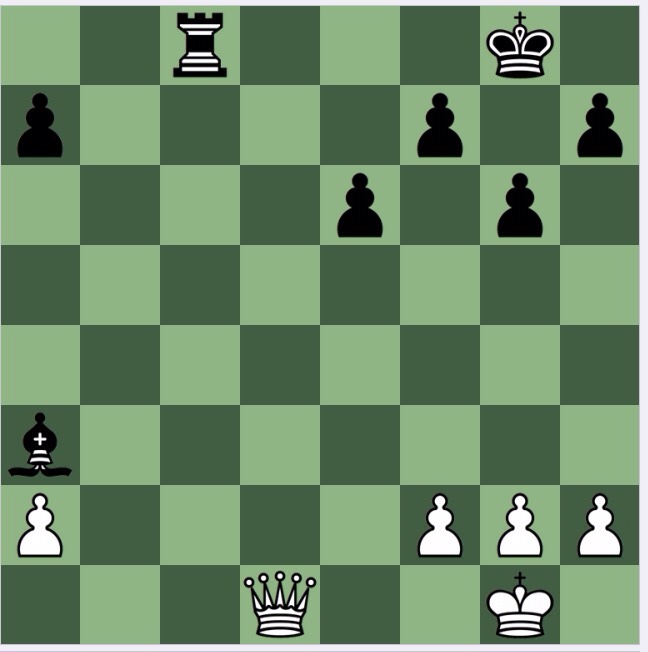
White to play and win
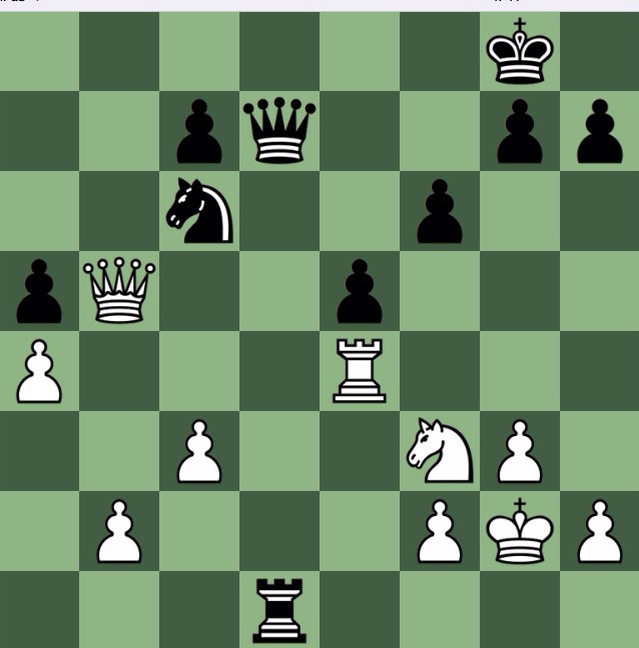
Benko v Robey, New York 1963
Solution
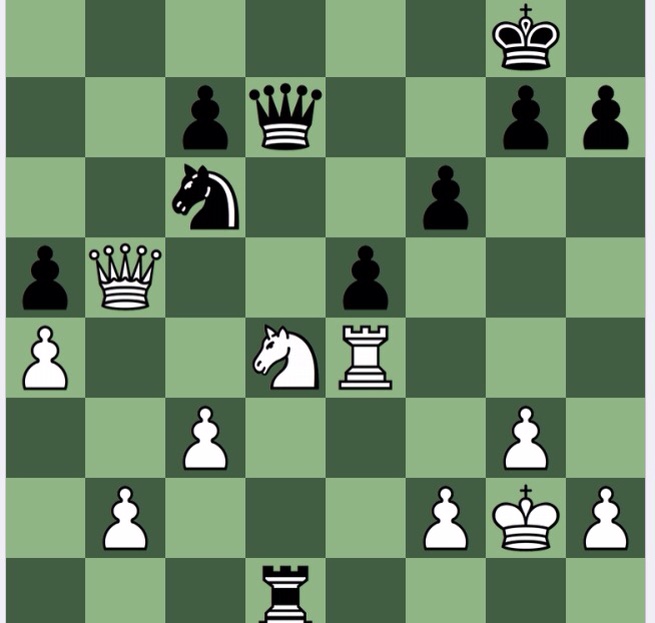
In CJS Purdy language, black's queen is tied to defending the Nc6 and Rd1. So, 1 Nd4! interferes, and one or other of the defended pieces drops off- with Qb3+ threatening to take the LPDO Rd1.
 allanbeardsworth