Black to play and win
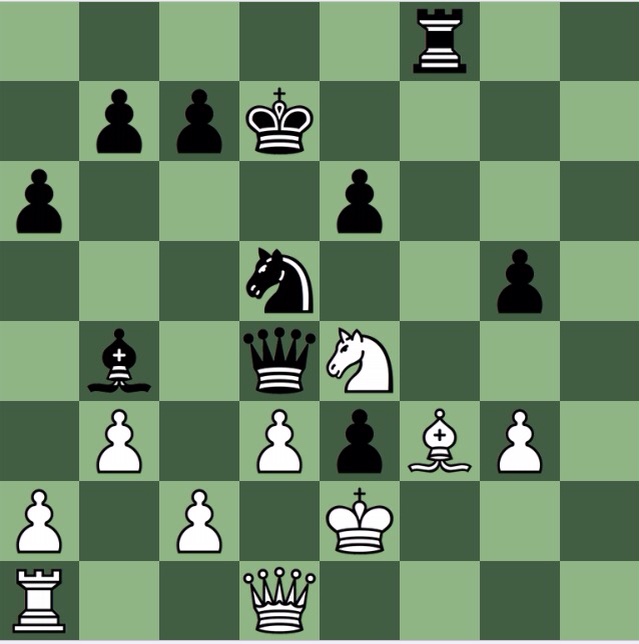
J Geyser v RS Hansen 1974
Solution
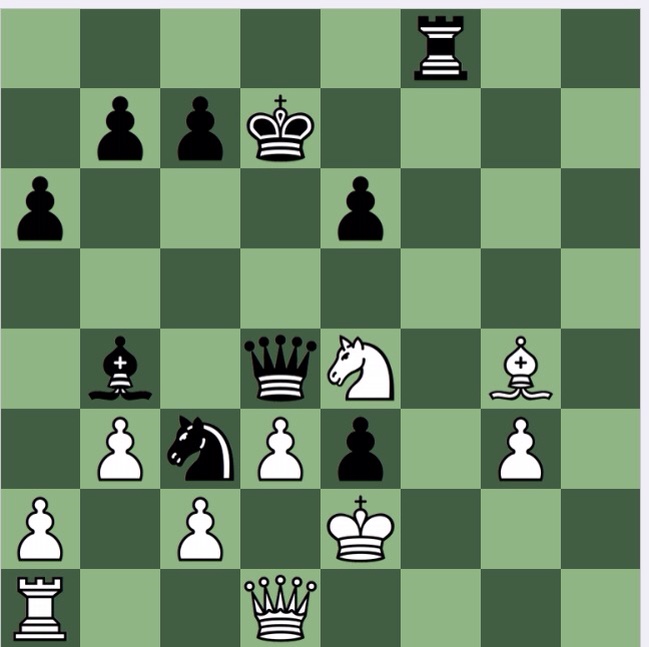
Not too hard today, because the obvious 1…Nc3+ wins (Stockfish has it at -7) but the alternative move order 1..g4 is clearly better. Stockfish spoils the fun by initially evaluating it as -150 before, after half a minute or so, switching to mate in 11. But all a human needs to see is 2 Bg4 Nc3+ and either the queen is lost or Qg4+ follows, ruinously.
 Posted with Blogsy
White to play and win
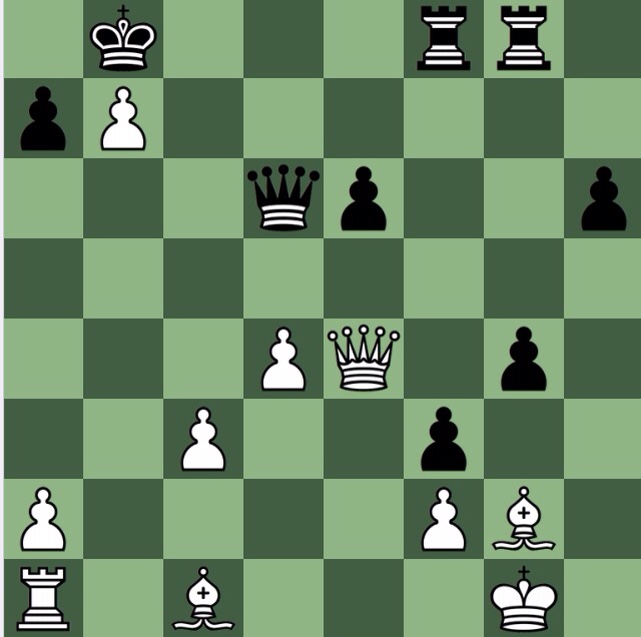
M Kolnik v KV Grivainis 1957
Solution
Reitstein's hint is that in the game white played 1 Bf1 and lost, but Stockfish says that, objectively, white is winning after that move (+1.7). However, knowing that 1 Bf1 is 'not the move' it isn't too hard to find the far better 1 Ba3!- Purdy's approach of ignoring threats and also to examine all biffs both lead to having to look at the move.
It is fairly easy to see what happens after 1…Qa3: 2 Qe5+, and an open king hunt starts. 2…Kb7[] 3 Rb1+ and in practice I would more or less stop there (3…Ka8? 4 Qe4+ mates; 3…Ka6?? 4 Qb5 is mate; so 3…Kc8 or 3..Kc6 are the only moves: if I had time, I would work out how to defeat both moves, otherwise I would rely on intuition.
It is more interesting to work out what happens if Black's queen moves, keeping an eye on d6. 1…Qd5 2 Rb1!! is another example of Ignoring all threats,
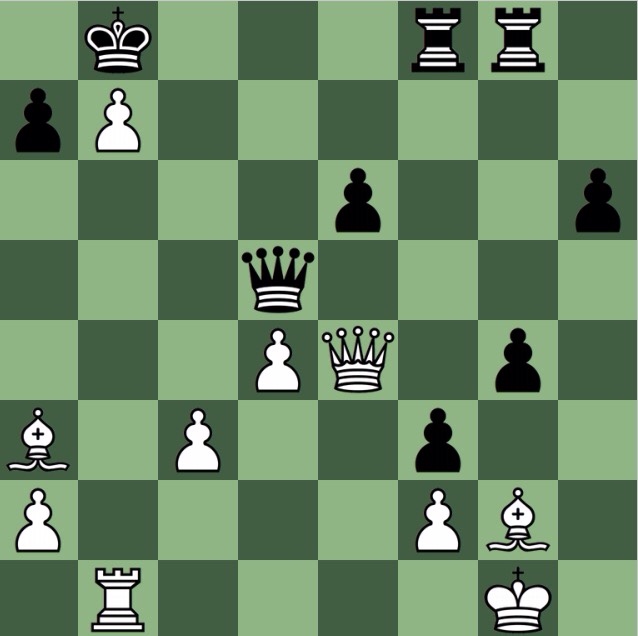
and if 2….Rf5 3 Rb5!! ignores all threats one last time.
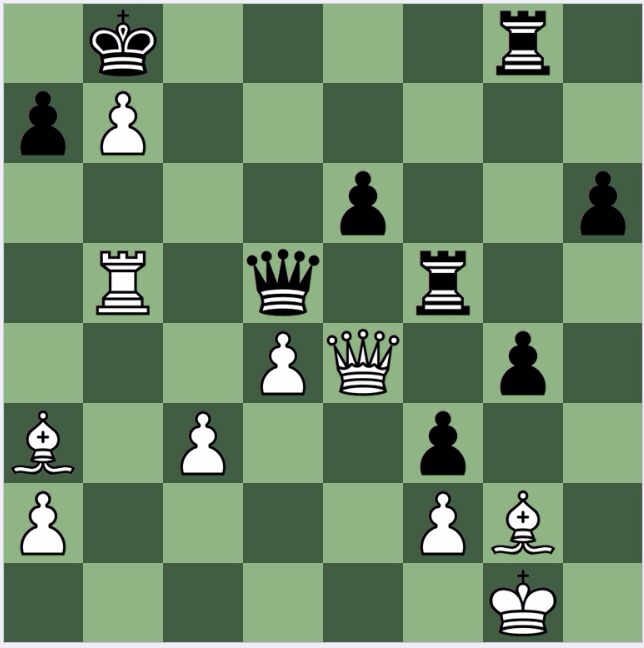
It isn't over, though. 3…Qd7! still controls d6, so white has to play 4 Bf1, and whilst the engines show +6, after 4…g3 there would be room to be scared as white – or, at least, I would need to keep control of my emotions, knowing that objectively the Q and 2 Bs will either maul black's king, or there would be simplification to a winning ending.
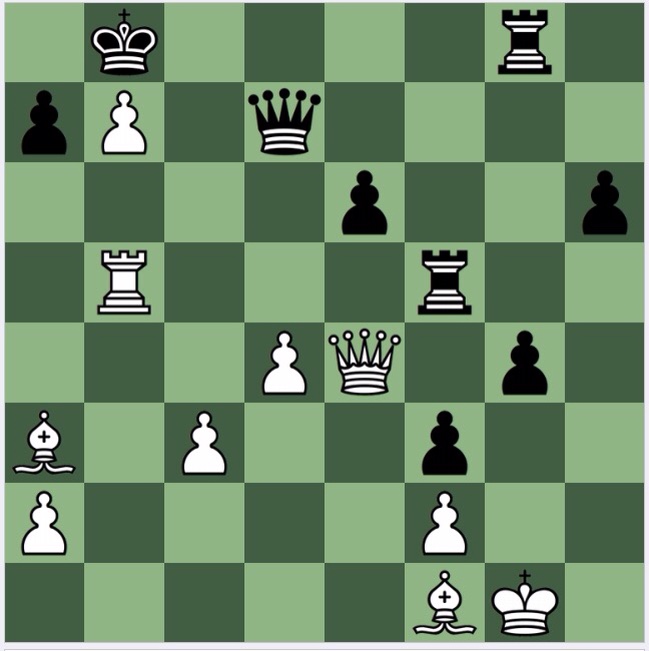
One more line: if after 1 Ba3, Black controls d6 by playing 1…Qd7, the lines are simpler. 2 Qe5+ Kb7 gets the king into the open, and white can follow up by 3 Rb1+ and probably take the Rf8, with a winning material and positional advantage.
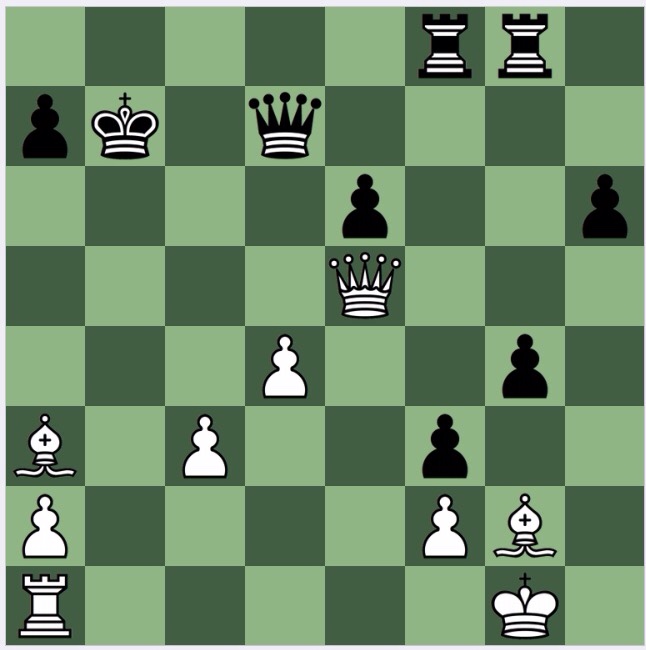
I wrote the above paragraph before looking at Stockfish, and, strangely, it drops its assessment from +13 In the above position to +6 after 3 Rb1+; it prefers 3 Bf1: I wonder why? One more conundrum to spend some time on, when there is time…or maybe a reader would care to look at it and comment.
Black to play and win
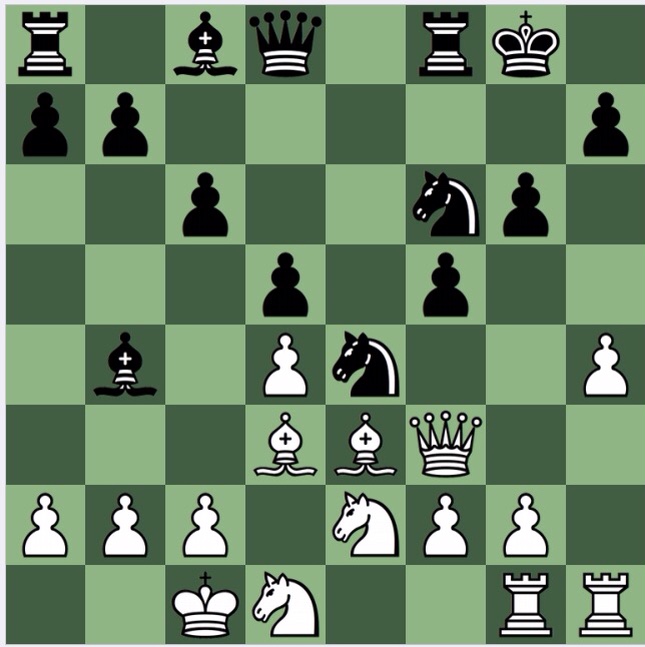
A Nel v V Blasl 2004
Solution
The concentration of pieces in the centre makes this hard to calculate, except in the same breath it is clear that the motif is that white's queen is in a net, to use CJS Purdy's terminology.
1…f4! and if 2 Bf4 Bg4 3 Qe3[] Bd2+ winning the queen; 2 Nf4 Bg4 again netting the queen; so 2 Be4 is relatively best, when 2…fe! 3 Bd3
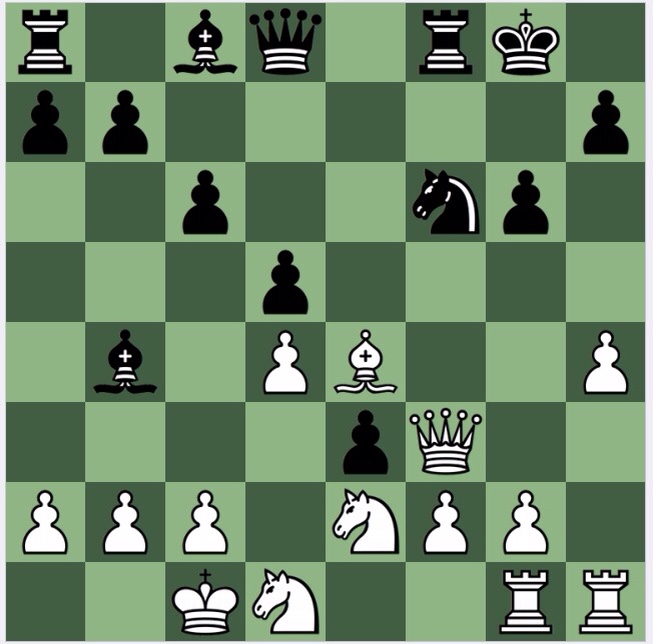
I could only see to here, thinking 3…Bd2+ keeps control and white's queen might still be in a net, and indeed it is…with 4…Nh5 winning the queen immediately.
Black to play and win
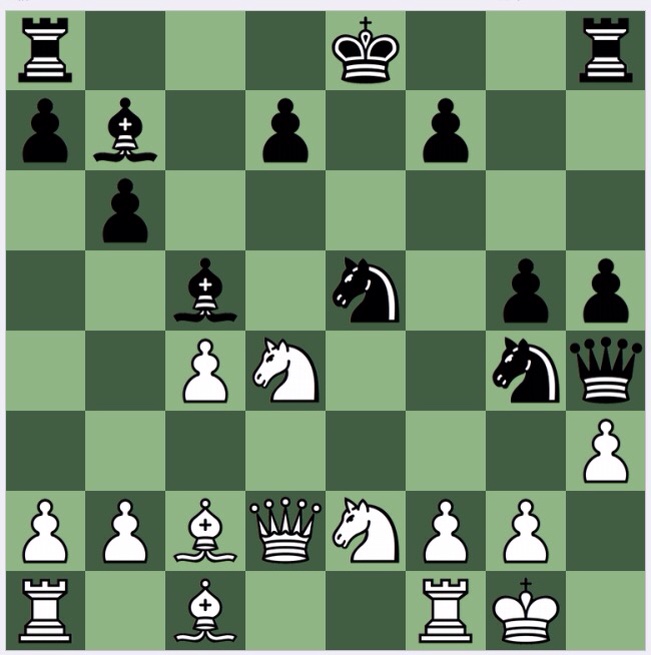
N Verlander v D Gluckman 1982
Solution
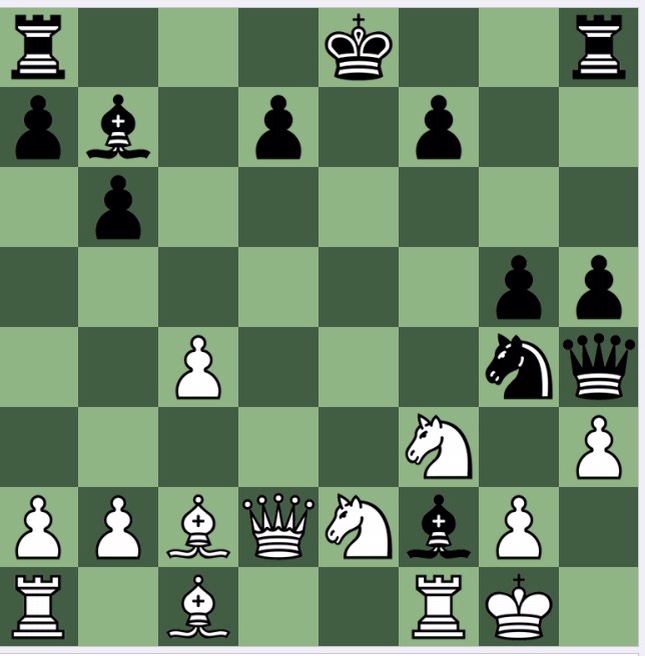
A nice calculation exercise. 1…Nf3+! 2 Nf3 (2 gf Qh3+) Bf2+! and the rest is easy. 3 Kh1 Bf3 etc
White to play and win
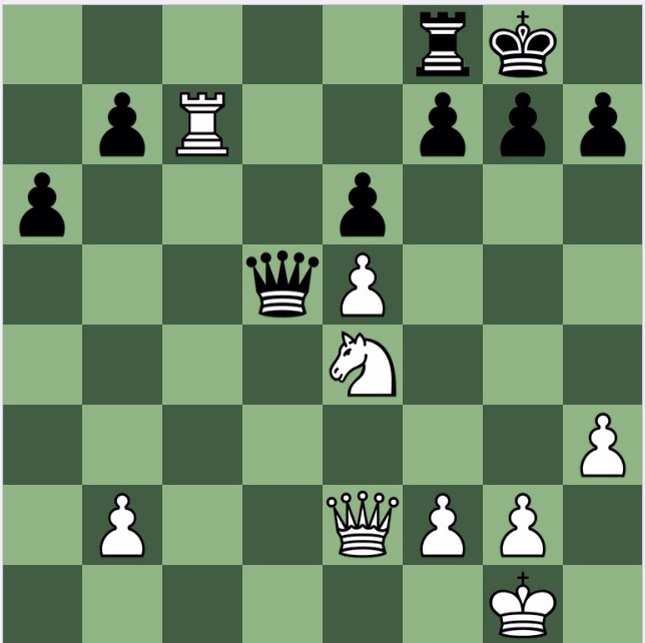
O Santos v R Kleiner 1980
Solution
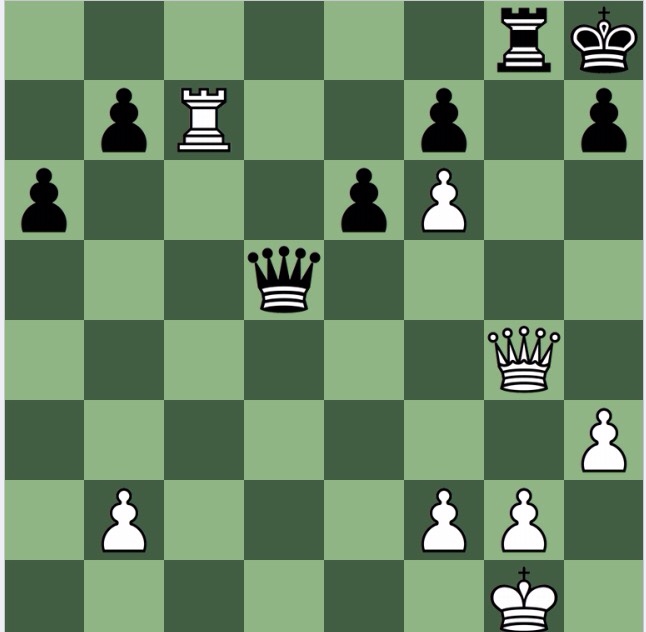
Fairly standard: examine all biffs leads quickly to 1 Nf6+ (the first move I suspect most players would look at) 1…gf[] 2 Qg4+ Kh8[] 3 ef Rg8[]
When 4 Rc8! is a nice, albeit typical, finale, although since black can defer losing by 4…Qd1+, better is the more prosaic 4 Qg8+! mating.
White to play and win
Black has just castled by hand, Ke8-d7
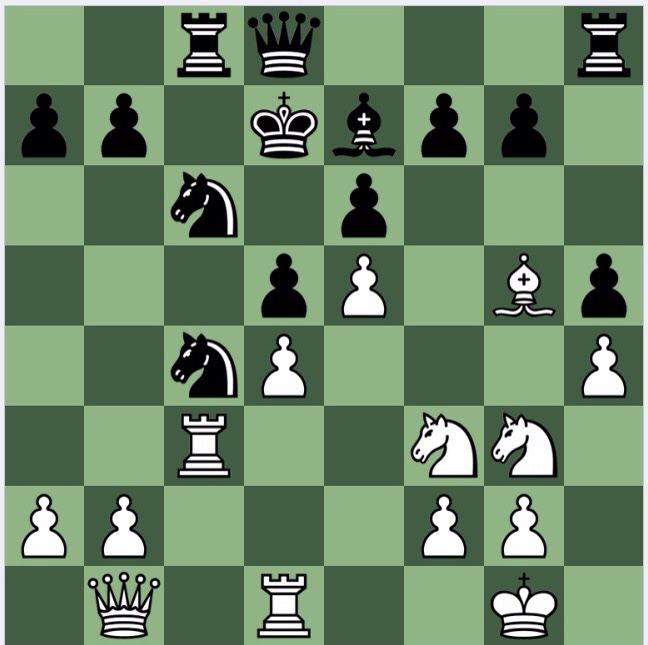
N Bloch v J Tsalicolgou 1977
Solution
Not too hard today, the biff 1 Rc4! dc[] 2 d5 is natural, seeking to open lines against the king and queen. And a quick look at the then position means the best that black can do is let his Nc6 go, with a then lost position.
White to play and win
W Weise v LR Reitstein 1966
Solution
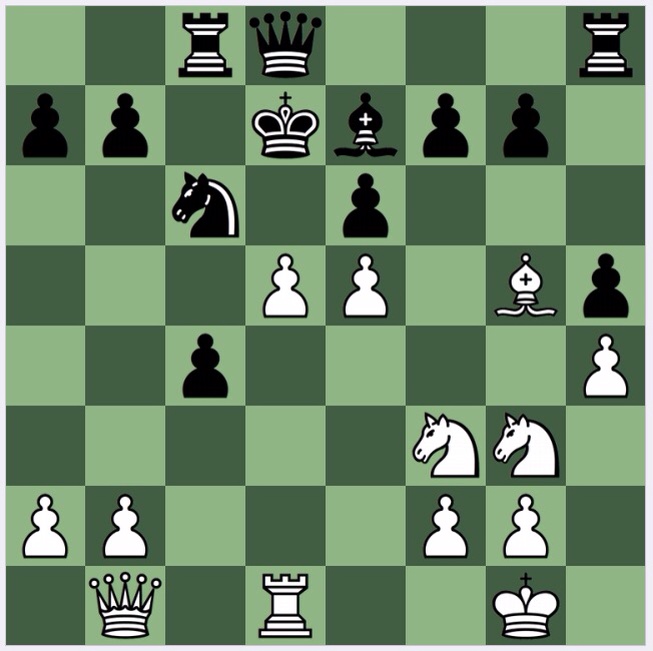
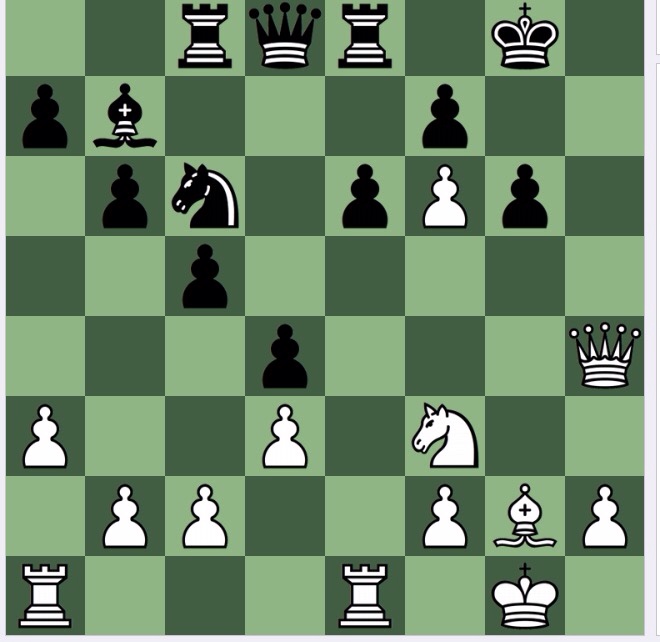
If 1 Ng5 then 1…Qf6 and black is fine, but 1 Ne5! and it is game over: 1…Ne5 2 Re5 Qd6 3 Rh5! and black hasn't got time to play 3…Qf8, so 3…gh 4 Qg5+ and 5 Qg7 mate.
The nicest line is 1 Ne5! Qd6! when white must find the pretty deflction 2 Nd7!! keeping the Q from f8: 2….Nd7 3 Rh5 as before.
As I normally do, I wrote the above before entering the problem into Stockfish. In this case, Stockfish had things to tell me. Firstly, it also likes 1 b4! and 1 Re4! both of which it says are winning; but it rates 1 Ne5 for higher. But after 1 Ne5! Qd6 at first it likes 2 Ng6 (+8) before deciding 2 Nd7! is even better, though it defends with 2….Ne7!! a move which would have rocked my confidence had I been playing white. But then the engine says 3 Re5!! and black can't prevent mate. Lovely.
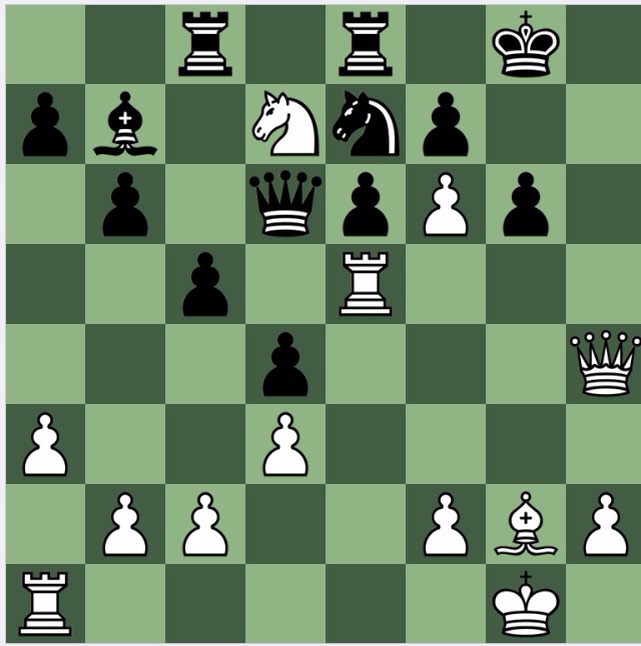
White to play and win
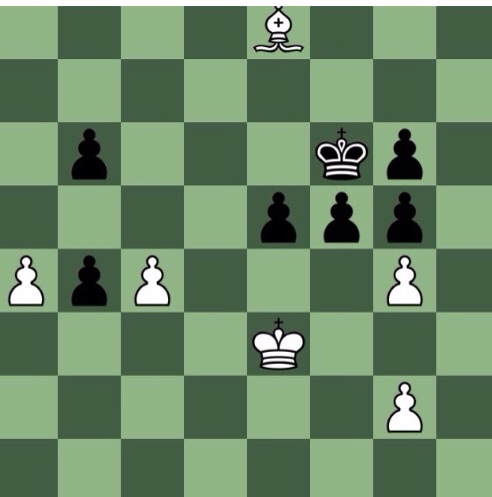
C Wu v F Odendaal 2005
Solution
I find counting pawn advances hard, really hard at times. I believe you are meant to be able to say 'his pawn is on the fourth rank, so will promote in four moves, mine…., 'and then know who wins the race, but I have never been able to do that, always getting in a tangle about 'they both promote, whose move is it?' and instead have to do the 'he goes there, I go there, he goes there…' counting. Shame on me.
With this puzzle, 1 c5! is obvious, and the help of the B in corralling the black pawns makes the problem easier; plus intuition tells me that the K can stop the b pawn, and the B the e pawn. But, still, not easy.
White to play and win
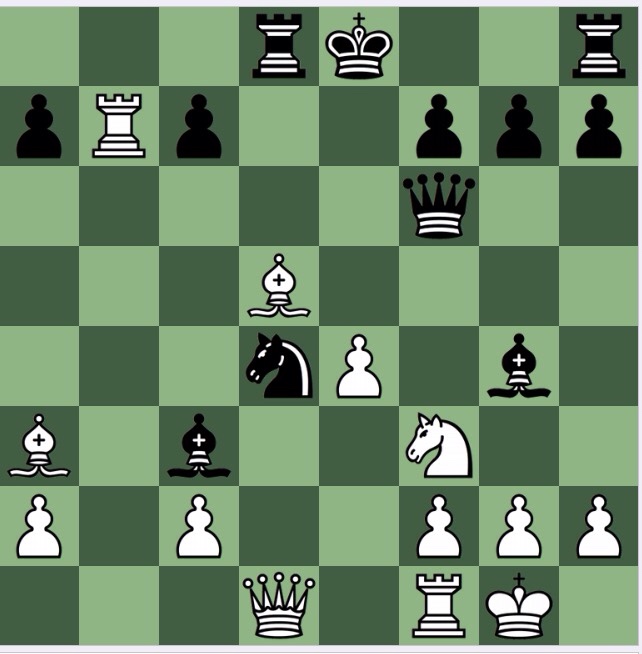
M Rubery v AV Agnew 1979
Solution
1 Nd4! has to be tried, after which 1…Bd1[] 2 Bc6+ and if 2…Rd7 3 Rb8+ 1-0
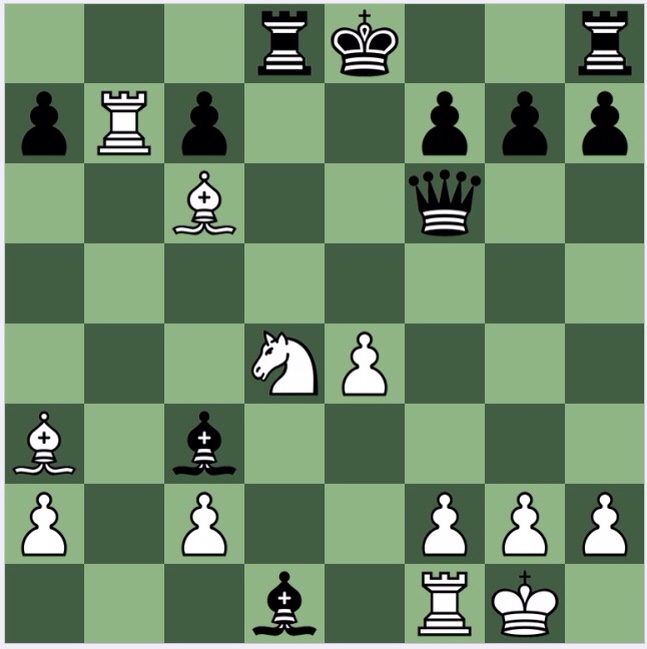
White to play and win
(Actually, more of a discussion)
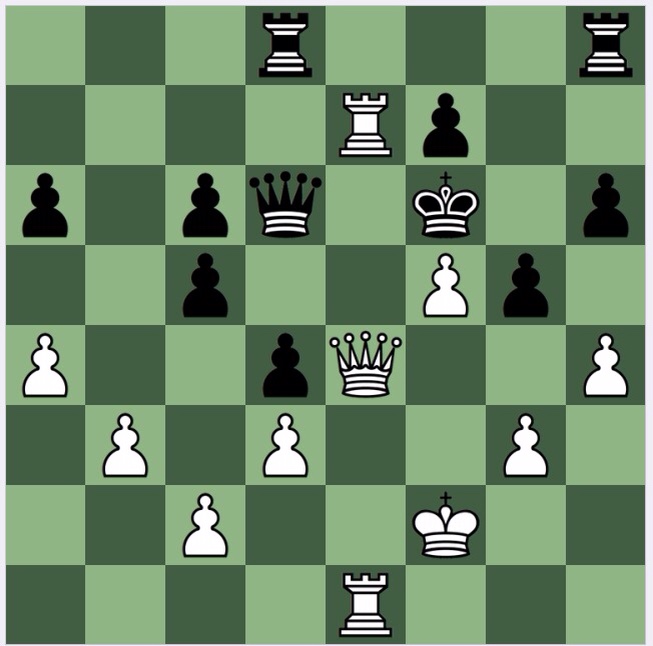
A moment ago, I posted the solution to what happens if Black plays Qd5: white exchanges on g5 and sacs on f7, and the troops storm in.
Reitstein says that since it is just heavy pieces, it is hard to see how White can press home his positional superiority, and indeed it is. Black might for instance play 1…a5 and then shuffle his rooks around.
Breaking down Black's defences is a task for an engine, not a human, and I would recommend playing this position first as white, then as black, against one. I have, and (I) failed to hold as black (2) failed to win as white (3) failed to understand the subtleties, of which there are plenty.
The engine (Stockfish) gives the initial position as a winning +1.5. I don't understand how it wins, but it exploits its space advantage superbly. First, it improves the king, putting it into safety on the first rank, by Re2 and Ke1, then it fiddles around with its Q and Re2, with often there being little tictacs depending on black's precise piece placement.
The position reminds me somewhat of Carlsen's win against Anand earlier this year, in a similar rook and queen ending, in which Magnus did a Ra1-a3 lift over the king side, then also hit Vishy's weak c pawn. Similar precise magic appears here: well worth personal study: I intend to look at it again, to try to understand what is going on,
 allanbeardsworth