Today’s puzzle is from round 2 of the British Chess Championships. The blog was prepared live during the round, and as is my custom, is posted in arrears.
White to play
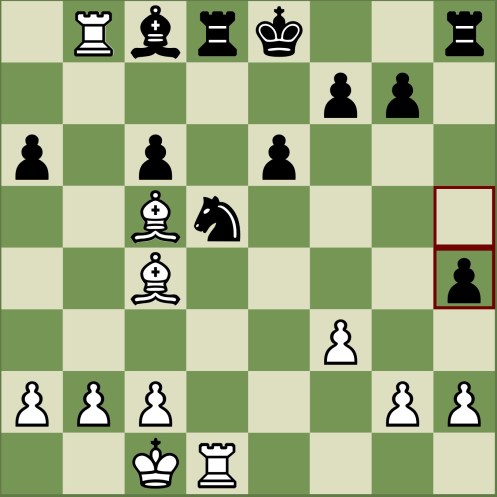
Adams v Pigott, British Championships, Torquay, 28th July 2019
Solution
1 Bd5! ed 2 Bb6 and White wins the exchange.

Link
Adams 1-0 Pigott
https://live.followchess.com/#!106th-british-championship-2019/935888031
Today’s puzzle is from round 2 of the British Chess Championships. The blog was prepared live during the round, and as is my custom, is posted in arrears.
White to play

Adams v Pigott, British Championships, Torquay, 28th July 2019
Solution
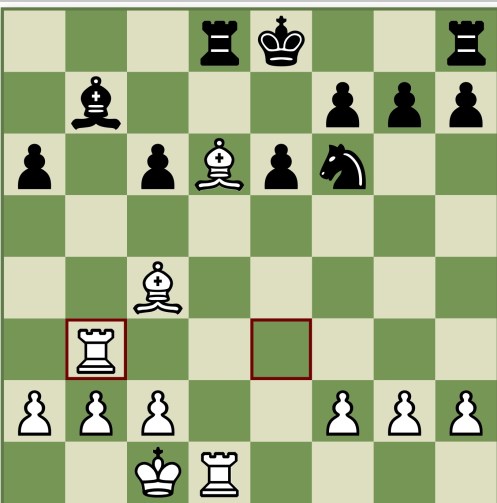
Improve the worst placed piece and identify the weaknesses led to Mickey playing 1 Re3! lifting the rook to the third rank, and in particular targeting the Bb7: Rb3 followed.
Link
Adams 1-0 Pigott
https://live.followchess.com/#!106th-british-championship-2019/935888031
Today’s puzzle is from round 2 of the British Chess Championships. The blog was prepared live during the round, and as is my custom, is posted in arrears.
White to play
Adams v Pigott, British Championships, Torquay, 28th July 2019
Solution
Link
Adams 1-0 Pigott
https://live.followchess.com/#!106th-british-championship-2019/935888031
Another recent finish of a 3 minute blitz game on Chess.com
White to play and win

Allan Beardsworth v Sergey Melkozerov, 3-0 blitz, Chess.com, 19th July 2019
Solution
1 Nf6! Bf6[] 2 Be4 and mate can’t be prevented. The first move prevents Black interposing f6-f5.
A recent 3 minute blitz game on Chess.com, with a nice finish.
White to play and win
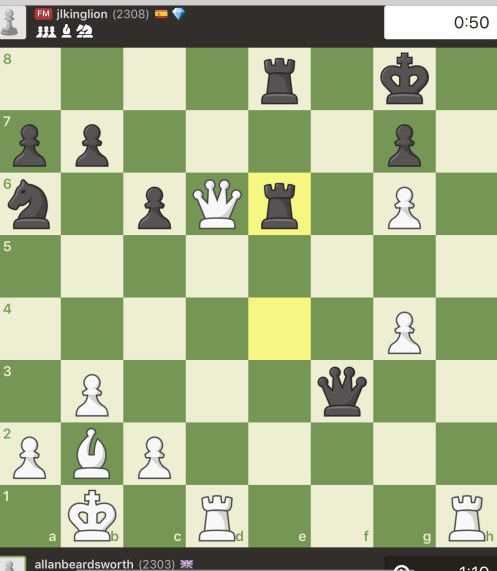
Allan Beardsworth v FM J Kinglion (pseudonym), Chess.com, 3-0 18th July 2019
Solution
1 Rh8+! Kh8[] 2 Qh2+ Kg8 3 Qh7+ Kf8[] 4 Qh8+ Ke7[] 5 Qg7+ and mates.
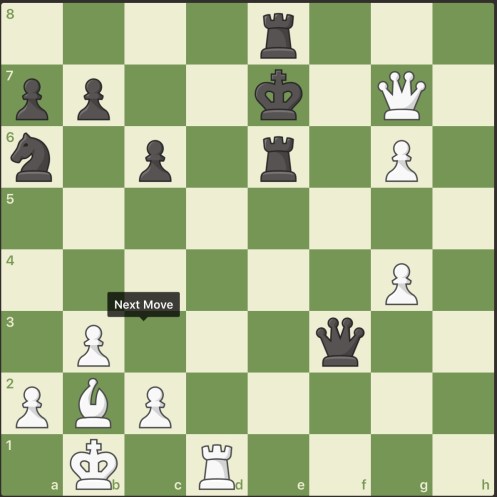
A nice epaulette mate ends a standard combination, which is nice whenever you get the chance to play it.
Today’s problem is from the 1997 book ‘Improve your chess Now’ by Jonathan Tisdall. A book that I think I read when it was published, but am re-reading whilst on holiday. It is very thought-provoking.
White to play
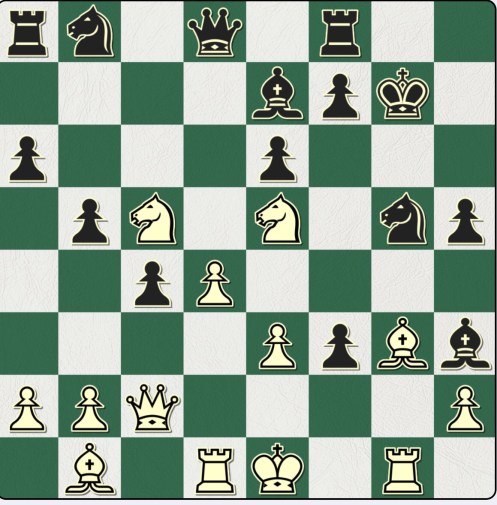
Lamparter v Fairhurst, Australian championships 1938
Solution
1 Nc6!!
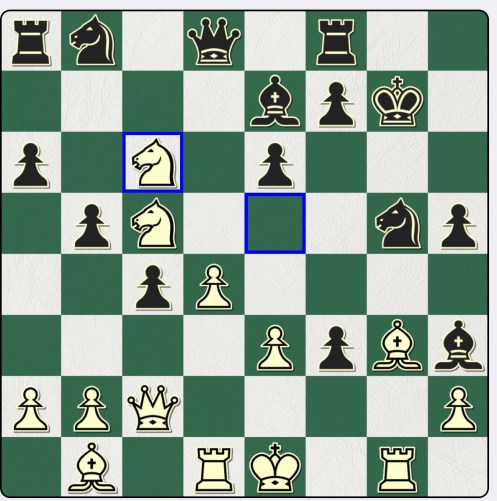
1…Nc6
2 Qh7+!!

3 Be5+ Kh6[] 4 Bg7 mate.
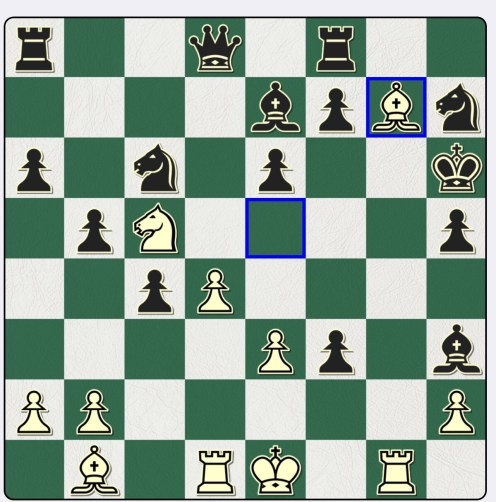
Beautiful.
My engine, SmallFish, on my iPad, doesn’t see beauty and says 1…Bf5 is a better defence, but still winning for White, and prefers 1 Bf4. But for us humans, how can one not see the combination and smile?
FEN
rn1q1r2/4bpk1/p3p3/1pN1N1np/2pP4/4PpBb/PPQ4P/1B1RK1R1 w – – 0 1
Today’s problem is what I regard as my prettiest combination of the last season. Not a quick mate, but nice, at my level of strength, to play it in a classical time limit game. i.e. real chess, as opposed to my normal 3 minute internet blitzing.
As is my custom, I only say which side is to play: and not giving an idea if the move wins or otherwise, unless on occasion I think signposting would be helpful. Instead, the problems are posed with the instruction to decide what you would play, as in a game.
Black to play
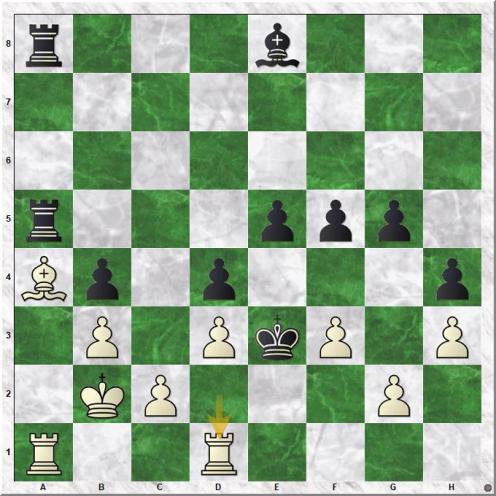
Mckie v Beardsworth, East Cheshire v Stockport, 24th April 2019
Solution
1…Kf2! and White played 2 Be8 (2 Re1+ Kg3 was better, with best play the position gets to a Q+P ending, which an engine would win, but my nerves would have been shredded).
2…Ra1 3 Ra1[] Ra1 4 Ka1[] Kg2
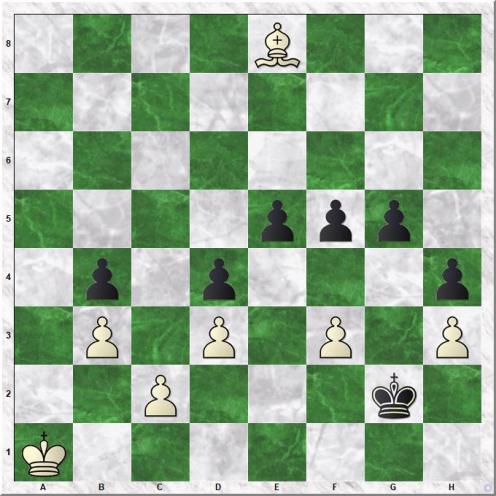
5 Bd7[] Kh3 6 Bf5+[] Kg3
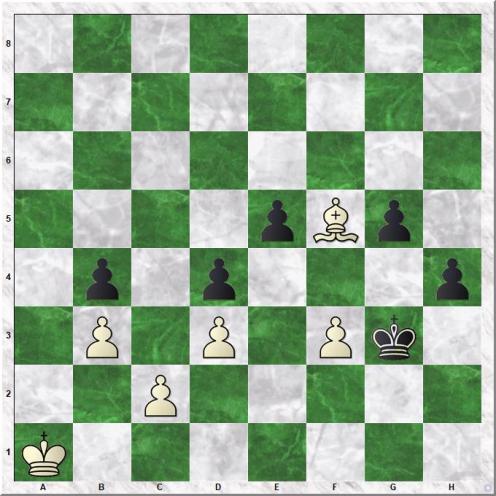
and Black wins the pawn ending after 7 Bg4 h3 8 Bh3[] Kh3
The combination will never appear in a magazine, but I was pleased to accurately calculate a long, albeit forced, line.
FEN
r3b3/8/8/r3ppp1/Bp1p3p/1P1PkP1P/1KP3P1/R2R4 b – – 0 57
Today’s problem is from the 1997 book ‘Improve your chess Now’ by Jonathan Tisdall. A book that I think I read when it was published, but am re-reading whilst on holiday. It is very thought-provoking. [I did read it: I have found a ‘yellow stickie note’ on one page, with some annotations I did at the time. Helpfully to my future self, I dated my note 16th February 1998].

As has been my custom on this blog for a while, I adopt the style of only saying which side is to play: and not giving an idea if the move wins or otherwise, unless on occasion I think signposting would be helpful. Instead, the problems are posed with the instruction to decide what you would play, as in a game.
White to play, played 1 Rha7. What followed?
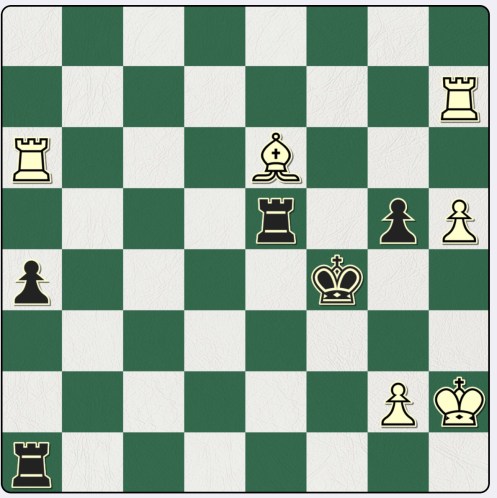
Donner v Spanjaard, Leeuwarden 1961
Solution
1 Rha7?? was a blunder, met with by 1… Rh1+!! 2 Kh1[] Kg3 and mates.

FEN
8/7R/R3B3/4r1pP/p4k2/8/6PK/r7 w – – 0 1
Today’s problem is from the July 1979 Chess magazine. I have hundreds (many hundreds) of magazines on my book shelves, and I thought I would dip into them; and thought I would start with going forty years back.
Whilst my previous postings from this magazine have been from the puzzles page, July 1979 was when the new kid on the block, Garik (now Garry) Kasparov arrived on the scenes, as far as English chess magazine readers were concerned. Chess printed 8 of Garry’s games, mostly annotated, all terrifying to the seventeen year old (same age) me.

A powerful face and a powerful personality

We salute Garik Kasparov
As has been my custom on this blog for a while, I adopt the style of only saying which side is to play: and not giving an idea if the move wins or otherwise, unless on occasion I think signposting would be helpful. Instead, the problems are posed with the instruction to decide what you would play, as in a game.
White to play
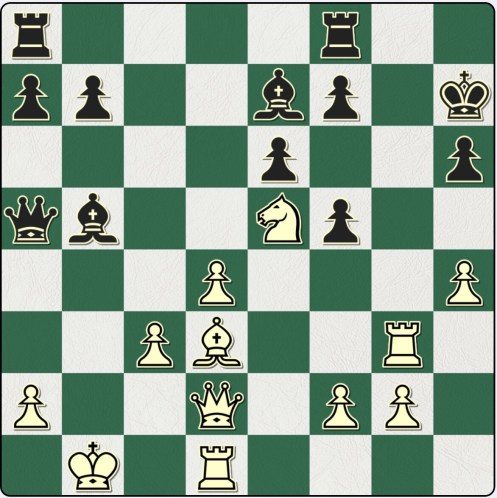
Kasparov v Marovic, Banda-Luka 1979
Solution
Garry played 1 Rf3, and apparently remarked that this was the strongest move he played in the whole tournament. Chess shows the game continuation after 1…f6, but also gives a line after each of 1..Bf6 and 1…Bd3+.

I won’t give the lines. The game is in Megabase, and is the type of position which only deep analysis would give justice to. For what it is worth, my iPad engine (SmallFish) isn’t impressed with Garry’s line after 1…Bf6, thinking Black is better: but maybe there is a horizon effect, and if I put the line onto deep analysis on my laptop, a different evaluation would emerge.
FEN
r4r2/pp2bp1k/4p2p/qb2Np2/3P3P/2PB2R1/P2Q1PP1/1K1R4 w – – 0 1
Today’s problem is from the July 1979 Chess magazine. I have hundreds (many hundreds) of magazines on my book shelves, and I thought I would dip into them; and thought I would start with going forty years back.
As has been my custom on this blog for a while, I adopt the style of only saying which side is to play: and not giving an idea if the move wins or otherwise, unless on occasion I think signposting would be helpful. Instead, the problems are posed with the instruction to decide what you would play, as in a game.
White to play
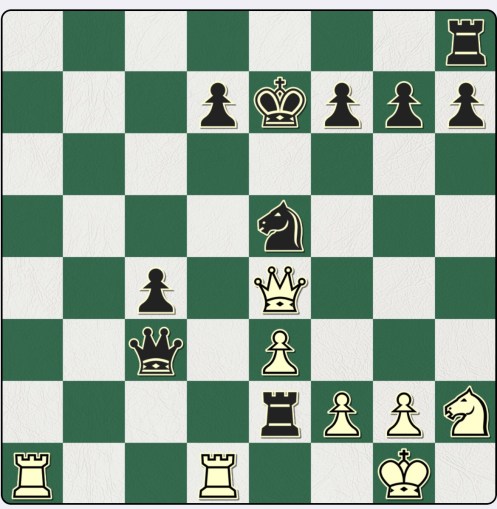
Freeman v Gras, Islington 1978
Solution
1 Rd7+ Kd7 is obvious, but then White must proceed with care.

It isn’t clear that if Black’s king can slip away to f5 (e.g. after Qb7+) that White will be able to mate him: the octopus on e5, and the threats on the back rank, will keep White busy.
Centralisation is the key. 2 Qd5+! is the winning move, looking in some lines at f7, in others at d6. 2…Ke7 3 Ra7+ Kf6 4 Ra6+!

is my engine’s best line (in the game, Michael played 4 Ng4+, which was also good enough to win. Too many lines to show, better for readers to study rather than see just a few of a possible (and some computer) lines.
I failed to solve this puzzle. My second move, 2 Ra7+, loses: I missed 2…Kd6 and running to c5 and beyond. My alternate second move, 2 Qb7+, is apparently three zeroes: there is a perpetual check line after best play.
FEN
7r/3pkppp/8/4n3/2p1Q3/2q1P3/4rPPN/R2R2K1 w – – 0 1
 allanbeardsworth