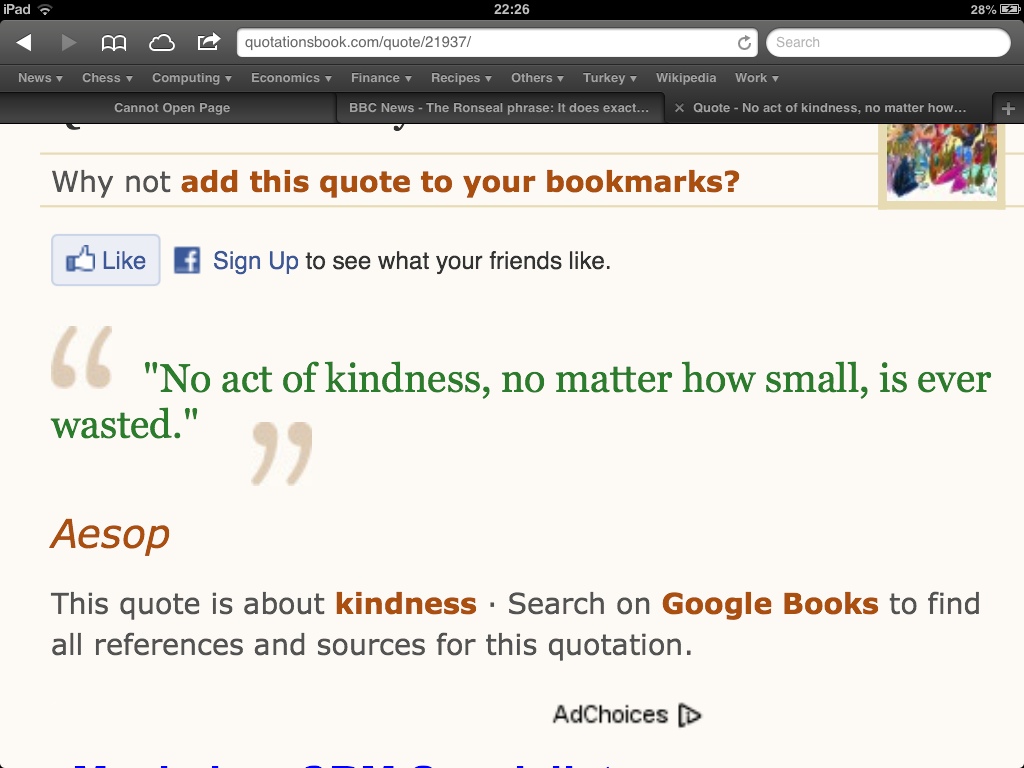
For the last thirty or more years- since my teenage years, I have more or less lived by the above motto; or at least tried to, since I am far from perfect. But in the way I treat colleagues, clients and friends, I try to aspire to this, and it has stood me in good stead, or I believe it has. Kindness and courtesy do payback.
Why am I blogging about it? Well, for some reason it came to me recently that my late mother told me this phrase, or maybe even said this was one she lived by: or, rather, that I wanted to ask my brother and father whether my recollection was true, so I did so today. Alas, neither has any recollection of this in terms of mum, so it is either something she said to me, or a false memory, of which I have several, perhaps many.
So, a moment ago, having seen dad earlier this evening and been told he has no recollection of it, I googled it, and was surprised to learn it was an actual phrase from Aesop's Fables. So for thirty plus years I have not known its source, and whilst I would doubt mum will have read Aesop (she might, as a child), she could of course have seen the quote somewhere.
I would still like to think it was mum's phrase, and still intend to make it my own.
Finally, for the avoidance of doubt, in the way only google searches can do, if in doubt, this phrase is about…kindness.
 Posted with Blogsy
The day after I wrote my previous blog about Korchnoi, Malcolm Pein wrote a similarly warm article in his Daily Telegraph column, wishing Victor well.
Malcolm showed a game Victor played against Sergey Tiviakov in the Banyoles Open 23/8/2006 which was quietly venomous. Playing through it, I can only marvel that black’s only slip was to permit a5! clamping down on the queenside and in particular black’s white squared bishop. I wouldn’t have found a5! because it relies on a hidden tactic (…Na5 Bc7); nor would I have played Bh3 keeping the pressure on.
Malcolm ends his article with the position below as a puzzle, which I failed to solve; though, in my defence, I would have in practice played either the winning move or, the move I chose when trying to solve the problem, which is also winning, according to the engine. I say ‘according to the engine’ because the final position whilst clearly better for white, to me didn’t seem entirely winning, until I had silicon assistance…and then I saw the beautiful combination of threats and pressure. I do know, though, that if I glance upon the position again, some time in the distant future, I will again not appreciate I overwhelming White’s position actually is.
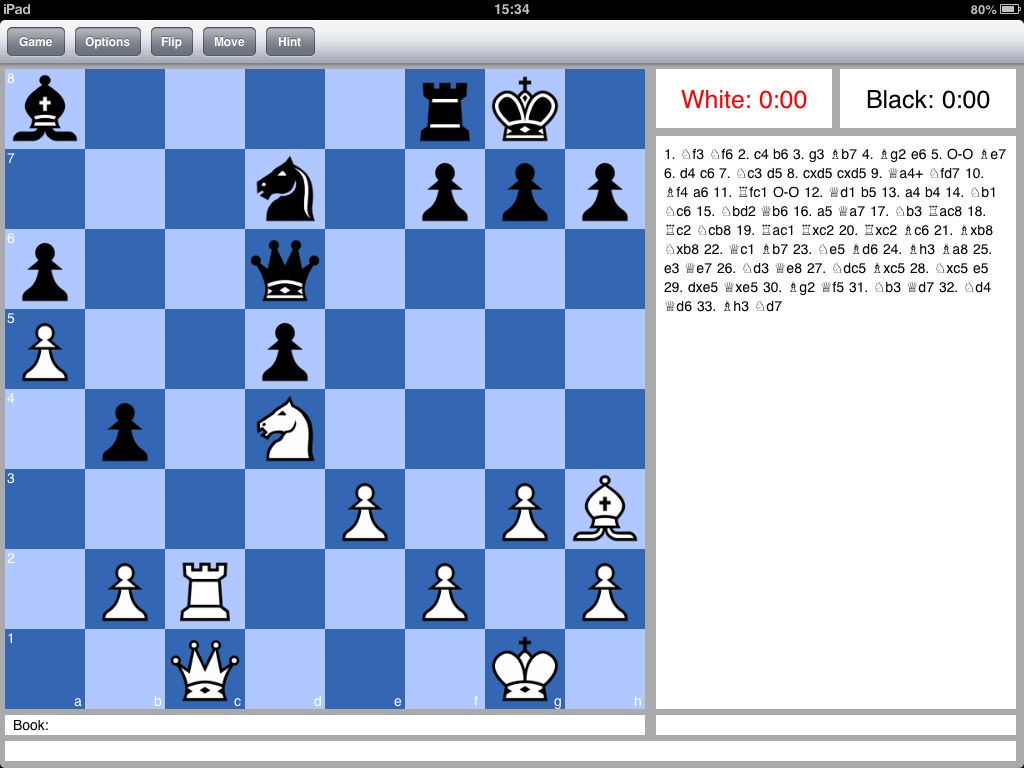
Victor the Terrible, truly.
One of the pleasures I get from work is when colleagues ask me for career advice. There is something personally very satisfying when people pick you out as being worthy of asking your opinion, especially when it is in confidence. Far better to be honest and open, critical and straight if needed, than bland or commenting only on positives.
I still remember- I think I will always remember- the best piece of feedback that I have been given (by my retired partner, Philip Johnson- for whom my thirty year acquaintance has morphed from him recruiting me, to working for him in my first few years, to starting to appreciate simply how good a professional he was, to being his partner, to being his friend); I won't share that feedback (but might in another blog), but remember it extremely frequently. Whereas all the bland positive feedback is as lost as a grain of sand on a beach.
Recently, I was asked by a colleague who had reached a stumbling block in her career, not getting the promotion she felt she deserved. I recommended to her, as I have done over the years to several colleagues, that she spends some time when she is free from distraction watching carefully Randy Pausch's Last Lecture. <link>
I told her to watch our for, and concentrate on bricks. We all face bricks in our life and careers: I can think now of one of my partners who for me will always be a brick (spell checked, though a typo wouldn't change the accuracy of this comment). And in my twenties, I faced the brick of overwhelming shyness, but through a lot of effort, and (I would single out the help of Dale Carnegie's books and the course his organisation run) I managed to climb that wall, and make myself somewhat less diffident.
I have no hesitation in recommending Randy Pausch's last lecture to everyone. I remember when I asked my son to watch it with me when he was in his mid teens: Tom said he would agree to dad's request and watch it for a few minutes until he was bored; and then sat through it with me silently for the whole hour; I recall he watched it again subsequently by himself.
Powerful stuff, and whole heaterdly recommended.
One of the saddest things for me during 2012 was to learn of the grave illness of Victor Korchnoi ChessBase.com – Chess News – Korchnoi in a clinic recovering from a stroke. I hope he recovers, and that (even more inconceivably) he hasn't played his last game, however unlikely that now seems.
Victor means a lot to me:
Firstly, of course, I beat him on 9th December 2010, in a simul, in what was probably my most memorable game. (http://tinyurl.com/cr8d4zs ), which I annotated in Chess magazine in February 2011. The joy of victory is as deep today as it was when I realised, a few moves before the end, that victory would be mine.
Secondly, he was a hero during my teenage years. I didn't have a great understanding, and more information of his plight came out afterwards, but seeing his titanic, if eventually all unsuccessful, struggles against Karpov, where key parts of my post Fischer formative years. If you add on the pressure of him fighting the Russian establishment, defecting, with pressure and pain in his wife and son, then the fact that he was the world no 2 for so many years is even more remarkable.
Thirdly, hearing him in Mallorca in 2004 explain why he plays chess…to keep alive….and how he survived the siege of Leningrad as a child, whilst taking relatives to the morgue in the depths of winter, is something which will be with me for life. When you know what he has been through, you forgive his more or less ever grumpy nature and irascible temperament.
Finally, I will always cherish that I visited the Gibraltar tournament in January 2011 when he beat the teenage Fabuana Caruana, now the world #5, but even at that time in the world elite Fabiano Caruana vs Viktor Korchnoi (2011) ; I stood literally next to the board (well placed so i could also watch my friend Nigel Short outplay Pia Cramling Pia Cramling vs Nigel Short (2011)) for much of the game, and could tell an upset was likely; and then I listened to every word of the post game commentary Victor gave in which he explained his overwhelming surprise of the passivity Fabuana showed.
Get well, Victor.
Recently, and I don't remember I read it, I learned that the Egyptians had a method of calculating square roots which appealed to me: make an estimate, divide that estimate into the number, average the estimate with the result, and iterate.
For example, to work out the square root of 9, make a guess, say 4; divide 4 into 9, result 2.25; average 4 and 2.25, 3.15, and use this as the next guess. It quickly settles on 3. Even a bad guess, say 10, iterates quickly: next guess being the average of 10 and 9/10.
I couldn't prove this mathematically, but thinking about it whilst driving somewhere, I can see it visually. The result of the first guess, 4 and 2.25, comprise a rectangle with area 10; the next average shortens the long side, and lengthens the short side, so that the next shape is a stubbier rectangle with 3.15 being the longer side; and the next rectangle stubbed still. Very neat.
I then decided the method should work for cube roots, and indeed it does, with the adaption that you divide the guess twice into the number, then taken the mean of the three; visually, you have a cuboid with the correct volume, which becomes more cubical on each iteration.
Whilst I can't visualise it, you would think that it works for 4th and higher powers, since again the volume of the shape remains. Alas, when I created an Excel model to test this, whilst it does indeed work for square and cube roots, for 4th and 5th powers it oscillates around the answer, never getting into a convergence to the root, unless you make a good first guess.
There might be a modification which could be made, maybe averaging the results after a while, but that wouldn't be elegant. Also, maybe there is a higher power or powers where the method does converge rather than oscillate. I might work on these two issues at some future time.
I was struck by an article in the Financial Times by Lawrence Summers on 17th December, giving suggestions on how to reform the US tax system.
There was a great deal I agree with, or rather strikes an accord with issues facing the UK's situation.
Amongst many things, I found the following quote interesting:
http://www.ft.com/cms/s/2/68ed84d4-4536-11e2-838f-00144feabdc0.html#ixzz2GOnylQVb
A simple calculation shows that the US estate tax system is broken. Assets that are passed to relatives or other personal relations are often badly misvalued relative to what they cost on an open market. The total wealth of American households is estimated at more than $60tn. It is heavily concentrated in very few hands.
A conservative estimate given the lifespans of Americans would be that 2 per cent ($1.2tn) is passed down each year, mostly from the very rich. Yet estate and gift taxes raise less than $12bn, or 1 per cent, of this figure each year.
I wondered how this might compare with the yield from the UK's estate tax, inheritance tax (IHT). Making some guesses (and I use word rather than estimates, because I suspect there might be both GIGO and faulty process in my calculations, I come up with a similar conclusion: IHT raises far less than might be expected. A secondary conclusion, though, is that reforming IHT is unlikely to raise significantly more.
I have no idea whether my calculations are along the right lines, or wildly inaccurate; but maybe they provide something worth considering.
Net personal wealth in the UK £6.7 trillion (I)
Population 63m (II)
Wealth distribution: top decile own >£1.6m; second decile £1.2m-£1.6m; third decile £800k-£1.2m; remainder ignored (III)
Remainder own approx 1/2 of net wealth, say £3.3tn. Then the top three deciles own £3.3tn, £100m and £63m respectively. (III)
Assume £325,000 exemption accounts for none of the top decile, 1/3 of the second, and 1/2 of the third.
Assume wealth inherited every 70 years.
Then taxable estate pa is £50bn, of which £47bn is top decile people. This £50bn is far higher than the actual, c £9bn.
Looking instead at the gross inheritance, I.e ignoring the lifetime exemption, results in a gross inheritance of £50bn (£3.4tn/70) which is close to the actual, c £33bn. (Iv)
Maybe my estimate of the effect of the exemption is understated; but the greater effect is such exemptions as business property relief, agricultural property relief, charitable exemptions and so forth. Of course, some of the top decile will be non domiciled and/or will have much of their wealth outside the UK. So, my conclusions are:
I) my calculations aren't totally ridiculous;
II) at most, estate taxes might raise £20bn pa taxing £50bn at 40%) rather than the £3bn or so they historically have done. Given the political dislike to estate taxes, this is not a great enough increase for the consequences.
Sources
(I) survey by Lloyds reported here Baby boomers with 80pc of UK wealth shouldn’t feel guilty about younger generations' problems – Telegraph Blogs and elsewhere; at c £100k per person, £6.7tn is plausible. It also bears comparison with the $60tn cited by Larry Summers in his 17/12/12 FT article.
(II) googled, 12/12
(III) googling, including these images wealth distribution uk – Google Search
(Iv) HMRC website, latest figures 09/10; figures have been broadly constant for years.
Each year, a highlight is visiting this tournament, held at the Kensington Olympia. It is great that through the efforts of Malcolm Pein, England has a world class tournament.
I wrote the piece below for http://www.chessbase.com, mainly centred on the informal game played against the world elite players. Not serious, in fact decidedly not, but we were lucky to play a very interesting game, and to win it.
Today it is one of those rain and wind strewn days in the Lake District when it is simply best to stay indoors.
Not wanting to do my normal things, I decided to spend some time setting up a blog; and in 2013 I will start blogging, and see where things lead. I am presently intended to write about what interests me: probably business, economics, maths, taxation and chess, and also things which amuse me or take my fancy.
We shall see.
Allan Beardsworth 28/12/12
 allanbeardsworth