Today’s problem is from the 1972 book “Chess Combination as a Fine Art”, a book based on articles published in the 1950s-1960s by Kurt Richter.
Since the start of 2018, I have decided to adopt the style of only saying which side is to play: and not giving an idea if the move wins or otherwise, unless on occasion I think signposting would be helpful. Instead, the problems are posed with the instruction to decide what you would play, as in a game.
White to play: evaluate 1 Be6
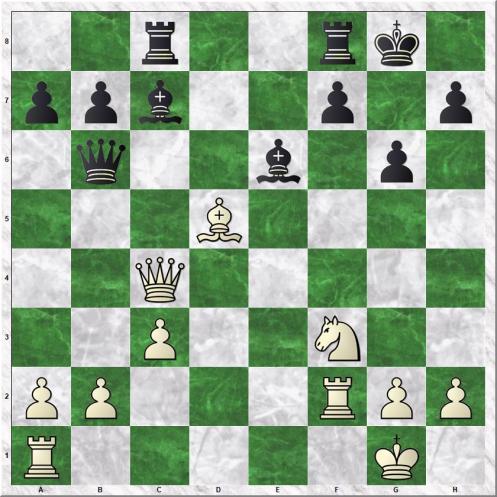
von Spreckelsen v Weiss, Hamburg 1964
Solution
1 Be6? is poor: 1…Bh2+! 2 Nh2[]

and now not 2…f4 and the game goes on, with White better; but 2…Qf2+!! and it is all over: 3 Kf2 fe+ and the Qc4 falls.

FEN
2r2rk1/ppb2p1p/1q2b1p1/3B4/2Q5/2P2N2/PP3RPP/R5K1 w – – 0 1
Today’s problem is from the 1972 book “Chess Combination as a Fine Art”, a book based on articles published in the 1950s-1960s by Kurt Richter.
Since the start of 2018, I have decided to adopt the style of only saying which side is to play: and not giving an idea if the move wins or otherwise, unless on occasion I think signposting would be helpful. Instead, the problems are posed with the instruction to decide what you would play, as in a game.
White to play
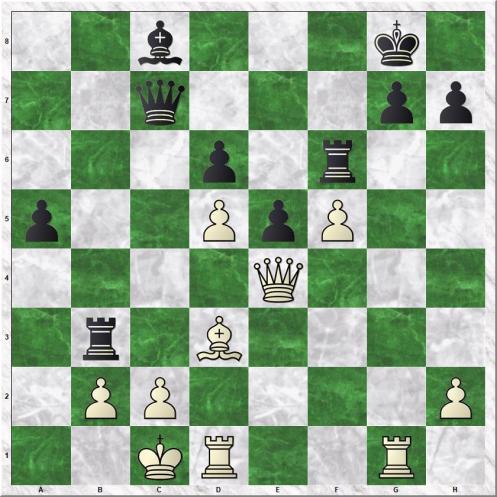
Soelter v Ophoff, Bielefeld, 1965
Solution
1 Qh4! is a lovely move, forcing 1…Kh8, when 2 Qa4! is another nice move, now being a fatal double attack, on e8 and the Rb3: 1-0.
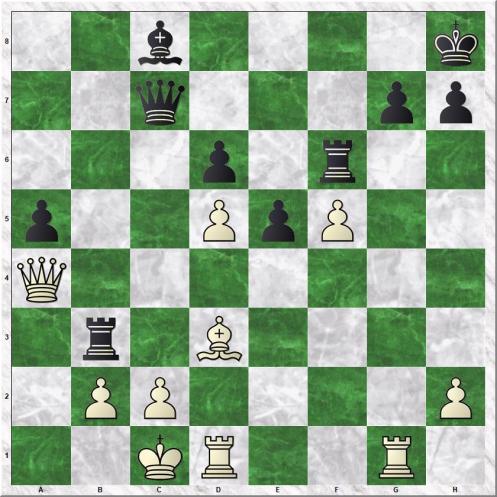
FEN
2b3k1/2q3pp/3p1r2/p2PpP2/4Q3/1r1B4/1PP4P/2KR2R1 w – – 0 24
Today’s problem is from the first round of the British Championship. A lovely combination by GM Nick Pert
Since the start of 2018, I have decided to adopt the style of only saying which side is to play: and not giving an idea if the move wins or otherwise, unless on occasion I think signposting would be helpful. Instead, the problems are posed with the instruction to decide what you would play, as in a game.
White to play
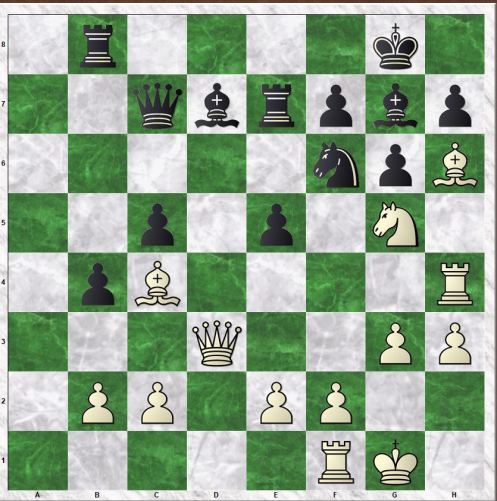
Nick Pert v Richard Britton, British Championships Hull 28/7/18
Solution
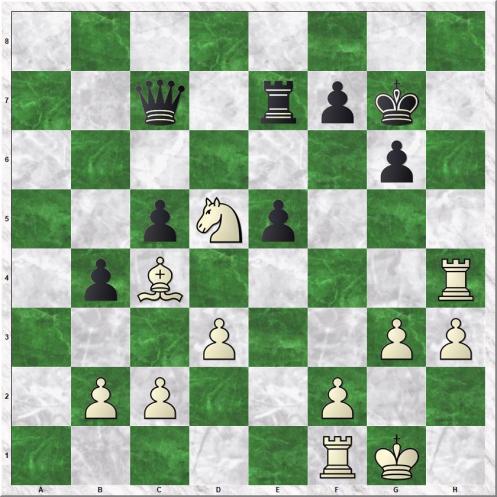
1 Nh7! is a lovely, and deep, combination.
(a) 1…Nh7 2 Qg6 and because of the pin on the f7 pawn, White wins;
(b) 1..Kh7 2 Bg5+ Kg8 3 Qg6 and again White crashes through.
Black played 1…Bf5 leading to the sacrifice 2 Bg7!
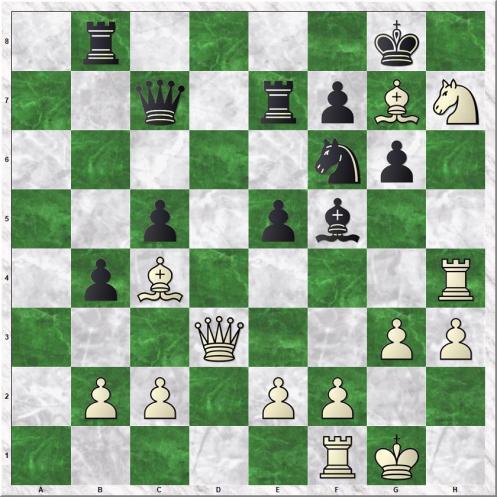
and after 2…Bd3 3 Bf6! Rf6[] 4 ed Rf6[] 5 Nf6+ Kg7 6 Nd5 White emerged with an overwhelming advantage.
FEN
1r4k1/2qbrpbp/5npB/2p1p1N1/1pB4R/3Q2PP/1PP1PP2/5RK1 w – – 0 24
Today’s problem is from the 1972 book “Chess Combination as a Fine Art”, a book based on articles published in the 1950s-1960s by Kurt Richter.
Since the start of 2018, I have decided to adopt the style of only saying which side is to play: and not giving an idea if the move wins or otherwise, unless on occasion I think signposting would be helpful. Instead, the problems are posed with the instruction to decide what you would play, as in a game.
White to play: evaluate 1 Ng4 Qd8: what is White’s best move
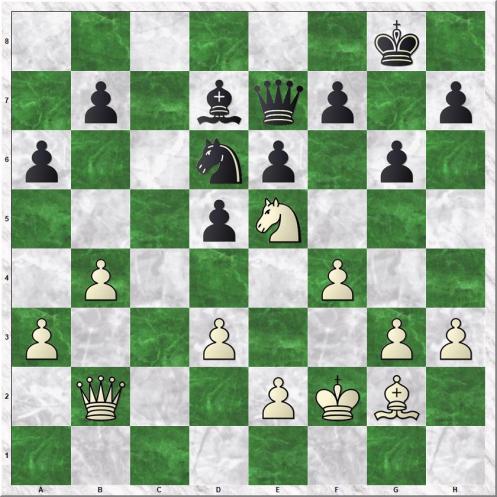
allanbeard v J Honido, Playchess.com 3min blitz 8/7/18
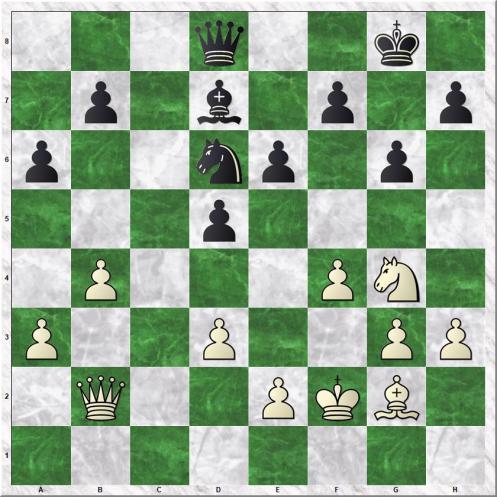
Or, below, I have given the position after 1 Ng4 Qd8
Solution
My engine suggests 2 Bd5!!; a move I would never have thought of, and I needed its assistance to understand.
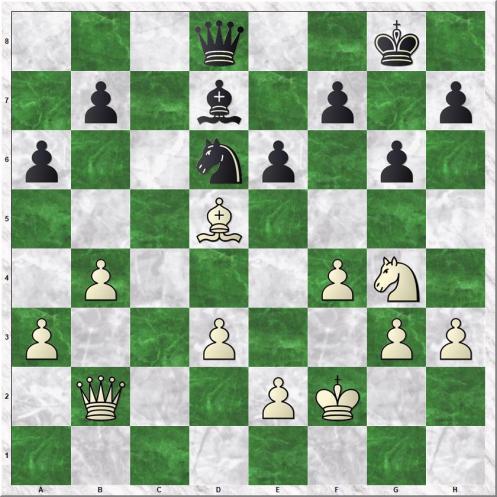
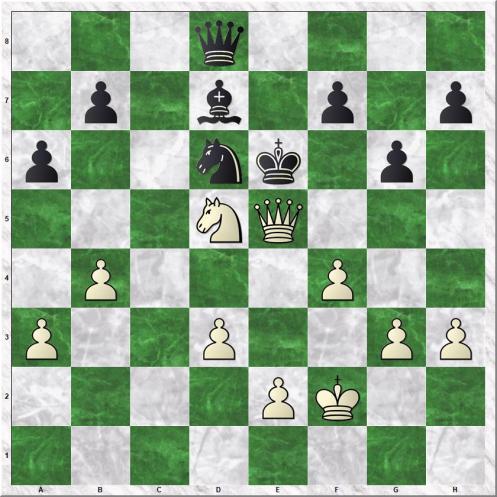
2…ed 3 Nh6+ Kf8[] 4 Qh8+ Ke7[] 5 Ng8+ Kf8 6 Nf6+! Ke7[] 7 Nd5+!
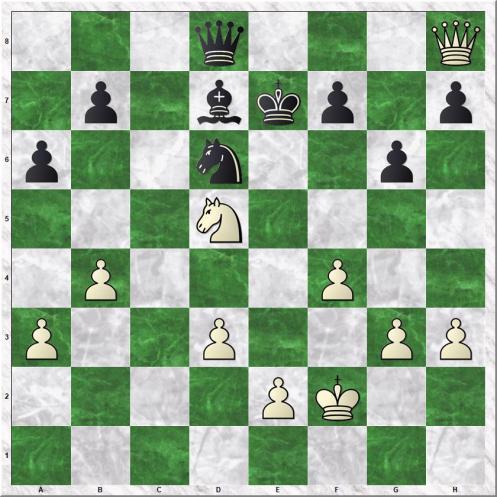
The point of 1 Bd5!!: the N can capture the d5 pawn
7…Ke6[] 8 Qe5 mate.
Lovely.
FEN
6k1/1p1bqp1p/p2np1p1/3pN3/1P3P2/P2P2PP/1Q2PKB1/8 w – – 0 1
Today’s problem is from one of my recent games
Since the start of 2018, I have decided to adopt the style of only saying which side is to play: and not giving an idea if the move wins or otherwise, unless on occasion I think signposting would be helpful. Instead, the problems are posed with the instruction to decide what you would play, as in a game.
White to play: evaluate 1 Ng4 Nf5, as played in the game
allanbeard v J Honido, Playchess.com 3min blitz 8/7/18
Solution
After 1 Ng4 Nf5 2 Nf6 wins: easily after 2…Kh8 3 Nd5+ discovering on the Queen; and also after 2…Kf8 3 Nd5! is a nice mate.

FEN
6k1/1p1bqp1p/p2np1p1/3pN3/1P3P2/P2P2PP/1Q2PKB1/8 w – – 0 1
Today’s problem is from the 1972 book “Chess Combination as a Fine Art”, a book based on articles published in the 1950s-1960s by Kurt Richter.
Since the start of 2018, I have decided to adopt the style of only saying which side is to play: and not giving an idea if the move wins or otherwise, unless on occasion I think signposting would be helpful. Instead, the problems are posed with the instruction to decide what you would play, as in a game.
White to play: in the last two days we have examined 1 Qe6 and 1 R1f7; neither of which are strong: What is White’s strongest continuation?

Kornfilt v Hukel, corres 1965
Solution
1 Nf6!! wins:
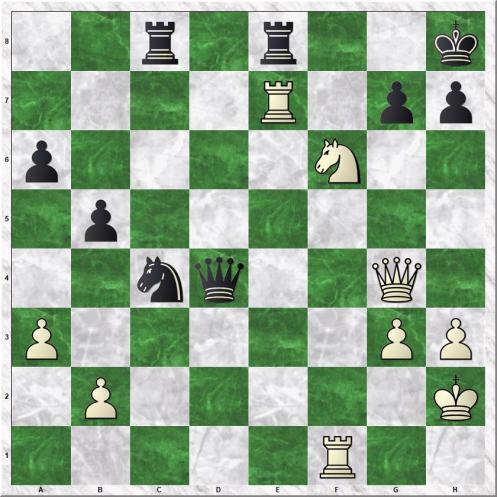
: the ‘point’ is that after 1….Qg4 the zwischenzug 2 Ne8!! wins.
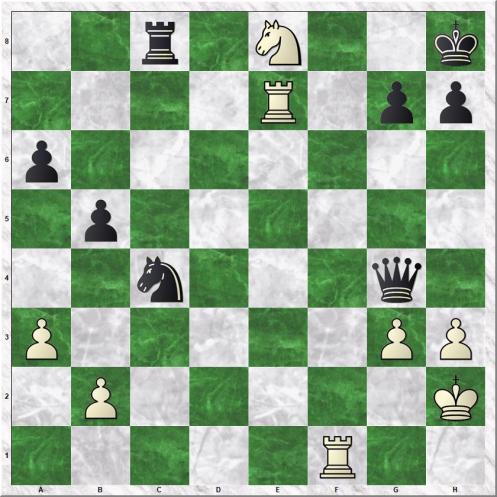
Lovely; and hard. It gave me great pleasure when I solved this one.
FEN
2r1r2k/4R1pp/p7/1p6/2nqN1Q1/P5PP/1P5K/5R2 w – – 0 1





Final position

 allanbeardsworth