Today’s problem was seen in a Youtube video by Var Akobian; I was impressed with Akobian’s style of lecturing in his recent Gibraltar 2018 Masterclass, and have since looked him up on Youtube.
Since the start of 2018, I have decided to adopt the style of only saying which side is to play: and not giving an idea if the move wins or otherwise, unless on occasion I think signposting would be helpful. Instead, the problems are posed with the instruction to decide what you would play, as in a game.
Black to play
White threatens Ba6-d3, and then winning the N; with a likely win. What to do?
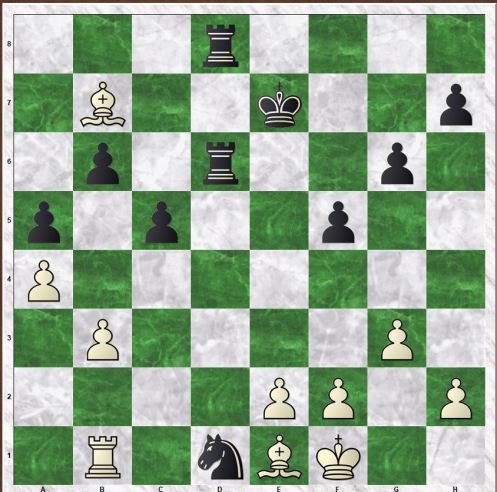
Psakhis v Speelman, Hastings 1987
Solution
Jon played the wonderful 1…g5 2 Ba6 f4! 3 Bd3 Rd3! 4 ed Rd3 5 Ke2

5…Rd5 the point being 6 Rd1? f3+!
A really imaginative way to save the stranded N.
FEN
3r4/1B2k2p/1p1r2p1/p1p2p2/P7/1P4P1/4PP1P/1R1nBK2 b – – 0 29
Today’s problem is from the 1972 book “Chess Combination as a Fine Art”, a book based on articles published in the 1950s-1960s by Kurt Richter.
Since the start of 2018, I have decided to adopt the style of only saying which side is to play: and not giving an idea if the move wins or otherwise, unless on occasion I think signposting would be helpful. Instead, the problems are posed with the instruction to decide what you would play, as in a game.
White to play: White played 1 Kg3
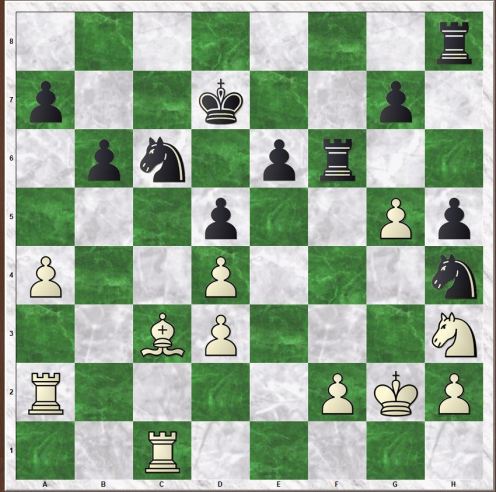
Bruchner v Koch, Berlin 1954
Solution
It is mate in 6. 1…Rf3+ 2 Kh4 Ne7 3 g5[] Ng6+ 4 Kg5[] Rh6
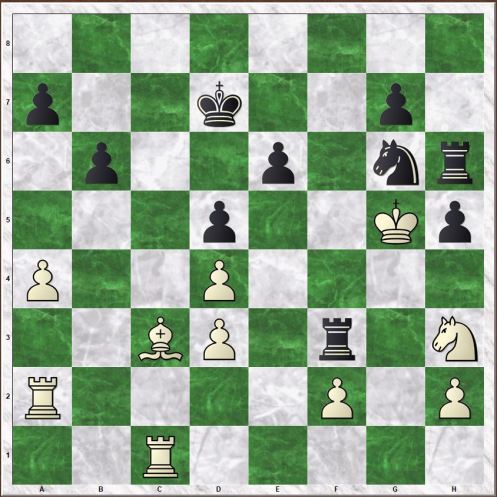
And after the desperado Nf4 Rf4, Black mates next move by Rf5+/
FEN
7r/p2k2p1/1pn1pr2/3p2Pp/P2P3n/2BP3N/R4PKP/2R5 w – – 0 1
Today’s problem is from the 1972 book “Chess Combination as a Fine Art”, a book based on articles published in the 1950s-1960s by Kurt Richter.
Since the start of 2018, I have decided to adopt the style of only saying which side is to play: and not giving an idea if the move wins or otherwise, unless on occasion I think signposting would be helpful. Instead, the problems are posed with the instruction to decide what you would play, as in a game.
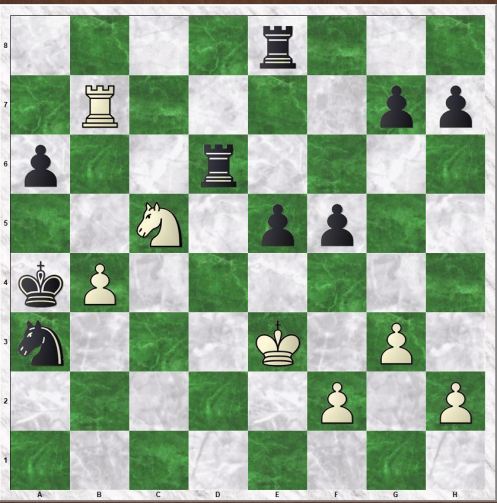
White to play and mate Black
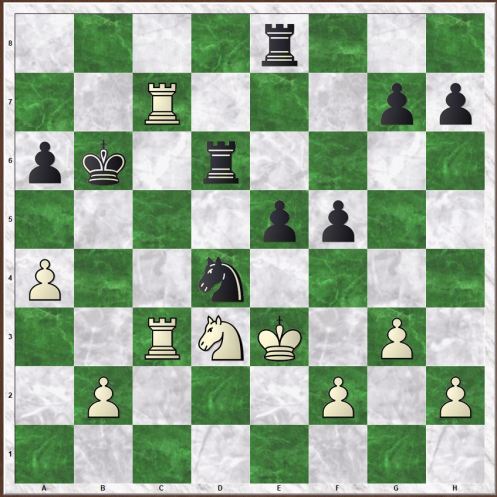
Christoffel v Muller, Zurich 1965
Solution
1 a5+! examine all biffs and if 1…Kb5? 2 R7c5+ Ka4[] 3 Ra3 mate; so 1…Ka5 2 Rb7!

2…Nb5 (or insert a spite-check 2…f4+ first)
3 Ra3+! Na3[] 4 b4+ Ka4[] 5 Nc5 mate. A very nice smothered mate.
FEN
4r3/2R3pp/pk1r4/4pp2/P2n4/2RNK1P1/1P3P1P/8 w – – 0 1
Today’s problem is from the recent Bunratty chess festival
Since the start of 2018, I have decided to adopt the style of only saying which side is to play: and not giving an idea if the move wins or otherwise, unless on occasion I think signposting would be helpful. Instead, the problems are posed with the instruction to decide what you would play, as in a game.
White to play
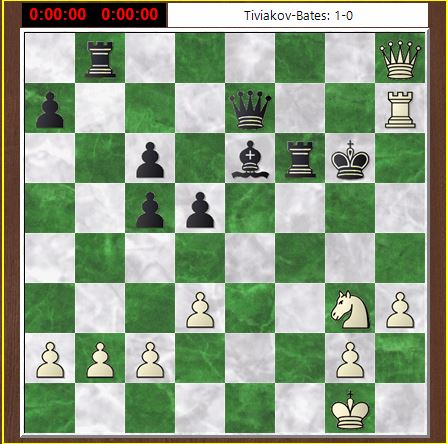
Tivakov v Bates, 25/2/18, Bunratty
Solution
This position was chosen since I watched the game live, being a fan of Tiviakov (because of the chapter on him in Sadler’s and Regan’s excellent book Chess for Life. It is the end of the game shown yesterday.
1 Rg7+! since if 1…Qg7, 2 Qh5 is a nice smothered mate.
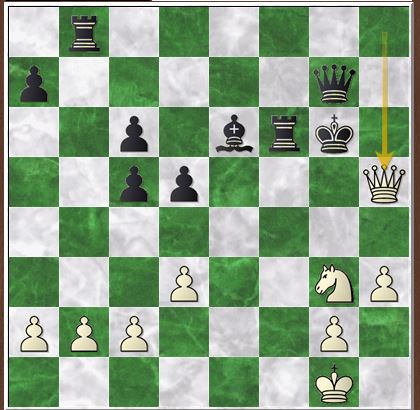
FEN
1r5Q/p3q2R/2p1brk1/2pp4/8/3P2NP/PPP3P1/6K1 w – – 0 25
Today’s problem is from the recent Bunratty chess festival
Since the start of 2018, I have decided to adopt the style of only saying which side is to play: and not giving an idea if the move wins or otherwise, unless on occasion I think signposting would be helpful. Instead, the problems are posed with the instruction to decide what you would play, as in a game.
White to play

Tivakov v Bates, 25/2/18, Bunratty
Solution
This position was chosen since I watched the game live, being a fan of Tiviakov (because of the chapter on him in Sadler’s and Regan’s excellent book Chess for Life.
1 Rf6! and it is game over: 1…gf 2 Qh6 and mates.

FEN
r4rk1/p3qpp1/2p1b2p/2ppP2Q/7R/3P2NP/PPP3P1/5RK1 w – – 0 19
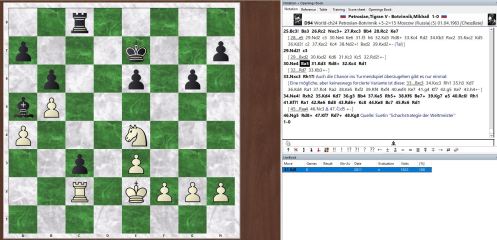
As in the last two days, I will use a position from this game for today’s puzzle.
White to play
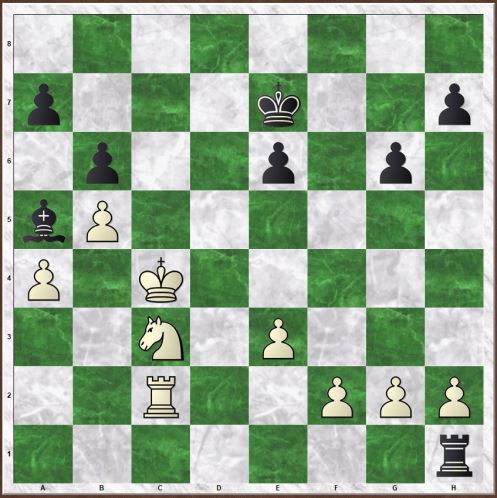
Petrosian v Botvinnik, game 5, World championship match, 1/4/1963 Moscow
Solution
The game was quite Carlsen-grind-esque, so hard to choose. But Tigran clearly knew to ignore threats and played 1 Ne4! Rh2 2 Kd4!
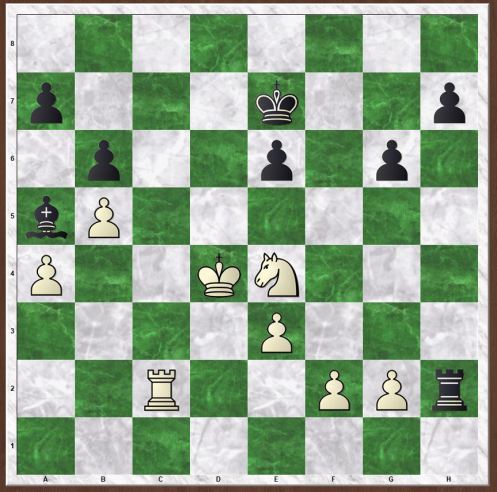
White has activated his pieces, including his King; and the Ba5 isn’t in the game. He gave back the extra pawn from the initial position, swapping it for other advantages.
After 2..Kd7 3 g3 Bb4 4 Ke5 White’s king advanced and advanced.
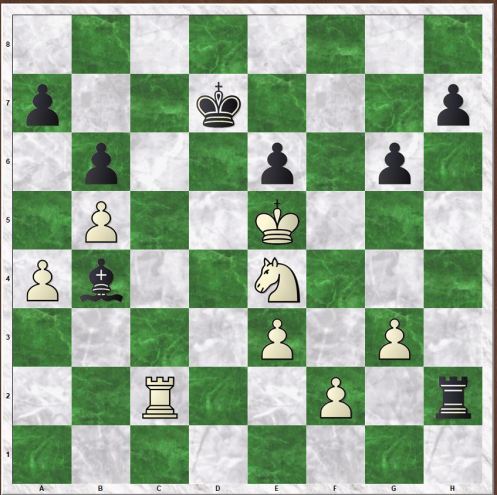
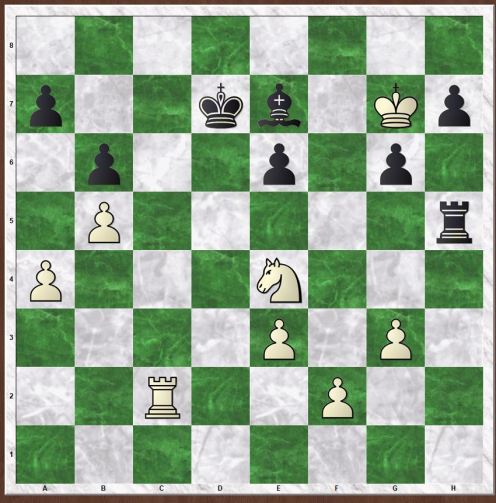
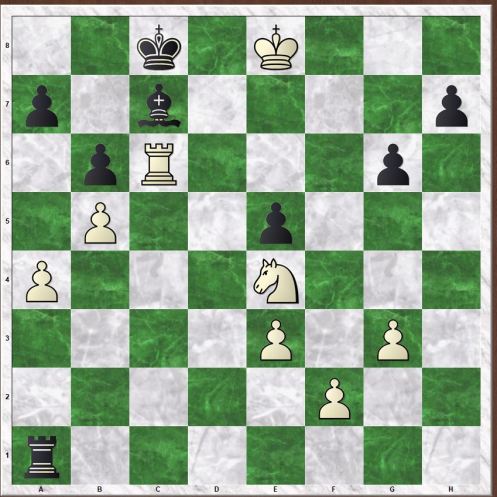
After a few more moves, Black’s defences finally succumbed: the king side pawns dropped off (though Botvinnik resigned when the inevitable was nigh). An ending worth playing through.
FEN
8/p3k2p/1p2p1p1/bP6/P1K5/2N1P3/2R2PPP/7r w – – 0 34
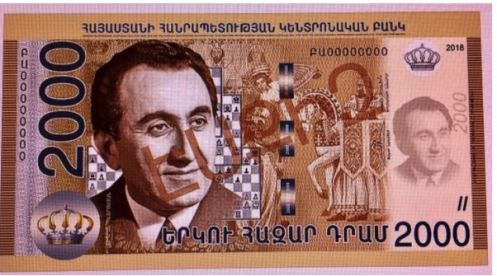
Chessbase recently had a news item that Tigran Petrosian has appeared on one of the Armenian bank notes.
I decided to try to find the games pictured on the note. Using Megabase 2018, I think I have done.
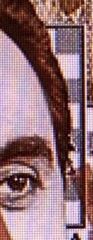
Not many clues here!- just the white pawn on h3, and black pawn on h4. However, from using Chessbase’s search by position tool, by far the most likely is game 18.
Petrosian v Botvinnik, game 18, World championship match, 8/5/1963 Moscow

For today’s puzzle, I will again choose a position from this game from the stamp.
Black to play

Petrosian v Botvinnik, game 18, World championship match, 8/5/1963 Moscow
Solution
1…c3+! the point being 2 Kc1 either 2…ab or 2…Ng4 3 hg[] h3 traps the Ng2.
So 2 Kc3 was played, when 2…Rc8+ 3 Kd2 Nec4+ and 4…Na3, and White had a knight-mare, as both of Black’s Knights invaded.

I will give the final game segment tomorrow.
FEN
4r3/5rk1/3n1p2/pp1PnPp1/PPp3Pp/7P/2BK1RN1/1R6 b – – 0 51
Chessbase recently had a news item that Tigran Petrosian has appeared on one of the Armenian bank notes.
I decided to try to find the games pictured on the note. Using Megabase 2018, I think I have done.
Game 1
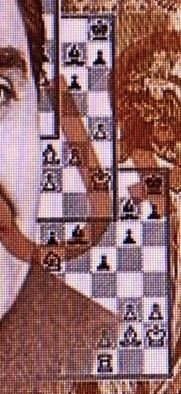
Strangely, both these diagrams are from the same game.
Petrosian v Botvinnik, game 7, World championship match, 6/4/1963 Moscow
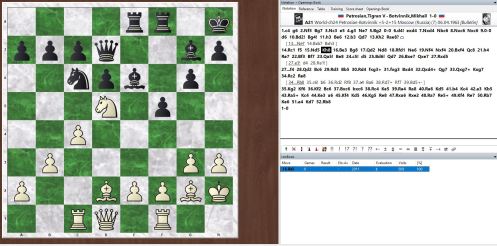
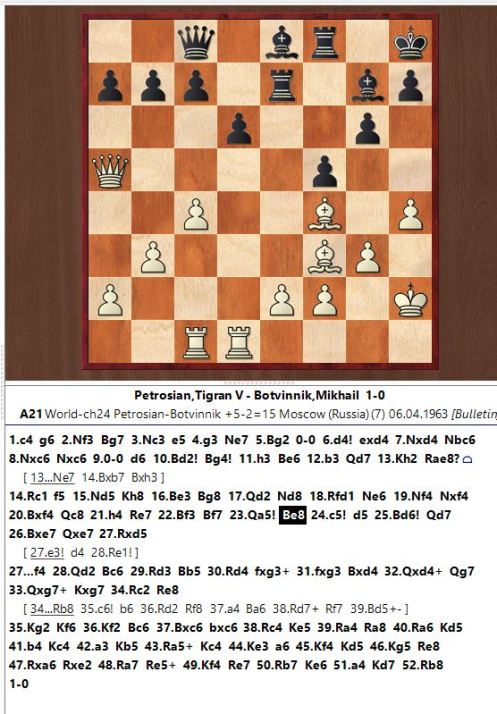
I will show the next position tomorrow. For now, a puzzle from this seventh game.
White to play
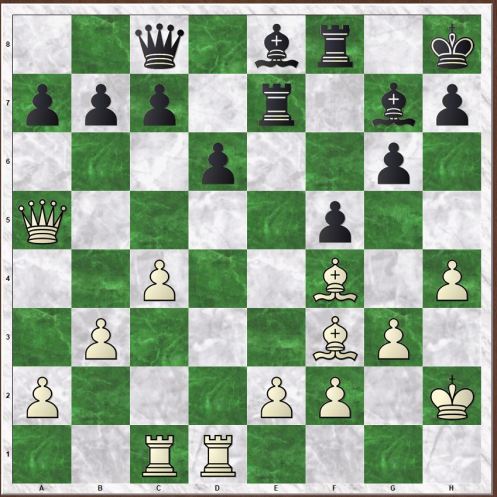
Petrosian v Botvinnik, game 7, World championship match, 6/4/1963 Moscow
Solution
1 c5! and after 1…d5 2 Bd6! won the exchange.
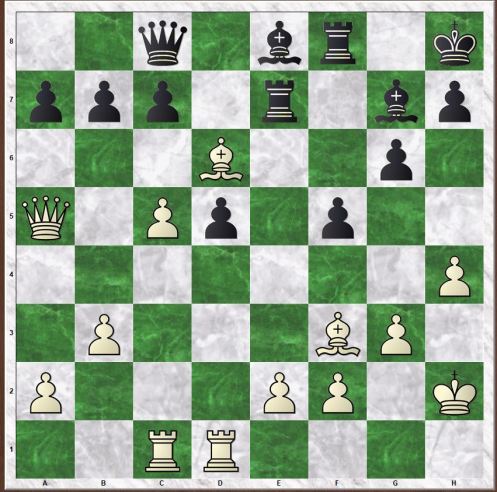
I have never studied the match; I see from Megabase that it ended after 22 games, Petrosian +3, with two to play.
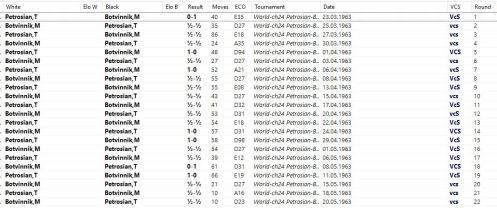
FEN
2q1br1k/ppp1r1bp/3p2p1/Q4p2/2P2B1P/1P3BP1/P3PP1K/2RR4 w – – 0 24
I’ve recently just come home from my first visit of 2018 to London; for me, no trip there is complete without popping into Malcolm’s Pein’s shop and buying some books. This time, amongst those I bought were a 2015 book which I had been hoping to buy for a while, but which has long been out of stock at Amazon (which I hate to use for chess books) and at my preferred chess vendor, Malcolm’s shop. But this time, I was pleased that GM Ramesh’s Fundamental Chess: Logical Decision Making was in stock.
His very first diagram is today’s puzzle: what would you play? The puzzle sets the tone for what I suspect, from my dipping into it so far, is a really instructive book.
Since the start of 2018, I have decided to adopt the style of only saying which side is to play: and not giving an idea if the move wins or otherwise, unless on occasion I think signposting would be helpful. Instead, the problems are posed with the instruction to decide what you would play, as in a game.
White to play
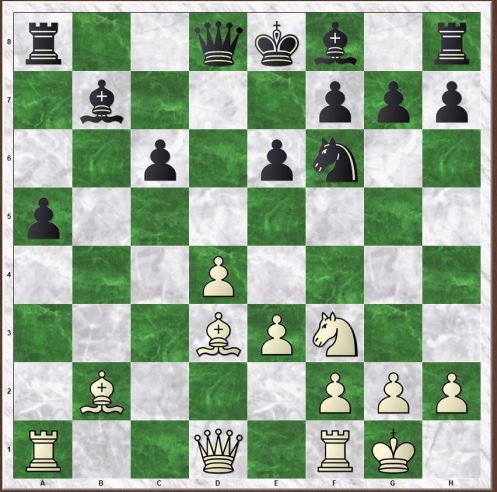
Carlsen v Aronian, Bilbao 2008
Solution
1 d5!!
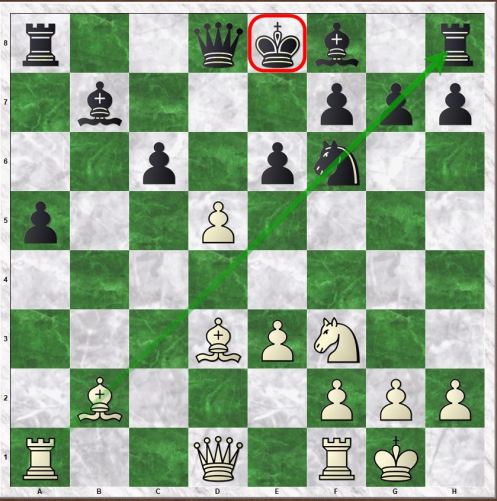
A move I would never, ever, consider. And, alas, as soon as I saw the move in the book, I had vague recollections of seeing the game 10 years ago. The move doesn’t win, but expands the scope of at least two of White’s pieces (Bb2 and Nf3-d4) whilst Black’s king is in the centre and he is still a move or two from castling.
Not a winning move, of course, but incredible ingenuity; maybe silicon created, but stunning nevertheless. The game is in Megabase, with detailed annotations by Igor Stohl.
FEN
r2qkb1r/1b3ppp/2p1pn2/p7/3P4/3BPN2/1B3PPP/R2Q1RK1 w kq – 0 15
Today’s problem was one I saw on Twitter, re=posted by Simon Williams, being a composition by Yochanan Afek.
I’ve just come home from my first visit of 2018 to London; for me, no trip there is complete without popping into Malcolm’s Pein’s shop and buying some books. This time, amongst those I bought were two by Yochanan. If I find the date of composition of this study I will update my blog.
Since the start of 2018, I have decided to adopt the style of only saying which side is to play: and not giving an idea if the move wins or otherwise, unless on occasion I think signposting would be helpful. Instead, the problems are posed with the instruction to decide what you would play, as in a game.
White to play
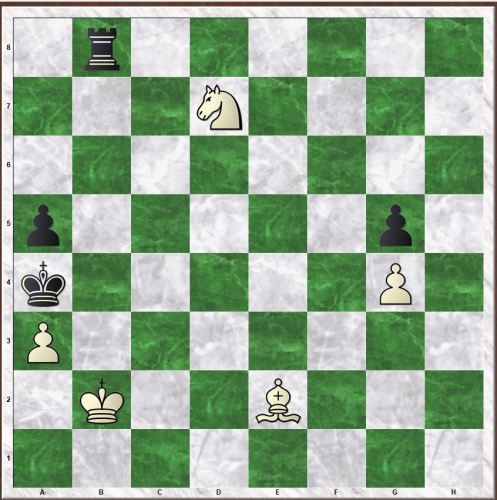
Composition, Yochanan Afek
Solution
After trying more obvious moves (1 Ka2? Rb2+! and 2 Kb2 stalemate; or 1 Nb8 stalemate; and tries such as 1 Ka1/ 1 Nb6+….I turned to a move I had seen immediately, but just as immediately rejected. But, for want of others, it merited looking at again:
1 Bb5+!

1…Kb5 frees the king from its stalemate nest, so 1..Rb5+[] 2 Ka2 and then the point is revealed: Black has no none-losing rook moves: zugzwang, 1-0.

FEN
1r6/3N4/8/p5p1/k5P1/P7/1K2B3/8 w – – 0 1
 allanbeardsworth