Today’s problem is from the 1972 book “Chess Combination as a Fine Art”, a book based on articles published in the 1950s-1960s by Kurt Richter.
Since the start of 2018, I have decided to adopt the style of only saying which side is to play: and not giving an idea if the move wins or otherwise, unless on occasion I think signposting would be helpful. Instead, the problems are posed with the instruction to decide what you would play, as in a game.
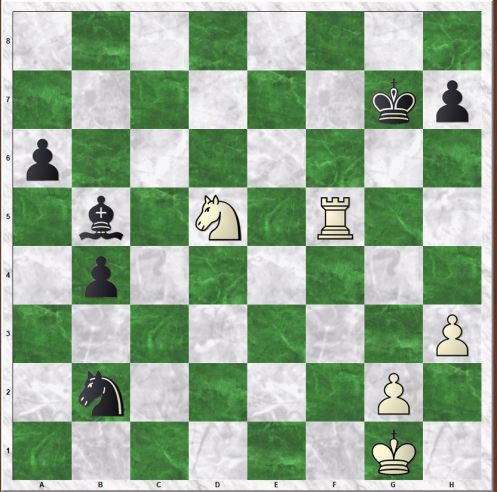
White to play
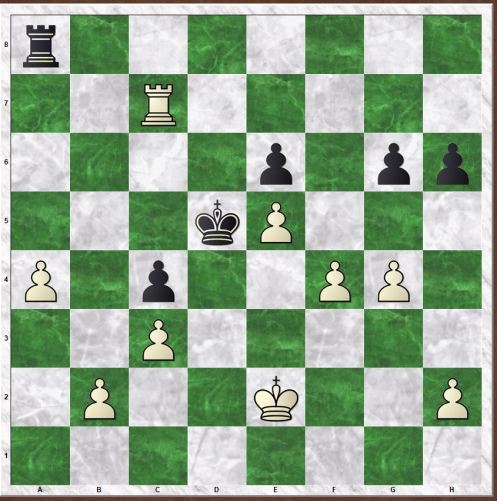
Fischer v Durao, Havana 28/10/66
Solution
The end of yesterday’s game.
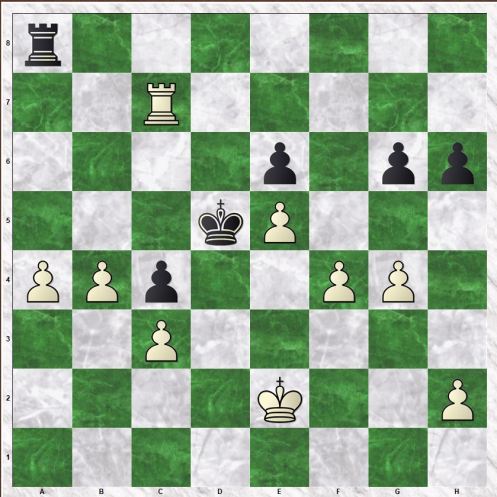
1 b4! and White mates. If 1…cb 2 Kd3 and 3 c4 mate.
FEN
r7/2R5/4p1pp/3kP3/P1p2PP1/2P5/1P2K2P/8 w – – 0 46
Today’s problem is from the 1972 book “Chess Combination as a Fine Art”, a book based on articles published in the 1950s-1960s by Kurt Richter.
Since the start of 2018, I have decided to adopt the style of only saying which side is to play: and not giving an idea if the move wins or otherwise, unless on occasion I think signposting would be helpful. Instead, the problems are posed with the instruction to decide what you would play, as in a game.
White to play

Fischer v Durao, Havana 28/10/66
Solution
Part of my chess education. I haven’t checked, but presume this is in Bobby’s memorable games collection, since I instantly knew 1 Na5!, the point being a pretty smothered mate if 1…ba (Black didn’t play it, and carried on a pawn down).
2 Nf6+ Ke7[] 3 Rb7+ and mates.

FEN
2nrkb2/5p2/1pr1p1pp/p1p1P3/P1N1NPP1/1RP4R/1P2K2P/8 w – – 0 33
Today’s problem is from the 1972 book “Chess Combination as a Fine Art”, a book based on articles published in the 1950s-1960s by Kurt Richter.
Since the start of 2018, I have decided to adopt the style of only saying which side is to play: and not giving an idea if the move wins or otherwise, unless on occasion I think signposting would be helpful. Instead, the problems are posed with the instruction to decide what you would play, as in a game.
What is wrong in the sequence shown over the last several days?
1 Qh6
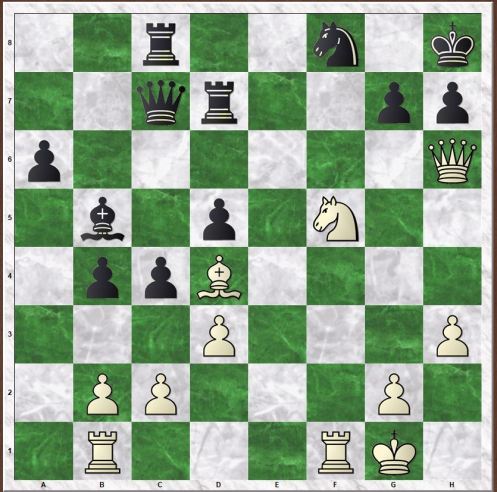
1…Qc7 2 Bd4 Rd7 3 Rf3 Ng6 4 Rbf1 Kg8 5 Qg7+ Rg7[] 6 Ng6+ Kh8[]

7 Rf7 Qf7 8 Rf7 Rg8 9 Rd7 Bd7 10 Nf7 mate.
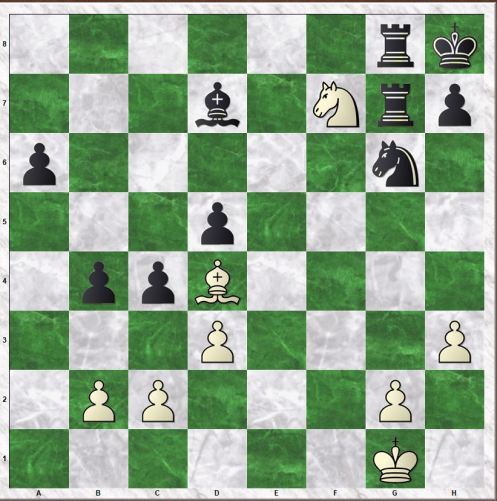
Black missed a stunning defence somewhere towards the end of this line.
Blumenthal v McGunnigle corres 1962
Solution
7…Qf7?? is a mistake, and instead 7…Qe5!! almost turns the tables.

8 Be5[] Ne5 9 Rf8+ Rg8!

And White’s best is 10 Ng8 Rf8 11 Rf8[] Kg7
and I know, if I were White, I would be seriously thinking I had messed up, and likely lose, “on tilt”.

The engine says best play is 12 Rf5 cd! 13 cd[] (13 Re5?? d2! -+) Nd3 14 Ne7 Nb2 15 Nd5 and the game goes on. I know in my practice, I could lose with either colour.
FEN
2rr1n1k/6pp/p3Q3/qb1p1N2/1pp5/3P3P/1PP2BP1/1R3RK1 w – – 0 1
Today’s problem is from the 1972 book “Chess Combination as a Fine Art”, a book based on articles published in the 1950s-1960s by Kurt Richter.
Since the start of 2018, I have decided to adopt the style of only saying which side is to play: and not giving an idea if the move wins or otherwise, unless on occasion I think signposting would be helpful. Instead, the problems are posed with the instruction to decide what you would play, as in a game.
(i) White to play after 1…Rg7[] 2 Nh6+ Kh8

Blumenthal v McGunnigle, corres 1962
Solution
3 Rf7! is obvious, met by 3…Qf7 4 Rf7[] Rcg8
White to play and win

5 Rd7!! (5 Re7 also wins, more slowly) and after 5…Bd7 6 Nf7 mate.
FEN
2r3k1/2qr2Qp/p5n1/1b1p1N2/1ppB4/3P1R1P/1PP3P1/5RK1 b – – 0 5
Today’s problem is from the 1972 book “Chess Combination as a Fine Art”, a book based on articles published in the 1950s-1960s by Kurt Richter.
Since the start of 2018, I have decided to adopt the style of only saying which side is to play: and not giving an idea if the move wins or otherwise, unless on occasion I think signposting would be helpful. Instead, the problems are posed with the instruction to decide what you would play, as in a game.
White to play
Blumenthal v McGunnigle, corres 1962
Solution
This position continues from yesterday’s puzzle.
Reader’s of Jacob Aagaard will know about “bringing all the pieces to the party” and indeed simple evolution (another of his phrases) works here: 1 Rf3 (strangely, my engine slightly prefers 1 Rf2) 1…Kg8 2 Rbf1 and White is winning.

Apparently we are in +8 territory, but for me, it is in “better for white, easy to mess up” territory.
In the game, Black played 2…Ng6 when simple steady play by 3 Qg5 or 3 Qe3 is +9 (apparently), but in the game, White played the crowd pleaser (but it was a correspondence game) 3 Qg7+, which the book gives as !! but in fact is ??
I will continue this puzzle tomorrow, and show what the players and annotators missed.
FEN
2r2n1k/2qr2pp/p6Q/1b1p1N2/1ppB4/3P3P/1PP3P1/1R3RK1 w – – 0 3
Today’s problem is from the 1972 book “Chess Combination as a Fine Art”, a book based on articles published in the 1950s-1960s by Kurt Richter.
Since the start of 2018, I have decided to adopt the style of only saying which side is to play: and not giving an idea if the move wins or otherwise, unless on occasion I think signposting would be helpful. Instead, the problems are posed with the instruction to decide what you would play, as in a game.
White to play
A position to choose moves to play, not to force a win; more to consider alternatives.

Blumenthal v McGunnigle, corres 1962
Solution
I chose 1 Qf7, hitting g7, and it turns out this is the engine’s first choice: 1…Qc7 2 Ne7 Nt6 3 Bd4 is one line (3…Qe7 4 Bg7 mate).
The engine also likes 1 Qe5, with a similar idea, but in the game, White played the lovely 1 Qh6!. In the book I am using, it is heralded as a start of a fine combination. The first few moves are easy.
1…Qc7 2 Bd4 Rd7
I will leave this problem for tomorrow: White to play.
FEN
2rr1n1k/6pp/p3Q3/qb1p1N2/1pp5/3P3P/1PP2BP1/1R3RK1 w – – 0 1
Today’s problem is from the 1972 book “Chess Combination as a Fine Art”, a book based on articles published in the 1950s-1960s by Kurt Richter.
Since the start of 2018, I have decided to adopt the style of only saying which side is to play: and not giving an idea if the move wins or otherwise, unless on occasion I think signposting would be helpful. Instead, the problems are posed with the instruction to decide what you would play, as in a game.
White to play
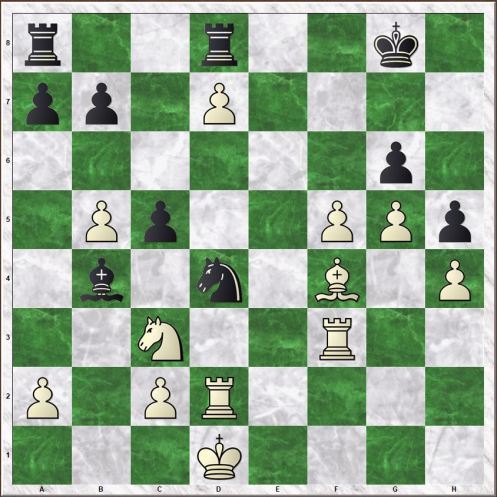
Korchnoi v Bastrikov, Minsk 1952
Solution
There are only two games in Megabase between these two players: yesterday’s great attack by Victor, and today’s. The whole game is worth playing through, but here,
1 Rd4! cd 2 Nd5

Now, Black’s bishop has several moves, but since the Pd7 is poisoned (Nf6+ fork), White’s attack prevails. In the game, Black was mated after 2..Ba5 3 fg Rf8 4 Ne7+ with Be5+ to follow.

FEN
r2r2k1/pp1P4/6p1/1Pp2PPp/1b1n1B1P/2N2R2/P1PR4/3K4 w – – 0 28
Today’s problem is from the 1972 book “Chess Combination as a Fine Art”, a book based on articles published in the 1950s-1960s by Kurt Richter.
Since the start of 2018, I have decided to adopt the style of only saying which side is to play: and not giving an idea if the move wins or otherwise, unless on occasion I think signposting would be helpful. Instead, the problems are posed with the instruction to decide what you would play, as in a game.
Black to play: how to meet 1..hg?
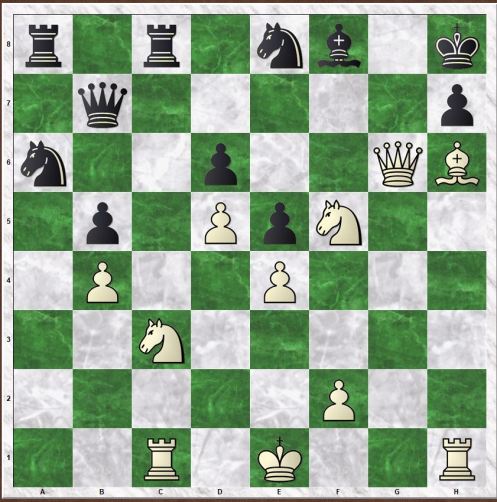
Korchnoi v Bastrikov, Tashkent 1958
Solution
Another problem based on yesterday’s game.
After 1…hg, not 2 Bf8+, but 2 Bg7+!! Kh7[] 3 Rh8+ Kf7[] 4 Rf8 mate.
Pretty!
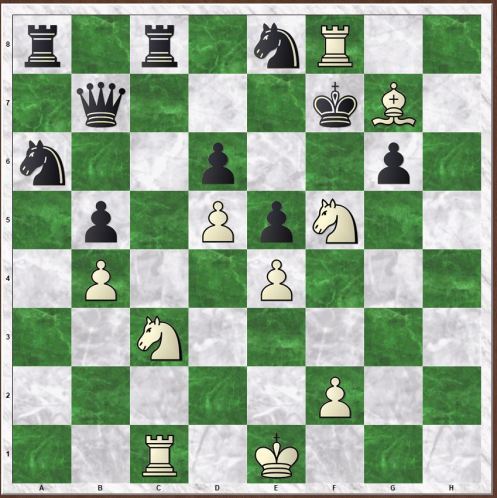
FEN
r1r1nb1k/1q5p/n2p2QB/1p1PpN2/1P2P3/2N5/5P2/2R1K2R b K – 0 30
Today’s problem is from the 1972 book “Chess Combination as a Fine Art”, a book based on articles published in the 1950s-1960s by Kurt Richter.
Since the start of 2018, I have decided to adopt the style of only saying which side is to play: and not giving an idea if the move wins or otherwise, unless on occasion I think signposting would be helpful. Instead, the problems are posed with the instruction to decide what you would play, as in a game.
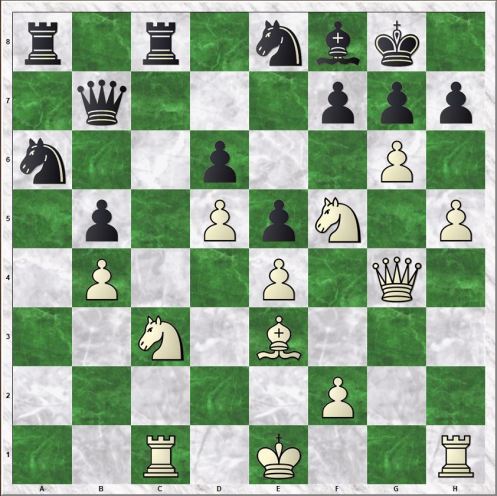
Black to play: Black played 1…Kh8; what happened next?
Korchnoi v Bastrikov, Tashkent 1958
Solution
The first move isn’t too hard, 2 h6, met with by 2..fg, when since it is a puzzle, I immediately met by 3 Qg6!!
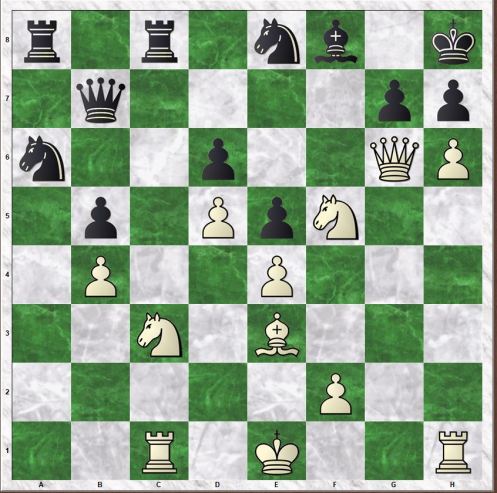
It isn’t too hard, really: 3…hg 4 hg+, 5 Rh8+ and 6 promote the pawn, 1-0. Black though played 3…gh met with by 3 Bh6!
Black took on h6, and Korchnoi won about 10 moves later.
FEN
r1r1nbk1/1q3ppp/n2p2P1/1p1PpN1P/1P2P1Q1/2N1B3/5P2/2R1K2R b K – 0 27
Today’s problem is from the 1972 book “Chess Combination as a Fine Art”, a book based on articles published in the 1950s-1960s by Kurt Richter.
Since the start of 2018, I have decided to adopt the style of only saying which side is to play: and not giving an idea if the move wins or otherwise, unless on occasion I think signposting would be helpful. Instead, the problems are posed with the instruction to decide what you would play, as in a game.
White to play
If I were White, I would spend a lot of time on 1 Bd5, before rejecting it: for not being able to fathom all the variations. And, indeed, my engine says 1 Kh2 is best, with a slight advantage to White.
But White played 1 Bd5, met with by 1…ed. Then what?

Rossetto v Cardoso, Portoroz Interzonal 4/9/1958
Solution
If I had dared play 1 Bd5, which I wouldn’t, I would have now played 1 Re7, and indeed it is winning after 1…d4 2 Rg7+! [] (others lose) 2…Kg7 3 Nf5+ and apparently White is winning- though for me, it is near losing!
But White played 2 Qg7+!!

I will leave it to my readers to try to work out the variations to their satisfaction, after 2…Kg7 3 Nf5+.

Black has 5 king moves, each of which has to be defeated. I found it impossible to visualise how to defeat each of them, and have noted it as an exercise for me to have a go at, another time, with pieces, board, and clock.
FEN
6k1/r1qn2np/3pp3/2p3P1/2P3PN/1PQ1R1KP/r5B1/4R3 w – – 0 40
 allanbeardsworth