Today’s problem is from the 1972 book “Chess Combination as a Fine Art”, a book based on articles published in the 1950s-1960s by Kurt Richter.
Since the start of 2018, I have decided to adopt the style of only saying which side is to play: and not giving an idea if the move wins or otherwise, unless on occasion I think signposting would be helpful. Instead, the problems are posed with the instruction to decide what you would play, as in a game.
White to play
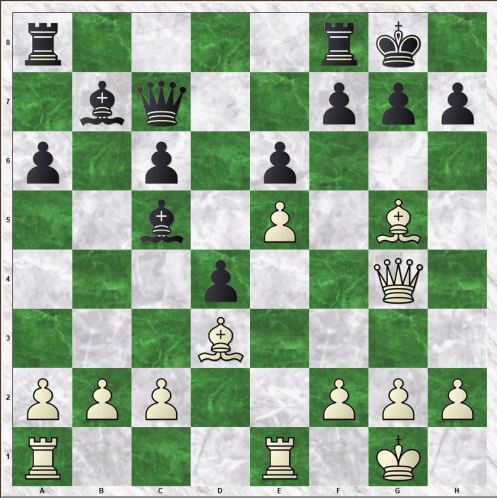
Mohring v Fiensch, GDR 1961
Solution
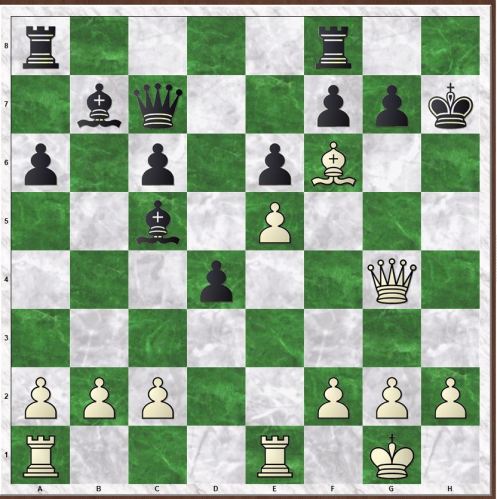
Not too hard today. First a Greek gift, then a follow up. 1 Bh7+ Kh7 2 Bf6! and it is game over.
FEN
r4rk1/1bq2ppp/p1p1p3/2b1P1B1/3p2Q1/3B4/PPP2PPP/R3R1K1 w – – 0 1
Today’s problem is from the recently concluded Gibraltar chess congress, which I enjoyed watching from home: but I thoroughly intend to visit again, as I once managed to do to spectate some years ago. Stuart Conquest and his team run a thoroughly top-notch tournament.
Since the start of 2018, I have decided to adopt the style of only saying which side is to play: and not giving an idea if the move wins or otherwise, unless on occasion I think signposting would be helpful. Instead, the problems are posed with the instruction to decide what you would play, as in a game.
Black to play
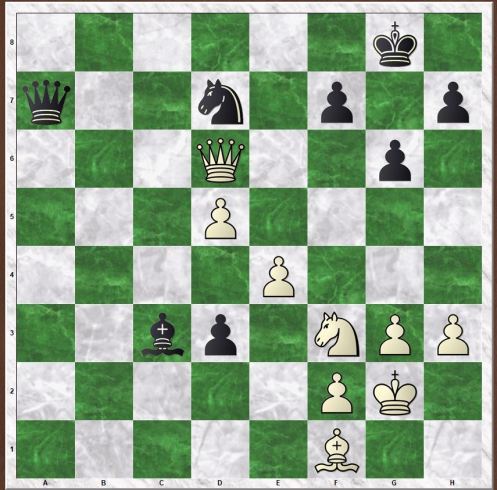
Saric v Swapnil, Gibraltar 26/1/18
Solution
Black missed the winning move, and lost in a few moves after 1…d2? 2 Be2.
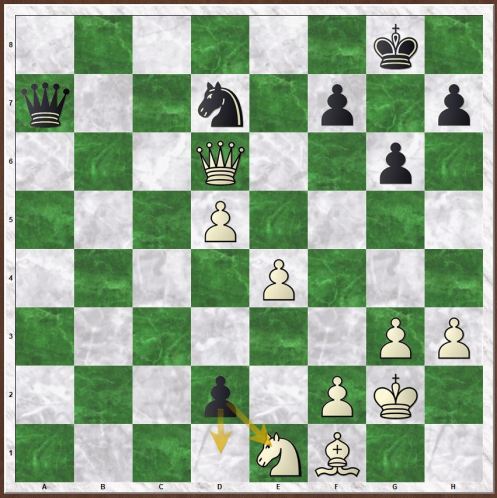
But by 1…Be1! the tables would have been turned: 2 Ne1 d2 is a winning double attack (on e1 and d1(Q)).
FEN
6k1/q2n1p1p/3Q2p1/3P4/4P3/2bp1NPP/5PK1/5B2 b – – 0 35
Today’s problem is from the 1972 book “Chess Combination as a Fine Art”, a book based on articles published in the 1950s-1960s by Kurt Richter.
Since the start of 2018, I have decided to adopt the style of only saying which side is to play: and not giving an idea if the move wins or otherwise, unless on occasion I think signposting would be helpful. Instead, the problems are posed with the instruction to decide what you would play, as in a game.
White to play
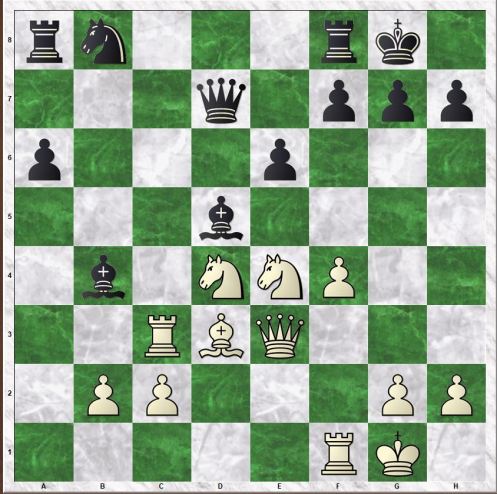
Radovici v Neamtu, Romanian chmps, 1963
Solution
Examine all biffs means you have to look at 1 Nf6+!; the N has to be captured, since the K and Q are forked, when 2 Bh7+ follows.

If the Bishop is captured, then Qh3+/Qg4+/Rh3 mate; otherwise 3 Qh3 and mates similarly.
FEN
rn3rk1/3q1ppp/p3p3/3b4/1b1NNP2/2RBQ3/1PP3PP/5RK1 w – – 0 19
Today’s problem is from the 1972 book “Chess Combination as a Fine Art”, a book based on articles published in the 1950s-1960s by Kurt Richter.
Since the start of 2018, I have decided to adopt the style of only saying which side is to play: and not giving an idea if the move wins or otherwise, unless on occasion I think signposting would be helpful. Instead, the problems are posed with the instruction to decide what you would play, as in a game.
White to play
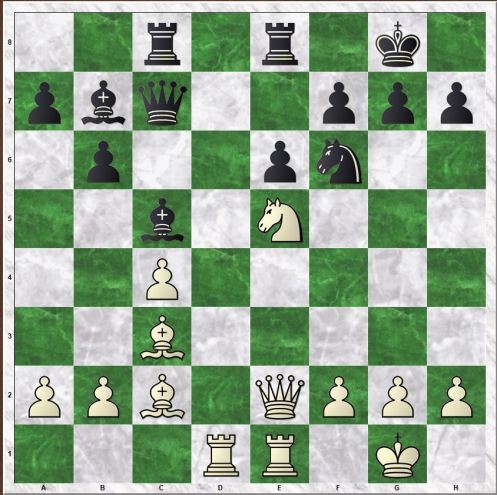
Koz v Riskin, Sverdlovsk 1963
Solution
In some ways “standard”, but a nice problem, since the main task is to decide if to start with Rd7 or Bh7+; by process of comparison, 1 Bh7+! was the move. If 1…Nh7, then 2 Rd7 and 3 Rf7+-, so 1…Kh7 when 2 Rd7! now forces 2…Nd7, when the Queen comes into the attach: 3 Qh5+ and 4 Qf7+
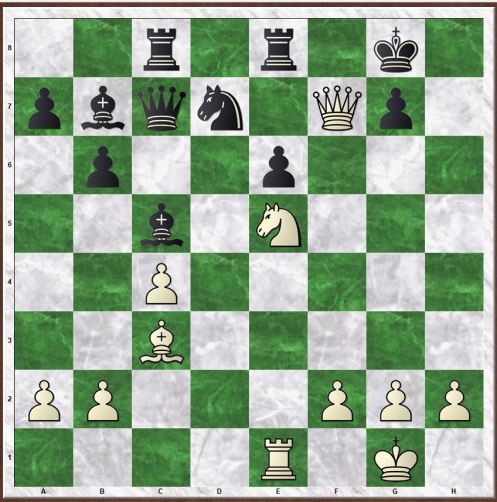
5 Nd7 follows, with a threat of Qg7 mate; Black’s best hope is to swap off into a clearly lost ending. Note that 5. Rg8 defending g7 is met by 6 Qh5 mate.
FEN
2r1r1k1/pbq2ppp/1p2pn2/2b1N3/2P5/2B5/PPB1QPPP/3RR1K1 w – – 0 1
Today’s problem is from the recently concluded Gibraltar chess congress, which I enjoyed watching from home: but I thoroughly intend to visit again, as I once managed to do to spectate some years ago. Stuart Conquest and his team run a thoroughly top-notch tournament.
Since the start of 2018, I have decided to adopt the style of only saying which side is to play: and not giving an idea if the move wins or otherwise, unless on occasion I think signposting would be helpful. Instead, the problems are posed with the instruction to decide what you would play, as in a game.
White to play
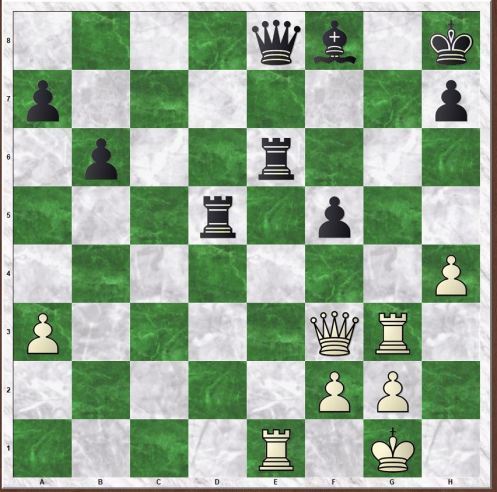
Gupta v Ivanchuk, Gibraltar 30.1.18
Solution
A sparkling victory against the great Ivanchuk.
1 Rg8+!! and the pin after 1…Kg8[] 2 Qd5 is devastating.
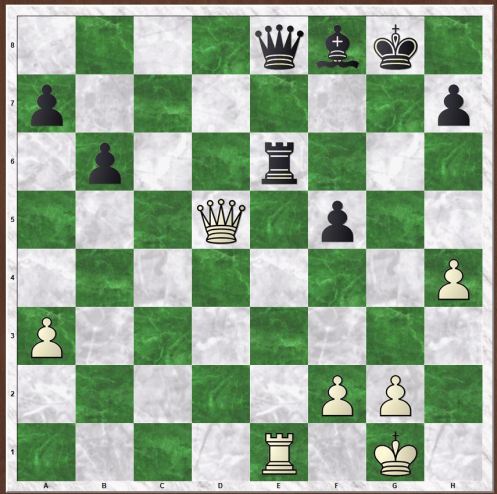
Watching it live, it wasn’t immediately obvious at this stage, but the point is that 2..Kf7 3 Qf5+ leads to a lost ending after 3…Rf6 4 Qf6+ or 4 Qh7+: 4 Qf6+ being easiest.
If 2…Qc6, then 3 Qe6+ Qe6 4 Re6 Ba3, but the engines say White is winning:
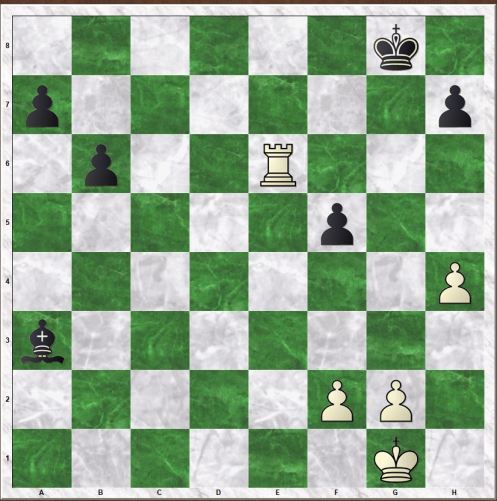
I imagine it is; at my level, I could well mess up as White, but hopefully if I kept calm I could control the a and b pawns with my king; then win on the kingside.
FEN
4qb1k/p6p/1p2r3/3r1p2/7P/P4QR1/5PP1/4R1K1 w – – 0 31
Today’s problem is from the 1972 book “Chess Combination as a Fine Art”, a book based on articles published in the 1950s-1960s by Kurt Richter.
Since the start of 2018, I have decided to adopt the style of only saying which side is to play: and not giving an idea if the move wins or otherwise, unless on occasion I think signposting would be helpful. Instead, the problems are posed with the instruction to decide what you would play, as in a game.
White to play

Forintos v Tomovic, Budapest 1957
Solution
White is about to be mated, so (more or less) only checks matter. 1 Bd3+! g6[] 2 Rh8+ Kh8 3 Qf8+ Kh7[] 4 Qf7+ Kh8[] 5 Qf8+! Kh7[]
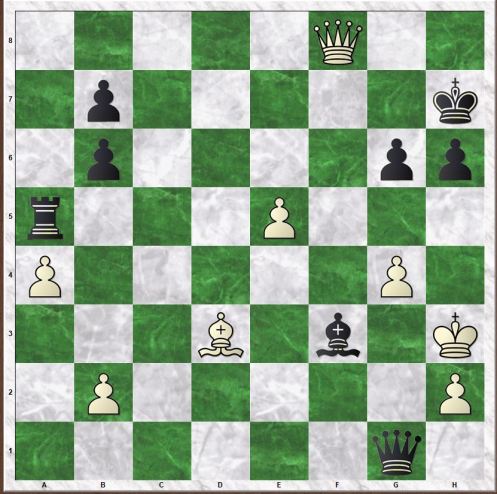
And now the key move, 6 Bg6+! Kg8[] 7 Qg8 mate.

(Note that 1 Rh8+ followed by 2 Qf8+ and 3 Bd3+ also wins, in the same way)
FEN
3R4/1p3ppk/1p5p/rB2P3/PQ4P1/5b1K/1P5P/6q1 w – – 0 1
Footnote
I thought I had seen this problem before, and indeed I had: good news for me that I instantly recalled the solution, including the denouement 6 Bg6+.
Today’s problem is from the new book “The Shereshevsky Method” by Mikhail Shereshevsky. A very interesting new edition to my library.
Since the start of 2018, I have decided to adopt the style of only saying which side is to play: and not giving an idea if the move wins or otherwise, unless on occasion I think signposting would be helpful. Instead, the problems are posed with the instruction to decide what you would play, as in a game.
White to play
This game was new to me; the 16 year old Magnus Carlsen defeated Mickey Adams for the second time in Classical chess in this game (the first time was at the Turin Olympiad, 18 months earlier, which I witnessed first hand, as then England captain). Today’s problem is to determine a plan for White.

Carlsen v Adams, World Cup 3.12.2007
Solution
I would never, ever, dream of playing the moves Magnus played. I am sure I would have played 1 e3, allowed the rc8 to penetrate into c2, and then “seen what happened”. Not Magnus.
1 Nd2! Rc2 2 Rb1 Rac8
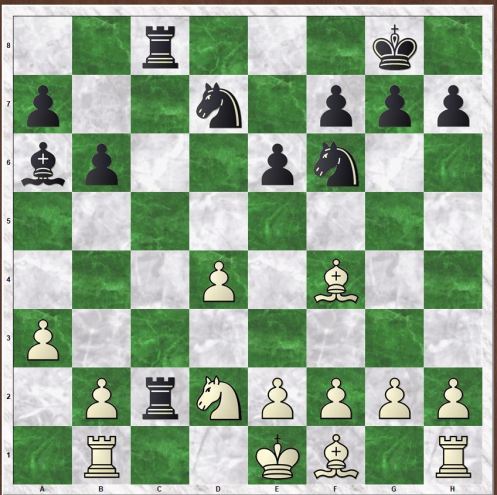
3 Nb3! Bc4 4 Na1!!

Wow!! If I had been Black, the shock of the move would have caused me to feel great pressure for the rest of the game. Mickey played 4..Ba2, exchanging a pair of rooks, and the N then returned to a1

The rest of the game was a long grind, Magnus eventually defeating Mickey. In preparing this blog posting, I see that Rogazenco has annotated this game in Megabase 2018- as well as Shereshevsky’s coverage in his book. Worth studying; I intend to re-read Shereshevsky’s annotations and work through Rogazenco’s too, but for now I have published this posting in admiration of the concept of Na1 covering c2.
FEN
r1r3k1/p2n1ppp/bp2pn2/8/3P1B2/P4N2/1P2PPPP/R3KB1R w KQ – 0 13
Today’s problem is from the 1972 book “Chess Combination as a Fine Art”, a book based on articles published in the 1950s-1960s by Kurt Richter.
Since the start of 2018, I have decided to adopt the style of only saying which side is to play: and not giving an idea if the move wins or otherwise, unless on occasion I think signposting would be helpful. Instead, the problems are posed with the instruction to decide what you would play, as in a game.
White to play

Eggenberger v Schumacher, Basle 1959
Solution
White threatens Ne7+ Kh8[] Nf7 smothered mate, so the Qb4 is tied to defending e7. Therefore, any deflection might work, and it isn’t hard to see that 1 Qd2! does the trick: hitting the LPDO Qb4 and the LPDO Nf4.
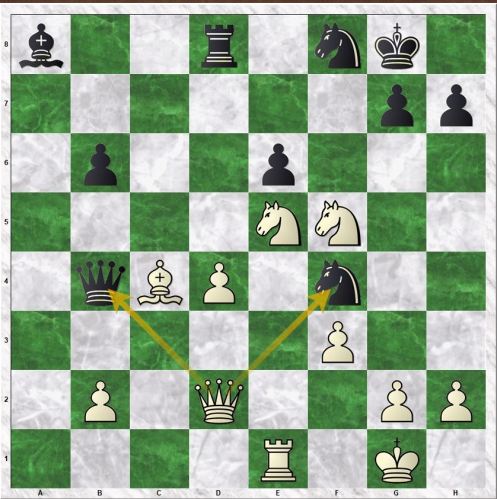
After 1..Qd2 White gets to play his smothered mate.

FEN
b2r1nk1/6pp/1p2p3/4NN2/1qBP1n2/5P2/1P4PP/3QR1K1 w – – 0 1
Footnote
I solved this problem instantly, which meant- good news for me- that I had learnt a lesson.
Today’s problem is from the recently concluded Gibraltar chess congress, which I enjoyed watching from home: but I thoroughly intend to visit again, as I once managed to do to spectate some years ago. Stuart Conquest and his team run a thoroughly top-notch tournament.
Since the start of 2018, I have decided to adopt the style of only saying which side is to play: and not giving an idea if the move wins or otherwise, unless on occasion I think signposting would be helpful. Instead, the problems are posed with the instruction to decide what you would play, as in a game.
White to play

Composed problem: I don’t recall if Akobian gave the composer’s name {if I listen to the lecture again, I will watch out for the name, and update this post)
Solution
I highly recommend the Gibratar chess MasterClasses, which are on YouTube.
Today’s puzzle is from the same lecture as yesterday’s, by the Armenian/American GM Var Akobian.
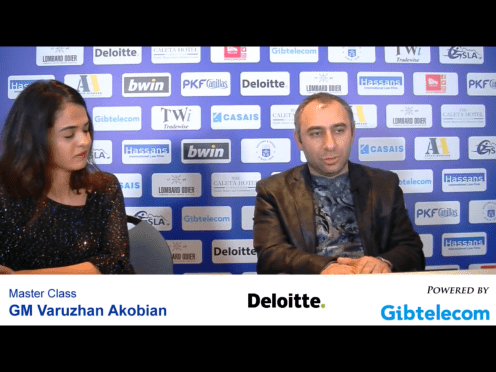
Really high class; whilst I personally liked the “route to the candidates” lecture by my friend Nigel Short the most, I quickly realised that Var Akobian had the knack of lecturing. The link to his MasterClass hosted by Tania Sachdev is here. It didn’t surprise me at all to learn later in the lecture that he now gets much of his income from chess training, including lecturing at the St. Louis club.

Here, I was pleased to find the solution: having paused the lecture, as Akobian suggested. 1 f4 forces 1…Kc7 (or 1..Kc8) else White wins (but not straightforwardly: worth setting the pieces out, and seeing how: I will only cover the “main line”).
Then 2 fg a5 3 Kg3 a4 4 Kh4 a3 5 g3 a2 Stalemate.

FEN
1k6/8/p5p1/6p1/6P1/5P1P/6PK/8 w – – 0 1
Today’s problem is from the recently concluded Gibraltar chess congress, which I enjoyed watching from home: but I thoroughly intend to visit again, as I once managed to do to spectate some years ago. Stuart Conquest and his team run a thoroughly top-notch tournament.
Since the start of 2018, I have decided to adopt the style of only saying which side is to play: and not giving an idea if the move wins or otherwise, unless on occasion I think signposting would be helpful. Instead, the problems are posed with the instruction to decide what you would play, as in a game.
Black to play
This was a variation from Var Akobian’s game against Gagare. If 1…Nb3 White can either play 2 Qd3 (likely met by 2…e5 threatening 2…e4 “potassium cyanide“) or he can play 2 Qd1.
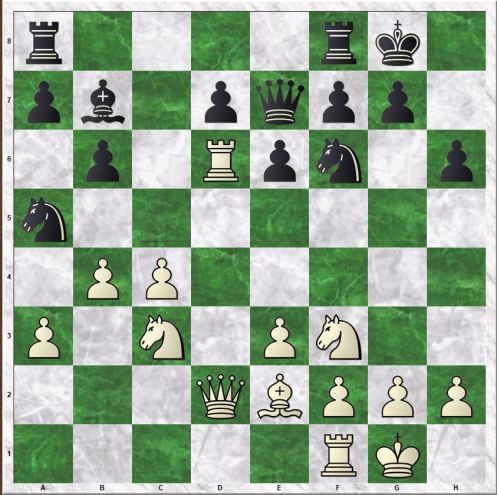
What was Black’s intention after 2 Qd1?
(for those readers who would prefer a slightly easier task, I have shown the position after 2 Qd1 below the heading “Solution”: it should be possible to look at this latter diagram without revealing all).
Akobian v Gagare, Gibraltar 29th January 2018
Solution
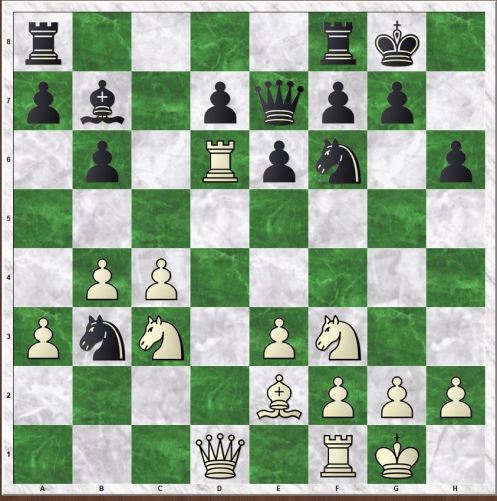
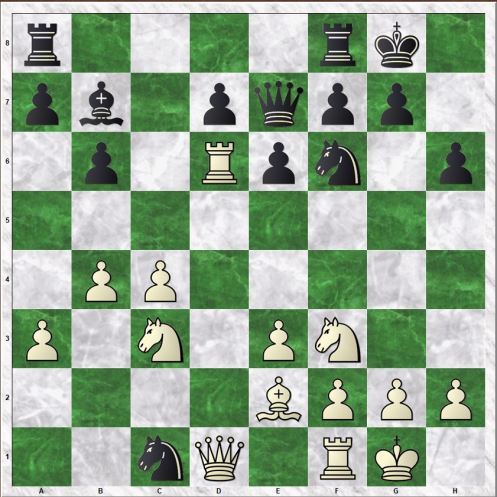
Position after 2 Qd1: Black to play?
Var analysed this game in a wonderful MasterClass hosted by Tania Sachdev.
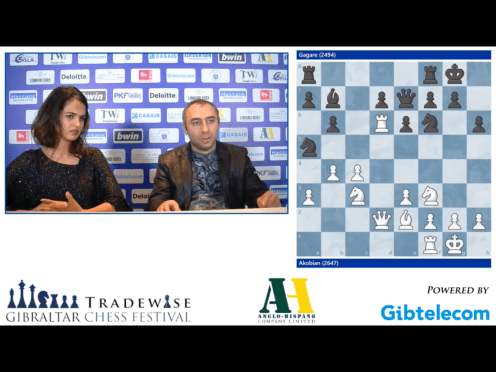
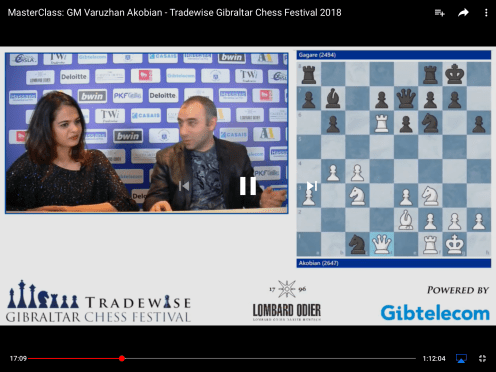
I highly recommend the Gibratar chess MasterClasses, which are on YouTube. Really high class; whilst I personally liked the “route to the candidates” lecture by my friend Nigel Short the most, I quickly realised that Var Akobian had the knack of lecturing. It didn’t surprise me at all to learn later in the lecture that he now gets much of his income from chess training, including lecturing at the St. Louis club.
I highly recommend the MasterClass. I intend watching it again, and am sure I will learn more from it.
In the diagram position, 2…Nc1! is the wonderful move which Gagare must have prepared. The Qd1 is tied to defending the Rd6, and the Be2 can’t move, so Black achieves an exchange of his “knight on the rim” for the bishop.
A very surprising motif. But for a player who follows Purdy of always looking for pins, nets and ties, Nc1 is a move which exploits the tie.
FEN
r4rk1/pb1pqpp1/1p1Rpn1p/n7/1PP5/P1N1PN2/3QBPPP/5RK1 b – – 0 1
 allanbeardsworth