Today’s problem is from the recently concluded Gibraltar chess congress, which I enjoyed watching from home: but I thoroughly intend to visit again, as I once managed to do to spectate some years ago. Stuart Conquest and his team run a thoroughly top-notch tournament.
Since the start of 2018, I have decided to adopt the style of only saying which side is to play: and not giving an idea if the move wins or otherwise, unless on occasion I think signposting would be helpful. Instead, the problems are posed with the instruction to decide what you would play, as in a game.
White to play
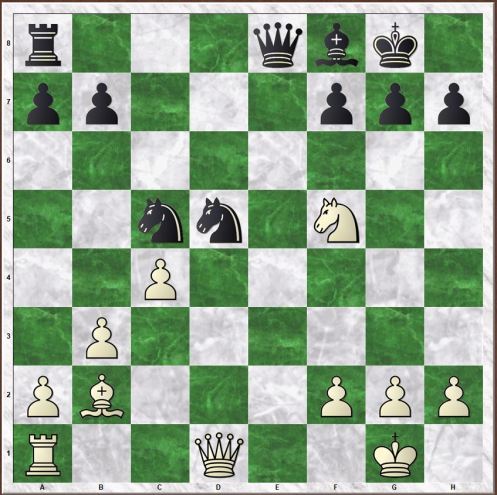
Adams v Grandelius,
Solution
Mickey doesn’t need mnemonics like Purdy’s examine all biffs. I imagine most players would have responded to the capture N*d5 which Black has just played by recapturing the Knight, but Mickey plays the far stronger zwischenschach 1 Nh6+! winning a further pawn.
After 1…gh? 2 Qg4+ mates; so 1..Kh8 is forced, met by 2 Qd5 and if 2… Ne6 3 Re1 wins.
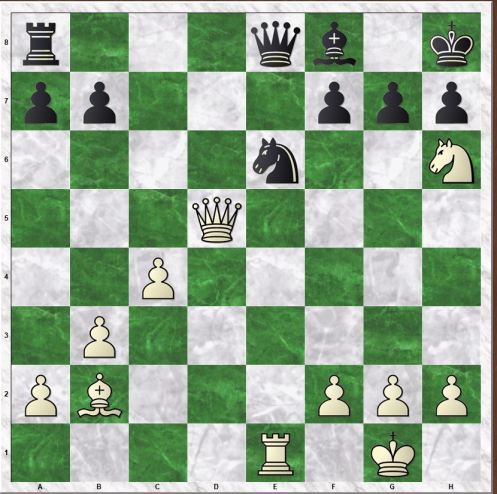
(I wondered about 3…Rd8, but it is met by 4 Qd8! and if 4…Qd8, 5 Nf7+ forks the king and queen.
Lovely.
FEN
r3qbk1/pp3ppp/8/2nn1N2/2P5/1P6/PB3PPP/R2Q2K1 w – – 0 1
Today’s problem is from the 1972 book “Chess Combination as a Fine Art”, a book based on articles published in the 1950s-1960s by Kurt Richter.
Since the start of 2018, I have decided to adopt the style of only saying which side is to play: and not giving an idea if the move wins or otherwise, unless on occasion I think signposting would be helpful. Instead, the problems are posed with the instruction to decide what you would play, as in a game.
White to play
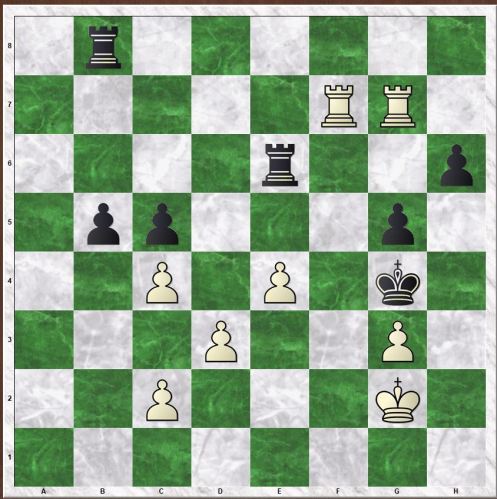
Durao v Catozzi, Dublin 1957
Solution
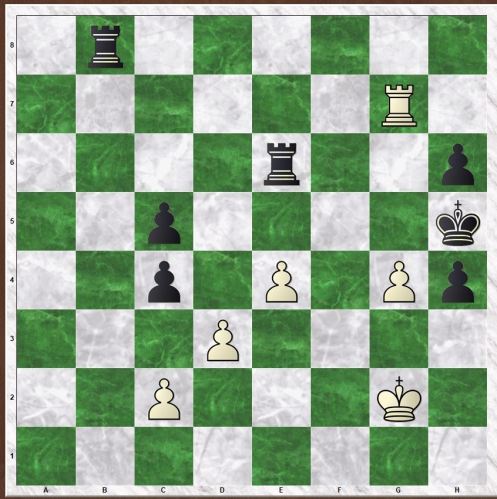
A nice, not too hard, finale. 1 Rf4+! Kh5[] 2 Rh4+! gh[] 3 g4 mate
FEN
1r6/5RR1/4r2p/1pp3p1/2P1P1k1/3P2P1/2P3K1/8 b – – 0 42
Today’s problem is from the 1972 book “Chess Combination as a Fine Art”, a book based on articles published in the 1950s-1960s by Kurt Richter.
Since the start of 2018, I have decided to adopt the style of only saying which side is to play: and not giving an idea if the move wins or otherwise, unless on occasion I think signposting would be helpful. Instead, the problems are posed with the instruction to decide what you would play, as in a game.
Black to play
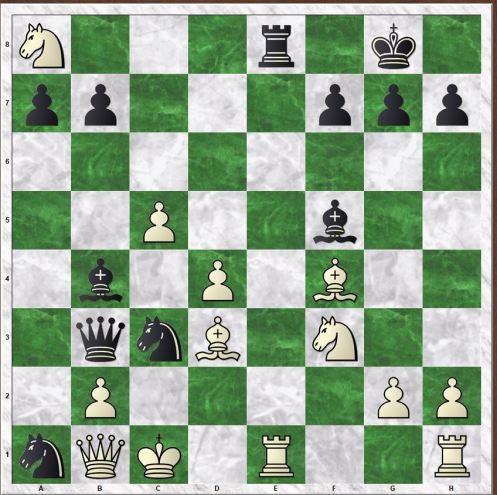
Druganov v Panteleyev, corres USSR 1955-56
Solution
I suspect I have seen this position before, or the same clearance mechanism, since I saw the solution instantly.
1….Qd1+! 2 Rd1 Ne2+ 3 Be2[] Nb3 mate.

FEN
N3r1k1/pp3ppp/8/2P2b2/1b1P1B2/1qnB1N2/1P4PP/nQK1R2R b – – 0 1
Today’s problem is from the 1972 book “Chess Combination as a Fine Art”, a book based on articles published in the 1950s-1960s by Kurt Richter.
Since the start of 2018, I have decided to adopt the style of only saying which side is to play: and not giving an idea if the move wins or otherwise, unless on occasion I think signposting would be helpful. Instead, the problems are posed with the instruction to decide what you would play, as in a game.
White to play

Borik v Novak, Czechoslovakia 1969
Solution
Not too hard, but smothered mates are always nice.
1 Nf7+ Ke8[] 2 Nd6+ Kd8 3 Qe8+ Ne8 4 Nf7 mate.

FEN
rnbk4/pp1pb3/2p2nQ1/4N3/3PpB2/2N5/PPP1KP1P/q7 w – – 0 18
Today’s problem is from the 1972 book “Chess Combination as a Fine Art”, a book based on articles published in the 1950s-1960s by Kurt Richter.
Since the start of 2018, I have decided to adopt the style of only saying which side is to play: and not giving an idea if the move wins or otherwise, unless on occasion I think signposting would be helpful. Instead, the problems are posed with the instruction to decide what you would play, as in a game.
White to play

Starck v Bertholdt, Gera 1962
Solution
A nice finale: 1 Qf2 Bg6[] 2 Qf7+! Bf7[] 3 ef mate.

FEN
5bk1/ppq1p3/2r1P2p/3p2N1/3B2PQ/2P4P/PPb5/R5K1 w – – 0 31
Today’s problem is from the 1972 book “Chess Combination as a Fine Art”, a book based on articles published in the 1950s-1960s by Kurt Richter.
Since the start of 2018, I have decided to adopt the style of only saying which side is to play: and not giving an idea if the move wins or otherwise, unless on occasion I think signposting would be helpful. Instead, the problems are posed with the instruction to decide what you would play, as in a game.
White to play

Winz v Videla, Mendoza 1955
Solution
Another pretty puzzle. 1 Bc7+! Rc7[] 2 Rb8+ Rc8[] 3 Qe8+! Ke8 4 Rd8 mate.
3…Kc7 4 Qc8 mate is the alternative.

FEN
2rk1b1r/1Rp1p3/p3P2p/3p2pQ/5B2/P5PP/4KP2/7q w – – 0 1
Today’s problem is from the 1972 book “Chess Combination as a Fine Art”, a book based on articles published in the 1950s-1960s by Kurt Richter.
Since the start of 2018, I have decided to adopt the style of only saying which side is to play: and not giving an idea if the move wins or otherwise, unless on occasion I think signposting would be helpful. Instead, the problems are posed with the instruction to decide what you would play, as in a game.
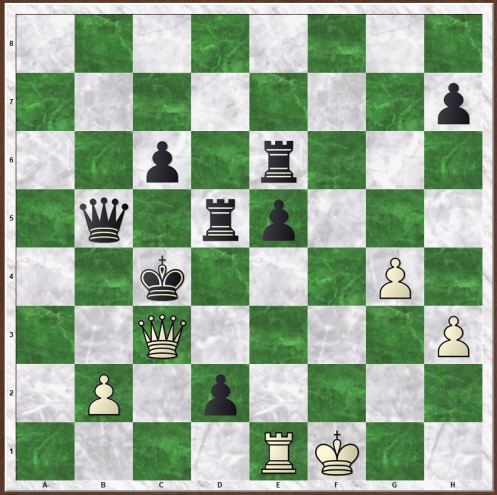
Black to play, played 1…Qb5+: what happened next?
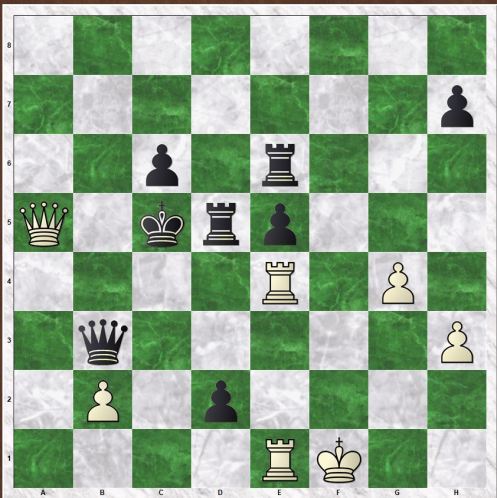
Bucher v Muller, Basle 1959
Solution
White wins by 2 Rc4+!!. If 2…Kd6, 3 Qd8 mate; so 2….Kc4, when 3 Qc3 is a pretty epaulette mate.
FEN
8/7p/2p1r3/Q1krp3/4R1P1/1q5P/1P1p4/4RK2 b – – 0 1
Today’s problem is from the 1972 book “Chess Combination as a Fine Art”, a book based on articles published in the 1950s-1960s by Kurt Richter.
Since the start of 2018, I have decided to adopt the style of only saying which side is to play: and not giving an idea if the move wins or otherwise, unless on occasion I think signposting would be helpful. Instead, the problems are posed with the instruction to decide what you would play, as in a game.
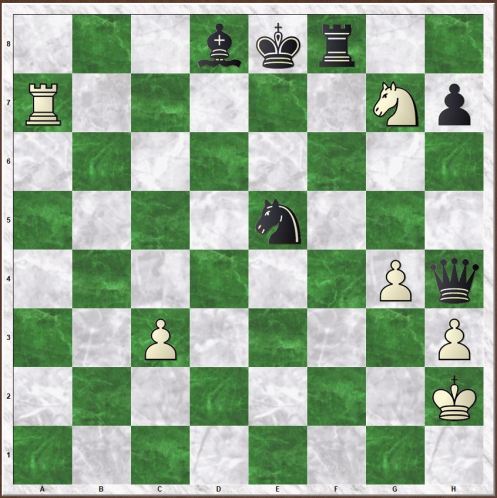
White to play

composition by Alberic O’Kelly de Galway
Solution
I think this was a variation from one of the GM’s games.
It is a pretty epaulette mate: 1 Ne6+ Ke8[] 2 Qd8+! Bd8[] 3 Rf8+! Rf8[] 4 Ng7 mate.
FEN
5kr1/R6p/5b2/4n3/3N2Pq/2P4P/3Q3K/5R2 w – – 0 1
Today’s problem is from the 1972 book “Chess Combination as a Fine Art”, a book based on articles published in the 1950s-1960s by Kurt Richter.
Since the start of 2018, I have decided to adopt the style of only saying which side is to play: and not giving an idea if the move wins or otherwise, unless on occasion I think signposting would be helpful. Instead, the problems are posed with the instruction to decide what you would play, as in a game.
Black to play

Molinari v Cabral, Uruguay 1943
Solution
The obvious try 1…Ng4+ 2 h3 Qh6+ fails to 3 Qh3; so something more is needed, and 1..Bg1+! both diverts the white queen from looking at h3, and blocks an escape square for the king. After 2 Qg1 Ng4+! now works.
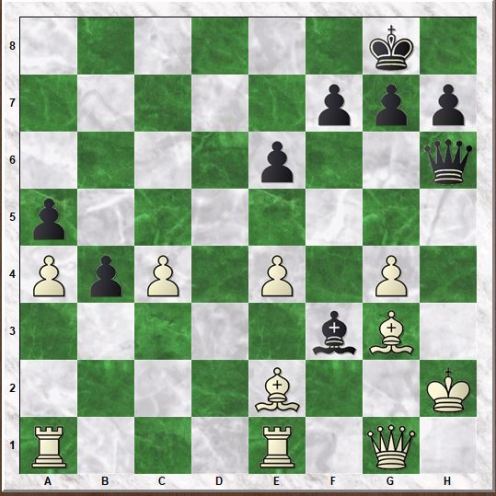
FEN
6k1/5ppp/4p3/p1b1n3/PpP1Pq2/5bBP/4B2K/R3RQ2 b – – 0 1
Today’s problem is from the 1972 book “Chess Combination as a Fine Art”, a book based on articles published in the 1950s-1960s by Kurt Richter.
Since the start of 2018, I have decided to adopt the style of only saying which side is to play: and not giving an idea if the move wins or otherwise, unless on occasion I think signposting would be helpful. Instead, the problems are posed with the instruction to decide what you would play, as in a game.
White to play, played 1 Ne6, to dissuade 1…Rh3 (because of 2 Ng5+ forking k and r); what happened?
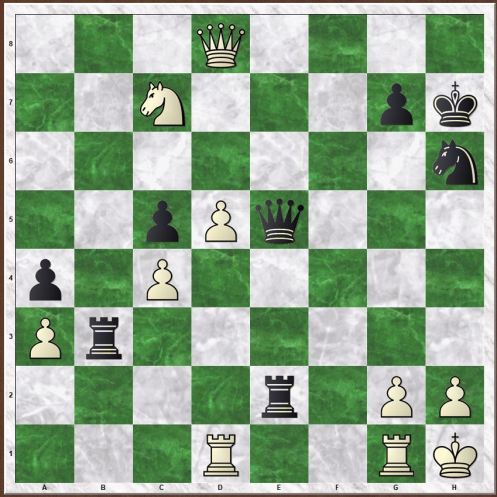
Polvin v Krejcik, Vienna 1954
Solution
1 Ne6 was met by 1…Qh2+! 2 Kh2[] Ng4+ 3 Kh1[]

3…Rh3+! 4 gh[] Rh2 mate.

FEN
3Q4/2N3pk/7n/2pPq3/p1P5/Pr6/4r1PP/3R2RK w – – 0 1
 allanbeardsworth