Today’s problem is from this year’s Wijk. I drafted this blog mid-game, whilst watching on Playchess. Posted online today, since I write my posts in advance.
Since the start of 2018, I have decided to adopt the style of only saying which side is to play: and not giving an idea if the move wins or otherwise, unless on occasion I think signposting would be helpful. Instead, the problems are posed with the instruction to decide what you would play, as in a game.
White to play: what happens if 1 Re5 Qf4?
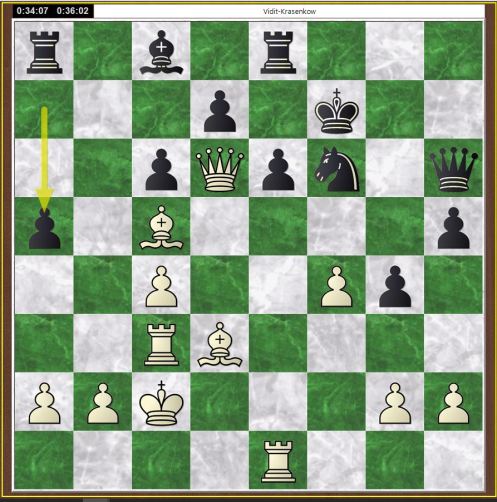
Vidit v Krasenkow, Wijk aan Zee, Challengers, round 2
Solution
White wins by 2 Be3!, trapping the Queen.
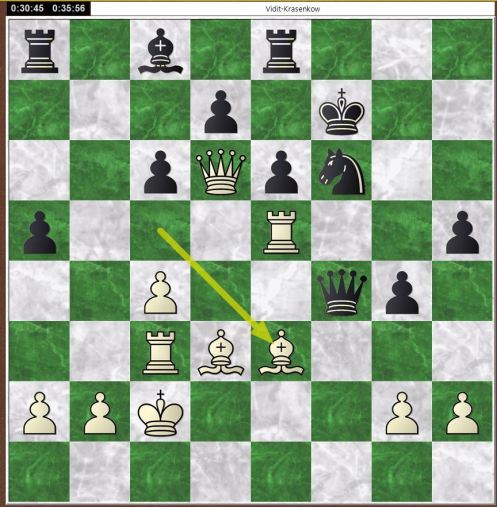
My forecast is that Vidit is a likely winner of this year’s Challengers. He seems to have a good style and approach to the game. In this game, he got a dominating position soon after this opening:
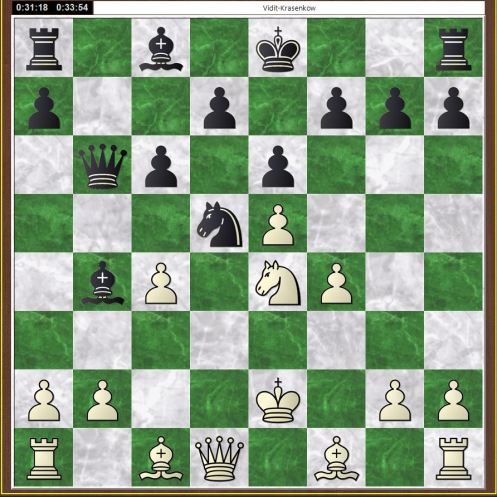
As mentioned, this posting is mid-game, but I suspect it will be 1-0. White seems to be dominant, with two of Black’s pieces not playing in the game.
FEN
r1b1r3/3p1k2/2pQpn1q/p1B4p/2P2Pp1/2RB4/PPK3PP/4R3 w – – 0 25
One nice angle of preparing a daily blog is that I sometimes stumble across things I otherwise never would. In producing the blog postings, I typically check on Megabase to see if the game is included (often it isn’t, especially for older games: I think hardly any from “Richter” have been in, so far). Searching for yesterday’s game, using “Krylov” as the search term, I saw that a Pavel Krylev beat Alexander Alekhine in 1933. I played through the game: a positional tour de force, culminating in a stylish finish. Vintage Alekhine, except he was the loser.
Since the start of 2018, I have decided to adopt the style of only saying which side is to play: and not giving an idea if the move wins or otherwise, unless on occasion I think signposting would be helpful. Instead, the problems are posed with the instruction to decide what you would play, as in a game.
White to play

Pavel Krylov v Alexander Alekhine, Prague 1933
Solution
1 Rg7! is obvious, 1…Kg7[] 2 Qf6+ Kh7 (2….Kg8? 3 Qd8+ picks the rook up with check) 3 Qf7+ Kh8[] 4 Rh6 Bf8[]

5 Rh6+! opening the way up for 6 Be5+ and mate on g7.
The whole game, which is in Megabase, is worth examining. White’s play was very impressive. A google search doesn’t reveal anything about Krylov, but (if it is the same player) Megabase has one game of his in 1933, a handful from 1959 and another handful from 1967.
FEN
3r3k/4R1p1/3bPp1p/1bpPp3/2q1P3/2B2QP1/5R1P/6K1 w – – 0 40
Today’s problem is from the 1972 book “Chess Combination as a Fine Art”, a book based on articles published in the 1950s-1960s by Kurt Richter.
Since the start of 2018, I have decided to adopt the style of only saying which side is to play: and not giving an idea if the move wins or otherwise, unless on occasion I think signposting would be helpful. Instead, the problems are posed with the instruction to decide what you would play, as in a game.
White to play
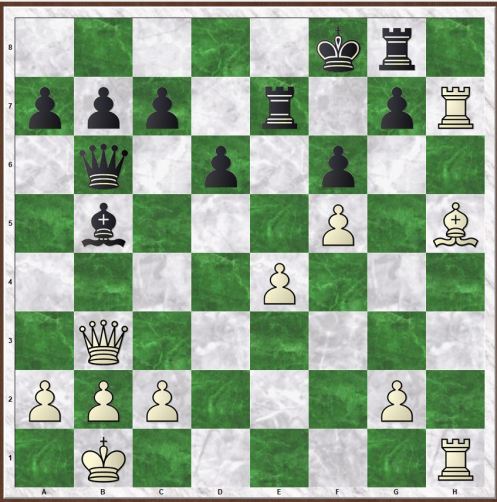
Krylov v Tarassov, USSR 1961
Solution
One which I suspect most of my readers, like I did, will see instantly. Quite a standard theme of sac, sac and mate.
1 Qg8+! Kg8[] 2 Rh8+ Kh8[] 3 Bf7 mate.

FEN
5kr1/ppp1r1pR/1q1p1p2/1b3P1B/4P3/1Q6/PPP3P1/1K5R w – – 0 1
Today’s problem is from the 1972 book “Chess Combination as a Fine Art”, a book based on articles published in the 1950s-1960s by Kurt Richter.
Since the start of 2018, I have decided to adopt the style of only saying which side is to play: and not giving an idea if the move wins or otherwise, unless on occasion I think signposting would be helpful. Instead, the problems are posed with the instruction to decide what you would play, as in a game.
White to play
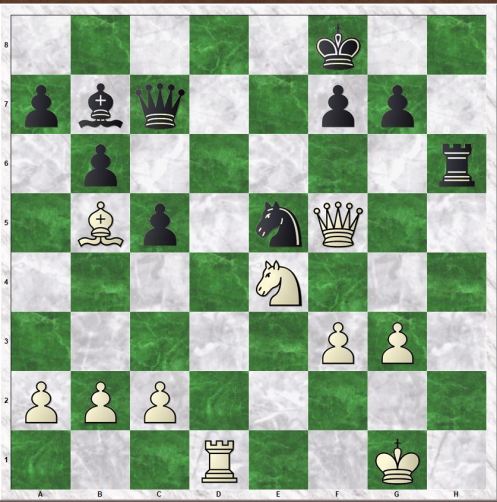
King v Bedjanian, California 1962
Solution
Very pretty today. Examine all biffs means one has to look at 1 Qe5! and after 1…Qe5[], 2 Rd8+ Ke7 3 Re8 mate is a very satisfying conclusion. I am sure Mr King would have enjoyed the game, and even Mr Bedjanian would have taken some solace from losing prettily.

FEN
5k2/pbq2pp1/1p5r/1Bp1nQ2/4N3/5PP1/PPP5/3R2K1 w – – 0 1
Today’s problem is from the 1972 book “Chess Combination as a Fine Art”, a book based on articles published in the 1950s-1960s by Kurt Richter.
Since the start of 2018, I have decided to adopt the style of only saying which side is to play: and not giving an idea if the move wins or otherwise, unless on occasion I think signposting would be helpful. Instead, the problems are posed with the instruction to decide what you would play, as in a game.
Black to play
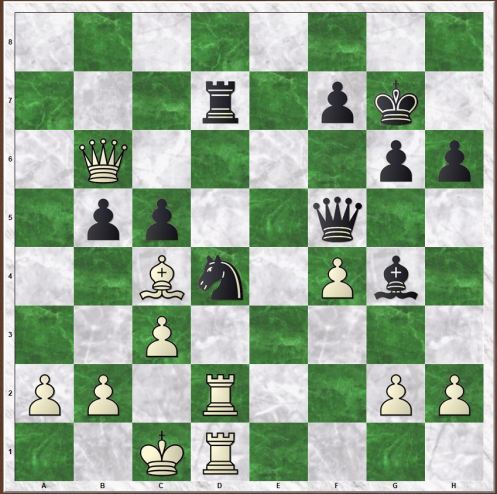
Driksna v Strautinsch, corres, Latvia 1968
Solution
A variation of a standard theme: what is the order you need to make the moves in order to mate, possibly on the back rank, possibly just with N and B? In my cases, I few missed attempts (1… Qb1+; 1…Ne2+) before I saw the correct path. 1…Qc2+ 2 Rc2[] Nb3+ 3 ab Rd1 mate.

FEN
8/3r1pk1/1Q4pp/1pp2q2/2Bn1Pb1/2P5/PP1R2PP/2KR4 b – – 0 1
Today’s position is a little tactical exercise, from my first win against a GM in 2018: at 3 minute blitz, on ICC.
Since the start of 2018, I have decided to adopt the style of only saying which side is to play: and not giving an idea if the move wins or otherwise, unless on occasion I think signposting would be helpful. Instead, the problems are posed with the instruction to decide what you would play, as in a game.
White to play
White played 1 Ne6: how did the game proceed?

GM Rygel (pseudonym) v Allan Beardsworth, ICC 5/1/18, 3 minute blitz
Solution
I wouldn’t normally post such a victory, but the coup was fairly pretty. Strangely, my very next game was a 14 move win as Black vs another GM, in a truly scrappy unorthodox opening.
Here, I saw that after 1 Ne6 fe 2 Ke3 ed+, I at least had drawn the King out into the open, and also had one or two pawns for the exchange; though I also saw that White obtains the d5 square for his N.

But at the same time, more or less instantaneously, I saw that after 3 Kf2 (3 Kd3 Qd4mate or 3…Bf5 skewering the K and Q) I had the beautiful 3…Qd4+!
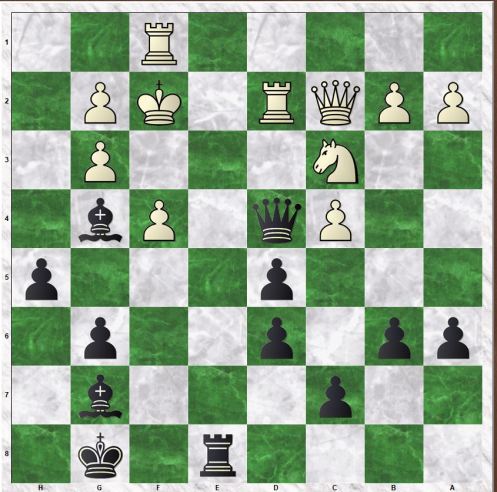
White took the Q, allowing the B to mate.
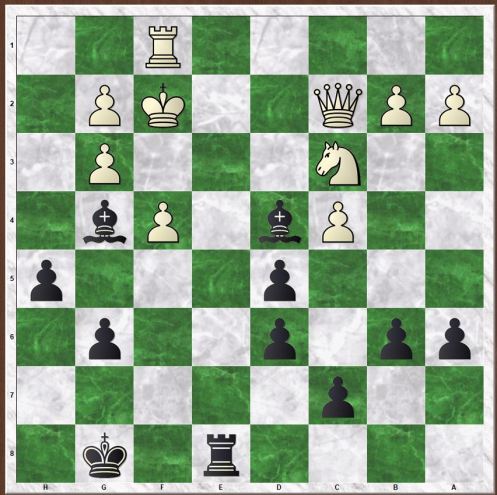
Chess is a good game when such fortune happens.
FEN
4r1k1/2p2pb1/pp1p1qp1/3P3p/2PN1Pb1/2N1r1P1/PPQR1KP1/5R2 w – – 0 27
Today’s problem is from the 1972 book “Chess Combination as a Fine Art”, a book based on articles published in the 1950s-1960s by Kurt Richter.
Since the start of 2018, I have decided to adopt the style of only saying which side is to play: and not giving an idea if the move wins or otherwise, unless on occasion I think signposting would be helpful. Instead, the problems are posed with the instruction to decide what you would play, as in a game.
White to play
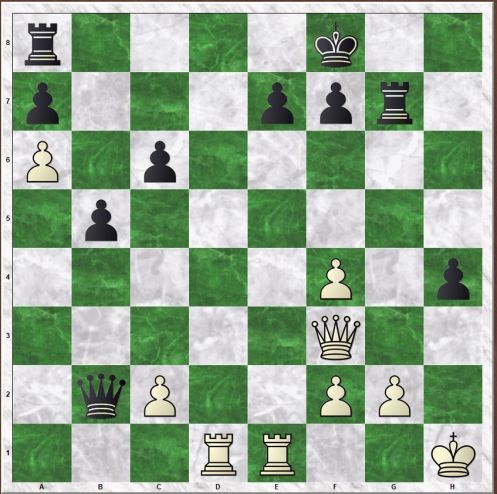
Florian v Koberl, Budapest 1961
Solution
This position relies on a motif I don’t think I have seen before. After the obvious 1 Qc6 Re8, how does White proceed?
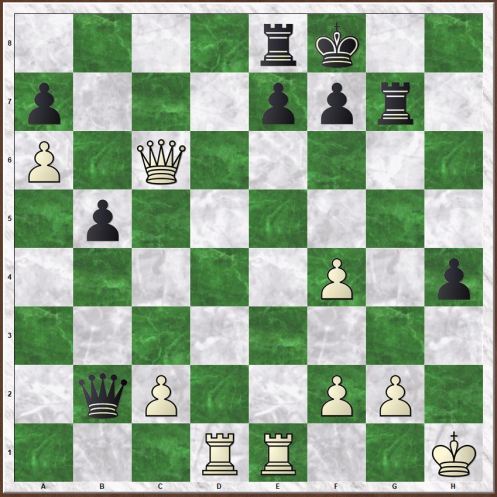
The answer is 2 Re7! so that 2…Re7 3 Rd8+ Re8[] 4 Qe8: I don’t recall seeing a similar idea of Re7 dragging the defender out so that a rook can land on the 8th rank.(Though is some way, in Purdy language, the Re8 is tied to the 8th rank and the Black king is in a net, so there are themes which are Purdy reader can work on).
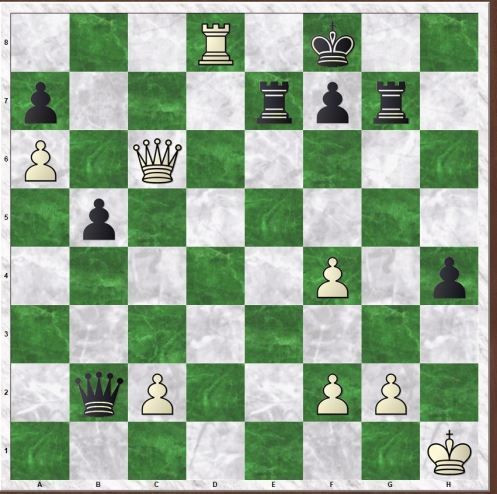
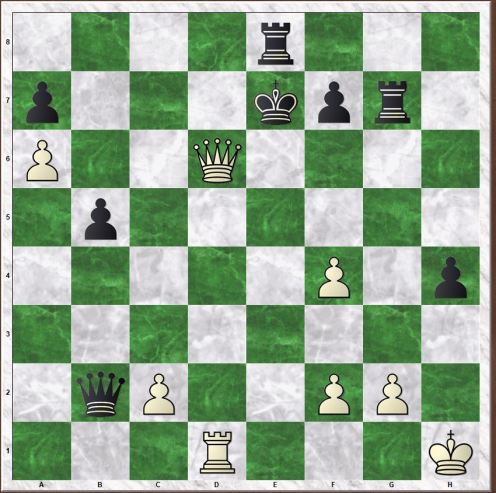
The second point is that after 2Re7, 2…Ke7 is met by 3 Qd6 mate. Quite a cute smothered mate.
FEN
r4k2/p3ppr1/P1p5/1p6/5P1p/5Q2/1qP2PP1/3RR2K w – – 0 1
Today’s problem is from the 1972 book “Chess Combination as a Fine Art”, a book based on articles published in the 1950s-1960s by Kurt Richter.
Since the start of 2018, I have decided to adopt the style of only saying which side is to play: and not giving an idea if the move wins or otherwise, unless on occasion I think signposting would be helpful. Instead, the problems are posed with the instruction to decide what you would play, as in a game.
White to play

Katalymov v Mnazakanian, USSR 1959
Solution
Several moves win for White (e.g. 1 Be5) but 1 Rd7 is the strongest and most spectacular.
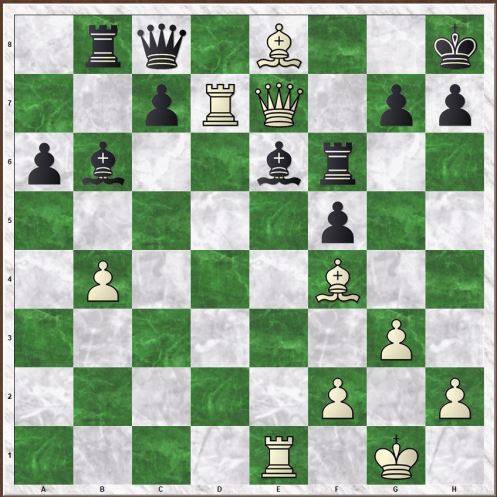
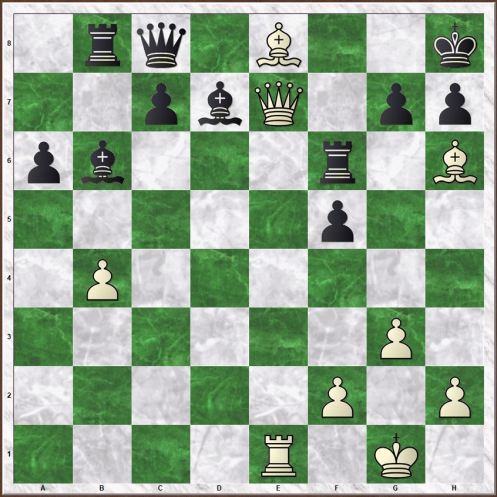
Then, if 1…Qd7, 2 Bd7 wins routinely. More interesting is 1… Bd7 when 2 Bh6!! deflects the Rf6. (If 2…Qe8, 3 Qg7 mate). And after 2..Rh6, 3 Qf8 concludes a pretty mate.
FEN
1rq1B2k/2p1Q1pp/pb2br2/5p2/1P3B2/6P1/5P1P/3RR1K1 w – – 0 1
Today’s problem is from the 1972 book “Chess Combination as a Fine Art”, a book based on articles published in the 1950s-1960s by Kurt Richter.
Since the start of 2018, I have decided to adopt the style of only saying which side is to play: and not giving an idea if the move wins or otherwise, unless on occasion I think signposting would be helpful. Instead, the problems are posed with the instruction to decide what you would play, as in a game.
Black to play

Hagloff v Andersson, corres 1968-69
Solution
1.. Re4 is obvious; so that 2 Rf8+ Qf8 and White can’t defend both e1 and f1.
A harder defence is 2 Qd3 when 2…Qf5! is a lovely exploitation of the same theme: again, e1 and f1 can’t both be defended.
If 3 Rg1, then 3…Re1 and since the Qd3 is LPDO, Black wins a piece after 4 Qf5 Rg1+.
FEN
4rr1k/1p4b1/6p1/p1q4p/4P3/P7/R3Q1PP/4NR1K b – – 0 1
Today’s problem is from the 1972 book “Chess Combination as a Fine Art”, a book based on articles published in the 1950s-1960s by Kurt Richter.
Since the start of 2018, I have decided to adopt the style of only saying which side is to play: and not giving an idea if the move wins or otherwise, unless on occasion I think signposting would be helpful. Instead, the problems are posed with the instruction to decide what you would play, as in a game.
White to play

Rovner v Kamyshev, Moscow 1947
Solution
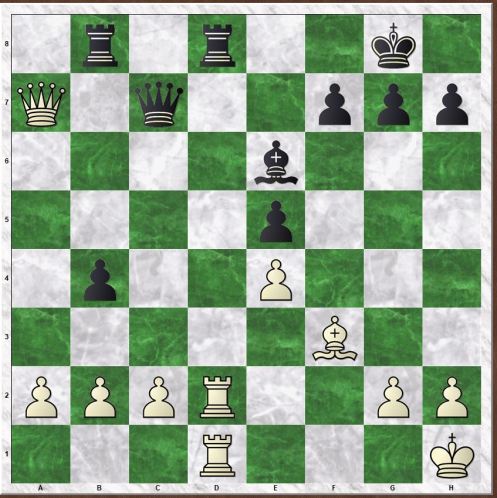
Shades of Adams v Torre: so not hard today. 1 Qa7! Qa5[] 2 Qa6! Qc7[] 3 Qa7 1-0 A nice dance with the queens, noting that the Bf3 defends the Rd1, so Black doesn’t have a R*d2 defence.
FEN
1r1r2k1/2q2ppp/p3b3/4p3/1p2P3/5B2/PPPR1QPP/3R3K w – – 0 1
 allanbeardsworth