Today’s problem is from my game 40 years ago today against Tigran Petrosian. I was one of the England Junior Squad playing the former World Champion in a simul in London.
My school mate Nigel Short was also playing:
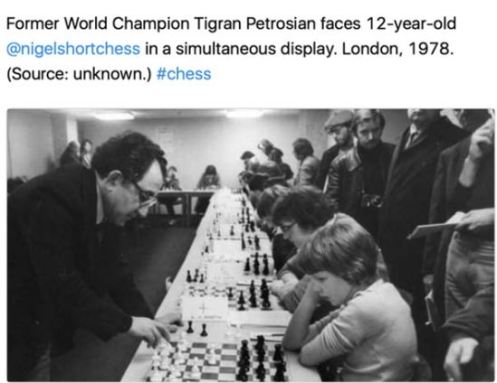
(I am pictured right at the far end of the picture, with a full head of dark hair obscuring my face. Alas, no more). Nigel won, one of his many early signs of his truly great ability.
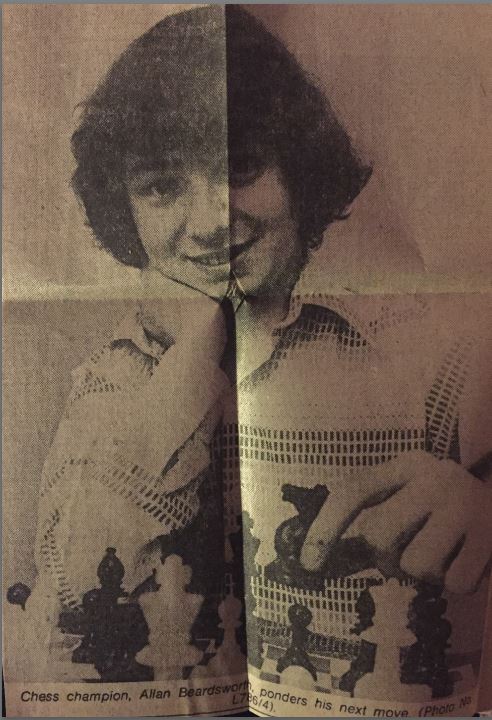
alas, all that hair was quickly to go….
Since the start of 2018, I have decided to adopt the style of only saying which side is to play: and not giving an idea if the move wins or otherwise, unless on occasion I think signposting would be helpful. Instead, the problems are posed with the instruction to decide what you would play, as in a game.
Black to play

Petrosian-Beardsworth, London (simul) 15/1/1978
Solution
The position arose from the Benko gambit: in 1978, a very modern, newly developed opening. Tigran had played a quick e4-e5 opening the position, whilst giving up his extra pawn. The position was unbalanced, and I suspect at the time I was just trying my hardest to play decent moves, with no thought to whether I might be winning or losing.
I chose the weak 1…Ne5?, met by 2 Rg7+ and a simplification to a position in which I now, with the benefit on engines, know was -+, but I could only draw. The final position was:
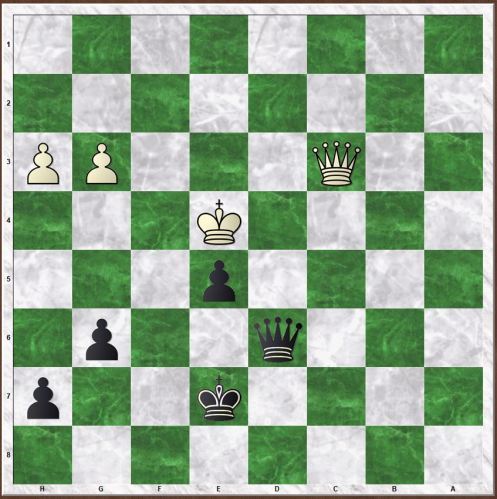
Position after 41 Qc3; 1/2-1/2
I still remember vividly the broad, warm, smile which Tigran gave me as we shook hands. That memory will last a lifetime.
It was only with the help of engine analysis a few years ago that I saw this I could have done better. Firstly, 1…Bd4 is strong, and maintains Black’s edge, but best of all is 1…Raa2!
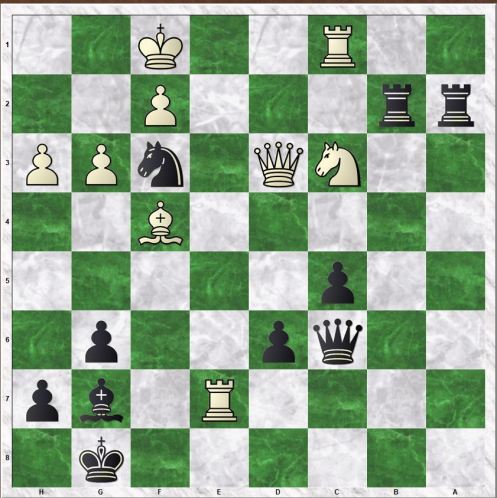
The motif is deflection: the aim is deflect the N to a2, so that it no longer controls d5, so that after (e.g.) 1 Na2 Ne5 wins, since White can no longer interpose on the h1-a8 diagonal (Black threatens both the Qd3 and Qh1+) on d5.
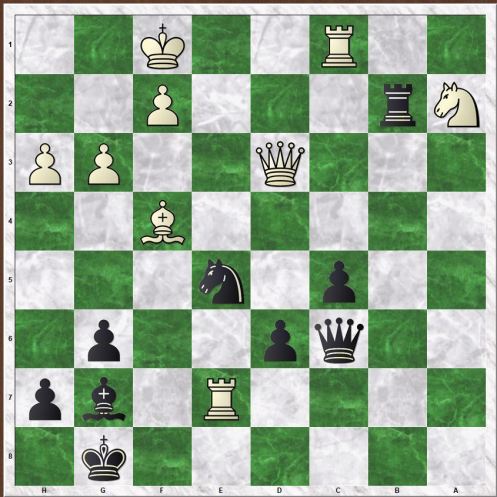
With the support of engines, lots more lines can be explored: but a key one is (1 Na2 Ne5) 2 Rg7+ Kh8! since 2…Kg7? permits 3 Be5+.
FEN
r5k1/4R1bp/2qp2p1/2p5/5B2/2NQ1nPP/Pr3P2/2R2K2 b – – 0 25
Today’s problem is from the 1972 book “Chess Combination as a Fine Art”, a book based on articles published in the 1950s-1960s by Kurt Richter.
Since the start of 2018, I have decided to adopt the style of only saying which side is to play: and not giving an idea if the move wins or otherwise, unless on occasion I think signposting would be helpful. Instead, the problems are posed with the instruction to decide what you would play, as in a game.
Black to play
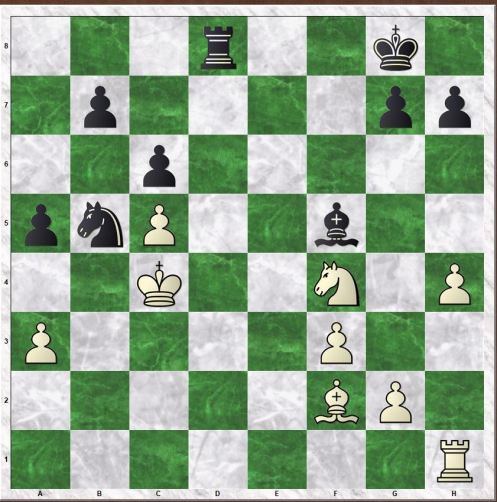
Kopylov v Karlson, Irkutsk 1961
Solution
Not too hard, and I think I have seen this position before. 1….Rd3! threatens 1…Rc3mate and 1…Na3mate, so 2 Nd3, when 2…Be6 is also mate.

FEN
3r2k1/1p4pp/2p5/pnP2b2/2K2N1P/P4P2/5BP1/7R b – – 0 1
Today’s problem is from the 1972 book “Chess Combination as a Fine Art”, a book based on articles published in the 1950s-1960s by Kurt Richter.
Since the start of 2018, I have decided to adopt the style of only saying which side is to play: and not giving an idea if the move wins or otherwise, unless on occasion I think signposting would be helpful. Instead, the problems are posed with the instruction to decide what you would play, as in a game.
Black to play
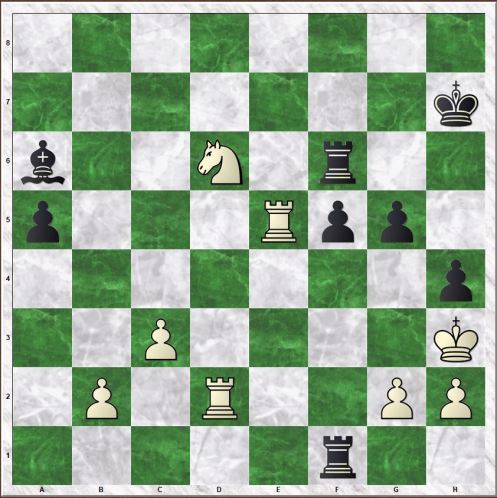
Mann v Papp, Budapest 1956
Solution
Fairly easy today. 1…Rf3+! forces 2 gf[] when 2…Bf1 is mate.
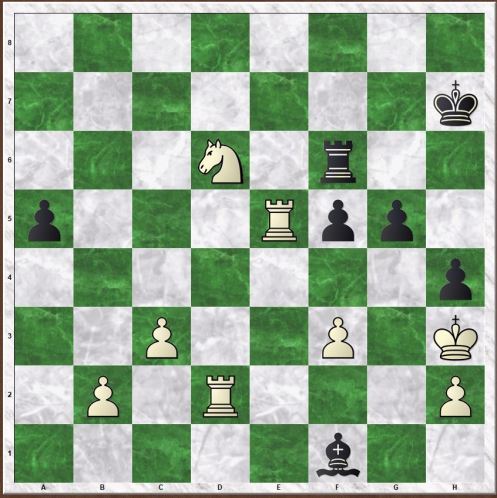
FEN
8/7k/b2N1r2/p3Rpp1/7p/2P4K/1P1R2PP/5r2 b – – 0 1
Today’s problem is from my first classical time limit game of 2018.
Since the start of 2018, I have decided to adopt the style of only saying which side is to play: and not giving an idea if the move wins or otherwise, unless on occasion I think signposting would be helpful. Instead, the problems are posed with the instruction to decide what you would play, as in a game.
For today’s puzzle, I would ask my readers to critique the following sequence of moves.
The context is that it had been an up and down game: as White, I got nothing from the opening; Black made some inaccuracies, giving me a Carlsen-esque slight pull and then after another slip, a significant advantage, which, embarrassed by a choice of good moves, I chose the one which through away all the advantage. As the time control loomed, Black had the initiative, and I feared losing; but I managed to simplify to this Queen ending, which I knew I could draw, and then quickly did. So, as the players deserved, a draw.
My engine showed that we missed something.
What did the players miss in this sequence of moves?
Position after 34 Q*d3

34… Qc1+
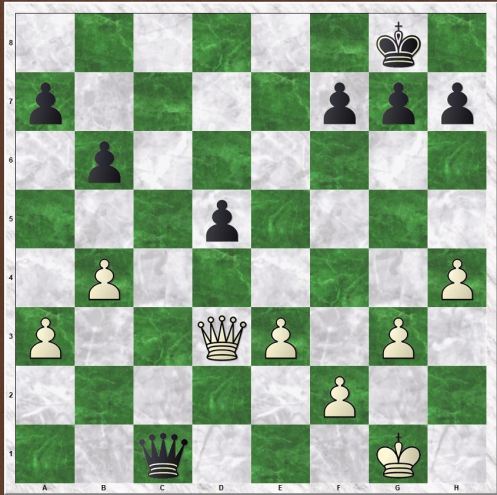
35 Kg2 Qc4

36 Qd2 Qb3
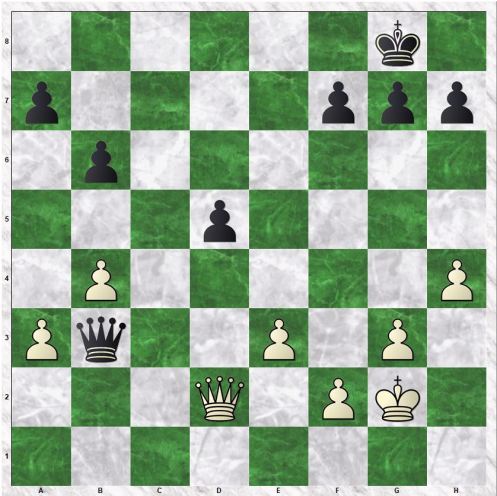
37 Qc1 g6 38 Qc8+
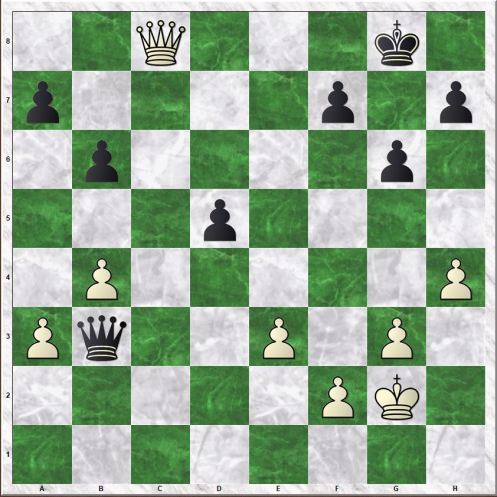
Allan Beardsworth v Joshua Pink, Bramhall 2/1/18
Solution
36..Qb3? was a mistake; it attacks the a3 pawn, and is the move I expected, and I immediately defended the threat and also aimed at c8 by playing 37 Qc1.
But go back to the position after 36…Qb3:
Just as with yesterday’s puzzle, if I could only put into practice what I know in analysis, and perhaps the most important thing I always forget: I should ignore threats.
Purdy on threats, In Search of Chess Perfection, pg 289You must see all real threats. That means you must also see the unreality of real threats…. When in doubt, you can always save time by remembering it is really your move. Try then the following way of thinking:Imagine the threat could not possibly be executed. Then what would be my best move? Try out each attractive move separately, considering each one as follows. Visualise the whole position as it would be after this move of yours, and then work out whether the opponent would gain by executing his ‘threat’.
and also I know full well Purdy’s notion of jump-checks and jump-biffs, and if it were analysis at home, I would see the jump-mate Qd8.
So, after 36…Qb3, the d-pawn is pinned, and 37 e4! wins it!

Black’s best is then 37..d4 38 Qd4 g6: I suspect I would then have had good chances to win, partly because by then Black would have been demoralised, as I had been earlier in the game when I knew a single careless move had let the advantage slip.
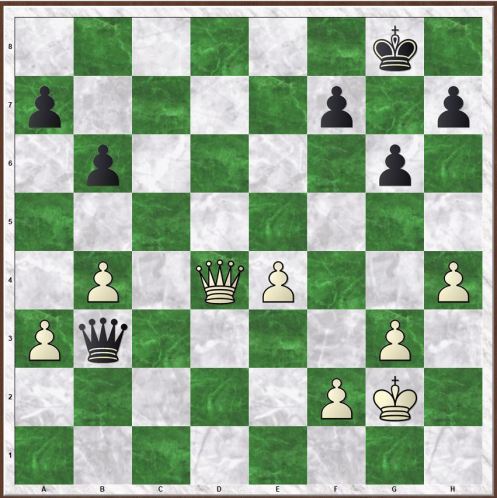
Position which would have been reached after 37 e4!
I wonder if I am alone in not being able to put into practise what I know in theory? I feel sure I am not alone, which is a reason why chess is such a tough game: which makes it worthwhile.
My new year’s resolution should have been, and can still be: to not ignore what I know.
I know what a big part of my problem is: emotions, during the game, which make me dispense with logic, and fear sometimes rules. Below I have sketched the broad “evaluation” of the game (an approach I first saw in one of Lev Alburt’s books). Any opening advantage White might have had went on move 2, as I played some random moves (if Carlsen can do it, why can’t I? Ans: I am not Magnus); I started to fear I was worse, despite it actually being equal; I started to get better and then very better; one poor choice by me, one good choice by my opponent, and he had the initiative; I feared he would have a winning blow; I managed to bale out into a totally level Queen ending/ Then, safe in the knowledge I couldn’t lose, I played out the remaining moves for the draw that was due, not seeing the one and only chance Black had inadvertently given me.
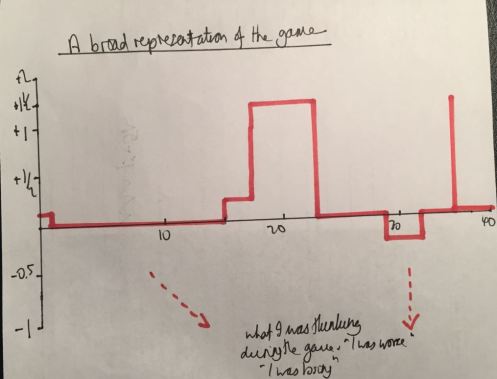
Chess is far easier to analyse afterwards, with Fritz, Komodo and their friends, then it is playing over the board. That’s why we play it.
FEN
2q3k1/p4ppp/1p6/3p4/1P5P/P2QP1P1/5P2/6K1 b – – 0 34
Today’s problem is from the 1972 book “Chess Combination as a Fine Art”, a book based on articles published in the 1950s-1960s by Kurt Richter.
Since the start of 2018, I have decided to adopt the style of only saying which side is to play: and not giving an idea if the move wins or otherwise, unless on occasion I think signposting would be helpful. Instead, the problems are posed with the instruction to decide what you would play, as in a game.
White to play
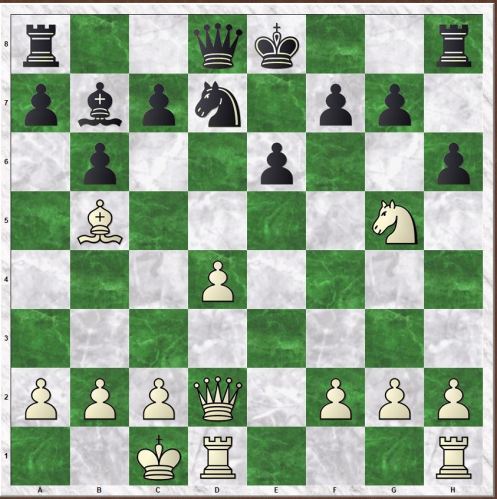
Richter v Brinckmann, Aachen 1935
Solution
As with yesterday’s puzzle, Kurt Richter here played a move I would not have considered, unless I was in top form. I think I would more or less automatically have reacted to the threatened hg by playing 1 Nf3, and had a very level game, with likely few chances.
As so often in my own play, I tend to ignore advice that I know. Here, I would ignore the advice of perhaps my favourite writer, CJS Purdy, to ignore threats.
Purdy on threats, In Search of Chess Perfection, pg 289You must see all real threats. That means you must also see the unreality of real threats…. When in doubt, you can always save time by remembering it is really your move. Try then the following way of thinking:Imagine the threat could not possibly be executed. Then what would be my best move? Try out each attractive move separately, considering each one as follows. Visualise the whole position as it would be after this move of yours, and then work out whether the opponent would gain by executing his ‘threat’.
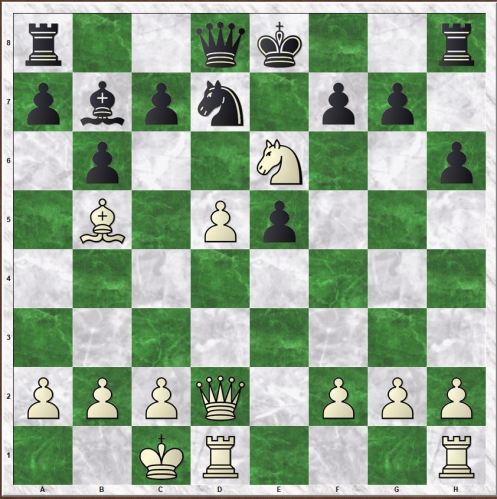
So, here, 1 d5! the point being 1…hg 2 de regains the piece since the Nd7 is attacked four times, but defended twice.

Black played 1…e5, met with by 2 Ne6 and Black’s position collapsed: 1-0, a few moves later, game in Megabase 2018.
FEN
r2qk2r/pbpn1pp1/1p2p2p/1B4N1/3P4/8/PPPQ1PPP/2KR3R w kq – 0 12
Today’s problem is from the 1972 book “Chess Combination as a Fine Art”, a book based on articles published in the 1950s-1960s by Kurt Richter.
Since the start of 2018, I have decided to adopt the style of only saying which side is to play: and not giving an idea if the move wins or otherwise, unless on occasion I think signposting would be helpful. Instead, the problems are posed with the instruction to decide what you would play, as in a game.
White to play
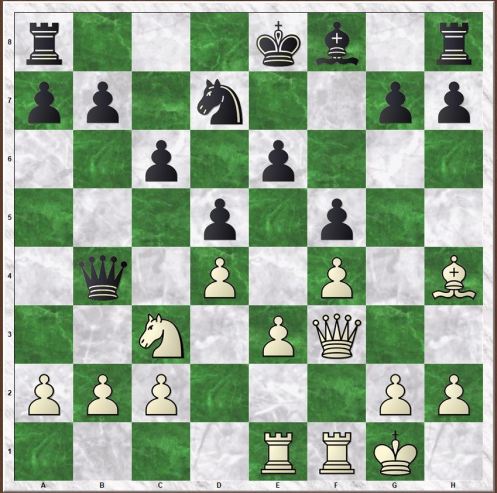
Richter v Baratz, Prague Olympiad, 14/7/1931
Solution
What would you play as White? Well, I doubt if I were White I would even think of 1 e4!? as Kurt Richter played.
For sure, it doesn’t win; but it is the engine’s first move, indicated to give White a slight advantage, and it certainly changes the flow of the game.
A few moves later, this was the position:
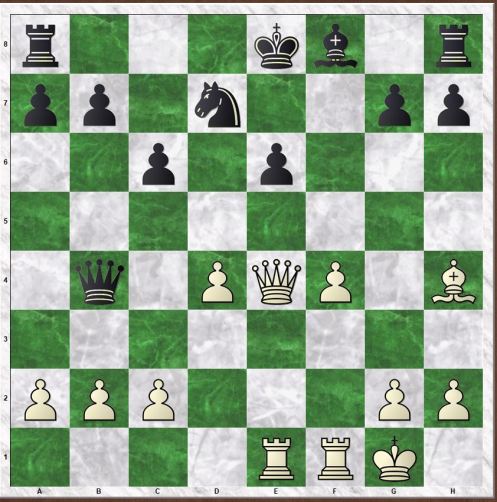
White is a piece for a pawn down, and yet the longer I leave the engine on, the more it likes White’s position. Maybe 1e4!? is an Alphazero type postional sacrifice?!
The full game is in Megabase 2018: 1-0, 29: Black quickly returned the piece in order to castle, but the game was then one-sided.
FEN
r3kb1r/pp1n2pp/2p1p3/3p1p2/1q1P1P1B/2N1PQ2/PPP3PP/4RRK1 w kq – 0 14
Today’s problem is from the 1972 book “Chess Combination as a Fine Art”, a book based on articles published in the 1950s-1960s by Kurt Richter.
Since the start of 2018, I have decided to adopt the style of only saying which side is to play: and not giving an idea if the move wins or otherwise, unless on occasion I think signposting would be helpful. Instead, the problems are posed with the instruction to decide what you would play, as in a game.
Black to play
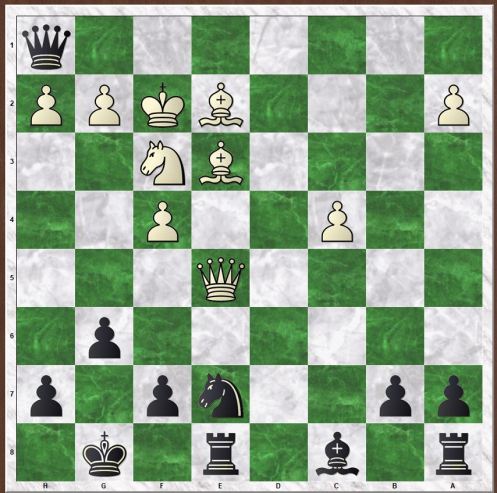
Silber v Suetin, Leningrad 1957
Solution
White is threatening 1 Bd4; Black has (at least) two defences. 1…f6! unpinning the LPDO Re8, and after 2 Qf6 Nf5 hits the Be3 and at the same time prevents 3 Bd4. Or the more spectacular move played in the game, 1…Bh3!

If the B is captured, then 2..Nf5, now that the Re8 is defended; and then Black captures the Be3. So 2 Bd4 Qg2+ 3 Ke1
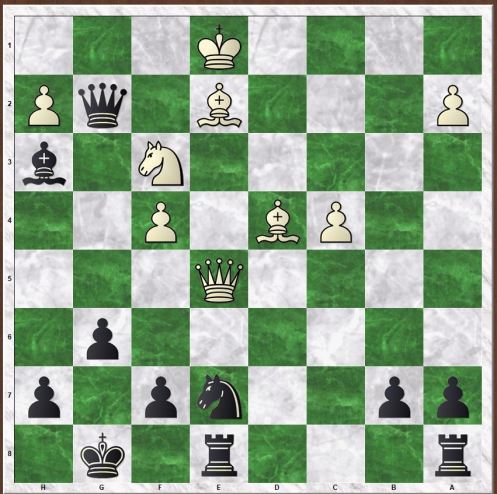
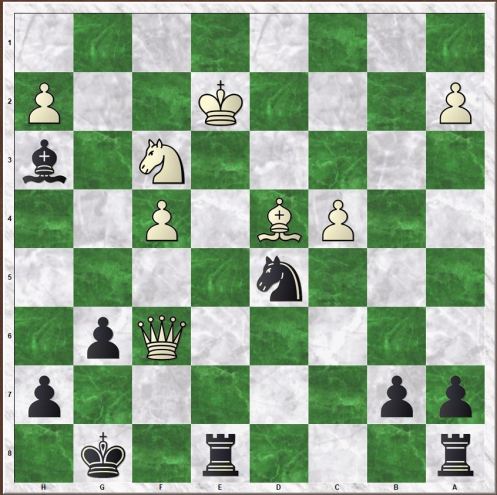
And now either 3…Qe2+ or the slightly better 3…f6 4 Qf6 Qe2+ 5 Ke2[] Nd5+ 0-1.
FEN
r1b1r1k1/pp2np1p/6p1/4Q3/2P2P2/4BN2/P3BKPP/7q b – – 0 1
Today’s problem is from the 1972 book “Chess Combination as a Fine Art”, a book based on articles published in the 1950s-1960s by Kurt Richter.
Since the start of 2018, I have decided to adopt the style of only saying which side is to play: and not giving an idea if the move wins or otherwise, unless on occasion I think signposting would be helpful. Instead, the problems are posed with the instruction to decide what you would play, as in a game.
White to play

Wachtel v Musiol, Poland 1953
Solution
1 Re5! and if 1…Re5 2 Be5 threatens 3 Bc3 mate, so 2..b5, met with 3 Bc7 mate.
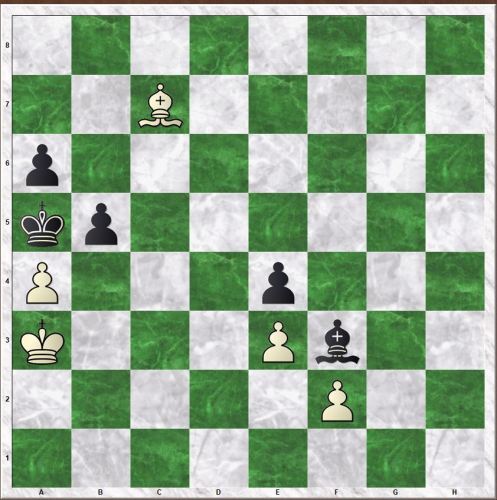
If instead a random move like 1…Bg2, then 2 Rc5+ and 3 Bc7 mate.
FEN
4R3/8/pp6/k1r5/P3p3/K3PbB1/5P2/8 w – – 0 1
Today’s problem is from the 1972 book “Chess Combination as a Fine Art”, a book based on articles published in the 1950s-1960s by Kurt Richter.
Since the start of 2018, I have decided to adopt the style of only saying which side is to play: and not giving an idea if the move wins or otherwise, unless on occasion I think signposting would be helpful. Instead, the problems are posed with the instruction to decide what you would play, as in a game.
White to play

Vanka v Skala, Prague 1960
Solution
1 b4! to give the Bc1 access to the long diagonal with tempo; Q moves, say 1…Qb6′ 2 Qf6+! and if 2…Kf6, 3 Bb2+ mates.

Checking with my engine, 1 b4! is firm favourite; 1 Bd2 Qc5 2 Qd3 is also assessed as winning, as is 1 f5, and I suspect others. But 1 b4! is most categorical.
FEN
r1b2r2/pp2npkp/3p1pp1/q2P4/3QPP2/8/PP2B1PP/R1B2R1K w – – 0 1
Today’s problem is from the 1972 book “Chess Combination as a Fine Art”, a book based on articles published in the 1950s-1960s by Kurt Richter.
Since the start of 2018, I have decided to adopt the style of only saying which side is to play: and not giving an idea if the move wins or otherwise, unless on occasion I think signposting would be helpful. Instead, the problems are posed with the instruction to decide what you would play, as in a game.
White to play

Ostropolski v Ivanovski, USSR 1949
Solution
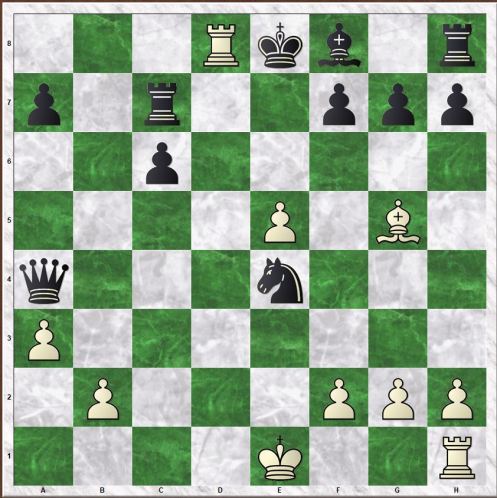
A variant of the famous Paul Morphy v Duke of Brunswick finale.
1 Qd7+! Rd7[] 2 Nc7+! Rc7[] 3 Rd8 mate.
FEN
4kb1r/pr1p1ppp/2p5/1N2P1B1/q3n3/P7/1P1Q1PPP/3RK2R w Kk – 0 1
 allanbeardsworth