Another puzzle from Dragoslav Andric’s 1981 book “Matni Udar”.
White to play and mate Black
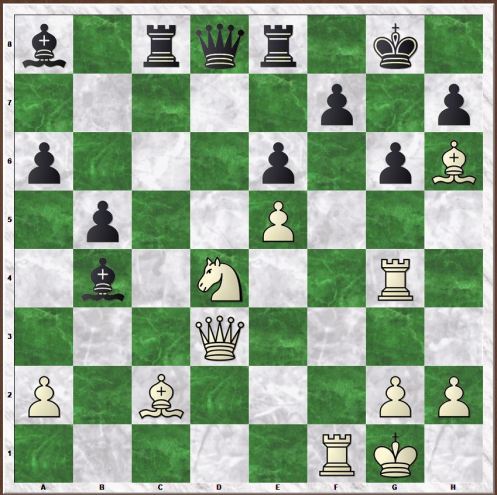
Hulak v Raicevic, Belgrade 1976
Solution
1 Rf7! has to be played, as does 2 Rg6! after 1…Kf7. Then the wolves are in. If 2…hg? 3 Qg6+ and 4 Qg7 mate. So the game continued 3…Rf8 4 Rg7+ Ke8

and 5 Qg6+! and check, check, check 1-0.
FEN
b1rqr1k1/5p1p/p3p1pB/1p2P3/1b1N2R1/3Q4/P1B3PP/5RK1 w – – 0 25
Another puzzle from Dragoslav Andric’s 1981 book “Matni Udar”.
Black to play and mate White

Sinkovics v Molnar, Sopron 1978
Solution
Elegant, but not too hard, though the second move is not obvious. 1…Qh4+! 2 gh[] Rc3+ and mate.
FEN
2Q5/1R1B1pk1/3p1qp1/2p2n1p/1p3P2/6PK/P4R1P/2r3r1 b – – 0 1
Another puzzle from Dragoslav Andric’s 1981 book “Matni Udar”.
Black to play and mate White (with a twist: try to find the twist)
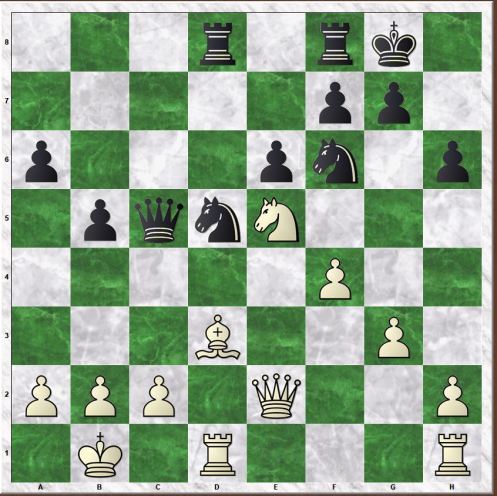
Schneider v Graz, Zalaegerszeg 1976
Solution
An unusual position for there to be a win: likely a typical Sicilian opposite side castle race. But knowing it is a problem, the only move has to be 1…Nc3+! forcing 2 bc[] when 2…Nd5 can be seen to be dominant.
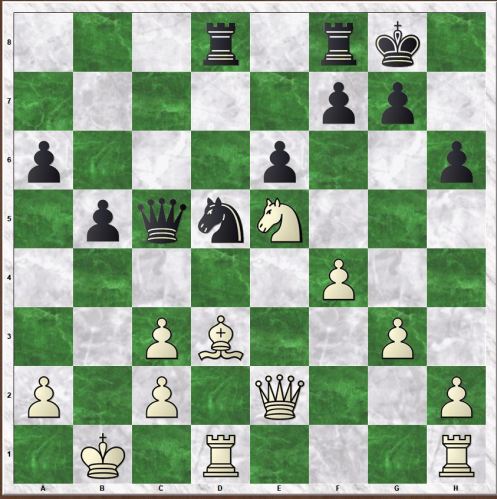
The game concluded swiftly: 3 Kc1 Qa3+ 4 Kd2[] Qc3+ 5 Kc1[] Qa3+ 6 Kd2[] Qb4+ 7 Kc1 7…Nc3 0-1
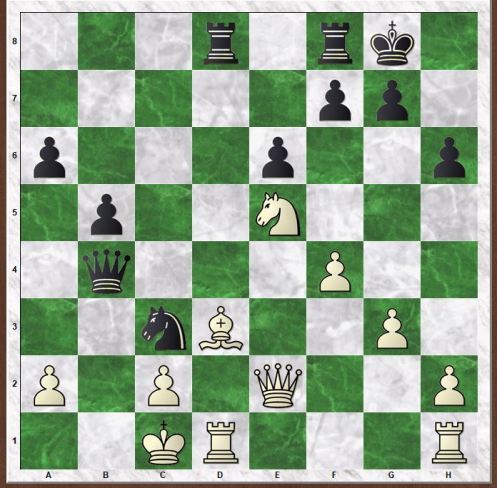
The above is fairly convincing, and the line despite being long is forcing, check, check, check.
However, there is a flaw. 3 Qf3! Qa3 4 Bh7+! Kh7 5 Rd3
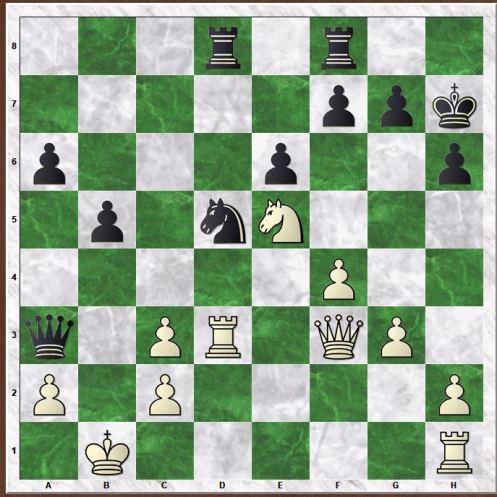
White has scrambled together a playable position. He ‘threatens ‘ c3-c4, so a Q move, say 5…Qc5 6 Kb2 and at top GM level, Black no doubt is winning, but at my level, the game goes on.
FEN
3r1rk1/5pp1/p3pn1p/1pqnN3/5P2/3B2P1/PPP1Q2P/1K1R3R b – – 0 1
Another puzzle from Dragoslav Andric’s 1981 book “Matni Udar”.
White to play and mate Black

Bach v Botto, Tjentiste 1975
Solution
1 Rg6! fg (1…Qc3 2 Qh7+! 3 Rh6+ 4 Rg1+ and mate) 2 hg Rf7

I now played the prosaic 1 gf, but in the game there was the spectacular 1 Qf8+! which took me a while to see why it worked.
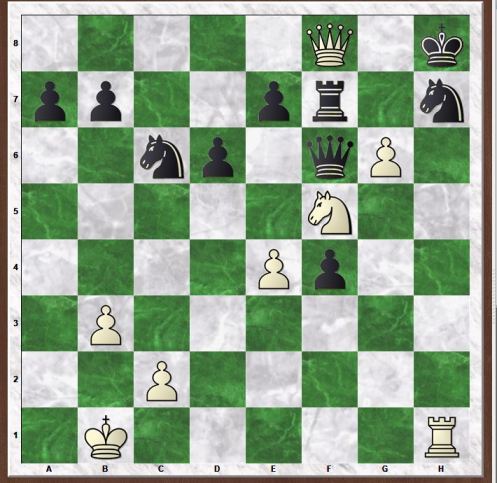
It is mate in two: Rh7+ and Nh6 mate. Pretty

FEN
5r1k/pp2pp1n/2np1q1Q/5N1P/4PpR1/1P6/2P5/1K5R w – – 0 27
Another puzzle from Dragoslav Andric’s 1981 book “Matni Udar”.
White to play and mate Black

Beliavsky v unknown, simul, Aznakajevo, 197
Solution
Two simple deflections- in the right order! 1 Rg8+! Rg8 2 Qd4+! Qd4 3 Nf7mate.

FEN
r4r1k/p2p3p/3N2RP/3q4/3p2Q1/8/P1P2PP1/6K1 w – – 0 1
Another puzzle from Dragoslav Andric’s 1981 book “Matni Udar”.
Black to play and mate White
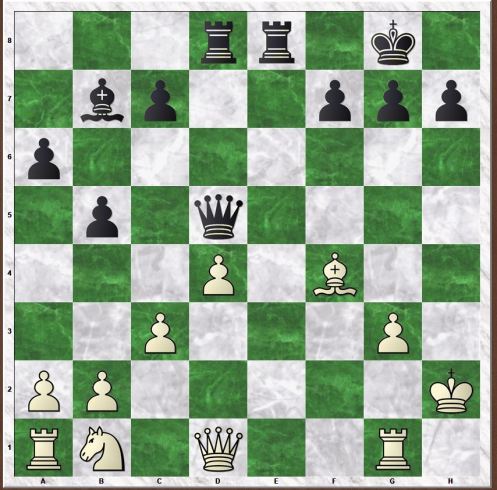
Betjonski v Pirogov, Moscow 1975
Solution
The Marshall wins (I would bet good money the position arose from a Marshall).
1…Re1! and mate or ruinous material loss occurs.
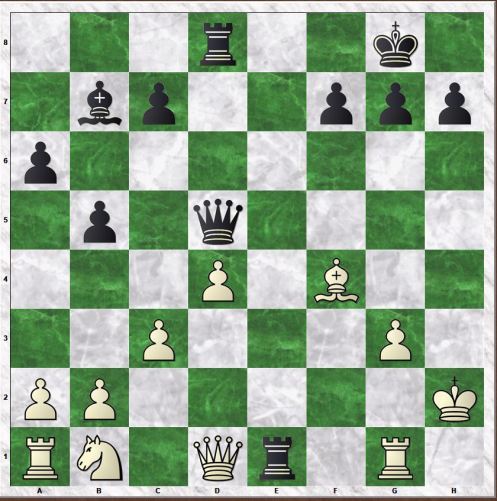
If 2 Qe1 2…Qh5 mate; 2 Re1 Qg2 mate.
FEN
3rr1k1/1bp2ppp/p7/1p1q4/3P1B2/2P3P1/PP5K/RN1Q2R1 b – – 0 1
Another puzzle from Dragoslav Andric’s 1981 book “Matni Udar”.
White to play and mate Black
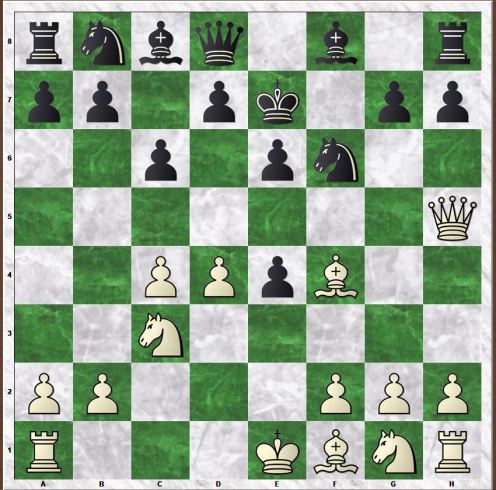
Manta v Ilen, correspondence Finland 1975
Solution
Easy today. 1 Bd6+ Kd6 2 Qc5+ Kc7[] 3 Nb5 mate. A single all-forced line.

FEN
rnbq1b1r/pp1pk1pp/2p1pn2/7Q/2PPpB2/2N5/PP3PPP/R3KBNR w KQ – 0 1
Another puzzle from Dragoslav Andric’s 1981 book “Matni Udar”.
White to play and mate Black

Vikman v Kanko, correspondence, Finland 1975
Solution
Nice; and took me a while to see that 1 Rd1! is a knock out. Black is mated on the bank rank.
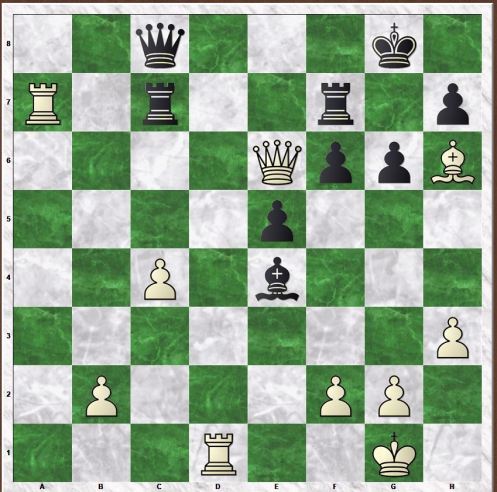
Much of my favourite author CJS Purdy’s writing applies here. There are pins, nets and ties:
Purdy on nets, pins and ties, Fine Art, vol 2, pg 205
Some things are hooey,
and most others lies;
But forks you mustn’t miss,
nor pins, nets, ties.
And for good message, the solution is found by ignoring the threat of Qc8* LPDO Qe6:
Purdy on threats, In Search of Chess Perfection, pg 289
You must see all real threats. That means you must also see the unreality of real threats…. When in doubt, you can always save time by remembering it is really your move. Try then the following way of thinking:
Imagine the threat could not possibly be executed. Then what would be my best move? Try out each attractive move separately, considering each one as follows. Visualise the whole position as it would be after this move of yours, and then work out whether the opponent would gain by executing his ‘threat’.
FEN
2q3k1/R1r2r1p/4QppB/4p3/2P1b3/7P/1P3PP1/R5K1 w – – 0 1
Another puzzle from Dragoslav Andric’s 1981 book “Matni Udar”.
Black to play and mate White

Domsgen v Kozlovska, 1975
Solution
A one mover today: 1… Qe4+! and resigns: 2 Ke4 Bc6 mate, and Kmoves loses either the Be3 or allows Rb2+ skewering the king and queen.

FEN
1r3bk1/1r6/p2p1Pp1/4p1Pp/b1p1P3/P1P1BK2/1Pq4Q/3N2RR b – – 0 1
Another puzzle from Dragoslav Andric’s 1981 book “Matni Udar”.
Black to play and mate White

Esnaola v Galonska, 1975
Solution
Examine all biffs leads to the solution: 1…Qg3+!
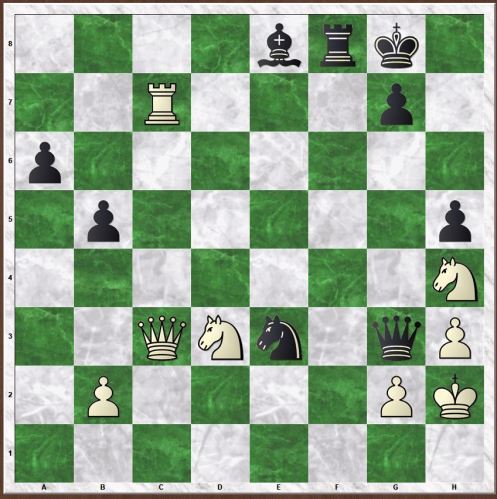
and White’s King is mated after 2 Kg1 Rf1mate, or the main point 2 Kg3 Nf1.
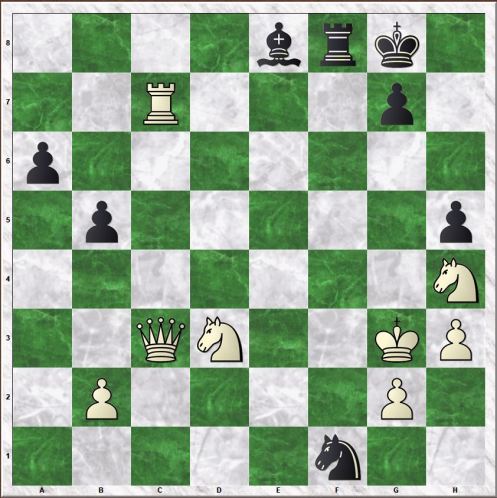
Of course, 1..Nf1+ is a more natural move to consider, perhaps followed by 2…Qg3: so 1…Qg3 also reverses the move order, always a good solving technique to try.
FEN
4brk1/2R3p1/p5q1/1p5p/7N/2QNn2P/1P4PK/8 b – – 0 1
 allanbeardsworth